
Franking credits (or imputation credits) are tax credits attached to Australian dividends, representing company tax already paid on the profit behind them. You declare both the dividend and the credit as income, then use the credit to reduce the tax you owe. If the credits exceed your tax, the ATO refunds the difference in cash.
This guide explains how the system works, how to calculate a franking credit from a dividend, what the credits do to your taxable income, and how to claim them at tax time. It is general educational information, not tax or financial advice.
Last reviewed: 18 July 2026.
What are franking credits?
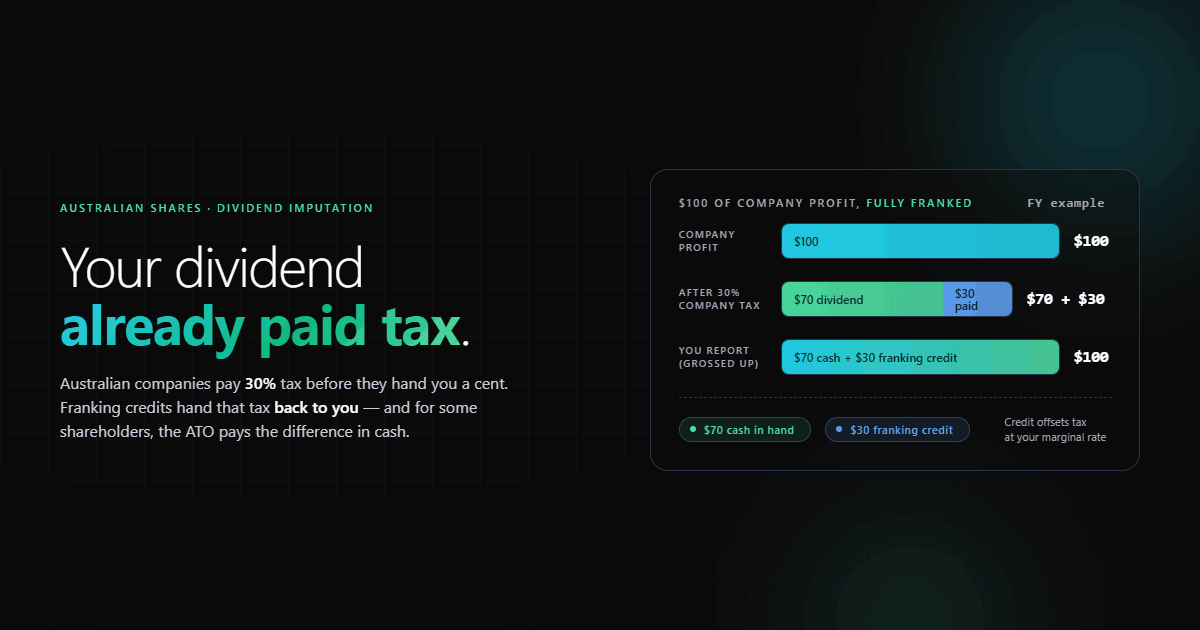
A franking credit is a record of company tax already paid that travels with a dividend to the shareholder. Australia introduced this arrangement, known as the dividend imputation system, in 1987 to stop company profits being taxed twice: once at the company level and again as personal income when paid out as dividends.
Here is the problem imputation solves. An Australian company generally pays tax on its profits at the company tax rate of 30% (smaller “base rate entity” companies pay 25%). Without imputation, the after-tax profit paid to you as a dividend would then be taxed again at your personal marginal rate. With imputation, the company tax already paid is “imputed” (credited) to you, so the dividend is ultimately taxed only once, at your personal rate.
A dividend that carries these credits is called a franked dividend. The ATO explains the company-side mechanics on its imputation system page. In practice, many of the largest ASX companies pay fully franked dividends because they earn most of their profits in Australia and pay full Australian company tax on them.
How do franking credits work?
Franking credits work by passing the company tax already paid on a dividend through to you, so the underlying profit is taxed once at your own marginal rate rather than twice. In practice it runs in five steps:
- The company pays tax. An Australian company earns a profit and pays company tax on it, typically at 30%.
- It pays a dividend with credits attached. When the company distributes after-tax profit as a dividend, it attaches franking credits representing the tax already paid. Your dividend statement shows both amounts.
- You “gross up” your income. In your tax return, you declare the cash dividend plus the franking credit as assessable income. This combined figure is called the grossed-up dividend.
- Tax is calculated at your marginal rate. Income tax is worked out on the grossed-up amount, along with the rest of your income.
- The credit offsets your tax. The franking credit is then applied as a tax offset. If the offset is larger than the tax you owe, the excess is refunded to you.
The end result depends on how your personal marginal tax rate compares with the 30% company rate:
- Marginal rate below 30% (including a 0% rate, such as a retiree below the tax-free threshold or a super fund in pension phase): you get some or all of the credit back as a refund.
- Marginal rate equal to 30%: the credit covers the tax on the dividend, so you generally pay nothing extra.
- Marginal rate above 30%: you pay a “top-up” equal to the gap between your rate and the company rate.
The ATO covers the shareholder side, including dividends and franking credits, on its investing in shares page.
How do you calculate franking credits?
You calculate a franking credit from three things: the dividend amount, the company tax rate, and the franking percentage. For a fully franked dividend from a company taxed at the standard 30% rate, the credit works out to the dividend times 30/70 – about 42.86 cents per dollar of dividend. The full formula is:
Franking credit = dividend amount × (company tax rate ÷ (1 − company tax rate)) × franking percentage
For a fully franked dividend from a company taxed at the standard 30% rate, this simplifies to:
Franking credit = dividend × 30/70 (that is, dividend × 3/7, or roughly 42.86 cents per dollar of dividend)
Worked example, step by step:
- You receive a $700 fully franked dividend from a company taxed at 30%.
- Franking credit = $700 × 30/70 = $300.
- Grossed-up income = $700 + $300 = $1,000. This is the amount added to your assessable income.
- Tax is calculated on the $1,000 at your marginal rate, and the $300 credit is then subtracted from your tax bill.

The logic checks out in reverse: to pay you $700 of after-tax profit, the company had to earn $1,000 before tax and pay $300 (30%) in company tax. The credit simply hands you back the company tax for your own tax calculation.
Here is how the same $700 fully franked dividend plays out at different marginal rates (Medicare levy excluded for simplicity):
| Your marginal rate | Tax on $1,000 grossed-up | Franking credit offset | Net outcome |
|---|---|---|---|
| 0% | $0 | $300 | $300 refund |
| 15% | $150 | $300 | $150 refund |
| 30% | $300 | $300 | $0 — no extra tax |
| 37% | $370 | $300 | $70 extra tax payable |
| 45% | $450 | $300 | $150 extra tax payable |
Current resident marginal rates and thresholds are published on the ATO tax rates page.
Two variations to be aware of:
- 25% company rate. If the paying company is a base rate entity taxed at 25%, the fully franked formula becomes dividend × 25/75, or one third of the dividend. A $700 fully franked dividend from a 25% company carries a $233.33 credit, not $300. Your dividend statement always shows the actual credit, so you rarely need to compute it yourself.
- Partial franking. Multiply by the franking percentage. A $700 dividend franked to 50% at the 30% rate carries $700 × 30/70 × 50% = $150 of credits, and the grossed-up amount is $850.
What is the difference between fully franked, partially franked and unfranked dividends?
- Fully franked (100% franked): the company has paid Australian company tax on all the profit behind the dividend, so the maximum credit is attached.
- Partially franked: only part of the underlying profit has borne Australian company tax, often because the company earns significant foreign income or has tax losses. The dividend statement shows the franked and unfranked portions separately.
- Unfranked: no credits attached. The full dividend is taxed at your marginal rate with no offset. Distributions from some companies, and some components of ETF and trust distributions, are unfranked.
ETFs and listed investment companies can also pass franking credits through to you. The credits flow via the fund’s annual tax statement rather than a standard dividend statement, which is one reason ETF tax paperwork looks different from direct shareholdings.
Are franking credits taxable income?
Yes. Franking credits are included in your assessable income, even though you never receive them as cash. This is the gross-up step: you declare the cash dividend and the attached credit, then claim the credit back as a tax offset. On paper your taxable income goes up by the credit amount; in exchange, your tax payable comes down by the same amount.
A related question is whether franking credits reduce taxable income. They do not. A franking credit is a tax offset, not a deduction. A deduction (like an interest expense) reduces your taxable income before tax is calculated. A franking credit is applied after tax is calculated, reducing the tax itself dollar for dollar — which generally makes an offset more valuable than a deduction of the same size.
One practical side effect of the gross-up: because credits increase your taxable income, they can affect income tests that use taxable income, even though they also reduce the tax you pay.
What is the 45-day holding rule?
To claim franking credits, you must satisfy the holding period rule: you need to hold the shares “at risk” for at least 45 days (90 days for certain preference shares), not counting the day you bought them or the day you sold them. The rule exists to stop investors buying shares just before a dividend, harvesting the credit, and selling immediately after.
“At risk” means genuinely exposed to movements in the share price — if you have hedged away substantially all of that risk with derivatives, the days do not count.
There is an important carve-out: the small shareholder exemption. If your total franking credit entitlement for the income year is less than $5,000 (roughly $11,700 of fully franked dividends at the 30% rate), the holding period rule does not apply to you as an individual. Most small retail portfolios fall under this threshold. The rule and the exemption are set out in the ATO’s You and your shares guide.
What happens to excess franking credits?
Since 1 July 2000, excess franking credits have been fully refundable for Australian resident individuals and complying superannuation funds. If your credits exceed your total tax bill, the surplus is paid to you as a cash refund after you lodge.
This is why franked dividends are especially valuable to low-rate taxpayers:
- A retiree whose income sits below the tax-free threshold pays no tax, so the whole credit is refunded.
- A super fund in retirement (pension) phase pays 0% tax on the assets supporting the pension, so credits on those holdings come back in full; in accumulation phase the fund’s 15% rate is still below 30%, so franked dividends usually generate refunds there too.
Note that the rules differ for companies: a company with excess franking credits does not receive a cash refund but may convert the excess into a tax loss to use in later years. For individual investors, though, the refund is real cash.
How do you claim franking credits?
You claim franking credits by declaring your dividends and their attached credits in your tax return; the ATO then applies the credits against the tax you owe and refunds any excess in cash. For most people the process is straightforward:
- Keep your dividend statements. Each statement shows the franked amount, the unfranked amount and the franking credit. ETF and managed fund investors get an annual tax statement with the same detail.
- Declare dividends and credits in your tax return. In myTax, dividend and credit amounts reported to the ATO are usually pre-filled; check them against your statements, especially for holdings bought or sold during the year. The ATO’s investment income page covers what must be declared.
- The offset is applied automatically. Once the credits are in your return, the ATO applies them against your tax and refunds any excess.
- Not required to lodge? If your income is low enough that you do not need to lodge a tax return, you can still get your franking credits back by applying to the ATO for a refund of franking credits — a short standalone process available through myGov or by phone.
The main failure mode is simply losing track: credits scattered across multiple brokers, DRP statements and ETF tax statements are easy to miss. A portfolio tracker such as Crowdfolio, which follows your ASX holdings and their dividend and tax details in one place, makes it easier to cross-check what the ATO pre-fills against what you actually received.
Key points to remember
- Franking credits are company tax passed to shareholders so dividends are not taxed twice.
- Fully franked at the 30% company rate: credit = dividend × 30/70. A $700 dividend carries a $300 credit and grosses up to $1,000.
- Credits increase your taxable income (gross-up) and then reduce your tax payable as an offset — they are not a deduction.
- Excess credits are refunded in cash to resident individuals and super funds.
- Hold shares at risk for 45 days to qualify, unless your total credits are less than $5,000 for the year.
For strategy-level reading on how investors at different income levels use franked dividends, see our guide to ASX dividend investing for passive income. When you sell shares, our capital gains tax calculator estimates the CGT on the gain.