
To find the best ASX dividend stocks, prioritize yield quality over headline percentages, screen for payout ratios under 90%, confirm dividend growth through downturns, and compare franking levels. The article’s due diligence checklist adds earnings trends, debt metrics, sector risks, and distribution composition across banks, REITs, infrastructure, and defensive sectors for a resilient income portfolio.
What Makes an ASX Dividend Stock Reliable?
Dividend Yield: Reading Beyond the Headline Number
Dividend yield is calculated by dividing the annual dividend per share by the current share price. A stock paying $0.80 per share at $16.00 has a yield of 5%.
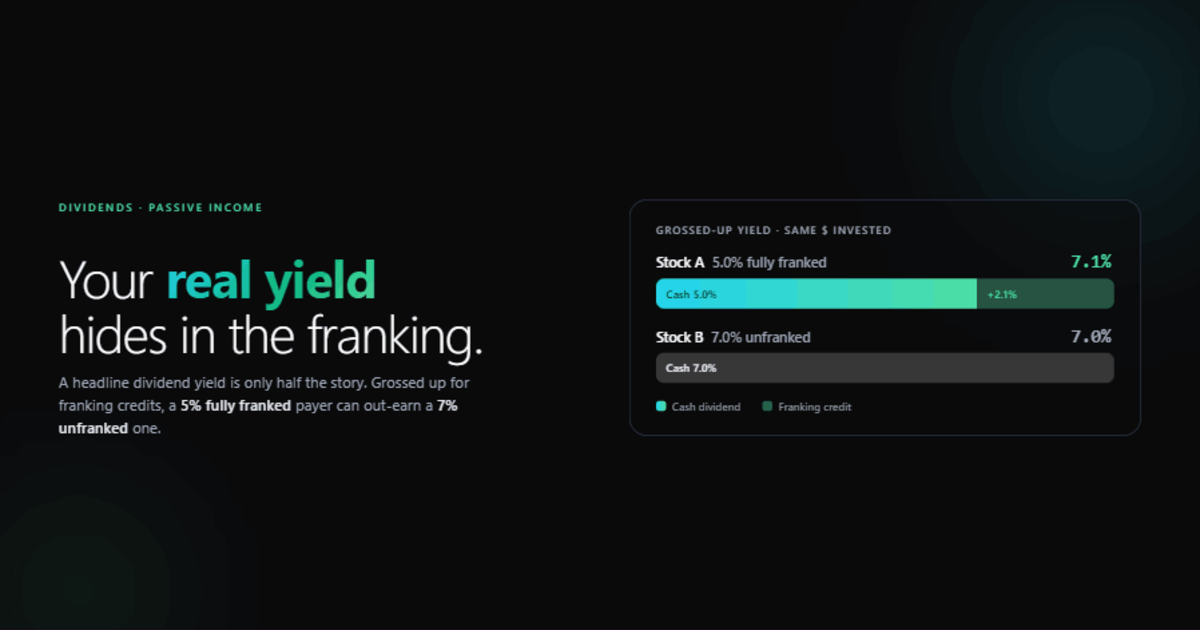
The headline number is a starting point, not a conclusion. A 9% yield deserves more scrutiny than a 4.5% yield. Yield quality — whether earnings genuinely support the payout — matters far more than the raw percentage.
Across ASX blue-chip income stocks, typical yields range from 3% to 7%. Yields consistently above that range often signal elevated payout ratios, declining share prices, or both.
Payout Ratio: The Sustainability Litmus Test
The payout ratio measures what percentage of earnings a company distributes as dividends. A company earning $1.00 per share and paying $0.70 has a payout ratio of 70%.
A payout ratio consistently above 90%–100% means little buffer if earnings fall. One bad quarter and the dividend is at risk.
Where possible, check both the earnings-based and cash-flow-based payout ratio. Some companies report strong accounting profits but weaker free cash flow, which is what actually funds dividend payments.
Dividend Growth History: The Signal Investors Often Overlook
A company that has maintained or grown its dividend through economic downturns signals that management believes earnings are stable enough to keep rewarding shareholders.
Dividend growers differ meaningfully from high-yield, no-growth stocks. A 4% yield growing at 5% per year will exceed a static 6% yield within a few years — with lower payout risk. Dividend growth also protects purchasing power. A fixed income stream loses real value to inflation over time. A growing one does not.
What are the best ASX dividend stocks?
How the Dividend Imputation System Works
Australia’s dividend imputation system allows companies to attach tax credits to dividends, reflecting corporate tax already paid on the underlying profits.
A fully franked dividend carries a credit for the full 30% corporate tax rate (25% for base-rate entities with turnover below $50 million). A partially franked dividend carries a proportional credit. An unfranked dividend carries no credit.
How to Calculate Grossed-Up Dividend Yield
The grossed-up yield adds the value of franking credits back to the face dividend yield. For a fully franked dividend at the standard 30% corporate tax rate:
Grossed-up yield = Face yield ÷ (1 − 0.30)
A stock with a 5% fully franked face yield has a grossed-up yield of approximately 7.14%. That extra 2.14 percentage points represents the franking credit value. Two stocks with a 5% face yield are not equal if one is fully franked and the other is unfranked.
Franking Credits at Tax Time
Franking credits appear on your ATO tax return as an offset against your total tax liability. If your franking credits exceed your tax bill, the ATO refunds the difference — a genuine benefit for low-income earners and retirees.
For SMSF investors, the advantage is substantial. An SMSF in accumulation phase pays 15% tax on dividend income. In pension phase, the rate is 0%. Franking credits attached to fully franked dividends often generate direct cash refunds to SMSFs in pension phase, significantly lifting effective yield. The ATO requires investors to retain dividend statements and related records for five years.

Which ASX company pays the best dividends?
ASX Banks: High Yields and Strong Franking
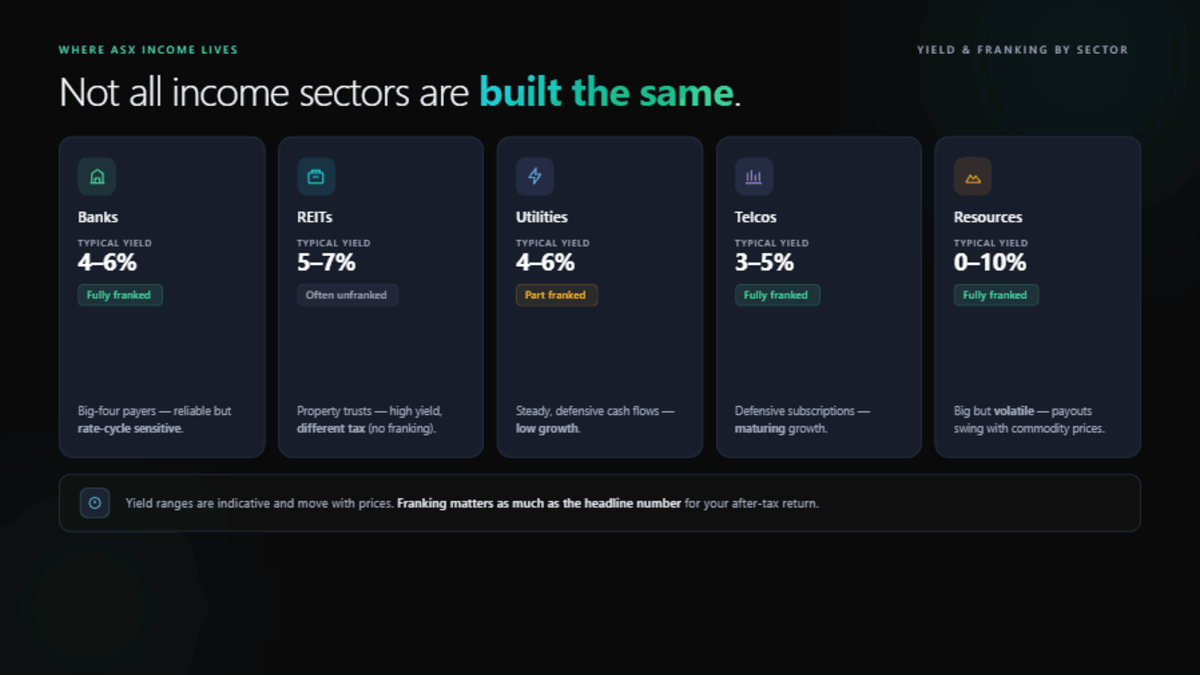
Australian banks have been a cornerstone of income portfolios for decades. The major banks typically pay fully franked dividends in the 5%–7% yield range, giving grossed-up yields well above the ASX average.
The key risk is earnings sensitivity. Bank profits are tied to interest rate cycles, credit conditions, and loan arrears. Diversify within this sector rather than concentrating in a single name.
REITs: Regular Distributions With Some Caveats
Australian Real Estate Investment Trusts (A-REITs) distribute income from property portfolios, often quarterly. The consistent cash flow appeals to income investors.
The catch is that REIT distributions are commonly unfranked or only partially franked. Distributions often include capital returns or trust components, taxed differently and carrying no franking credits. Always examine the distribution composition before comparing a REIT yield to a fully franked bank dividend.
Infrastructure and Utilities: Defensive Income Streams
Infrastructure and utility companies with long-term contracted revenues tend to generate stable earnings across economic cycles, supporting reliable dividend payments. Yields typically sit in the 4%–6% range with moderate franking. These stocks suit investors who prioritise income stability over growth.
Healthcare and Consumer Staples: Dividend Reliability Through the Cycle
Defensive sectors maintain earnings through recessions because demand for their products does not disappear. Dividends hold up better in downturns.
These sectors often sit at the lower end of the yield spectrum — typically 2%–4% — but provide a growth-plus-income profile. Including them smooths income during periods when cyclical sectors cut payouts.
Are dividend stocks passive income?
What Is a Dividend Trap?
A dividend trap occurs when a stock’s high yield reflects a falling share price rather than a generous payout policy. Because yield equals dividend divided by share price, a 30% share price fall inflates the apparent yield even if the absolute dividend has not yet changed.
Red Flags to Watch on the ASX
- Payout ratio above 100% of earnings for two or more consecutive periods
- Declining revenue, earnings, or free cash flow over 12–24 months
- Rising debt levels relative to earnings
- Recent dividend cuts or management commentary flagging reduced distributions
- Structural disruption to the sector
A Simple Due Diligence Checklist
Before buying a dividend stock, check:
- Yield: Face yield and grossed-up yield
- Payout ratio: Earnings-based and cash-flow-based
- Franking level: Fully, partially, or unfranked
- Earnings trend: Growth, stable, or declining over three to five years
- Debt levels: Net debt to EBITDA — above 3x warrants scrutiny
- Dividend history: Any cuts or suspensions in the past decade
- Sector risk: Structural tailwinds or headwinds
How to find the best long‑term dividend stocks on the ASX?
How ASX Dividend Reinvestment Plans Work
A Dividend Reinvestment Plan (DRP) lets you receive additional shares instead of cash dividends. Many ASX-listed companies offer DRPs at a small discount to the prevailing market price — often 1%–2.5%. DRPs are a low-friction way to compound wealth without paying brokerage on reinvested income.
Tax Implications of DRP Participation
DRP shares are treated as assessable income by the ATO in the financial year you receive them, at market value on the issue date. You do not avoid income tax by receiving shares instead of cash.
Each DRP parcel creates a new acquisition date and a new cost base for CGT purposes. The 50% CGT discount applies to individuals and trusts holding shares for 12 months or more before selling. Accurate DRP record-keeping is non-negotiable. Track every parcel, its issue date, and its cost base.
Building a Diversified ASX Dividend Portfolio
Core Principles of Dividend Portfolio Construction
No single sector pays dividends reliably through every market cycle. Banks slow when credit conditions tighten. REITs struggle when interest rates rise. Healthcare holds steady when both wobble.
A resilient income portfolio spreads exposure across banks, REITs, infrastructure, healthcare, and consumer staples. Balance yield, franking level, and earnings quality across your holdings rather than optimising for the highest yield alone.
Income ETFs as a Lower-Effort Alternative
ASX-listed income ETFs provide diversified dividend exposure in a single holding, with distributions paid monthly or quarterly. Before investing, examine the underlying holdings, distribution composition, franking levels, and management fees. A high distribution yield with minimal franking and high fees often delivers less after-tax income than it appears.
Income ETFs and direct stocks are not mutually exclusive. Many investors hold a core ETF position alongside individual income stocks.
Estimating How Much Capital You Need
If you target $3,000 per month in pre-tax income ($36,000 per year) from a portfolio yielding 5% grossed-up, you need approximately $720,000 in invested capital. At a 4% grossed-up yield, that figure rises to $900,000.
Avoid concentrating in the highest-yielding stocks to reduce the required capital. That path leads straight into dividend traps.
Dollar Cost Averaging Into an ASX Dividend Portfolio
Dollar cost averaging (DCA) means investing a fixed amount at regular intervals regardless of price. Over time this reduces the average entry price and removes the pressure of timing a single large purchase. Reinvesting dividends — through a DRP or manually — accelerates the compounding effect.
Tax Considerations for ASX Dividend Investors
Dividends and Your Marginal Tax Rate
Dividend income, including grossed-up franking credits, is assessed at your marginal tax rate. For lower-income investors and retirees below the tax-free threshold, fully franked dividends generate a cash refund from the ATO — making franking credits one of the most significant income advantages available to Australian investors.
Dividend income also interacts with the Medicare Levy, currently at 2% of taxable income. Factor this in when modelling your after-tax income.
SMSF Investors and the Franking Credit Advantage
SMSFs in accumulation phase pay 15% tax on dividend income. In pension phase, the rate is 0%. For a pension-phase SMSF receiving $10,000 in fully franked dividends with $4,286 in attached franking credits and zero tax to pay, the ATO refunds that $4,286 directly. SMSF compliance is complex. Always consult a licensed adviser before implementing a dividend income strategy inside a super fund.
ATO Record-Keeping for ASX Dividend Investors
Maintain the following records for every holding:
- Dividend and distribution statements (including franking credit amounts)
- DRP participation statements
- Brokerage confirmations for purchases and sales
- Cost base records for each parcel, including DRP parcels
The ATO requires these records for five years after the relevant tax return lodgement date. Platforms like Crowdfolio allow Australian DIY investors to track dividend income, franking credits, cost bases, and portfolio performance in one place, simplifying both ongoing monitoring and tax time preparation.
Frequently asked questions
What is a good dividend yield for ASX stocks?
A yield of 4%–6% with full or substantial franking is a strong benchmark for blue-chip ASX income stocks. Grossed-up, that translates to roughly 5.7%–8.6% for investors in lower tax brackets. Yields above 8% face yield warrant close scrutiny of payout sustainability.
How do franking credits affect my tax return?
Franking credits represent corporate tax already paid by the company. You include the grossed-up amount in your taxable income and claim the franking credit as an offset against your tax bill. If the credit exceeds your liability, the ATO refunds the difference.
How do I avoid dividend traps when choosing high-yield ASX stocks?
Check the payout ratio, earnings trend, free cash flow, and debt levels before investing. A high yield driven by a falling share price rather than strong earnings is a red flag. Apply the due diligence checklist above to every new position.
How much do I need to invest to live off ASX dividend income?
At a 5% grossed-up yield, you need approximately $720,000 in invested capital to generate $36,000 per year before tax. At 4% grossed-up, the figure rises to $900,000. A licensed financial adviser and a qualified tax professional should both be part of this planning process.