
ETF tax in Australia operates through a flow-through structure where most ASX-listed ETFs are unit trusts paying no tax themselves. Instead, all income and capital gains flow to investors who must report five components: CGT on unit sales, distribution income (franked, unfranked, foreign), AMIT cost base adjustments, franking credits, and FITOs. The 50% CGT discount applies for holdings over 12 months.
How are ETFs taxed in Australia?
Unit Trusts and the Tax Flow-Through Principle
Most ASX-listed ETFs are structured as managed investment trusts (MITs) — specifically unit trusts. The fund itself pays no income tax. As a result, all taxable income and capital gains flow directly through to you as a unit holder.
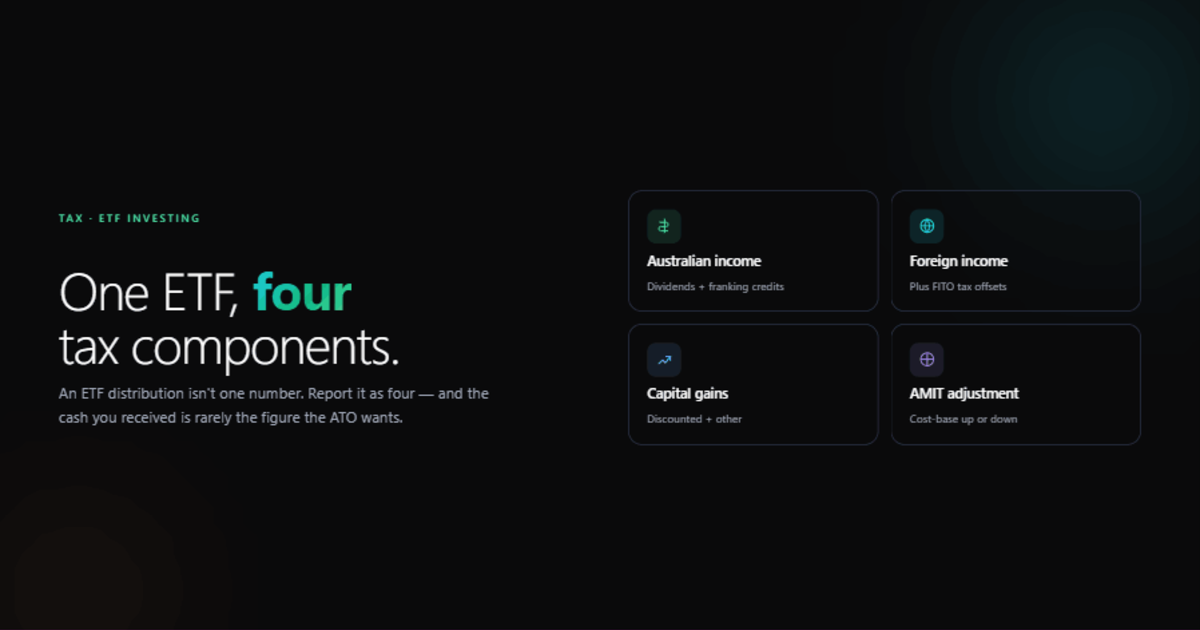
This differs from holding shares in a company, where the company pays tax first and you receive franked dividends after. In contrast, with a unit trust ETF, you carry the full tax reporting responsibility. Every dollar of income and every capital gain the fund realises must appear in your personal tax return.
The AMIT Regime: What It Means for You
Most major ASX ETFs elect into the Attribution Managed Investment Trust (AMIT) regime. Under AMIT, income is attributed to you for the financial year it relates to — 1 July to 30 June. However, the date cash arrives does not matter.
This creates one of the most common reporting errors: a distribution paid in July belongs to the prior financial year. In fact, your AMMA statement confirms the correct year. If you report it in the year cash arrived, you are filing incorrectly.
Understanding ETF Distribution Components
The Five Main Components of an ETF Distribution
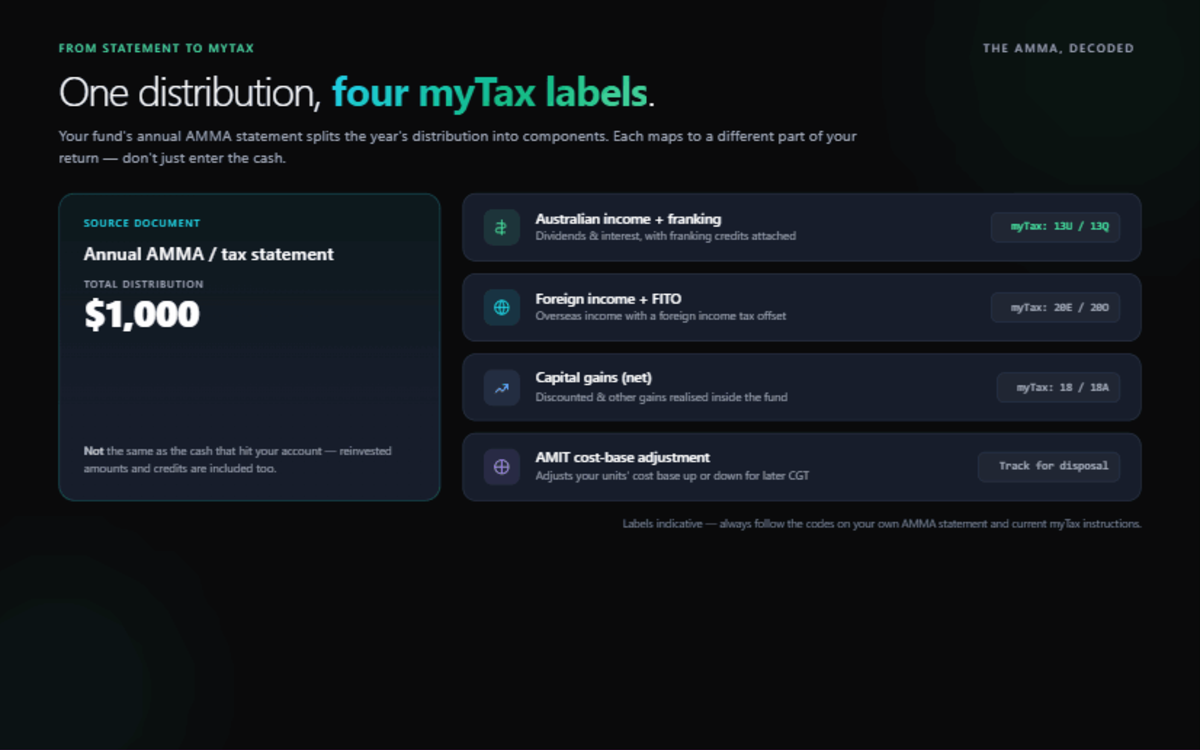
An ETF distribution is not a single lump sum for tax purposes. Your AMMA (AMIT Member Annual) statement breaks it into components, each treated differently by the ATO.
| Distribution Component | Tax Treatment | myTax Label |
|---|---|---|
| Australian franked income | Assessable — franking credits offset tax payable | Managed fund income → Franked distributions |
| Australian unfranked income | Assessable at marginal rate | Managed fund income → Unfranked distributions |
| Foreign income | Assessable — FITO offsets foreign tax paid | Foreign income section |
| Foreign income tax offsets (FITOs) | Reduces Australian tax on foreign income | Foreign income tax offsets |
| Distributed capital gains (discounted) | 50% discount already applied by the fund | Capital gains — CGT discount method |
| Distributed capital gains (non-discounted) | Fully assessable | Capital gains — other method |
Franking Credits: How Dividend Imputation Works With ETFs
When your ETF holds Australian shares and receives franked dividends, those franking credits flow through to you. Declare the gross amount (cash plus franking credit) as income. Then claim the franking credit as an offset against your tax payable.
Worked example: Your ETF distributes $700 of franked income with $300 in attached franking credits. You declare $1,000 as income. As a result, the $300 credit directly reduces your tax liability. If your tax bill is less than $300, the ATO refunds the excess — a meaningful benefit for retirees and lower-income investors.
The 45-day holding rule applies at the fund level, managed by the ETF provider. You receive the credits as shown on your AMMA statement.
Foreign Income and Foreign Income Tax Offsets (FITOs)
Internationally focused ETFs often earn income in overseas markets where withholding tax is deducted at source. A FITO prevents you from being taxed twice on the same income.
Worked example: Your AMMA statement shows $500 of foreign income with 15% withholding tax already paid. You gross up to $588 ($500 ÷ 0.85) and declare $588 as foreign income. You then claim the $88 FITO in myTax to offset the foreign tax already paid.
Holding US-domiciled ETFs directly is different from holding Australian funds that invest in US assets. Furthermore, no AMMA statement is issued. Different withholding rules apply. Therefore, consult a registered tax agent for this scenario.
Distribution Reinvestment Plans (DRPs): Taxable Even Without Cash
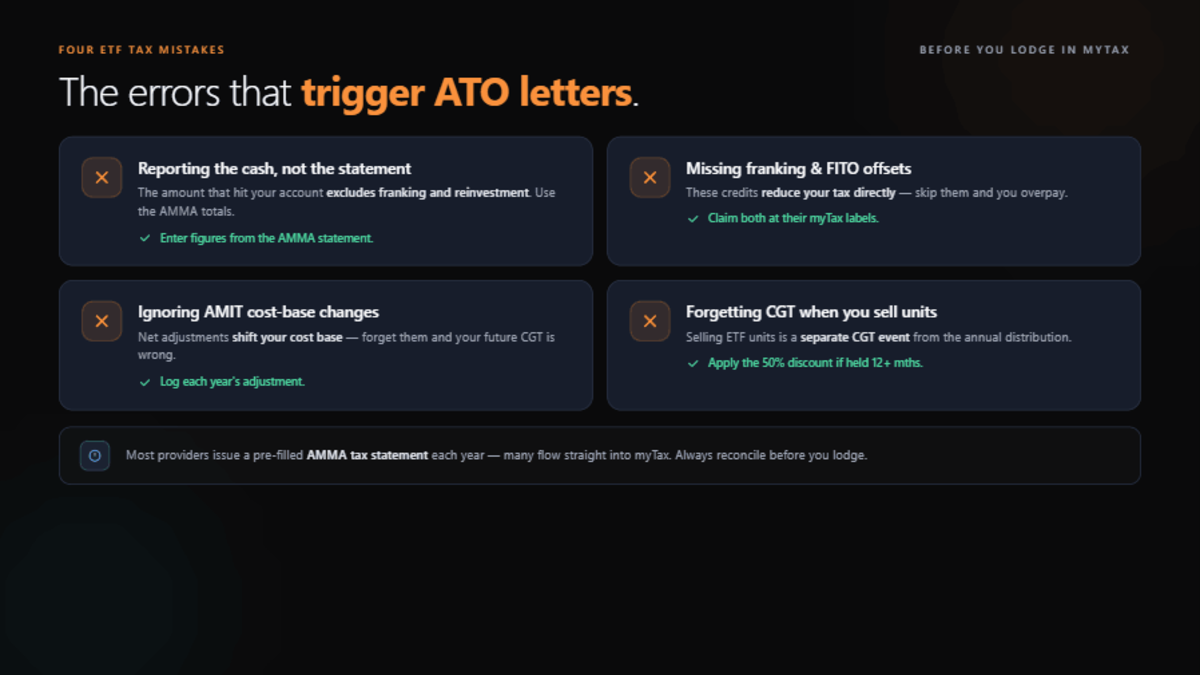
If you participate in a DRP, the reinvested amount is still assessable income. It is assessable in the year it is attributed — the same as receiving cash. In other words, you do not need cash in hand for a tax obligation to arise.
Each DRP parcel also creates a new CGT cost base event. Record the acquisition date and cost for each parcel separately. Both affect your CGT calculation when you sell. Long-term DRP investors build up many parcels. As a result, tracking them accurately is a real obligation.
What is the tax on index funds in Australia?
CGT Events and How They Apply to ETF Unit Sales
Selling ETF units on the ASX triggers CGT Event A1 — the disposal of a CGT asset. Specifically, your capital gain equals your capital proceeds minus your cost base.
Cost base components include:
- Purchase price of the units
- Brokerage paid on acquisition
- Any AMIT cost base adjustments accumulated over the holding period
Calculating Your Cost Base: A Worked Example
- Investor buys 500 units at $10.00 each = $5,000 + $10 brokerage → cost base: $5,010
- Year 1 AMIT cost base adjustment: +$45 → $5,055
- Year 2 AMIT cost base adjustment: −$20 → adjusted cost base: $5,035
- Sells 500 units at $13.00 = $6,500 − $10 brokerage → proceeds: $6,490
- Capital gain: $6,490 − $5,035 = $1,455
If you bought units at different prices through dollar cost averaging, each parcel must be tracked separately. In particular, the acquisition date and cost for each parcel determines whether the 50% CGT discount applies.
The 50% CGT Discount for Units Held Over 12 Months
Individuals and trusts who hold ETF units for more than 12 months qualify for the 50% CGT discount. Applying the discount to the example above: $1,455 × 50% = $727.50 added to assessable income.
| Investor Type | Income Tax Rate | CGT Discount |
|---|---|---|
| Individual (accumulation phase) | Marginal rate (up to 47%) | 50% if held 12+ months |
| SMSF (accumulation phase) | 15% | 33.3% if held 12+ months |
| SMSF (pension phase) | 0% | N/A — nil tax |
Note: “discounted gains” on your AMMA statement already have the 50% discount applied by the fund. Do not apply it again. For how the discount works and what changes in 2027, see our guide to the CGT 50% discount in Australia.
AMIT Cost Base Adjustments: Why They Matter
Upward adjustments arise when attributed income exceeds cash distributed. These increase your cost base, preventing double taxation when you sell. Downward adjustments arise when cash distributed exceeds attributed income. In extreme cases, a downward adjustment can push your cost base below zero. As a result, this triggers an immediate capital gain.
Skipping these adjustments leads to an overstated gain at sale. In short, this is not optional — it affects how much tax you pay.
Capital Losses: Offsetting Gains and Carrying Forward
Capital losses on ETF unit sales can only be offset against capital gains, not ordinary income. However, any net capital loss carries forward indefinitely to offset future gains.
Tax loss harvesting is a deliberate strategy. Sell underperforming ETF parcels before 30 June to lock in losses. As a result, these can offset gains made elsewhere in the same year. Watch out for the ATO’s wash-sale view. Buying the same assets back right after selling at a loss can attract scrutiny.
Do you pay tax on an investment account?
Your AMMA Statement: The Starting Point for Reporting
ETF providers issue AMMA statements in August or September, after 30 June. Specifically, each line item maps to a specific location in myTax.
| AMMA Statement Item | myTax Label |
|---|---|
| Australian franked distributions | Managed fund income → Franked distributions |
| Franking credits | Franking credits from managed funds |
| Unfranked distributions | Managed fund income → Unfranked distributions |
| Foreign income | Foreign income section |
| FITOs | Foreign income tax offsets |
| Distributed capital gains (discounted) | Capital gains — CGT discount method |
| Distributed capital gains (non-discounted) | Capital gains — other method |
Do not rely solely on myTax pre-fill. For example, pre-fill data may arrive late or miss cost base adjustments entirely. Therefore, cross-check every line against your AMMA statement before submitting.
Reporting Capital Gains From Unit Sales
Capital gains from selling your own units are entered manually in the Capital gains section of myTax. Most ETF investors use the CGT discount method for units held over 12 months, or the “other” method for short-term gains. However, the indexation method applies only to assets acquired before September 1999.
Additionally, include brokerage on both the buy and sell sides in your cost base calculations.
Record-Keeping Obligations Under ATO Rules
The ATO requires you to keep records for five years after the tax return for the year of disposal is lodged. For long-term holders, this extends well beyond the purchase date.
Retain the following for every ETF holding:
- Trade confirmations (buy and sell)
- Brokerage invoices
- AMMA statements for every year held
- DRP allocation statements
- A running CGT register with all AMIT cost base adjustments applied
Do you pay taxes on ETFs?
ETFs inside super are taxed very differently. In the pension phase the rate is 0%. By contrast, in your personal name it can reach 47%. The difference in outcome is significant.
SMSFs holding ETFs must apply AMIT cost base adjustments. Instead, all distribution components go in the fund’s SMSF annual return — not myTax. Self-managed trustees should check their accounting software handles AMIT adjustments before lodging.
FAQ: Common Questions From Australian ETF Investors
Q: How are ETF distributions taxed in Australia?
ETF distributions are split into components: franked income, unfranked income, foreign income, FITOs, and capital gains. Importantly, each has its own tax treatment. Your AMMA statement maps each component to the correct myTax label.
Q: Do I pay capital gains tax when I sell ETF units on the ASX?
Yes. Selling ETF units triggers CGT Event A1. You calculate the gain by subtracting your adjusted cost base (including brokerage and AMIT adjustments) from your sale proceeds. If you held the units for more than 12 months, the 50% CGT discount applies.
Q: What is an AMMA statement and how do I use it?
An AMMA statement is issued by your ETF provider after 30 June each year. It lists all income attributed to you for the year and shows any cost base adjustments. Use it to complete the managed fund and capital gains sections of your myTax return.
Q: Can I offset a capital loss from selling ETF units against other capital gains?
Yes. Capital losses from ETF unit sales can be applied against other capital gains in the same year — for example, from selling shares or property. Moreover, net capital losses carry forward to future years.
Key Takeaways
- Most ASX ETFs are unit trusts — the fund pays no tax, you do.
- Distributions contain multiple components, each reported separately in myTax.
- July cash payments typically belong to the prior financial year under the AMIT regime.
- The 50% CGT discount applies to units held over 12 months by individuals and trusts.
- AMIT cost base adjustments must be recorded each year — errors compound over time.
- DRP units are assessable income and create new CGT parcels.
- Franking credits offset your tax payable and excess credits are refundable.
- FITOs prevent double taxation on foreign income distributed by international ETFs.
- The ATO requires records for five years after your disposal return is lodged.