
How to avoid capital gains tax on shares in Australia: time sales after 12 months for the 50% CGT discount, offset gains with crystallised losses before 30 June, and hold investments to defer unrealised gains — the ATO only taxes realised gains.
How can you avoid capital gains tax on shares in Australia?
The ATO taxes you on what you realise, not what you hold. That single fact shapes every smart decision an Australian share investor makes before 30 June.

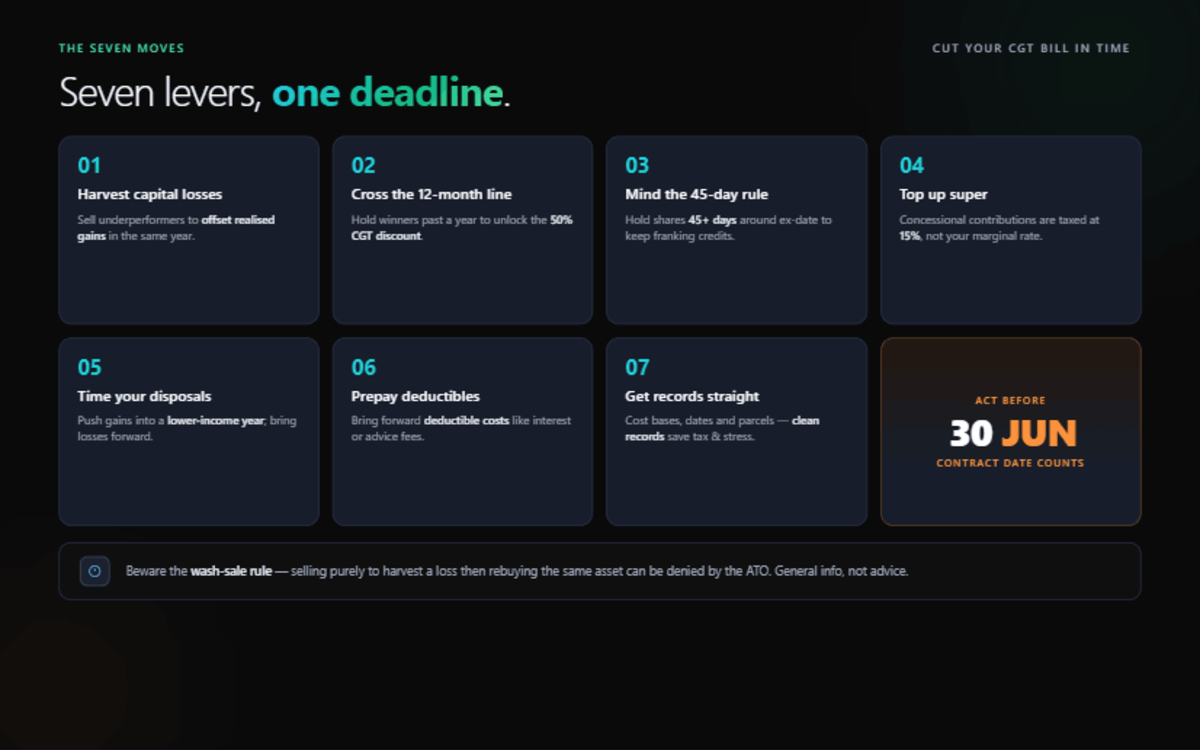
With the end of the financial year approaching, there is a narrow window in which these steps still apply to this income year. The tips below cover the areas that make the biggest difference — from CGT timing to franking credits, super contributions and ETF record-keeping.
When do you need to pay capital gains tax on shares?
Unrealised vs realised capital gains
An unrealised gain is the increase in value of shares you still hold. The ATO does not tax it. A realised gain occurs when you sell, triggering a CGT event. Until you sell, you control when tax applies.
Review your portfolio before 30 June
Log into your broker or portfolio tracker and pull your realised transactions for the financial year. Note any sales already made, then look at remaining holdings to decide whether to act before 30 June or wait until the next financial year.
Timing example
You hold shares worth $18,000 with a cost base of $10,000. Sell before 30 June and the $8,000 gain falls in this financial year. Wait until 1 July and it falls in the next. Timing the sale lets you match the gain against losses or lower income in the year that suits you best.
What is the ATO capital gains tax discount for shares held 12 months?
How the 50% CGT discount works
Individuals and trusts who hold ASX shares or ETFs for at least 12 months before selling are eligible for a 50% CGT discount. Only half the capital gain is added to your taxable income. Companies and super funds in accumulation phase do not receive this discount.
Why acquisition date matters more than purchase price
Check the purchase date before you sell any parcel. A parcel bought on 15 June last year becomes discount-eligible on 16 June this year. Selling one day too early costs you the discount on the full gain.
Worked example
You sell shares for a $20,000 gain. At 11 months, the full $20,000 is assessable. At a 37% marginal rate, that’s $7,400 in tax. At 13 months with the 50% discount, only $10,000 is assessable — tax drops to $3,700. Waiting two months saves $3,700.
How does tax-loss selling reduce your capital gains tax?
What tax-loss selling is
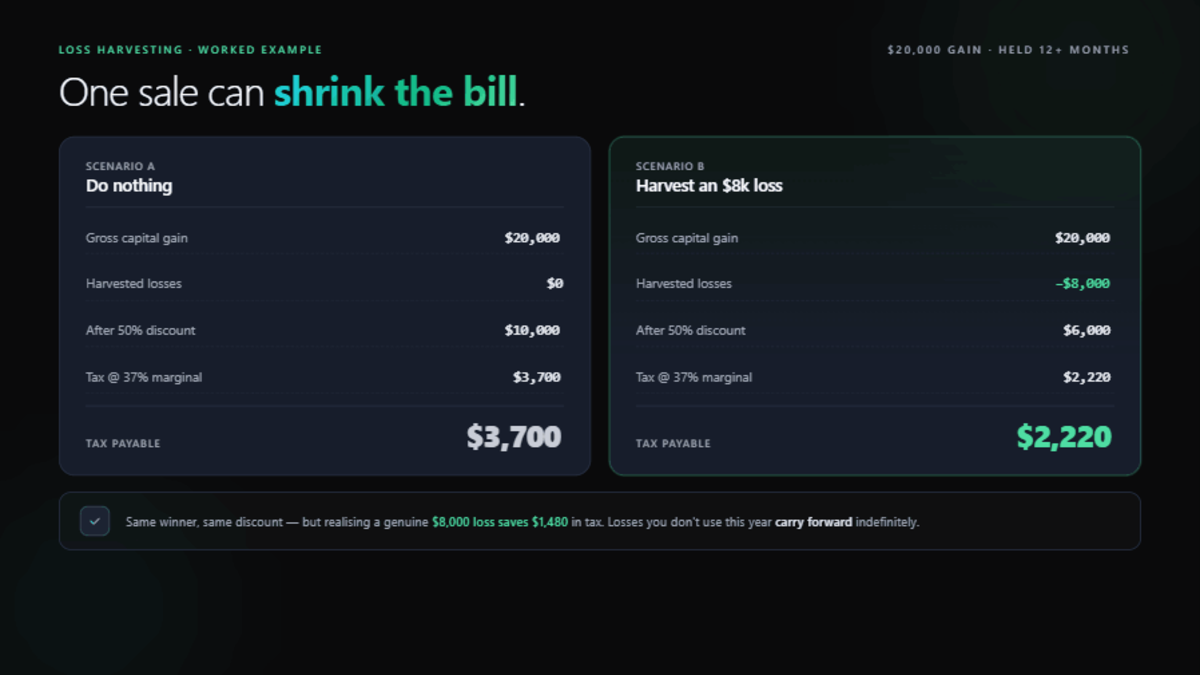
Tax-loss selling means selling holdings currently at a loss to crystallise that loss before 30 June. The realised loss then offsets capital gains already made this financial year, reducing your net CGT liability.
Carry-forward rules
Capital losses must first offset capital gains in the same financial year. If losses exceed gains, the net capital loss carries forward to future years and never expires.
Because that carry-forward never expires, a loss realised in a year with no gains is not wasted — it stays available against a future sale, which is worth remembering before you write off a loss as too small to bother crystallising.
The wash-sale risk
The ATO applies general anti-avoidance provisions to arrangements it considers artificial. Selling shares purely to crystallise a loss, then immediately rebuying the same shares with no genuine change in investment position, risks the ATO disallowing the loss. A genuine investment review should drive the decision.
Tip 4: Make the Most of Franking Credits From ASX Dividends
How dividend imputation works
When an ASX company pays a fully franked dividend, it attaches a franking credit representing the 30% company tax already paid. You include both the dividend and the credit in your taxable income, then use the credit to offset your tax payable.
Refunds versus reductions
If your marginal tax rate is below 30%, your franking credits exceed your tax liability on that income and the ATO refunds the difference in cash. If your marginal rate is above 30%, the credit reduces — but does not eliminate — your tax on the dividend.
Who benefits most
Low-income earners and retirees whose marginal rate sits below the 30% company tax rate benefit most, receiving a cash refund — in 2026–27 that means taxable income under $45,000. Super funds in pension phase (0% tax) receive franking credits as a full refund. High-income earners still benefit, but the credit only partially offsets their 45% marginal rate.
Tip 5: Top Up Super Before 30 June to Reduce Taxable Income
Concessional contributions and the personal deductible contribution pathway
The concessional contribution cap is $32,500 for 2026–27, up from $30,000, and it includes employer super guarantee payments and salary sacrifice. You can also make a personal deductible contribution — pay money into super from your bank account, then lodge a Notice of Intent to Claim a Deduction with your fund before you lodge your tax return.
Carry-forward rule for balances below $500,000
If your total super balance was below $500,000 at 30 June of the previous financial year, you may access unused concessional cap amounts from the previous five financial years. Unused amounts expire after five years, so any unused cap from 2021–22 is lost at the end of 2026–27.
Key deadline
Your super fund must receive the contribution by 30 June for it to count this financial year. Allow at least three to five business days for processing.
Tip 6: Prepay Deductible Investment Expenses Before the Year Closes
What is deductible
Expenses incurred in earning assessable investment income are generally deductible. This includes interest on margin loans, portfolio administration fees, and accounting fees related to your share portfolio.
The 12-month prepayment rule
Individuals can prepay up to 12 months of investment loan interest before 30 June and claim the full deduction in this financial year. Your lender must agree. This brings a future deduction forward — useful if your taxable income is higher this year than expected next year.
Other costs to note
Brokerage fees on share purchases are not immediately deductible — they form part of your cost base and reduce your capital gain on sale. Ongoing portfolio management fees and eligible investing subscriptions are deductible in the year incurred. Keep receipts for all amounts.
Tip 7: Get Your ETF Cost Base Right — The AMIT Trap
How AMIT tax statements adjust cost base
ETFs operating under the Attribution Managed Investment Trust (AMIT) regime issue an annual tax statement that includes a cost base adjustment. This increases or decreases your cost base in the ETF units. Ignoring it means your CGT calculation at sale is wrong — often resulting in overpaying or underpaying tax.
DRP shares and corporate actions
When you participate in a dividend reinvestment plan (DRP), new shares are issued at market price on the reinvestment date. Each parcel has its own cost base and acquisition date. Rights issues, share splits and spin-offs also create separate CGT events. Many investors miss these entirely.
Accurate records reduce errors
The ATO expects CGT calculations using accurate cost base figures, including all AMIT adjustments and corporate actions. Tools like Crowdfolio are built for Australian DIY investors and help track ETF cost base adjustments, DRP parcels and trade history in one place.
Which share parcel should you sell?
If you have bought the same share more than once, you do not own one holding — you own several parcels, and each is a separate CGT asset with its own cost base and acquisition date. When you sell part of a position, you decide which parcel goes.
That decision is yours, not a formula the ATO imposes on you. The ATO’s guidance is that you must be able to identify which shares you sold and when you acquired them, and that your CHESS or issuer-sponsored statements are the records that let you choose a parcel and establish what it cost. The Commissioner has long accepted first-in-first-out as a reasonable basis, and Taxation Determination TD 33 confirms your own selection is accepted too. What you cannot do is average the cost base across parcels bought on different days.
Why the choice matters
Suppose you hold 1,000 shares in one company, bought in three parcels, now trading at $15:
- 300 shares bought at $8, three years ago
- 400 shares bought at $10, 14 months ago
- 300 shares bought at $11, seven months ago
You want to sell 300. Nominate the oldest parcel and you realise a $2,100 gain, halved by the discount to $1,050 assessable — $389 of tax at a 37% marginal rate. Nominate the newest parcel and the gain is only $1,200, but it has been held under 12 months, so all of it is assessable: $444 of tax. The smaller gain costs more. Take 300 shares from the middle parcel instead and the $1,500 gain is discount-eligible, leaving $750 assessable and $278 of tax — the cheapest of the three.
So the lowest tax is neither the smallest gain nor automatically the oldest parcel. Keep the records that support whichever parcel you nominate. For the mechanics of tracking parcels through DRPs, splits and partial sales, see how tax lot tracking works in Australia.
How do you rebalance without triggering a large CGT bill?
Rebalancing means trimming what has grown — which is exactly where your largest unrealised gains sit. The sale that best restores your target weights is rarely the sale with the lowest tax cost, so the two have to be weighed together.
Three levers do most of the work:
- Direct new money instead of selling. Contributions and dividends bought into underweight holdings move your weights with no CGT event at all.
- Prefer discount-eligible parcels. Where two sales would correct the same drift, a parcel held beyond 12 months costs roughly half the tax of an equivalent gain held under 12 months.
- Pair a trim with a loss. Capital losses are applied to your gains before the 50% discount, so realising a loss and trimming a winner in the same financial year costs less than splitting them across two years.
Drift is also not an emergency. If a position sits a few weeks short of the 12-month mark, waiting is usually cheaper than correcting the weight immediately. Our guide to rebalancing your portfolio with CGT in mind works through the trade-offs in detail.
Should you time a sale around your income for the year?
A capital gain is added to your taxable income, so an identical gain costs different amounts depending on what else you earn that year. For 2026–27 the resident rates are nil up to $18,200, then 15%, 30%, 37% and 45%, with thresholds at $45,000, $135,000 and $190,000, before the 2% Medicare levy.
That makes the financial year in which you realise a gain a genuine decision rather than an administrative detail. Parental leave, a career break, a gap between jobs or a first year of retirement are all years in which the same gain is taxed less.
Worked example: the same gain in two different years
You hold a parcel sitting on a $40,000 gain and it qualifies for the 50% discount, so $20,000 is assessable. Realise it in a year when your other income is $150,000 and the whole $20,000 is taxed at 37% — $7,400. Realise the same gain in a year when your other income is $30,000, and it is taxed at 15% up to the $45,000 threshold and 30% above it — $3,750. Same sale, $3,650 of difference, decided only by which year it lands in. Both figures are before the Medicare levy.
This runs both ways. If you expect a higher-income year next year, bringing a planned sale forward into this one can be the cheaper path. Either direction needs a view of your income before 30 June, not when you lodge.
What records should you keep for CGT on shares?
The ATO requires you to keep records for five years from the date you lodge your tax return for the year a CGT event occurs. Required documents include trade confirmations, dividend statements, DRP records and ETF annual tax statements.
Every time you buy or sell shares, your broker issues a contract note — the primary document for establishing cost base and acquisition date.
If records are missing due to broker closures, contact the broker directly and request historical statements. Share registries such as Computershare and Link Market Services also hold some historical data. Document your attempts to reconstruct records in case the ATO requests them.
Frequently asked questions
Do capital losses carry forward if unused?
Yes. Net capital losses carry forward indefinitely and offset capital gains in future financial years. They do not offset other income such as salary or dividends.
Does the 50% CGT discount apply to ETFs?
Yes. The discount applies to ETF units held by individuals and trusts for at least 12 months, the same as direct ASX shares. AMIT cost base adjustments affect the gain calculation before the discount is applied.
How do I claim a deduction for a personal super contribution?
Lodge a Notice of Intent to Claim a Deduction with your super fund before you lodge your tax return. Your fund must acknowledge the notice. The deductible amount is then reported in your tax return.
Are brokerage fees tax-deductible?
No. Brokerage paid on purchase is added to your cost base. Brokerage paid on sale reduces your capital proceeds. Both affect your CGT calculation at the time of sale, not as an immediate deduction.