
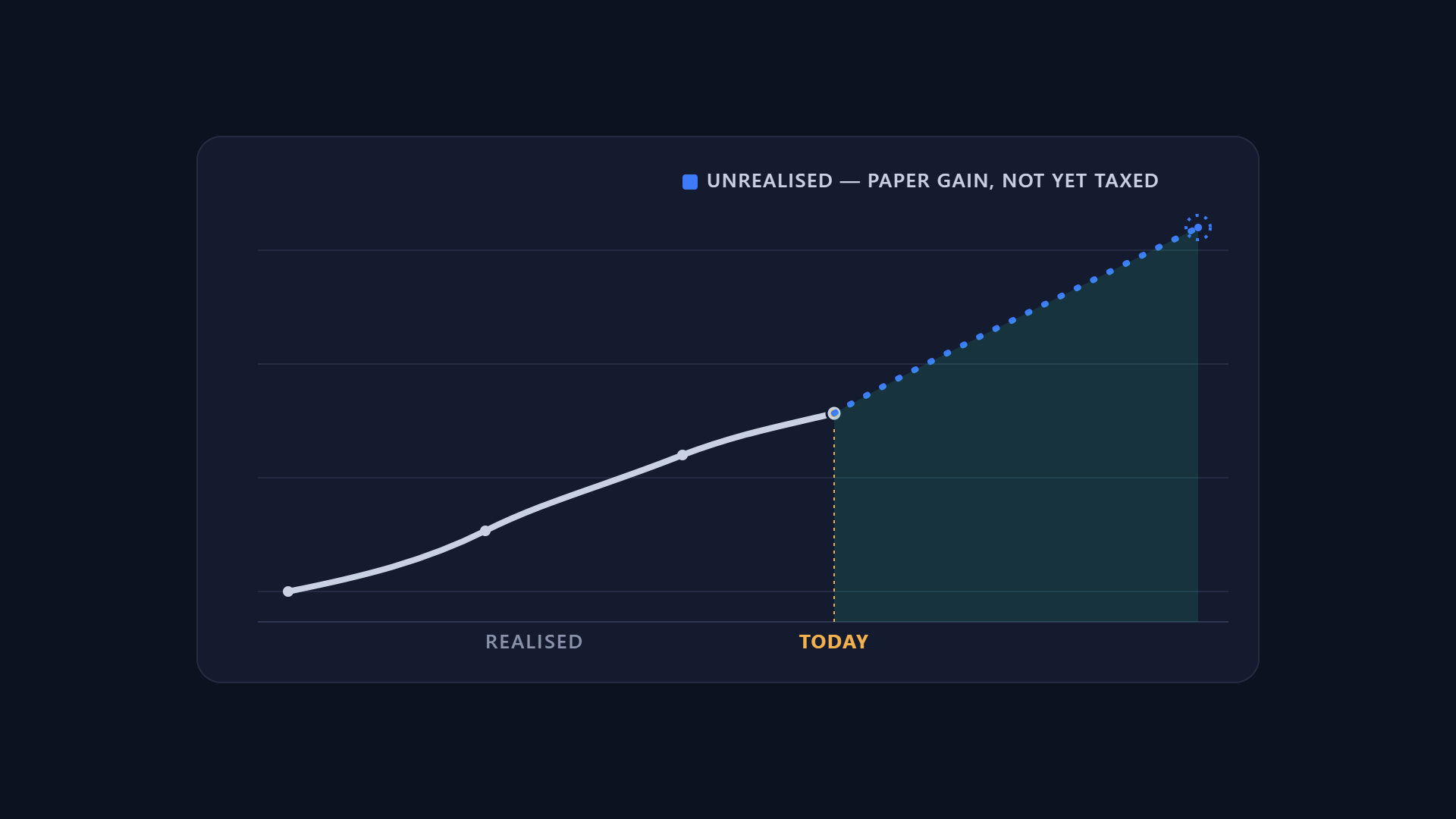
Australia does not have a general tax on unrealised (paper) capital gains. For an individual share or ETF investor, capital gains tax (CGT) applies only when a CGT event happens — usually when you actually sell or dispose of an asset. While you keep holding, a rise in value is an unrealised gain and is not taxed.
Two policies people mean when they ask about “unrealised capital gains tax” are different things: the enacted Division 296 super tax, which applies only to superannuation balances above $3 million and taxes realised earnings (its unrealised-gains component was dropped before it became law), and the 2027 CGT reform, whose one-off “deemed disposal” at 30 June 2027 is a valuation step that defers tax until you sell — not a tax on paper gains. This is general information, not tax advice; see the ATO on capital gains tax.
Last reviewed: 23 July 2026.
What is an unrealised capital gain?
An unrealised (or “paper”) capital gain is the increase in value of an asset you still own. It becomes a realised capital gain only when a CGT event occurs — most commonly when you sell or otherwise dispose of the asset.
For example, you buy 500 shares at $100 each — a cost base of $50,000. They rise to $110 each, so your holding is worth $55,000. You have a $5,000 unrealised gain, and nothing is taxable while you hold. If you later sell for $55,000, you realise a $5,000 capital gain, which then enters your CGT calculation for that financial year.
Is there an unrealised capital gains tax in Australia?
For assets you hold directly — shares, ETFs or managed-fund units in your own name — a rise in market value is not taxed on its own. CGT is triggered by a CGT event (usually disposal), so for directly held shares you largely control the timing by choosing when to sell.
One qualification applies to pooled investments: a managed fund or ETF (typically in the AMIT regime) can realise a capital gain inside the fund and attribute it to you, which you report even if you keep holding your units. That is still tax on a realised gain — the fund sold something — not on your units’ paper value; but it means fund investors do not control the timing the way direct shareholders do.
The phrase “unrealised capital gains tax” entered public debate through two separate measures, and, as enacted, neither taxes the paper gains of an everyday share portfolio:
- Division 296 — an extra tax on superannuation balances above $3 million. Its original design would have counted unrealised gains inside super, but that component was removed before it became law; the enacted measure taxes realised earnings only. It does not touch assets you hold outside super.
- The 2027 CGT reform — a legislated change to how CGT is calculated from 1 July 2027, including a one-off “deemed disposal” transition. No tax is payable at the deemed-disposal moment.
How the Division 296 super measure treats unrealised gains
Division 296 is a separate measure to the CGT reform, and it applies only to superannuation. It is enacted — the Treasury Laws Amendment (Building a Stronger and Fairer Super System) Act 2026 received royal assent on 13 March 2026 and commences from 1 July 2026 (with the first measurement point at 30 June 2027). It applies an additional tax to the earnings on total super balances above $3 million (an extra 15%), with a higher tier for balances above $10 million (an extra 25%); both thresholds are indexed.
On unrealised gains, the key point is that the enacted law does not tax them. The original proposal would have counted unrealised gains in the “earnings” it taxed — the feature that drew heavy criticism — but that was removed before the measure became law. Division 296 as enacted works on a realised-earnings basis (interest, dividends and realised capital gains, adjusted for contributions and withdrawals). So the “tax on unrealised gains in super” that dominated the debate is not in the final law. Check current thresholds and detail with the ATO.
Does the 2027 CGT reform tax unrealised gains?
No — the 2027 CGT reform does not tax unrealised gains. The reform (law since royal assent on 26 June 2026, effective 1 July 2027) changes how capital gains are calculated going forward. Its transition uses a deemed disposal: broadly, the CGT assets you hold at 30 June 2027 are treated as sold and immediately re-bought at their market value on that date (eligibility conditions and exclusions apply).
Crucially, no tax is payable at that deemed-disposal moment. The purpose is only to draw a line between the gain that accrued up to 1 July 2027 — calculated under the old rules, so it keeps the 50% CGT discount for assets held over 12 months — and growth after 1 July 2027, which will be CPI-indexed and taxed at your marginal rate subject to a 30% minimum. Both slices are only actually taxed when you later sell the asset. So the deemed disposal is a valuation reset, not a tax on holding. For the full detail, see our guide to the 2027 CGT changes for investors.
What this means for a retail share investor
- You are not taxed on your portfolio simply rising in value; you plan around realised gains, which you control by choosing when to sell.
- The 2027 reform changes the discount and indexation maths for gains you realise from 1 July 2027 onward, but the deemed-disposal transition itself triggers no immediate tax bill.
- Division 296 is an enacted, super-only measure that does not affect assets you hold in your own name — and, as enacted, it taxes realised earnings, not unrealised gains.
To see how a realised gain would be calculated on your own holdings under the current rules, model it in our capital gains tax calculator.
Frequently asked questions
What is an unrealised capital gain?
It is the increase in value of an asset you still own — a “paper” gain. It is not taxed while you hold. It becomes a taxable (realised) capital gain only when a CGT event happens, usually when you sell. Shares bought for $50,000 that are now worth $55,000 carry a $5,000 unrealised gain, with no CGT until you sell.
Does Australia tax unrealised capital gains?
No — a rise in the value of shares, ETFs or managed-fund units you hold is not taxed on its own; CGT applies when a CGT event occurs, typically disposal. One qualification: a managed fund or ETF can attribute a realised gain to you that you report while still holding the units, but that is a realised gain the fund made, not a tax on your units’ paper value. The two measures linked to “taxing unrealised gains” — Division 296 and the 2027 CGT reform’s deemed-disposal transition — do not, as enacted, tax the paper gains of an ordinary portfolio.
Does Division 296 tax unrealised gains in super?
No — the enacted Division 296 (royal assent 13 March 2026, commencing 1 July 2026) taxes realised earnings on super balances above $3 million, not unrealised gains. The unrealised-gains component in the original proposal was removed before it became law. It applies only to superannuation, not to assets held in your own name. Verify current thresholds and detail with the ATO.
Does the 2027 CGT reform tax my portfolio before I sell?
No. The reform’s deemed disposal at 30 June 2027 re-values the CGT assets you hold but charges no tax at that moment. The pre-2027 gain keeps the 50% discount; post-2027 growth is CPI-indexed and taxed at a 30% minimum — but only when you actually sell.
When do I actually pay capital gains tax on shares?
When you realise a gain by a CGT event — usually selling or disposing of the shares. The gain is your capital proceeds minus your cost base, reported in the financial year the event happens. You can model a realised gain in the Crowdfolio CGT calculator.