
Should I invest a lump sum or dollar cost average in Australia?
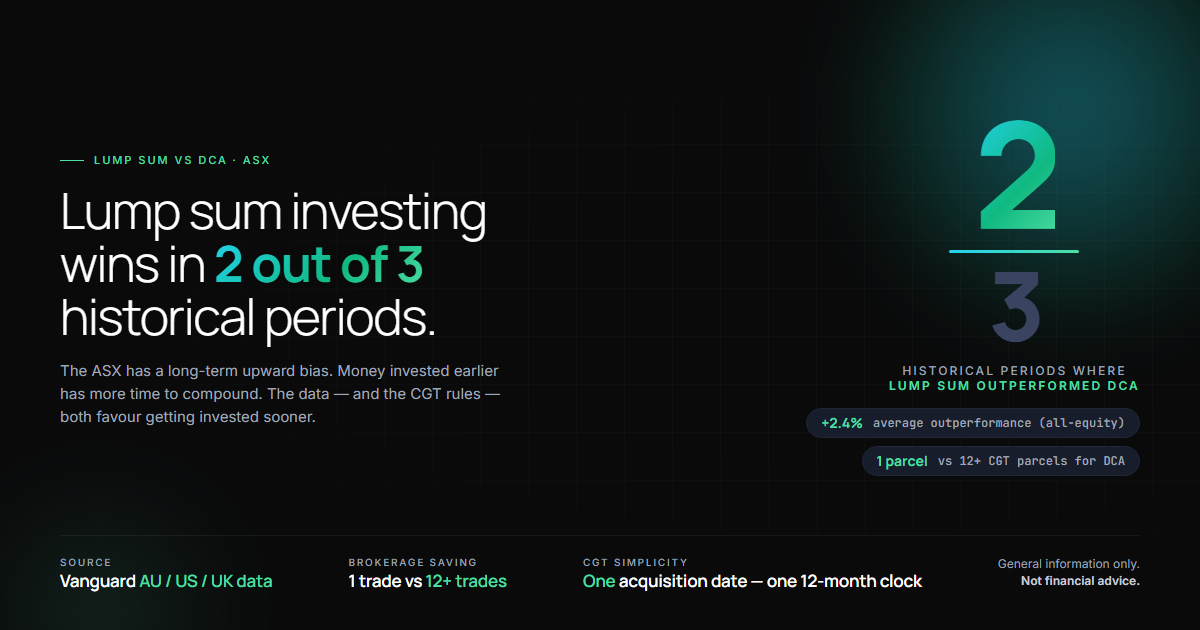
Lump sum investing in Australia outperforms dollar-cost averaging in roughly two-thirds of historical periods, delivering about 2.4% higher average returns for all-equity portfolios, per Vanguard research. The ASX’s long-term upward trend favors immediate deployment, though a hybrid approach — 60–80% lump sum now, remainder over 3–6 months — balances statistical advantage with behavioural risk.
Both are legitimate. The debate is about which produces better outcomes after tax and transaction costs.
Most Australian investors don’t encounter this as an abstract exercise. It arrives in specific moments: a parent passes and leaves $150,000, an employer offers an $80,000 redundancy package, or a property settlement deposits $220,000 into your account. The fear of investing at the wrong time feels amplified when the money is irreplaceable.
Both strategies work well with broad-market ASX ETFs from Vanguard, iShares, and BetaShares. The key difference is execution: a lump sum means one trade, DCA means a series of trades over weeks or months.
You’ve got a sizeable amount of cash sitting in your bank account. It came from an inheritance, a redundancy payout, or a property settlement. Now you need to decide: invest it all at once into ASX ETFs, or spread it out over several months?
The short version: lump sum investing wins more often than not. But the full picture matters for Australian investors, because CGT timing, franking credits, and brokerage costs all shift the calculation in ways that generic US-focused content never addresses.
How does lump sum investing compare to DCA for ASX ETFs?
The ASX has a long-term upward trend. That single fact is the primary reason lump sum investing outperforms DCA across most historical periods. Money invested earlier has more time to compound.
Vanguard’s research, covering Australian, US, and UK market data, found that lump sum investing outperformed a 12-month DCA approach in approximately two-thirds of historical periods. For all-equity portfolios, lump sum investing produced average returns around 2.4% higher. That gap is meaningful on a $100,000 windfall and compounds over time.
Investors focus on the risk of poor timing. They rarely consider the cost of being underinvested. DCA manages timing risk but introduces a different risk: underexposure during a rising market.
The Real Cost of DCA: Brokerage Fee Drag
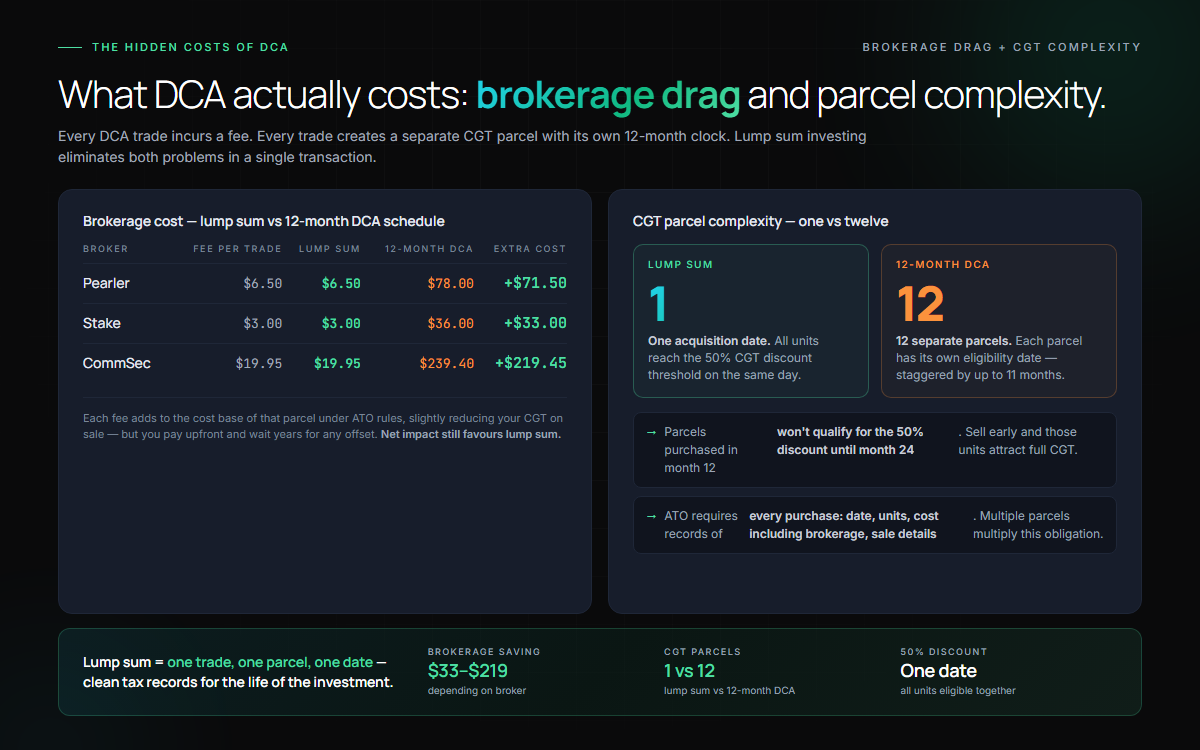
Every trade on CommSec, Pearler, and Stake incurs a fee. CommSec charges $10 to $20 depending on trade size. Pearler charges $6.50 per ASX ETF trade. Stake charges $3 per ASX trade.
A lump sum requires one trade. A 12-month DCA schedule requires at least 12.
| Broker | Fee Per Trade | Lump Sum Cost | 12-Month DCA Cost |
|---|---|---|---|
| Pearler | $6.50 | $6.50 | $78.00 |
| Stake | $3.00 | $3.00 | $36.00 |
| CommSec | $19.95 | $19.95 | $239.40 |
Each brokerage fee adds to the cost base of that parcel under ATO rules, which reduces your capital gain on sale. But you pay the fees upfront and wait years for any CGT benefit. The net impact still favours lump sum investing.
What are the tax implications of lump sum investing in Australia?
The ATO treats each ETF unit purchase as a separate CGT asset with its own acquisition date, quantity, and cost base. A 12-month DCA schedule creates 12 separate CGT parcels, each requiring individual record-keeping.
Individuals and trusts qualify for the 50% CGT discount on assets held for more than 12 months. With a lump sum, all units reach that threshold on the same date. With DCA, each parcel has a different eligibility date. Parcels purchased in month 12 won’t qualify for the discount until month 24. If you sell before the later parcels hit 12 months, those units attract full CGT with no discount.
A lump sum purchase creates one parcel, one acquisition date, and one cost base to track. Tax time is straightforward, and the risk of inadvertently triggering full CGT on younger parcels is eliminated.
The ATO requires records of every purchase including the date, number of units, total cost including brokerage, and sale details. Multiple DCA parcels multiply this obligation. Errors in parcel tracking lead to incorrect CGT calculations and potential ATO scrutiny.
Franking Credits and Getting Invested Sooner
Being fully invested from day one means you receive more dividend payments and more franking credits over the life of your investment. A DCA investor misses or receives reduced franking credits on the uninvested portion during the DCA period.
Investors on lower marginal tax rates, including retirees and part-time workers, often receive franking credit refunds from the ATO. Earlier full market exposure accelerates those refunds and improves total after-tax returns.
For SMSFs in pension phase, earnings supporting retirement income streams are generally tax-free within transfer balance cap limits. For pension-phase trustees, the lump sum vs DCA decision becomes less about tax and more about risk tolerance and the fund’s documented investment strategy.
The Behavioural Argument for DCA
Research consistently shows that investors feel losses more acutely than equivalent gains. Investing $150,000 as a lump sum and watching it drop 15% in the first month creates genuine psychological distress, particularly when the money came from a parent’s estate or a redundancy package. That distress triggers panic selling, which destroys returns far more than any timing disadvantage.
The biggest risk for most DIY investors isn’t a bad entry point. It’s exiting the market at the worst possible moment. DCA reduces the emotional weight of a large single entry and makes it easier to stay invested through volatility. A slightly lower expected return is worth paying for an investor who would otherwise sell at the bottom.
DCA makes sense when a lump sum represents a large proportion of your net worth, when you’re new to direct equity investing, or when you recognise that a sharp drawdown would genuinely affect your behaviour.
Matching the Strategy to Your Situation
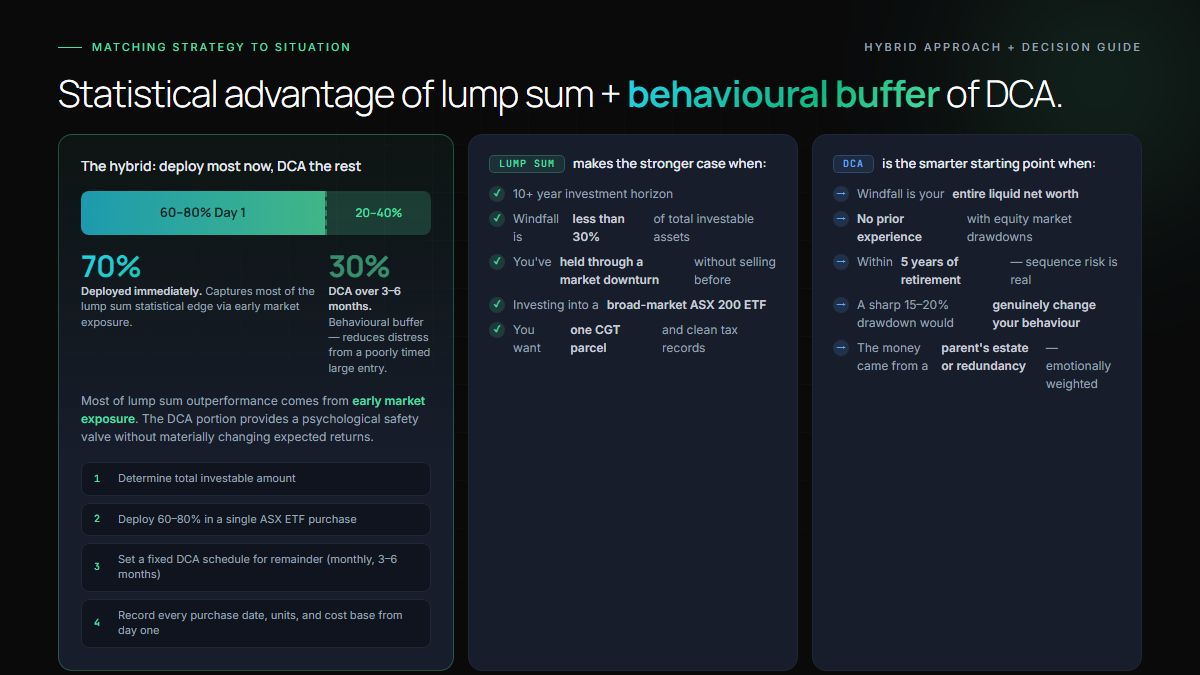
Lump sum makes the stronger case when:
- You have a 10-plus-year time horizon
- The windfall represents less than 30% of your total investable assets
- You’ve experienced previous market downturns without selling
- You’re investing into a broad-market ASX 200 ETF
DCA is the more sensible starting point when:
- The windfall is your entire liquid net worth
- You have no prior experience with equity market drawdowns
- You’re within five years of retirement and sequence risk is a genuine concern
A Hybrid Approach
A practical middle ground: invest 60 to 80% as a lump sum immediately and DCA the remaining 20 to 40% over three to six months. This captures most of the statistical advantage of lump sum investing while reducing the psychological risk of a poorly timed large entry.
The majority of lump sum outperformance comes from early market exposure. The DCA portion provides a behavioural buffer without materially changing expected returns.
Practical steps to implement:
- Determine your total investable amount
- Allocate 60–80% to an immediate lump sum purchase
- Set a fixed DCA schedule for the remainder over 3–6 months
- Record each purchase date, quantity, and cost base from day one
- Use a dedicated portfolio tracker to monitor your CGT position ahead of 30 June
Crowdfolio is built for exactly this use case, letting Australian DIY investors track multiple ASX parcels, monitor cost bases across DCA entries, and stay on top of their CGT position.
Frequently asked questions
Is lump sum or DCA better for the ASX?
Lump sum investing outperforms DCA in approximately two-thirds of historical periods, based on Vanguard research. The primary reason is the ASX’s long-term upward bias. DCA performs better only when the market falls significantly shortly after the lump sum would have been deployed.
How does DCA affect my CGT obligations?
Each DCA purchase creates a separate CGT asset parcel with its own acquisition date and cost base. The 50% CGT discount applies per parcel after 12 months from each respective purchase date, creating staggered eligibility and increased record-keeping obligations.
Should I invest a lump sum inheritance all at once?
If the inheritance represents a large share of your net worth or you have limited experience with market volatility, a hybrid approach — deploying 70% immediately and DCA-ing the rest over three to six months — balances the statistical case for lump sum investing against behavioural risk.
How do I track cost base for multiple DCA parcels?
Record the date, number of units, unit price, and total cost including brokerage for every purchase. Maintain these records for at least five years after the financial year in which you sell. A portfolio tracking tool that stores parcel-level data reduces the risk of errors in your CGT calculations.