
What is a margin loan in Australia?
LVR, Collateral, and Approved Securities
This guide to leverage investing in Australia compares margin loans, geared ETFs, and home equity loans, detailing LVR limits, margin call risks, tax deductibility under Section 8-1, and suitability criteria. The optimal approach depends on income stability, investment horizon, risk tolerance, and ability to maintain LVR buffers without forced selling.
Lenders assign individual lend ratios to each approved security — typically between 30% and 75% of that security’s market value. Broad ASX ETFs attract ratios toward the higher end. Smaller or more volatile stocks attract lower ratios, sometimes as low as 30%.
Your portfolio secures the loan. The lender holds a charge over those securities and has the legal right to sell your holdings if your LVR breaches their maximum threshold.
Leverage in Action: A Worked Example
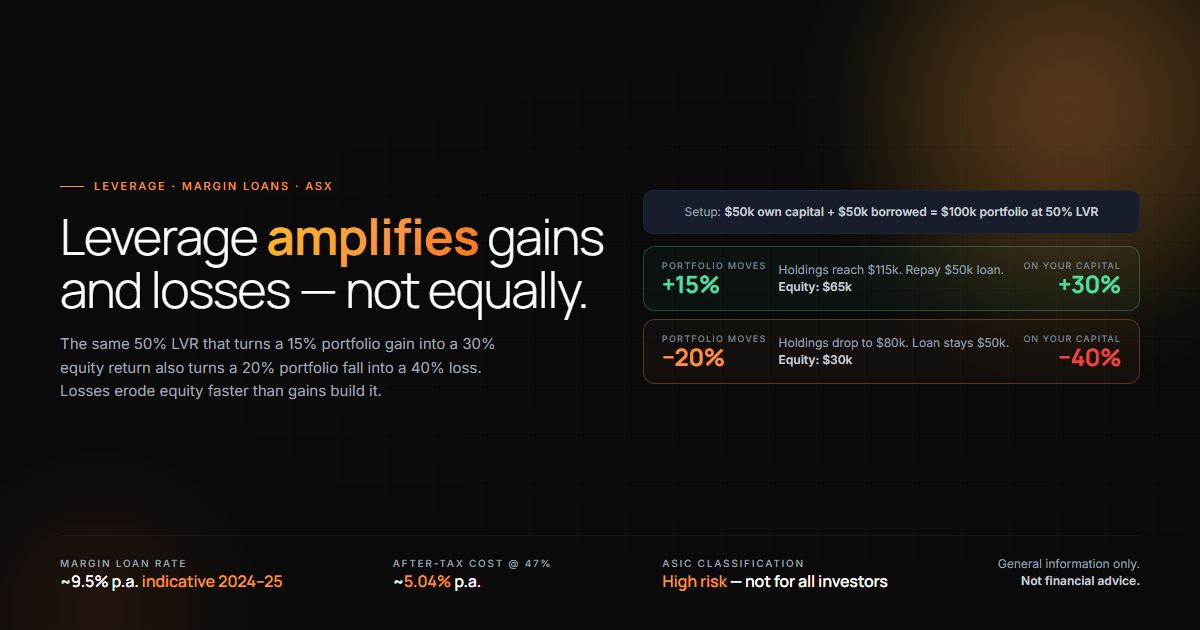
Suppose you invest $50,000 of your own capital and borrow a further $50,000, giving you $100,000 in ASX shares at a 50% LVR.
- 15% portfolio rise: Holdings reach $115,000. Repay the $50,000 loan and your equity is $65,000 — a 30% return on your original $50,000.
- 20% portfolio fall: Holdings drop to $80,000. Your loan stays at $50,000, leaving you with $30,000 equity — a 40% loss on contributed capital.
Losses erode equity faster than gains build it, and the higher your LVR, the faster that erosion occurs.
Margin loan vs home loan for investing
The Trigger Mechanism
A margin call is triggered when your portfolio’s LVR rises above the lender’s maximum permitted threshold following a market decline. Most lenders set a call LVR slightly above the standard maximum — but the gap between these figures is narrow and offers less protection than most investors assume.
Using the $100,000 portfolio example at 50% LVR: a 25% ASX drawdown drops your portfolio to $75,000. Your loan stays at $50,000. Your LVR is now 66.7%. If the lender’s maximum is 65%, you are in margin call territory — often with a 24-hour deadline to respond.
Forced Selling at the Worst Possible Time
You have three standard responses: inject cash, sell holdings, or transfer additional approved securities into the account. Each option is painful when markets are falling sharply and time is short.
Forced selling also carries a significant CGT consequence. Selling shares held for less than 12 months forfeits the 50% CGT discount available to Australian individuals and trusts. Your entire capital gain is taxed at your full marginal rate, compounding an already damaging market loss.
ATO Tax Rules: Is Margin Loan Interest Tax Deductible?
The Income-Producing Purpose Test
Under Section 8-1 of the Income Tax Assessment Act 1997, interest on money borrowed to buy income-producing investments is ordinarily deductible. The critical requirement is the income-producing purpose test — your loan must be directed toward acquiring assets expected to generate assessable income such as dividends and distributions, not purely capital growth.
Negative Gearing: Shares vs Property
Here is the insight most Australian investors miss: negatively geared share portfolios and negatively geared investment properties receive identical ATO treatment under Section 8-1. The tax law does not favour one asset class over the other.
The practical risk differences are significant. Property cannot be margin called, has a rental income floor, and is far less liquid. Shares can be force-sold within hours of a lender issuing a notice. The cultural stigma attached to leveraged shares — shaped largely by GFC margin call stories — is not matched by any structural tax disadvantage.
Franking Credits and the Gearing Equation
Franked dividends add another dimension. On a $100,000 portfolio, a 4% dividend yield generates $4,000 in dividends. At 70% franking, you receive approximately $1,200 in franking credits. If your marginal tax rate is 47%, those credits offset tax you would otherwise owe, effectively reducing your after-tax interest burden.
The Break-Even Maths
Calculating the After-Tax Borrowing Cost
Worked example: a high-income earner on the 47% marginal rate (Medicare levy included).
- Gross margin loan rate: 9.5% per annum (indicative 2024–25 market rate)
- After-tax interest cost: 9.5% × (1 − 0.47) = 5.04% per annum
- Estimated dividend yield (diversified ASX portfolio): 4.0%
- Required capital growth to break even: approximately 1.04% per annum
That looks achievable at first glance. But it assumes dividends are fully assessable, no margin call forces early loss crystallisation, and rates stay put — none of which is guaranteed.
How Rising RBA Rates Have Shifted the Equation
Before the RBA started hiking in May 2022, margin loans came in under 5% at plenty of providers. By 2024–25 indicative rates had pushed past 9%, effectively eating the spread between your borrowing cost and what the ASX might return. Any honest leverage plan has to assume rates stay high or climb further.
How to avoid margin calls in Australia
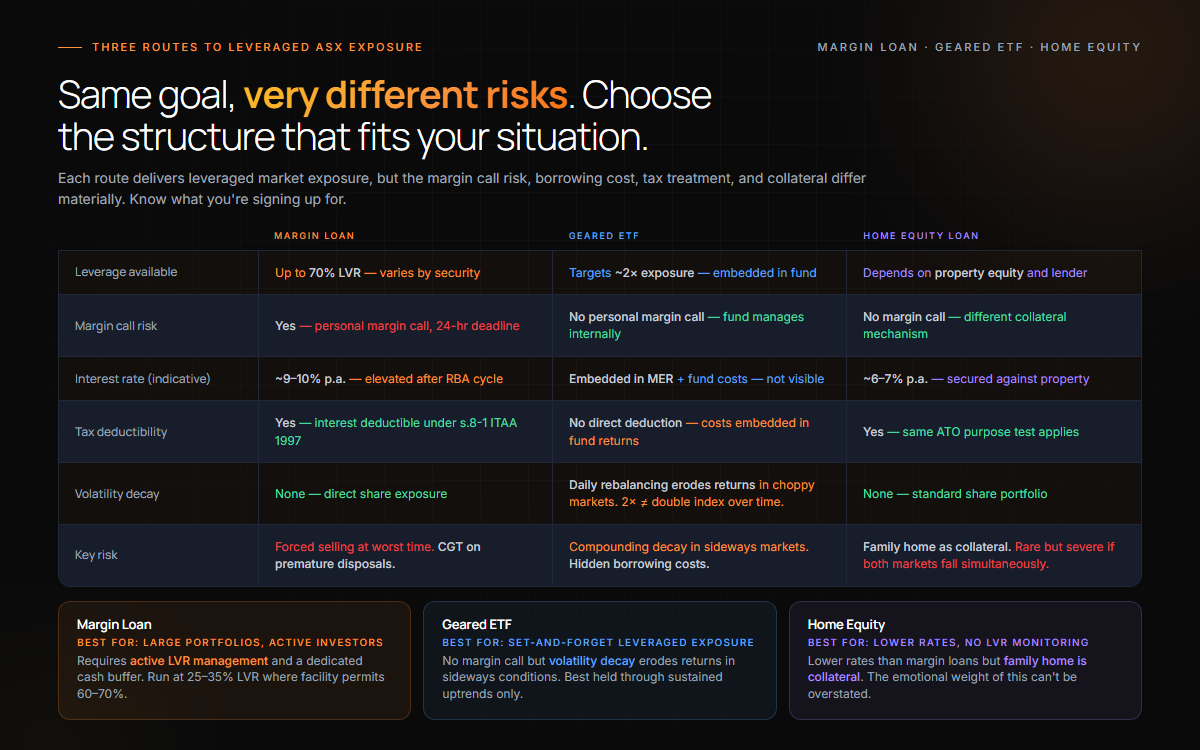
| Feature | Margin Loan | Geared ETF | Home Equity Loan |
|---|---|---|---|
| How leverage is applied | Investor borrows directly | Embedded within the fund | Draws against residential property |
| Effective LVR available | Up to 70% (varies by security) | Typically targets ~2× exposure | Varies by lender and property equity |
| Margin call risk | Yes — personal margin call | No personal margin call | No — different security |
| Interest rate (indicative) | ~9–10% p.a. | Embedded in MER and fund costs | ~6–7% p.a. |
| Tax deductibility of interest | Yes — subject to purpose test | No direct deduction | Yes — subject to same ATO rules |
| Key risks | Forced selling, LVR management | Volatility decay, embedded costs | Family home at risk |
Geared ETFs: Embedded Leverage Without a Margin Call
A geared ETF targeting approximately 2× exposure to a broad ASX index delivers leveraged market exposure internally, with no personal margin call risk. The trade-off is volatility decay — in choppy markets, a 2× geared fund does not simply double the index return over time. Daily rebalancing erodes returns during sideways conditions, and this effect compounds over long holding periods.
Home Equity Loans: Lower Rates, Different Risk
Drawing against home equity eliminates the margin call mechanism and typically offers lower rates than margin loan products. The trade-off is different collateral — your family home secures the loan. A severe simultaneous fall in both residential property values and ASX shares is historically rare but not impossible, and carries emotional weight a spreadsheet doesn’t fully capture.
Who Is (and Is Not) Suited to a Margin Loan
Conditions That Must Align
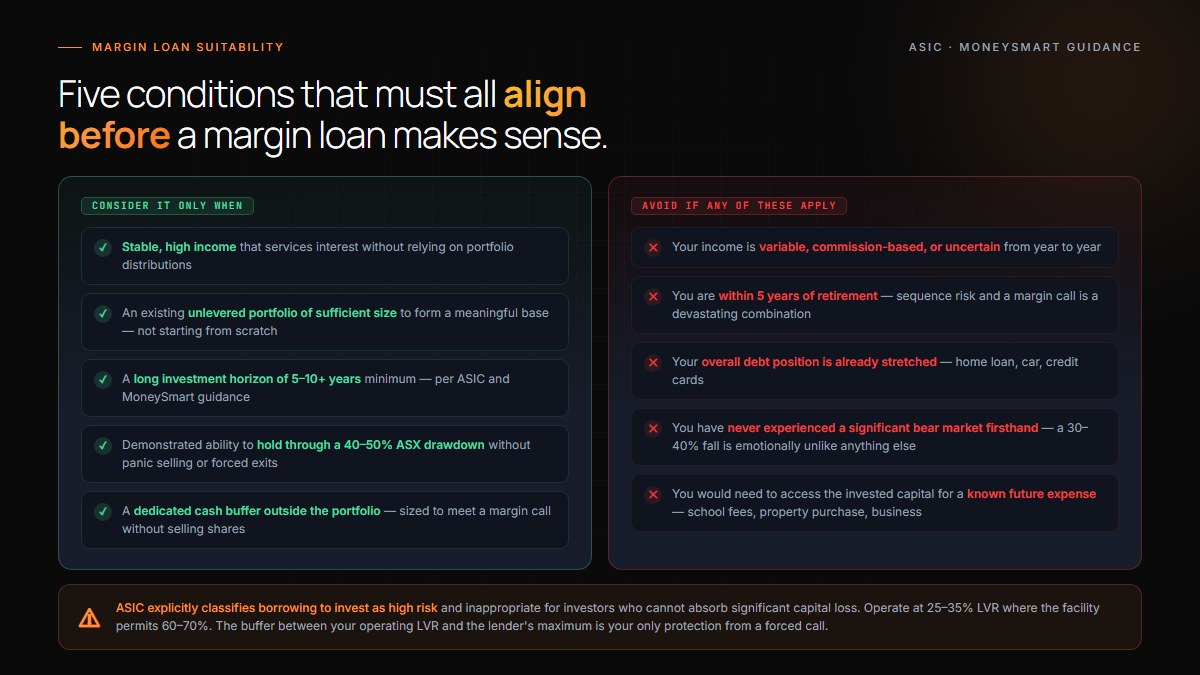
A margin loan only warrants a look when several conditions line up at once.
- Stable, high income that services interest without relying on portfolio distributions
- An existing unlevered portfolio of sufficient size to form a meaningful base
- A long investment horizon of at least five to ten years, as referenced by ASIC and MoneySmart
- Demonstrated ability to hold through a 40%–50% ASX drawdown without panic selling
- A cash buffer outside the portfolio to meet margin calls without forced selling
ASIC explicitly calls borrowing to invest high risk and unsuitable for anyone who can’t absorb a significant capital loss.
Who Should Not Use a Margin Loan
Avoid a margin loan if any of the following apply:
- Your income is variable or uncertain
- You are within five years of retirement
- Your overall debt position is already stretched
- You have not experienced a significant bear market firsthand
- You would need to access the invested capital for a known future expense
Practical Risk Controls for Those Who Proceed
Operate at a materially lower LVR than the lender’s permitted maximum. Running at 25%–35% LVR where the facility permits 60%–70% creates a meaningful buffer before a call is triggered.
Maintain a dedicated cash buffer outside the margin loan account to meet potential calls without forced selling. Review your LVR regularly — particularly during periods of elevated ASX volatility — and set a pre-committed rule for when you will proactively deleverage rather than waiting for a call.
Frequently asked questions
How does a margin loan work in Australia, and what LVR is considered safe?
A margin loan lets you borrow against your existing share portfolio to buy more ASX shares or ETFs. Approved securities carry individual lend ratios of roughly 30%–75%. A safe operating LVR sits materially below the lender’s maximum — aim for 25%–35% where the facility permits 60%–70%.
Is margin loan interest tax deductible under ATO rules?
Yes, generally. Under Section 8-1 of the ITAA 1997, interest on money borrowed to acquire income-producing investments is deductible, provided the purpose is to generate assessable income — dividends and distributions — not capital growth alone. Keep five years of loan statements and investment records per ATO requirements.
What happens during a margin call, and how do I avoid one?
A margin call is triggered when your LVR breaches the lender’s maximum after a market decline. Your three options are: inject cash, sell holdings, or transfer additional approved securities. The most important preventive measure is maintaining a meaningful LVR buffer combined with a separate cash reserve you can deploy without selling shares.
Should I use a margin loan or a geared ETF for leveraged ASX exposure?
A margin loan gives you direct control and full tax deductibility of interest but requires active LVR management and carries personal margin call risk. A geared ETF eliminates personal margin call risk but introduces volatility decay and embeds borrowing costs within the fund’s MER. Your choice depends on your portfolio size, income, and appetite for active management.