
What is the ASFA comfortable retirement standard?
Modest vs. Comfortable: What Do These Numbers Actually Mean?
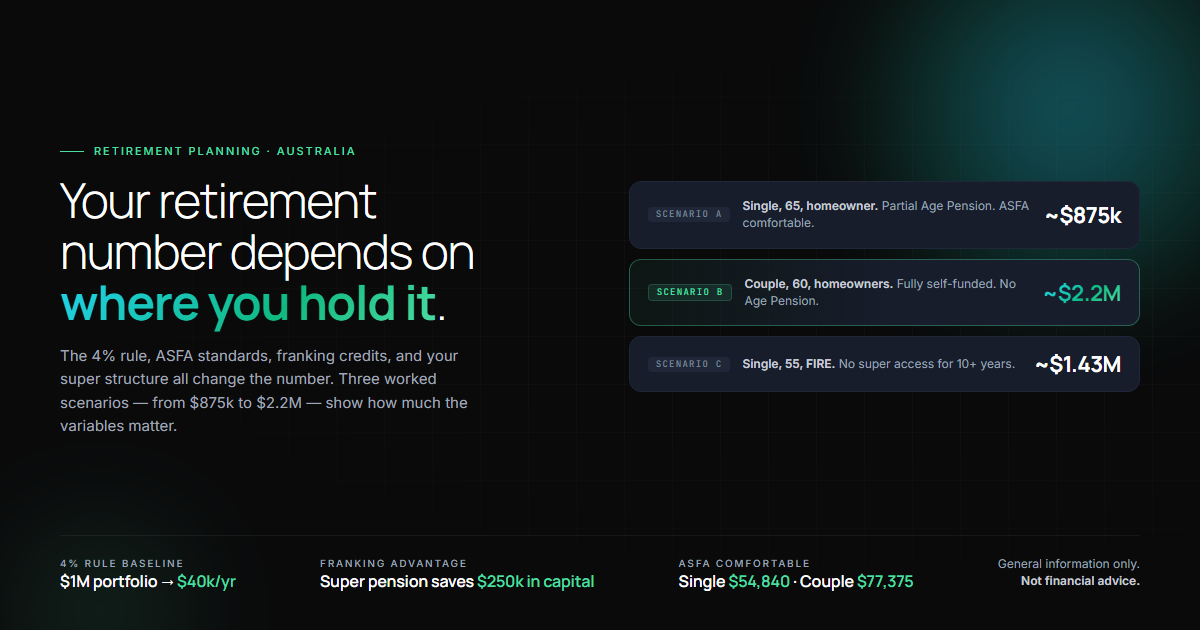
Your retirement number in Australia depends on five variables: target income, Age Pension entitlement, retirement age, portfolio structure, and withdrawal rate. Worked scenarios show a single homeowner with partial Age Pension needs ~$875,000, a self-funded couple ~$2.21 million, and a FIRE single ~$1.43 million.
| Lifestyle | Single (per year) | Couple (per year) |
|---|---|---|
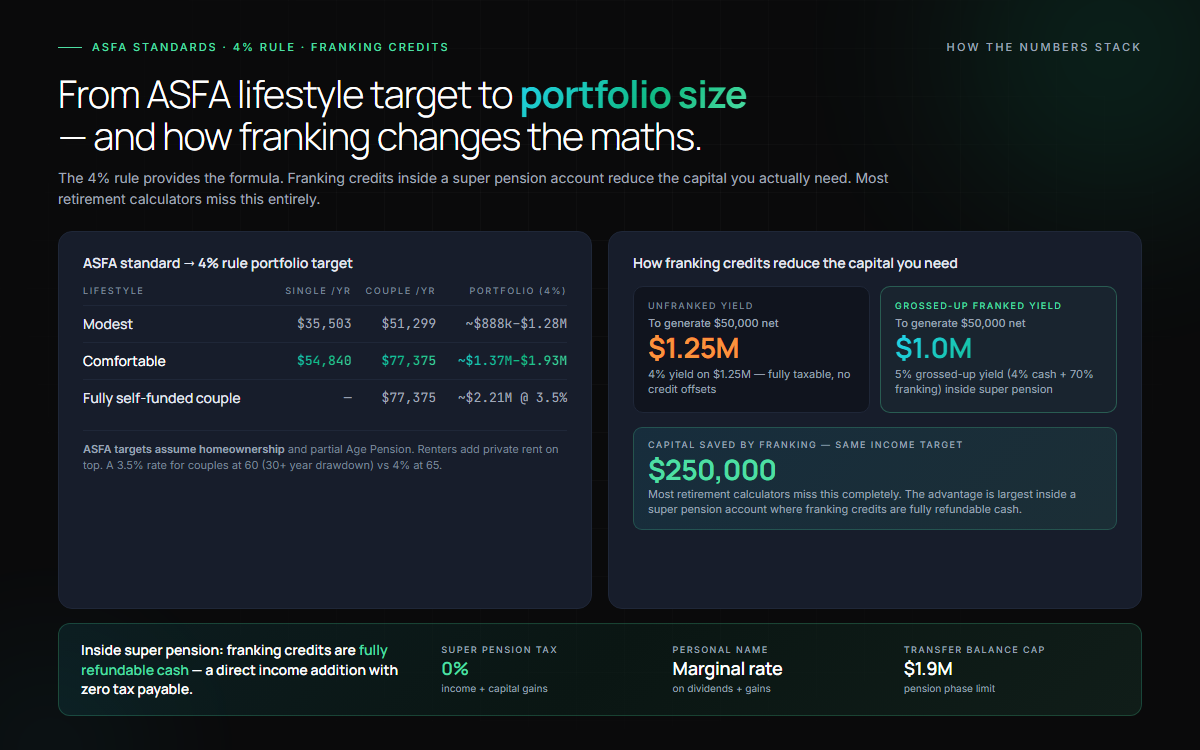
| Modest | $35,503 | $51,299 |
| Comfortable | $54,840 | $77,375 |
Both tiers assume you own your home outright. Renters need to add private rent costs on top, adding tens of thousands to the annual income requirement.
Why ASFA’s Numbers Are a Floor, Not a Ceiling
ASFA’s lump sum targets — $630,000 for a single and $730,000 for a couple at age 67 — assume partial Age Pension support. A fully self-funded retiree needs a substantially larger portfolio to generate the same income. These figures are in today’s dollars, so your nominal target needs to be higher once inflation is factored in.
Step 2: Apply the 4% Rule to an ASX Share Portfolio
How the 4% Safe Withdrawal Rate Works
The 4% rule states that withdrawing 4% of your portfolio in year one, then adjusting for inflation annually, gives a high probability of the portfolio lasting 30 years.
Annual Income Needed ÷ 0.04 = Required Portfolio Size
| Annual Income Target | Required Portfolio (4% rule) |
|---|---|
| $40,000 | $1,000,000 |
| $55,000 | $1,375,000 |
| $77,375 | $1,934,375 |
Does the 4% Rule Hold Up on the ASX?
The ASX has delivered approximately 13% p.a. in total returns since 1980, which comfortably supports a 4% withdrawal rate over the long term. For early retirees facing a 35–40 year drawdown period, some Australian planners recommend a more conservative 3.5% or 3% rate. The rule also assumes a diversified portfolio — a concentrated position in a handful of ASX shares introduces stock-specific risk that undermines historical return assumptions.
Worked Example: A Couple Targeting Comfortable Retirement
A couple, both homeowners, targeting ASFA comfortable at $77,375 per year with no Age Pension reliance need approximately $1.93 million at a 4% withdrawal rate. ASFA’s suggested super balance for a couple is $730,000 — the gap between these figures is the income the Age Pension fills.
How does capital gains tax affect retirement income?
The Mechanics of Dividend Imputation for Retirees
Franking credits are tax credits attached to dividends paid by Australian companies that have already paid 30% corporate tax. A 4% cash dividend with 70% franking translates to a grossed-up yield of approximately 4.7% to 5% — an advantage the 4% rule entirely ignores.
Inside a super pension account in retirement phase, the fund pays zero tax on income and capital gains. Franking credit refunds flow directly back into the fund as cash.
Franking Credits Inside Super vs. Outside Super
| Structure | Tax on Dividends | Franking Credit Treatment |
|---|---|---|
| Super pension (retirement phase) | Zero | Fully refundable cash to the fund |
| Personal name | Marginal rate | Offsets tax; excess refundable if tax liability allows |
For a $1,000,000 portfolio generating a 4% cash dividend with 70% franking, grossed-up income is approximately $47,000. Inside a super pension account, the full $47,000 is yours. In a personal name at a 19% marginal rate, the net outcome is meaningfully lower.
How Much Capital Do Franking Credits Save You?
To generate $50,000 net income, an unfranked yield of 4% requires $1,250,000 in capital. A grossed-up yield of 5% (including franking) inside super reduces that to $1,000,000 — a $250,000 difference most retirement calculators miss entirely.
Step 4: Super vs. Direct Shares — Which Structure Gets You There Faster?
The Tax Advantages of Holding Shares Inside Super
Earnings inside super are taxed at 15% in accumulation phase. From age 60, income and capital gains in retirement (pension) phase are tax-free. The Transfer Balance Cap of $1.9 million limits how much you transfer into pension phase, which matters for larger portfolios. An SMSF gives you direct ASX share exposure inside a super structure, combining tax efficiency with DIY control.
Shares Outside Super: CGT, Marginal Rates, and the 50% Discount
Dividends on shares held in your personal name are taxed at your marginal rate. Capital gains on shares held for 12 months or more attract the 50% CGT discount for individuals. Strategic parcel selection and timing sales across financial years reduce CGT leakage — especially relevant for early retirees who cannot yet access super.
Using Both Pillars Together
Combining a super pension account with a personally held share portfolio creates a two-tier income stream. Average super balances for Australians aged 60–64 sit at approximately $413,600 for men and $319,200 for women — well below ASFA’s comfortable threshold. A direct share portfolio outside super fills that gap.
Step 5: The Age Pension — Friend or Fallback?
How the Assets Test Affects Share Portfolio Investors
The Age Pension assets test applies a taper rate: for every $1,000 in assets above the full pension threshold, the fortnightly pension reduces by $3. For a homeowner couple, the full pension threshold is approximately $470,000 in assets. A couple with $800,000 in shares and $730,000 in super holds $1,530,000 in total assessed assets — well into part pension territory, with a smaller but still meaningful top-up payment.
Planning Around Age Pension Entitlements
Targeting partial Age Pension eligibility reduces your self-funded portfolio requirement. A couple receiving $500 per fortnight in part pension gets approximately $13,000 per year from the government, reducing the portfolio drawdown needed. Age Pension rates and thresholds are indexed and subject to policy change, so plan conservatively.
How much do I need to retire in Australia?
Longer Drawdown Periods Demand a Larger Portfolio
| Retirement Age | Drawdown Period | Suggested Withdrawal Rate |
|---|---|---|
| 55 | 35–40 years | 3.0–3.5% |
| 60 | 30–35 years | 3.5% |
| 65 | 25–30 years | 4.0% |
Early retirees under preservation age cannot access super, making a personally held share portfolio the primary income source in those first years.
FIRE in an Australian Context
Lean FIRE targets a frugal lifestyle on minimal spending. Coast FIRE means you have enough invested that compound growth reaches your target without further contributions. Barista FIRE combines a small share income with part-time work.
A Lean FIRE example: single person, $40,000 annual target, 4% rule — requires a $1,000,000 portfolio. FIRE calculations must account for decades of inflation, healthcare cost escalation, and the fact that the Age Pension won’t be accessible for 10–20 years.
Step 7: Sequence-of-Returns Risk — The Threat Most Calculators Miss
A portfolio that suffers heavy losses in its first few years of retirement runs out of money significantly earlier than one with the same average return but better-timed gains. The GFC and COVID-19 both produced sharp early drawdowns for ASX investors. This risk is most acute in the first five to seven years of retirement.
Practical Strategies to Protect Your Portfolio
- Cash buffer: hold one to two years of living expenses in a high-interest savings account to avoid selling shares at depressed prices.
- Bucket strategy: segment your portfolio into short-term cash, medium-term defensive equities, and long-term growth ASX shares and ETFs.
- Flexible withdrawals: reduce your drawdown rate temporarily during market downturns rather than selling at the trough.
What is the best retirement number for Australian investors?
The Five Variables That Determine Your Number
- Target annual income — ASFA comfortable, modest, or your own lifestyle figure
- Expected Age Pension entitlement — full, part, or none based on projected assets
- Retirement age and drawdown period — determines which withdrawal rate to apply
- Portfolio structure — super pension, personal name, or both, and the after-tax yield each produces
- Withdrawal rate assumption — 3%, 3.5%, or 4% depending on your retirement horizon
Three Worked Scenarios
| Scenario | Profile | Annual Target | Portfolio Target |
|---|---|---|---|
| A | Single, age 65, homeowner, partial Age Pension | $54,840 | ~$875,000 |
| B | Couple, age 60, homeowners, fully self-funded | $77,375 | ~$2,210,000 |
| C | Single, age 55, FIRE, no Age Pension for 10+ years | $50,000 | ~$1,430,000 |
Scenario A assumes approximately $20,000 in part Age Pension, reducing required drawdown to ~$35,000 at a 4% rate. Scenario B applies a 3.5% rate given the 30+ year drawdown period. Scenario C applies a 3.5% rate and no Age Pension for the first decade.
Frequently asked questions
Can I retire on $1 million in shares in Australia?
At a 4% withdrawal rate, $1,000,000 generates approximately $40,000 per year before tax. For a single homeowner with partial Age Pension eligibility, this approaches ASFA modest standard. Franking credits and super pension structure improve the after-tax outcome meaningfully.
How long will $500,000 in shares last in retirement?
At a 4% withdrawal rate, $500,000 generates $20,000 per year. Combined with a part Age Pension of approximately $15,000 to $20,000 per year and portfolio growth, $500,000 stretches significantly further than a simple division suggests. The key variable is portfolio growth relative to withdrawals.
Do franking credits count as income in retirement?
Yes. Franking credits are included in your assessable income but generate an equivalent tax offset. Inside a super pension account in retirement phase, franking credits are fully refundable cash with no tax payable — a direct income addition.
Is it better to hold shares inside super or outside super for retirement?
Inside a super pension account from age 60, income and capital gains are tax-free, subject to the Transfer Balance Cap. Outside super, dividends are taxed at your marginal rate, though the 50% CGT discount applies to shares held longer than 12 months. Most retirees benefit from maximising super pension phase first, then supplementing with a personally held portfolio.
Tracking Your Progress
Knowing your retirement number is only useful if you track progress toward it. Tools that show your total portfolio value, dividend yield, franking credit income, and unrealised capital gains give you an accurate picture of where you stand. Crowdfolio is built for Australian DIY investors who hold ASX shares, ETFs, and LICs and want to see all of that data in one place — including how your current portfolio maps against your retirement income target.