
How much cash should I keep in my portfolio in Australia?
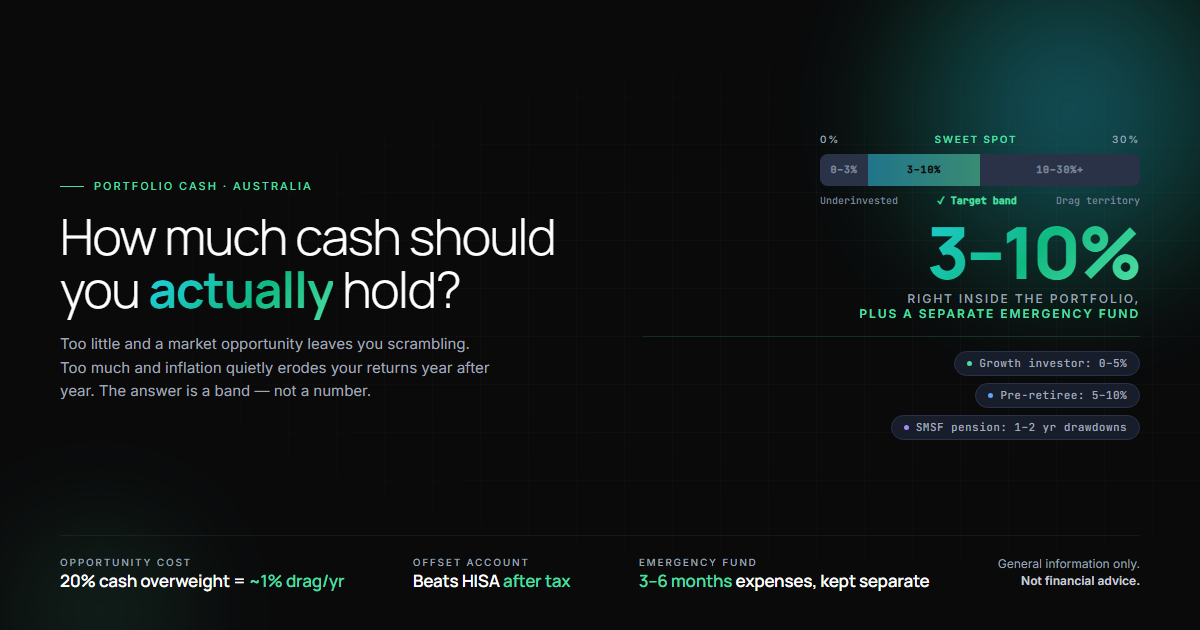
For an Australian portfolio, most DIY investors should hold 3–10% inside the portfolio plus a separate emergency fund of three to six months’ expenses. Growth investors in their 20s–30s target 0–5%, pre-retirees 5–10%, and SMSF pension members need one to two years of drawdowns. Professional ASX growth options hold 3–5%, balanced options 5–9%.
Hold too little and a sudden job loss or market opportunity leaves you scrambling. Hold too much and you quietly bleed returns year after year while inflation chips away at purchasing power. The answer is not a single number. It is a framework built around your life stage, tax position, and a clear separation between different types of cash.
Your emergency fund and your investment cash serve completely different purposes. One protects your life. The other funds your investment strategy. Mixing them creates a situation where a broken car or an unexpected medical bill forces you to sell shares at the worst possible moment.
The standard starting point is three to six months of living expenses held in a liquid, accessible account outside your portfolio entirely. This is not dry powder. It is a safety net for income disruption, urgent repairs, or health events.
When investors treat their emergency fund as investment cash, they tend to under-invest when markets are calm and panic-sell when life intervenes. These two buckets need separate accounts, separate mental labels, and separate rules.
What Professional Australian Portfolios Actually Hold
ASX data shows diversified growth options typically hold around 3–5% in cash, while balanced options sit closer to 5–9%. These are not arbitrary numbers. They reflect the liquidity needs of professionally managed, multi-asset portfolios.
As a portfolio takes on more defensive assets, the need for a separate cash buffer shrinks because bonds and fixed income already provide stability. A growth-oriented DIY investor sits closer to the 3–5% range. A more defensive investor in their 50s might target the higher end.
These bands give you an anchor. If your portfolio is sitting at 20% cash, you are materially outside what professional managers consider appropriate for almost any risk profile. If you are at 3%, you are operating within the range used by growth-oriented institutional portfolios.
What percentage of portfolio should be cash?
Vanguard Australia is direct on this point: holding too much cash risks underperforming your long-term goals. Cash earns a fixed rate. Equities compound over time through price growth, dividends, and reinvestment.
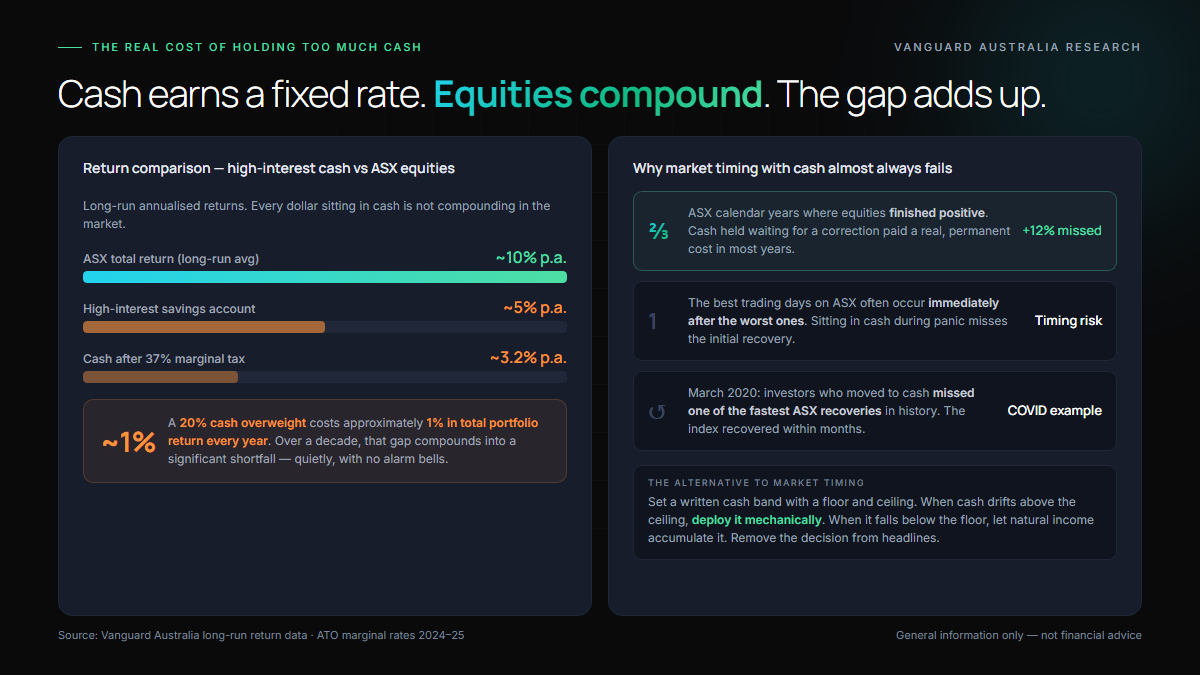
At a high-interest savings rate of 5% AUD and an ASX long-run total return of roughly 10% per annum, a 20% cash overweight costs you approximately 1% in total portfolio return every year. Over a decade, that gap compounds into a significant shortfall.
Investors who moved heavily into cash in March 2020 and waited for a “better entry point” missed one of the fastest recoveries in ASX history. The index recovered its losses within months. Waiting for a crash to pass before reinvesting sounds logical but consistently underperforms staying invested.
Tax Implications Australian Investors Cannot Ignore
Cash held in a high-interest savings account or term deposit generates interest taxed at your full marginal rate every financial year. A fully franked ASX dividend comes with attached franking credits that offset your ATO tax liability. For an investor on a 37% marginal rate, a 4% fully franked dividend yield is worth considerably more after tax than a 5% cash rate.
Moving into cash is not tax-neutral. Selling shares crystallises a capital gain or loss in the financial year the sale settles. If you held those shares for more than 12 months, you access the 50% CGT discount as an individual or trust, halving the taxable portion of the gain. Sell before 12 months and the full gain is taxable at your marginal rate. Frequent rotation between cash and shares generates short-term gains with no discount at all.
For investors with a home loan, the mortgage offset account is often the most tax-effective place to park idle cash. Interest saved on a mortgage is not taxable income. A 6.5% home loan offset is equivalent to a 6.5% pre-tax return with no ATO reporting required.
Does cash drag hurt returns in Australia?
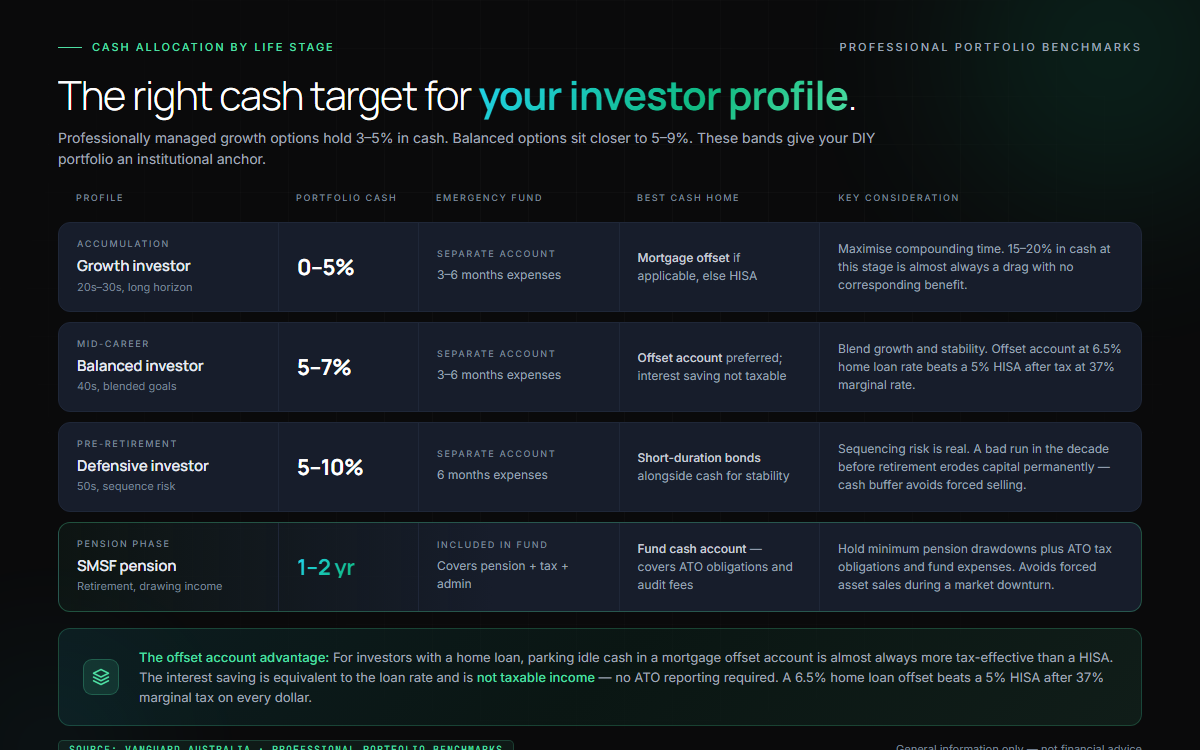
Accumulation phase (20s and 30s): A growth-focused investor in their 30s has time on their side. A target cash band of 0–5% inside the portfolio, plus a separate emergency fund, is appropriate. Keeping 15–20% in cash at this stage is almost always a drag with no corresponding benefit.
Pre-retirement (50s): Sequencing risk becomes real in the decade before retirement. A bad run of returns while you are still drawing down erodes capital permanently. A cash allocation of 5–10% alongside short-duration defensive assets gives a buffer without sacrificing too much growth.
SMSF members in pension phase: Members in pension phase generally need one to two years of minimum pension drawdowns held in cash or very low-risk assets. This avoids forced selling of growth assets during a downturn and covers ATO tax obligations, audit fees, and administration costs without disrupting the investment portfolio.
How do ATO rules affect cash holdings?
| Investor Profile | Portfolio Cash Target | Emergency Fund | Key Consideration |
|---|---|---|---|
| Growth investor (20s–30s) | 0–5% | 3–6 months expenses | Maximise compounding time |
| Balanced investor (40s) | 5–7% | 3–6 months expenses | Blend of growth and stability |
| Pre-retiree (50s) | 5–10% | 6 months expenses | Manage sequencing risk |
| SMSF pension phase | 1–2 years drawdowns | Included in fund cash | Cover ATO obligations and expenses |
When should I deploy cash in ASX market?
Global research consistently shows equities rise in roughly two-thirds of calendar years. If you hold cash waiting for a correction in a year the market finishes up 12%, you have paid a real and permanent cost.
The best trading days on the ASX often occur immediately after the worst ones. An investor sitting in cash during a market panic misses the initial recovery days, which account for a disproportionate share of long-term returns. Missing even a small number of the top trading days each decade substantially reduces your ending balance.
The alternative to market timing is mechanical rebalancing. When your cash allocation drifts above your ceiling, deploy it. When it falls below your floor, let natural income accumulate it. This removes the decision from headlines and puts it back into your written investment plan.
Setting Your Personal Cash Band and Sticking to It
Your cash floor is the minimum you need for liquidity and psychological comfort. Your ceiling is the point at which idle cash becomes a measurable drag. A range of 3–10% covers most investor profiles, with the right point inside that range determined by your life stage and risk tolerance.
A target band only works if it is written down and reviewed regularly. Write it into your investment plan alongside your asset allocation targets. Crowdfolio lets Australian DIY investors track their actual cash percentage across their full portfolio and compare it against their target allocation in real time.
There are legitimate reasons to hold more cash temporarily: an upcoming property purchase, a planned business investment, or a known large expense within 12 months. These are life events, not market calls. Move outside your band for a defined purpose with a defined timeline, not because you read a headline about a recession.
Frequently asked questions
How much cash should I keep in my investment portfolio in Australia?
For most DIY investors, a cash allocation of 3–10% inside the portfolio is appropriate, plus a separate emergency fund of three to six months of living expenses. Younger growth-focused investors sit toward the lower end. Pre-retirees and more defensive investors sit toward the higher end.
Is it better to put spare cash in an offset account or a high-interest savings account?
For investors with a home loan, the offset account almost always wins on an after-tax basis. The interest saving is equivalent to the loan rate and is not taxable income. A high-interest savings account generates fully taxable interest at your marginal rate.
Does moving into cash trigger a tax event with the ATO?
Yes. Selling shares to raise cash is a disposal for CGT purposes. The gain or loss is assessed in the financial year of settlement. If you held the shares for more than 12 months, the 50% CGT discount applies to net gains for individuals and eligible trusts.
How much cash should an SMSF hold in pension phase?
Most SMSF advisers recommend holding one to two years of minimum pension drawdowns in cash or short-duration defensive assets. This covers pension payments, ATO tax obligations, and fund expenses without requiring forced asset sales during a market downturn.