
How many ASX stocks should I own for diversification?
Effective portfolio diversification in Australia requires 15–25 ASX stocks across diverse sectors — not just count — plus international exposure via ETFs like VGS to counter home bias, since the ASX 200 is heavily weighted toward financials and materials. Research shows this range eliminates most unsystematic risk while avoiding diworsification and excessive tax complexity.
Evans and Archer demonstrated in 1968 that most unsystematic risk — company-specific issues like a CEO scandal or earnings miss — is eliminated by holding around 15 to 20 stocks. Systematic risk is market-wide: recessions, interest rate rises, global shocks. No amount of stock-picking removes it.
The risk-reduction benefit follows a curve. Going from 1 stock to 5 delivers a significant drop in volatility. Going from 5 to 15 delivers more. Beyond 20 to 30 stocks, each addition creates administrative complexity for negligible diversification gain.
Peter Lynch coined “diworsification” to describe what happens when you keep adding stocks past the point of benefit. Your best ideas get diluted by mediocre ones, returns converge toward the index average, and your tax and admin burden grows.
If you have ever stared at your ASX holdings and wondered whether you own too many stocks or not enough, you are not alone. Portfolio construction is one of the most searched questions among Australian DIY investors, and the answer is rarely a clean number. It depends on your capital, your time, your tax situation, and — critically — which stocks you are buying.
Research points to a practical sweet spot of 15 to 25 ASX stocks for most individual investors. But on the ASX, hitting that number is only half the job. The other half is making sure those stocks are not all doing the same thing.
How does Modern Portfolio Theory apply to ASX investing?
Sector Concentration
The S&P/ASX 200 is heavily skewed toward financials and materials, which together account for a disproportionate share of total index weight.
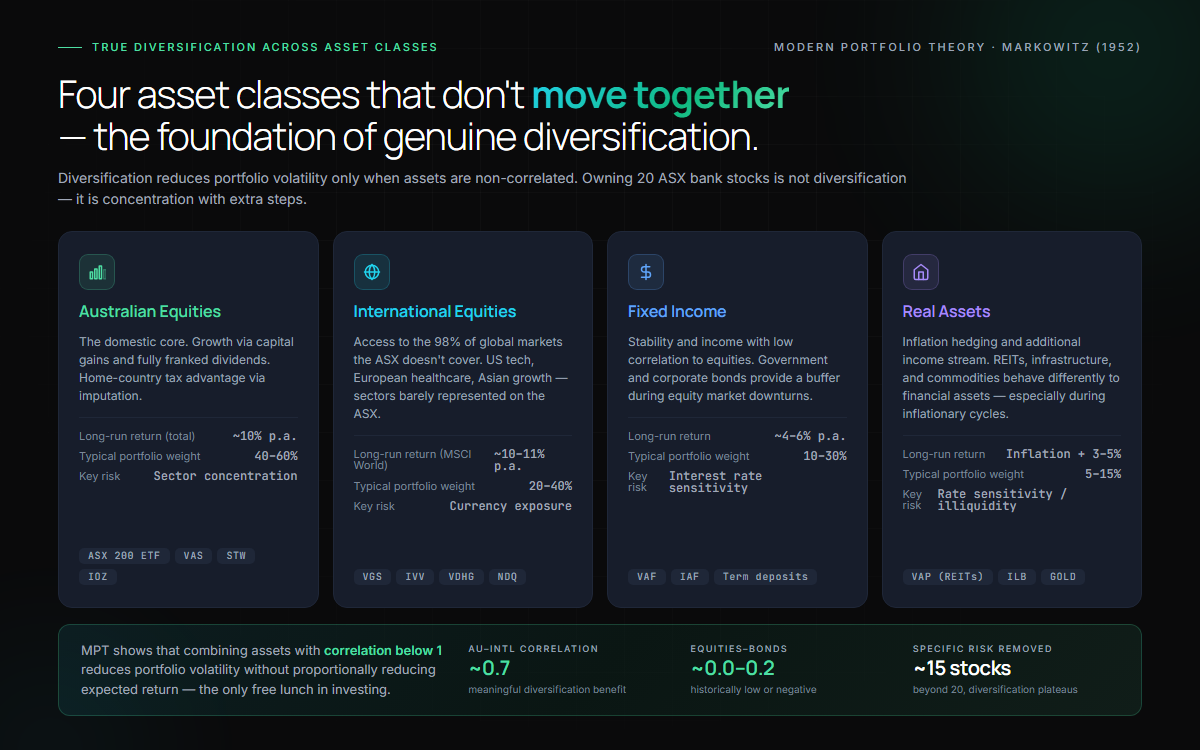
An investor who buys 20 ASX stocks by following popular names or chasing dividend yield can easily end up with 60 to 70% exposure to these two sectors. That portfolio looks diversified by stock count. In practice, it moves almost in lockstep because the same macro drivers — iron ore prices, the RBA cash rate — are steering most of those holdings.
Sectors systematically underrepresented in typical ASX portfolios include healthcare, consumer staples, consumer discretionary, industrials, technology, and real estate (A-REITs). True diversification requires deliberately including these areas.
Home Bias
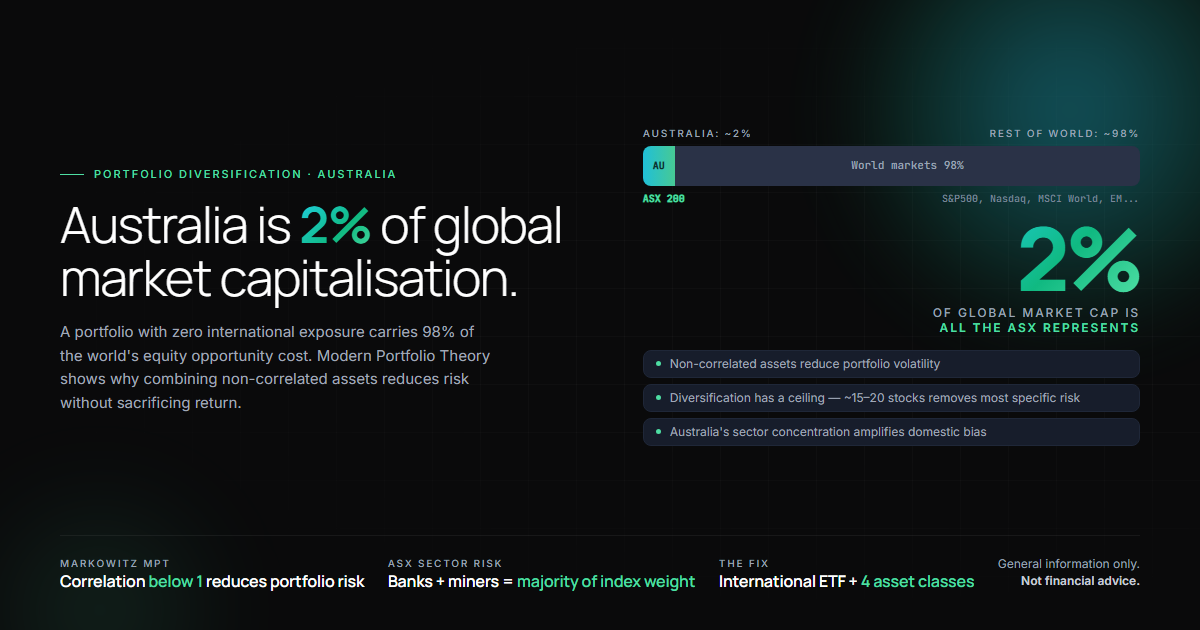
Home bias is the tendency for Australian investors to hold the majority of their portfolio in ASX-listed companies. Australia represents roughly 2% of global market capitalisation. Concentrating your wealth here means heavy exposure to the AUD, domestic economic cycles, and commodity prices. Global ETFs such as VGS provide a straightforward way to reduce home bias without adding stock-picking complexity.
Franking Credits and Inadvertent Clustering
For Australian investors — particularly retirees and SMSF trustees — fully franked dividends are genuinely valuable. The problem is that chasing franked yield reliably pulls investors toward large-cap financials and a handful of blue-chip industrials. A portfolio built primarily around franking credit income can end up heavily clustered in one or two sectors without the investor realising it.
What is the optimal number of stocks in an Australian portfolio?
Tier 1 — Beginners (Portfolio Under $10,000)
At small portfolio sizes, brokerage drag is a serious obstacle. Buying 20 parcels at $10 to $20 brokerage each costs $200 to $400 before your money does anything. A commonly cited rule is a minimum parcel size of around $2,000 to keep transaction costs at a manageable 0.5 to 1.0% per trade.
At this stage, a broad ASX ETF like VAS or A200, or a focused 3 to 5 stock portfolio across clearly different sectors, is the most sensible starting point. Build your capital first, then your stock count.
Tier 2 — Building Investors (Portfolio $10,000–$50,000)
As your capital grows, 10 to 15 direct ASX positions across 6 to 8 sectors becomes achievable without brokerage becoming punishing. Complement direct holdings with one or two ETFs to cover geographies or sectors — particularly international equities — that are harder to access through individual ASX stocks.
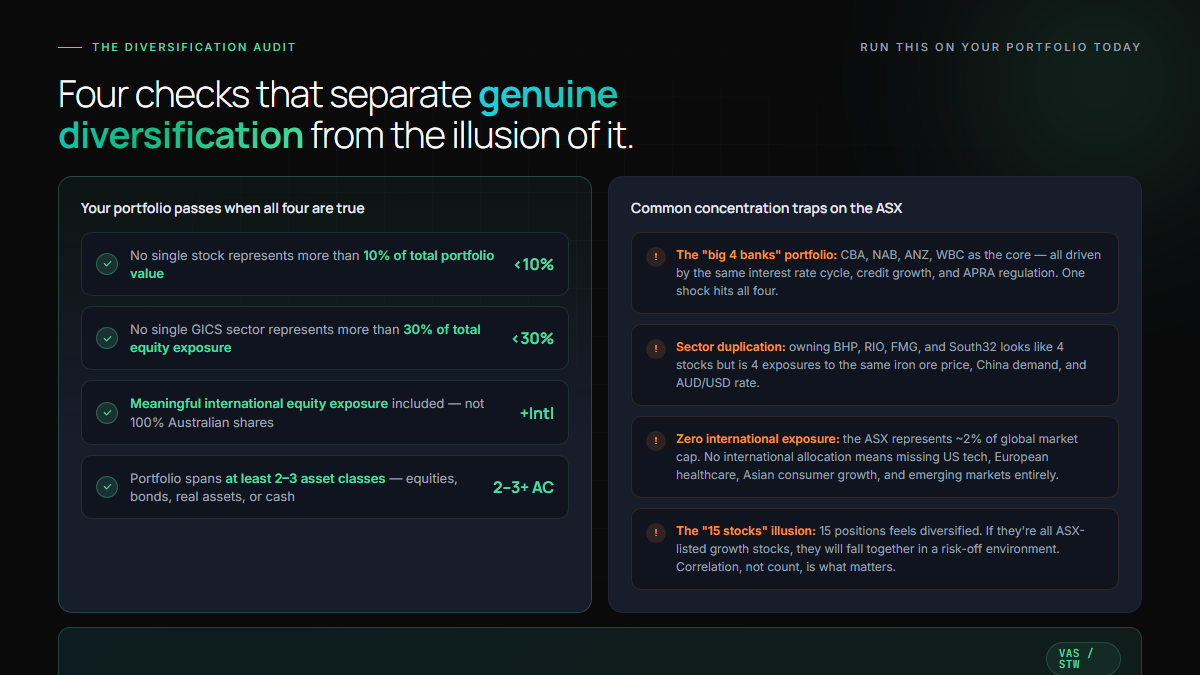
A practical position sizing rule at this tier: no single stock above 10% of the portfolio, no single sector above 20%.
Tier 3 — Established Investors (Portfolio $50,000 and Above)
Portfolios at this level comfortably support 15 to 25 direct ASX holdings. This range represents the research-backed sweet spot: enough holdings to eliminate most unsystematic risk, few enough to monitor with genuine attention.
Going beyond 25 to 30 stocks starts creating more problems than it solves — more CGT events, more record-keeping, and thinner conviction across your positions.
SMSF Investors: An Additional Compliance Layer
The ATO expects SMSF trustees to document a diversification strategy within their investment strategy document. A concentrated portfolio of 3 to 5 large-cap ASX stocks raises compliance questions without documented justification.
A blend of direct ASX holdings and broad ETFs satisfies both diversification goals and investment strategy obligations. A single ETF holding delivers hundreds of underlying exposures.
What are the best diversification strategies for Australian investors?
Owning 20 stocks does not mean you are diversified if one position is 50% of your portfolio. Position sizing and stock count must work together.
Equal weighting is a simple starting framework: 20 stocks at 5% each, or 15 stocks at roughly 6 to 7% each. Experienced investors sometimes run deliberate conviction positions of around 15%, but this involves intentional concentration risk, not accidental exposure.
Practical Sector Allocation for a 20-Stock Portfolio
| Sector | Holdings | Approx. Weight |
|---|---|---|
| Financials | 3–4 | 15–20% |
| Materials | 2–3 | 10–15% |
| Healthcare | 2–3 | 10–15% |
| Consumer Staples | 2 | 10% |
| Consumer Discretionary | 2 | 10% |
| Industrials | 1–2 | 5–10% |
| Technology | 1–2 | 5–10% |
| A-REITs | 1 | 5% |
| International ETF | 1–2 | 10–15% |
The goal is avoiding a scenario where 60% of your portfolio responds to the same macro driver.
The Tax and Admin Reality of More Holdings
Every sale of ASX shares triggers a CGT event that must be reported to the ATO, with records kept for at least 5 years. A large portfolio of 40-plus stocks generates substantially more paperwork.
The 12-month CGT discount — which reduces the taxable capital gain by 50% for individuals and trusts — is worth protecting. Frequent rebalancing across a large portfolio risks selling positions before that threshold.
On brokerage: 40 positions at $15 per trade costs $600 before a single dollar of return. A broad ETF handles rebalancing automatically with no CGT event for the investor and a low management expense ratio (MER). Limiting direct stock positions to higher-conviction holdings — and letting an ETF do the diversification heavy lifting — keeps both brokerage and tax administration manageable.
ETFs vs Direct ASX Shares
A single broad-market ETF like A200 or VAS instantly provides exposure to 200-plus ASX companies and handles rebalancing automatically. For beginners with limited capital or investors without time to research individual stocks, an ETF is the more efficient diversification tool.
The core and satellite approach works well for most Australian DIY investors:
- Core (50–60% of portfolio): A broad ETF providing market-wide diversification
- Satellite (40–50% of portfolio): Direct ASX stock picks for targeted income, sector tilt, or individual conviction
Combining the two is the most practical path at every stage. Tracking sector weights, CGT parcel dates, cost bases, and franking credits across a hybrid portfolio is where a purpose-built tool adds real value. Crowdfolio is built specifically for Australian DIY investors to manage exactly this kind of portfolio without a spreadsheet nightmare.
Frequently asked questions
Am I properly diversified with just 10 ASX stocks?
Ten stocks spread across genuinely different sectors provides a reasonable starting level of diversification. Each position automatically represents 10% of your portfolio, leaving limited buffer if one holding suffers a major loss. Ten stocks is a reasonable intermediate goal rather than a destination.
Does the ASX have enough variety to diversify within, or do I need international shares?
The ASX offers reasonable sector variety but is structurally concentrated in financials and materials. Australia represents roughly 2% of global market capitalisation. Adding international exposure through a global ETF like VGS meaningfully reduces home bias.
How does owning too many ASX stocks affect my tax obligations?
Each sale triggers a CGT event that must be reported to the ATO. A portfolio of 40-plus small positions creates substantially more record-keeping, increases the risk of selling before the 12-month CGT discount threshold, and generates more complexity at tax time.
What is the minimum parcel size to make diversification cost-effective?
The commonly cited rule of thumb is around $2,000 per parcel. At $10 to $20 brokerage per trade, a $2,000 parcel keeps your transaction cost at 0.5 to 1.0%. Buying $500 parcels across 20 stocks would see brokerage consume 2 to 4% of each position before you have made a single dollar of return.