
What are the best term deposit rates in Australia right now?
What a Term Deposit Actually Delivers
Term deposits provide fixed interest rates, capital protection up to $250,000 under the Financial Claims Scheme, and predictable income, but their after-tax returns vary by marginal tax rate and often trail fully franked ASX dividends for low-income earners and SMSFs in pension phase.
That certainty has real value. For income investors who need to know exactly what they will receive, a term deposit removes almost all uncertainty.
How the ATO Taxes Term Deposit Interest
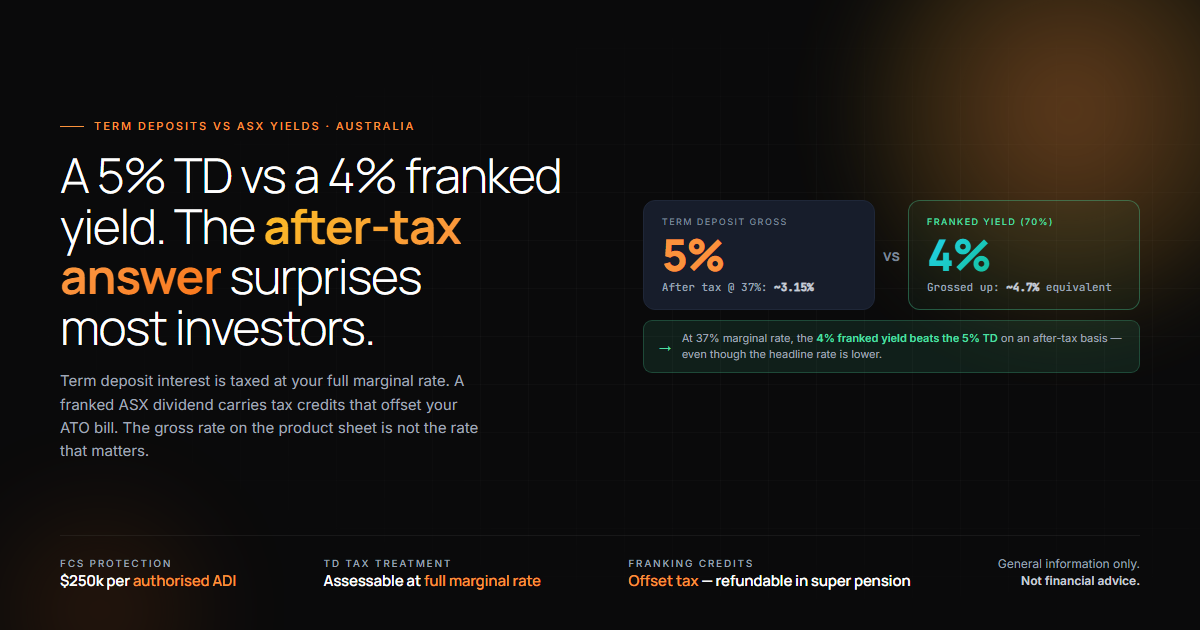
The ATO treats term deposit interest as ordinary assessable income. You include it in your tax return for the financial year in which it is earned or credited. No tax offsets are attached.
If your marginal tax rate is 45%, you keep 55 cents of every dollar of interest. At 30%, you keep 70 cents. The gross rate on the product sheet tells you nothing about what you receive after tax.
The Risks Headline Rates Hide
A fixed rate protects you from market volatility but exposes you to two other risks. First, if inflation runs above your deposit rate, your real purchasing power falls over the term. Second, when your deposit matures, you will need to reinvest at a lower rate if interest rates have fallen. Neither risk shows up in the advertised rate.
How do term deposits compare to ASX dividend shares for income?
Dividends, Franking Credits, and the Imputation System
ASX-listed companies pay dividends from after-tax profits. When a company has already paid Australian corporate tax at 30%, it attaches a franking credit to the dividend to reflect the tax already paid. You receive the cash dividend plus a credit to offset your own tax liability.
A fully franked dividend of $700 carries $300 in franking credits, giving a grossed-up dividend of $1,000. If your marginal rate is below 30%, the ATO refunds the difference. If your rate is above 30%, you pay the shortfall. This mechanism is unique to Australia and changes the after-tax calculation significantly.
Why the ASX Yields More Than Most Global Markets
Australia has a strong dividend culture driven by the imputation system. According to S&P Global research, the S&P/ASX 300 dividend yield before imputation was 4.1% as at 31 December 2024, compared with 1.9% in the United States and 2.3% globally.
Financials and materials dominate the dividend pool, so sector concentration is a real consideration. A high-yield ASX portfolio often carries significant exposure to banks and mining companies.
What Dividend Yield Numbers Hide
Dividend yield is the annual dividend per share divided by the current share price. When a share price falls sharply, the yield rises even if the dividend has not changed or is at risk of being cut.
A yield of 8% on a falling share is not the same as 4% on a stable or growing one. High-yield screens without quality filters frequently lead investors toward companies under financial stress.
The After-Tax Comparison
High-Income Earner at 45% Marginal Rate
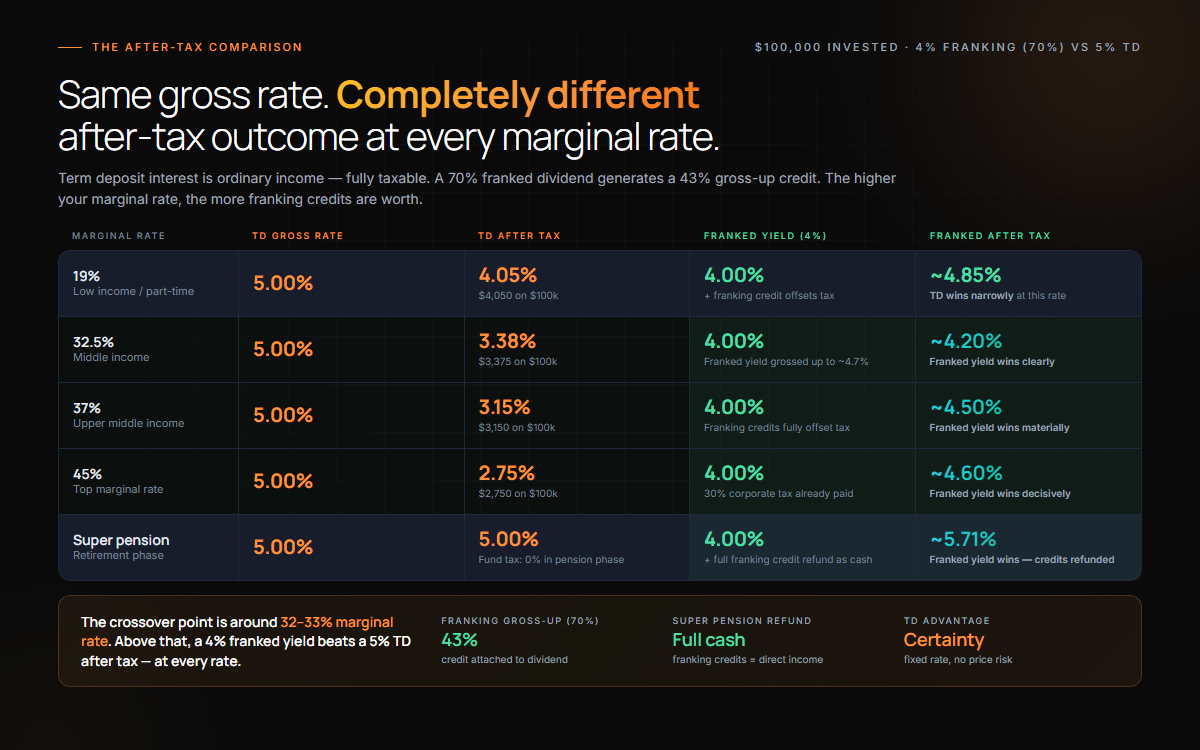
Assume a $100,000 investment. A term deposit at 4% generates $4,000 in interest. After 45% tax, you keep $2,200.
A fully franked ASX dividend yield of 4% generates $4,000 in cash dividends plus $1,714 in franking credits, giving a grossed-up income of $5,714. Tax at 45% is $2,571. Subtract the $1,714 franking credit, and the net tax bill is $857. After tax, you keep $3,143.
The after-tax advantage of the franked dividend is approximately $943 per year on the same $100,000. The gap widens further if the company delivers dividend growth over time.
Retiree or Low-Income Earner
At a marginal rate of 19%, tax on the $5,714 grossed-up dividend is $1,086. After applying the $1,714 franking credit, the ATO refunds $628 on top of the $4,000 cash dividend. Effective income exceeds the face value of the dividend.
By contrast, the term deposit delivers $4,000 minus $760 in tax, leaving $3,240. The refundable franking credit puts ASX share income meaningfully ahead.
SMSFs in Pension Phase
An SMSF in pension phase pays zero tax on investment earnings. A fully franked dividend creates no tax liability, so the entire franking credit becomes a cash refund from the ATO. A $4,000 franked dividend generates an additional $1,714 in cash back. A term deposit cannot replicate this outcome. For SMSFs in pension phase, the after-tax gap between fully franked ASX shares and term deposits is substantial.
Risk Profile: What You Are Signing Up For
Capital Risk and Volatility in ASX Shares
ASX shares carry capital risk. Share prices move daily, and the value of your investment at any point may be below what you paid. Dividends are not contractually guaranteed and companies cut or suspend them during downturns, meaning the income stream you model today may not persist.
Both risks are absent from a term deposit held to maturity. Investors moving to ASX shares to chase yield are taking on a fundamentally different risk profile.
Capital Preservation and Cashflow Certainty in Term Deposits
A term deposit held to maturity returns your principal in full. Interest payments are fixed and known in advance. For investors who need a specific dollar amount at a specific date, this certainty is difficult to replicate in share markets. The trade-off is that your income does not grow, and inflation erodes the real value of fixed interest income over multi-year periods.
CGT When Selling ASX Shares
When you sell ASX shares for more than your cost base, you trigger a capital gains tax event. That gain is assessable in the financial year of sale. Individuals and trusts who have held shares for at least 12 months are eligible for the 50% CGT discount, which halves the taxable gain before applying the marginal rate.
Term deposits do not create CGT events. Tracking your cost base, purchase dates, and realised gains across a share portfolio requires discipline. Crowdfolio helps Australian DIY investors monitor dividend income, franking credits, and cost base records in one place.
Practical Framework: Choosing the Right Option
Key Questions Before Allocating Income Capital
- What is your marginal tax rate?
- Do you need your capital returned intact at a specific date?
- How would a 20–30% fall in portfolio value affect your financial position?
- Is your income need fixed or flexible?
- Are you inside or outside superannuation?
When Term Deposits Belong in the Portfolio
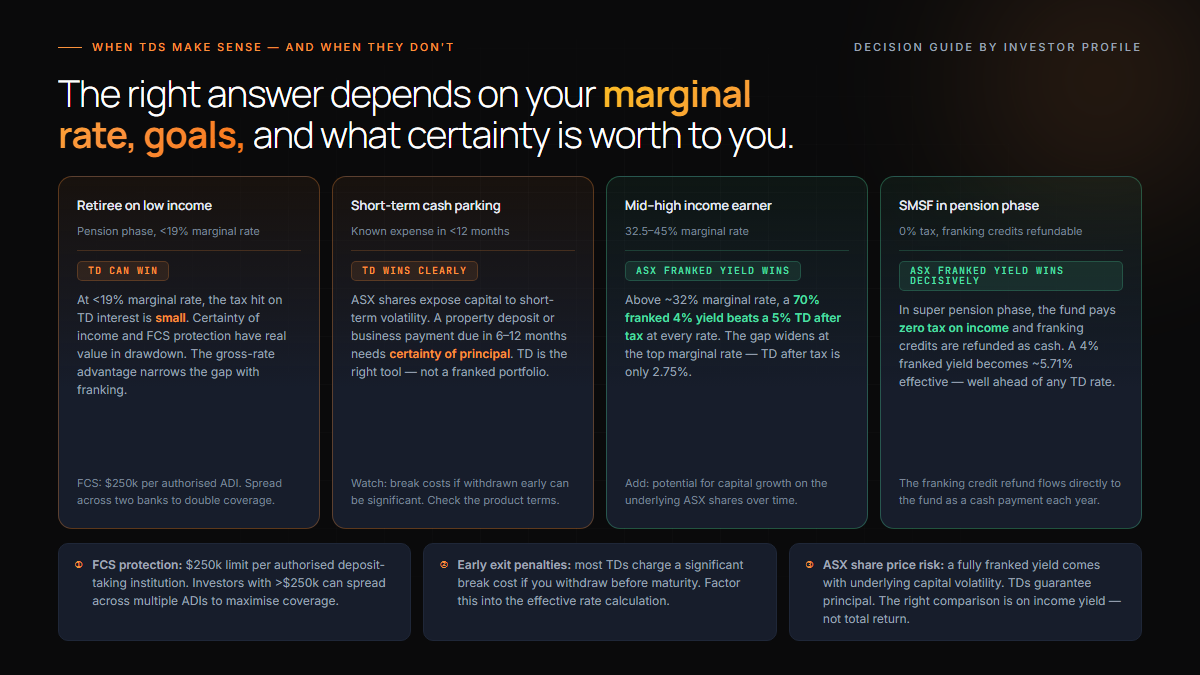
Term deposits suit investors who need income certainty to meet specific expenses, cannot tolerate capital loss, are in a high tax bracket, or are holding short-term cash while deciding on a longer-term allocation.
When High-Yield ASX Shares Are the Better Tool
High-yield ASX shares suit investors with a medium to long time horizon who absorb short-term price volatility, are in a low tax bracket or in pension-phase superannuation, want income with growth potential, and understand that dividend cuts are possible.
Using Both as Complementary Income Sources
Many income investors use term deposits for near-term, non-negotiable cashflow needs and ASX dividend shares for longer-term income growth. Holding both separates your “income I must have” from your “income I want to grow.” This structure reduces the pressure to sell shares at the wrong time.
Frequently asked questions
Are franking credits worth more than term deposit interest?
For low-income earners and SMSFs in pension phase, fully franked dividends deliver significantly more after-tax income than equivalent term deposit interest. For investors on the top marginal rate, franked dividends still carry a tax advantage, though a smaller one.
Can an SMSF claim a cash refund on franking credits?
Yes. An SMSF in pension phase pays zero tax on earnings. Franking credits attached to dividends become a direct cash refund from the ATO, making this one of the most tax-efficient income structures available to Australian investors.
Do I pay CGT when a term deposit matures?
No. Maturing a term deposit does not create a CGT event. The interest is assessable as ordinary income only.
What happens to my dividend income if a company cuts its dividend?
Your income falls. Dividends are paid at the discretion of a company’s board and can be reduced or suspended at any time. A diversified portfolio reduces the impact of any single cut, but the risk does not disappear entirely.