
The CGT 50% discount in Australia lets eligible residents halve the taxable capital gain on an asset held for at least 12 months. It applies where a parcel has been held for at least 12 months. Capital losses are applied before the discount, the parcel sold determines the gain, and the gain falls in the income year of the disposal. From 1 July 2027, indexation replaces the discount for individuals and trusts.

What Is the CGT 50% Discount?
The Capital Gains Tax (CGT) 50% discount is a concession provided by the Australian Taxation Office (ATO) that allows eligible investors to reduce the taxable portion of a capital gain by half. In practical terms, if you sell an asset and make a $100,000 gain, only $50,000 is included in your assessable income — potentially saving you tens of thousands of dollars depending on your marginal tax rate.
This concession was introduced as part of the Ralph Review reforms in 1999, replacing the previous CPI indexation method that adjusted the cost base for inflation. For more than two decades, it has been a cornerstone of long-term investment strategy for everyday Australians — rewarding patient, buy-and-hold investors over short-term traders.
The discount is not a loophole or a workaround. It is a deliberate policy concession designed to encourage long-term investment and capital formation in the Australian economy. Using it effectively simply means aligning your investment behaviour with the conditions the ATO has set out.
Who Is Eligible for the CGT 50% Discount?
To qualify for the CGT 50% discount, you must satisfy two key conditions simultaneously:
1. Hold the asset for at least 12 months
The ATO’s definition of ’12 months’ is more precise than most investors realise. You must exclude both the day you acquired the asset and the day you sold it from your count. This means the actual minimum holding period is 367 days (or 368 days in a leap year). Mark this in your records carefully — selling even one day too early disqualifies you entirely from the discount.
2. Be an Australian resident for tax purposes at the time of the sale
The discount is only available to Australian tax residents. Foreign residents who acquired assets after 8 May 2012 are generally not entitled to the concession — and where someone was a foreign or temporary resident for the entire ownership period of an asset acquired after that date, no discount is available at all. Former Australian residents may be eligible for a partial, apportioned discount based on the proportion of time they held the asset while a resident.
Before that question arises, check what is actually taxable. Foreign and temporary residents are subject to Australian CGT only on taxable Australian property — broadly Australian real property, an indirect interest in it (a holding of 10% or more in an entity whose assets are mainly Australian real property), a mining right, or an asset used in an Australian permanent establishment. Ordinary ASX shares and ETFs are not taxable Australian property. In practice that means a foreign resident holding an ASX portfolio usually has no Australian CGT on it, so the discount restriction never comes into play. It becomes relevant if the holding is taxable Australian property, or if the investor chose to disregard the deemed disposal that otherwise happens when they stopped being an Australian resident — that choice turns those shares into taxable Australian property. Residency and CGT interact in ways worth confirming with a registered tax agent.
Who can access the discount:
- Individual investors
- Partnerships
- Trusts
- Self-managed super funds (SMSFs) — though at a reduced rate of 33.33%
Who cannot access the discount:
- Companies — corporations are excluded from the CGT discount entirely and must use a cost base approach instead.
How does the 12-month rule work for ASX share parcels?
The 12-month test is applied parcel by parcel, not stock by stock — and for ASX investors that distinction is where most of the tax outcome is decided.
Each parcel runs its own clock
If you have bought the same stock at different times and in different quantities, each parcel has its own acquisition date and its own 12-month clock. Selling shares held for less than 12 months means those gains are fully taxable at your marginal rate with no discount — even if you have held other parcels of the same stock for years.
DRP shares are separate parcels
Dividend reinvestment plan (DRP) shares are treated as separate parcels too, each with its own acquisition date based on when the DRP allocation occurred. A long-held position topped up every distribution is really dozens of parcels, and the most recent ones will not qualify for the discount.
The financial-year trap
A common mistake is assuming that buying in one financial year and selling in the next automatically satisfies the 12-month rule. It does not. If you purchased shares on 1 March 2024 and sold them on 28 February 2025, you would fall just short of the threshold and miss the discount entirely. Waiting a few more days would have halved the taxable gain.
Choosing which parcel to sell
When you hold multiple parcels of the same stock at different prices and acquisition dates, you can choose which parcel you are disposing of. Selecting a parcel held for more than 12 months may produce a larger but discountable gain, while selling a newer parcel at a loss can offset other gains. That choice only exists if your records support it, which is why parcel-level record-keeping is not optional — it is what makes the strategy usable at all.
Which Assets Qualify?
The 50% CGT discount applies to a broad range of investment assets, including:
- ASX shares and managed funds — among the most common assets Australian investors hold
- Exchange-Traded Funds (ETFs) — whether tracking the ASX 200 or international indices
- Units in listed investment trusts — a CGT asset in their own right, with their own acquisition dates
- Managed fund units — where you dispose of the units themselves
- International shares — including US stocks held directly
- Investment properties — residential and commercial
- Cryptocurrency — the ATO treats crypto as a CGT asset, not currency
- Collectables — subject to certain limitations and thresholds
- Certain small business assets — which may also qualify for additional small business CGT concessions
Notably, your primary residence (main home) is generally exempt from CGT altogether under the main residence exemption, making the discount most relevant for investment assets held outside your home.
Where the discount does not reach. Collectables and personal-use assets are subject to separate rules and thresholds. Foreign residents face specific restrictions, particularly on residential property, following the changes introduced in 2012 and tightened since. The general 50% discount is also entirely separate from the small business CGT concessions, which apply to active business assets under additional eligibility tests — covered further down this page.
Pre-CGT assets — and why 2027 changes the answer. Assets acquired before CGT commenced on 20 September 1985 have historically sat outside the CGT system altogether. That is no longer true from 1 July 2027. Under the deemed-disposal rules in the Treasury Laws Amendment (Tax Reform No. 1) Act 2026, pre-CGT assets are brought into the net: they are taken to have been sold just before 1 July 2027 and re-acquired at their market value at that moment, so growth from that date onward is taxable. Do not assume a pre-1985 asset is exempt on a disposal after that date.
How do you calculate the CGT discount on shares?
The ATO requires a specific order of operations when calculating your capital gain. Getting this wrong can lead to underpaying or overpaying tax. Here is the correct sequence:
Step 1: Calculate your total capital gain — this is the sale proceeds minus your cost base (which includes the purchase price, brokerage, and certain other acquisition costs).
Step 2: Apply any capital losses — use current-year capital losses first, then any carried-forward losses from prior years. Critically, capital losses must be applied before the CGT discount, not after.
Step 3: Apply the 50% CGT discount to the remaining net gain.
Step 4: Include the discounted amount in your taxable income and report it in your annual income tax return.
Worked example:
- Sale of shares: $150,000
- Cost base: $50,000
- Gross capital gain: $100,000
- Less capital losses (carried forward): $10,000
- Net capital gain before discount: $90,000
- Less 50% CGT discount: $45,000
- Taxable capital gain: $45,000
If your marginal tax rate is 37%, you would pay approximately $16,650 in tax on this gain — compared to $33,300 if the discount did not apply. That is a $16,650 saving from holding one day longer than 12 months.
How can you use the CGT discount in your investment strategy?
Savvy investors use the CGT 50% discount not just passively, but as an active part of their portfolio management strategy. Here are some of the most effective approaches:
Timing disposals carefully
If you are approaching the 12-month mark on an asset, it almost always makes sense to wait until you cross the threshold before selling. The tax saving from the discount typically far outweighs any short-term market movements.
Harvesting capital losses — offset your short-term gains first
If you hold underperforming ASX positions or ETFs sitting below your cost base, realising those losses in the same income year as a gain lets you offset them before the discount is applied. One nuance many investors miss: because losses must be applied before the 50% discount, each dollar of capital loss reduces your eligible gain on a one-for-one basis — whereas that same dollar of gain, once discounted, would only have added 50 cents to your taxable income. Capital losses are therefore worth more against short-term, non-discounted gains (assets held under 12 months, taxable in full) than against long-term discounted gains. If you have both kinds of gain in the same year, structure your harvesting to offset the short-term gains first.
The ATO wash-sale caveat
The sale has to be a genuine investment decision. Disposing of a holding and reacquiring substantially the same position purely to book a loss is a wash sale, and the ATO’s guidance treats those arrangements as tax avoidance rather than legitimate harvesting. Realising a loss you intend to immediately undo is the pattern to avoid.
Unused losses carry forward — they never expire
Unused capital losses can be carried forward indefinitely under Australian tax law. There is no expiry. That makes it worthwhile to crystallise a loss even in a year with no gains to offset: the loss is preserved in full and can be applied against a larger capital gain in a future year, whether or not that future gain is discountable.
Time realisations to lower-income years
The discount reduces the taxable portion of a gain but does not change the rate applied to what remains, so your marginal rate still matters. If you expect a lower-income year — a career break, parental leave, a move to part-time work, or retirement — crystallising gains in that year lowers the effective tax on the discounted gain. Crowdfolio can help you track holdings and identify CGT-aware rebalancing opportunities with that timing in mind.
Review your ownership structure
Whether you hold assets personally, through a family trust, inside superannuation, or via a company makes a substantial difference to the outcome:
- Individuals and Australian trusts — the full 50% discount. A family trust can distribute discounted gains to beneficiaries on lower marginal rates, multiplying the benefit across a household. This requires proper legal and tax advice to implement correctly.
- Complying super funds, including SMSFs — a one-third (33.33%) discount rather than 50%. Because the remaining two-thirds is then taxed at the 15% super rate, the effective CGT rate inside super works out at roughly 10% — the lowest available to most investors, and a large part of why super is such an efficient long-term vehicle. The trade-off is access: the money is preserved until you meet a condition of release.
- Companies — no CGT discount at all, though a company pays a flat 25% or 30% rate depending on its size.
If you are approaching retirement and plan to move assets into an SMSF, the sequencing matters: holding assets personally until they qualify for the full 50% discount may be preferable to transferring first, depending on your circumstances.
Affordable housing bonus
If you own a residential rental property and provide affordable housing to low-to-moderate income earners through an approved rental housing provider, you may qualify for an additional 10% CGT discount — bringing your total concession to 60%. This is a niche but meaningful incentive for investors open to this type of tenancy arrangement. The eligibility criteria are specific, so confirm your arrangements qualify with a tax adviser before relying on this enhanced rate.
How do small business CGT concessions interact with the 50% discount?
If you are disposing of business assets, the CGT framework becomes considerably more complex — but also potentially more generous. The ATO provides a suite of small business CGT concessions that are applied in a specific sequence before the standard 50% discount is calculated. Misapplying the order can cost you significantly.
The four concessions, applied in this sequence, are:
- Small business 15-year exemption — if you have continuously owned an active business asset for 15 or more years and are aged 55 or older (or retiring or permanently incapacitated), the entire gain may be exempt from CGT. No further concessions need to be considered if this applies.
- Small business 50% active asset reduction — reduces the capital gain on qualifying active business assets by 50%. This step applies after the 15-year exemption test has been considered and found inapplicable or only partially applicable.
- Small business retirement exemption — allows up to $500,000 of capital gains to be contributed to superannuation tax-free over a lifetime. Amounts contributed under this exemption count toward the lifetime limit regardless of age, though investors under 55 must make the contribution to super.
- Small business rollover — defers the remaining gain if you reinvest in qualifying replacement assets within the prescribed timeframe.
Importantly, after applying whichever of the above concessions you are eligible for, you may still be able to apply the standard 50% CGT discount on any remaining gain — provided you meet the 12-month holding period and other eligibility criteria. This combination can result in a capital gain being reduced by as much as 75% before it reaches your assessable income.
One critical warning: the ATO’s anti-avoidance provisions under Part IVA of the Income Tax Assessment Act apply with particular force in this space. Arrangements that convert what were originally trading stock or ordinary income assets into capital assets — primarily to access the small business concessions or the 50% discount — can be unwound where the dominant purpose is tax reduction rather than genuine business or investment activity. The ATO is vigilant about these arrangements. Small business CGT concessions are complex and carry strict eligibility tests; specialist tax advice is strongly recommended before any disposal where these concessions may apply.
Property Investors: Negative Gearing, Main Residence, and Cost Base
The CGT 50% discount is frequently discussed in the context of Australian investment property, and for good reason — property transactions often involve the largest capital gains individual investors will ever realise. Several property-specific rules interact with the discount in ways that are worth understanding clearly.
Negative gearing and the CGT discount
Rental losses from negative gearing offset your ordinary income during the holding period, reducing your tax in those years. However, when you sell, those same revenue-account losses do not reduce your capital gain — the sale proceeds and cost base calculation operate entirely separately from the annual rental deficit. This means investors in negatively geared properties effectively receive two distinct tax benefits: annual deductions during the holding period, and then the 50% CGT discount on the eventual sale. The two concessions are complementary, not mutually exclusive.
Main residence exemption and partial CGT liability
Your primary home is generally fully exempt from CGT, representing the most valuable CGT concession available to individual taxpayers. However, if you have ever rented out your main residence or used it for income-producing purposes — even partially — a proportionate CGT liability may apply when you sell. The taxable portion is calculated based on the floor area used for income-producing purposes and the time during which the property was used that way. The 50% discount is then available on the taxable portion, provided the 12-month holding period is satisfied.
Cost base uplift through capital improvements
Capital improvements — such as renovations, extensions, new fencing, landscaping, or structural additions — are added to your cost base and directly reduce your capital gain on sale. This is a legally straightforward but frequently overlooked method of legitimately reducing your CGT exposure. Keeping meticulous records of all capital expenditure throughout ownership is not just good practice; it is a legal requirement, and underestimating your cost base because of poor records is one of the most common — and avoidable — sources of inflated CGT liabilities.
Residency Edge Cases: Temporary Residents, Dual Residency, and Apportionment
Residency status at the time of a CGT event is not always straightforward, and the consequences of getting it wrong are material. Several scenarios deserve specific attention.
Temporary residents
Individuals who hold temporary visas and are considered temporary residents for tax purposes are generally not entitled to the CGT 50% discount on most assets. The exception is taxable Australian property (such as Australian real estate or interests in land-rich entities), where the discount may still apply. If you hold shares, ETFs, or other non-property assets as a temporary resident, you should not assume the discount is available — confirm your entitlement with a registered tax agent.
Dual residency and time overseas
If you have spent extended periods overseas, you may have been a tax resident of both Australia and another country simultaneously under each country’s domestic rules. Australia’s tax treaties with various countries include tie-breaker rules that determine which country has primary taxing rights over your income and gains during periods of dual residency. For CGT purposes, your residency status at the date of the disposal (the CGT event date) is what determines discount eligibility — not your historical residency, and not your intention to return.
Apportionment for partial residency periods
Former Australian residents who became non-residents during the holding period of an asset may still access a partial CGT discount. The discount is apportioned based on the proportion of the total holding period during which the taxpayer was an Australian resident. This calculation can be complex, particularly for assets held across multiple periods of residency and non-residency, and professional advice is essential before any disposal in these circumstances.
What changes on 1 July 2027?
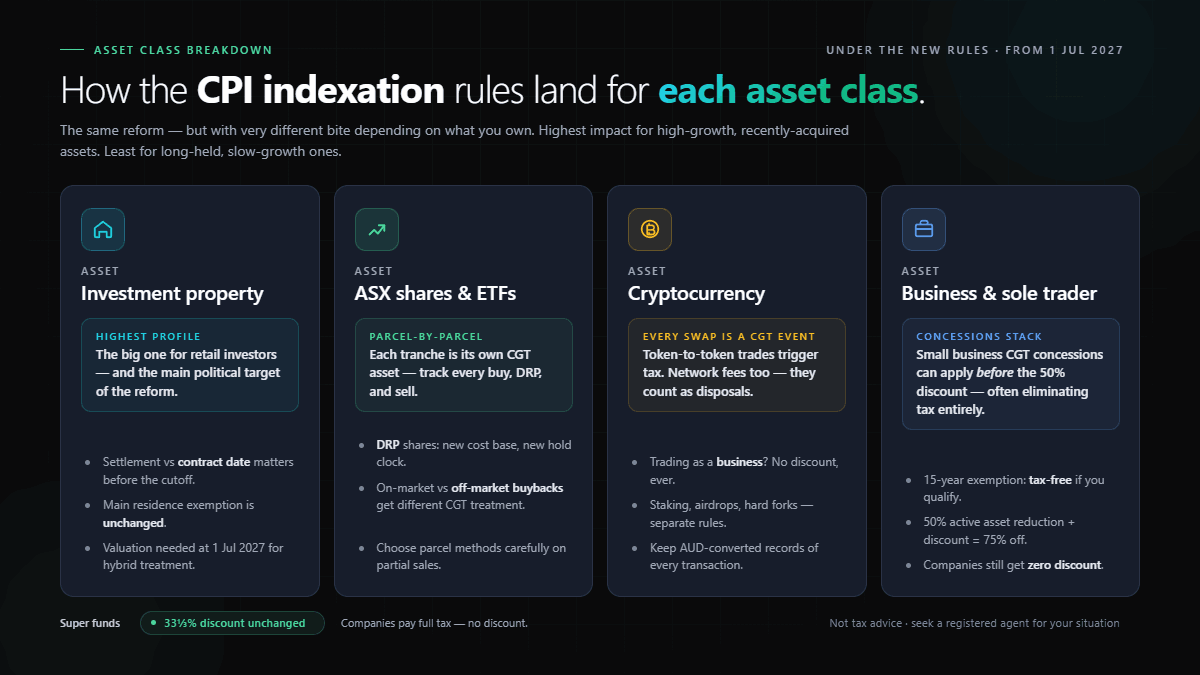
In what represents the most significant change to Australian CGT in over 25 years, the 50% CGT discount is replaced from 1 July 2027 by CPI indexation of the cost base plus a 30% minimum tax rate on net capital gains, which applies to certain Australian-resident individuals only, subject to exclusions. Indexation itself reaches individuals and trusts. This is settled law, not a proposal: it was enacted by the Treasury Laws Amendment (Tax Reform No. 1) Act 2026 (Act No. 49 of 2026), which received royal assent on 26 June 2026. It applies to all CGT assets, ASX shares and ETFs included — it is not limited to residential property. This is not a minor adjustment — it fundamentally changes the tax treatment of long-term investment gains.
What replaces it?
From 1 July 2027, the discount method will be replaced with:
- CPI indexation of the cost base — your purchase price is adjusted upward by the Consumer Price Index (CPI) for the holding period, meaning only real gains above inflation are taxed.
- A 30% minimum tax rate on gains above the inflation-adjusted cost base, for certain Australian-resident individuals only, subject to exclusions.
How will existing assets be treated?
The reform will not apply retrospectively. For assets held before 30 June 2027, a hybrid system applies:
- Gains accrued up to 30 June 2027 (from original cost to the asset’s value on that date) — the 50% CGT discount applies
- Gains accrued after 1 July 2027 (from the 30 June 2027 value to eventual sale) — CPI indexation plus the 30% minimum tax applies
The deemed-disposal split above applies to individuals and trusts, and to an individual’s gain attributable to a partnership. The 30% minimum rate is narrower: it reaches certain Australian-resident individuals only, subject to exclusions, and not partnerships or trusts. Practically speaking, investors will need to establish the market value of their assets at the changeover. The Act frames that as the market value just before 1 July 2027, which for a listed holding is the 30 June 2027 close — accurate valuations at that date are critically important. Where a market value is impractical the Act allows an apportionment method instead, but the Minister has not yet made the legislative instrument that sets it. For the full picture of the reform and the measures alongside it, see our guide to the Australian budget tax changes for investors.
What this means for your strategy now
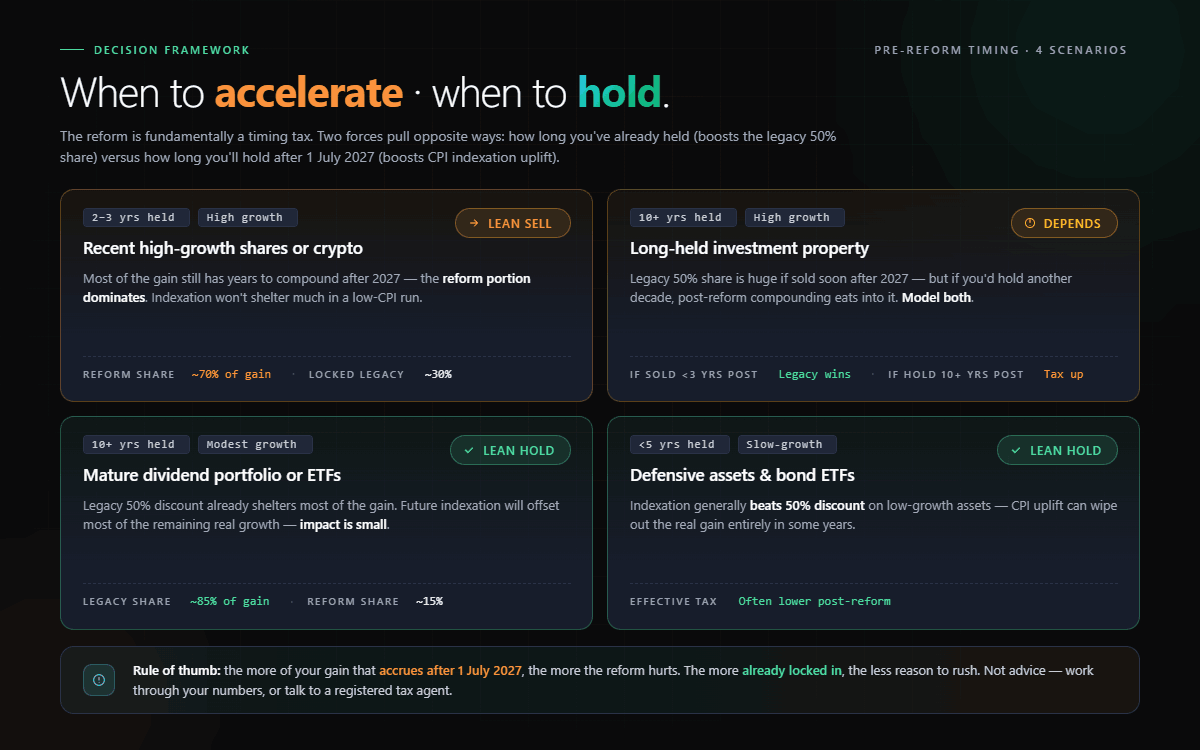
The years between now and 30 June 2027 represent a window of opportunity. Investors using platforms like Crowdfolio to manage diversified portfolios should be actively reviewing their holdings, identifying assets with large unrealised gains, and working with a tax adviser to model whether realising gains before the cut-off date is beneficial given their personal circumstances. In many cases, locking in the 50% discount before the deadline will prove significantly more tax-efficient than deferring the sale into the new regime.
Special Circumstances and Edge Cases
Several special rules apply to the CGT discount that can catch investors off guard:
Relationship breakdown: If you received an asset through a property settlement following a relationship breakdown, the 12-month holding period includes the time the asset was held by your former spouse. So if they held it for eight months and you held it for a further six months, the combined 14-month period satisfies the eligibility requirement.
Deceased estates: Assets inherited from a deceased estate where the deceased acquired the asset on or after 20 September 1985 can still qualify for the CGT discount. The holding period generally commences from the date the deceased originally acquired the asset.
Cryptocurrency: The ATO treats cryptocurrency as a CGT asset. If you hold crypto for more than 12 months before disposing of it (including selling, swapping, or using it to purchase goods), you are entitled to the 50% discount on any gain — though meticulous record-keeping of acquisition dates and cost bases is essential.
New builds: The elections available to investors in newly constructed residential dwellings are set out in the Treasury Laws Amendment (Tax Reform No. 1) Act 2026 (Act No. 49 of 2026), which received royal assent on 26 June 2026 — they are enacted, not pending. What remains outstanding is narrower: the ATO’s operational guidance, and the apportionment method for the 1 July 2027 split, which the Minister is to set by legislative instrument and has not yet published. Because an election of this kind is irreversible, confirm your position with a registered tax agent before relying on either outcome.
Key Takeaways
- The CGT 50% discount reduces your taxable capital gain by half when you hold an eligible asset for at least 367 days (12 months, excluding the acquisition and disposal dates) and are an Australian tax resident.
- Capital losses must be applied to your gain before the 50% discount is applied — getting this order wrong can result in an incorrect tax calculation.
- Each parcel of an ASX holding — including every DRP allocation — has its own 12-month clock, so parcel-level records decide whether a given sale is discountable.
- Capital losses are worth more against short-term, non-discounted gains than against long-term discounted gains; where you have both in the same year, offset the short-term gains first.
- Unused capital losses carry forward indefinitely with no expiry, so crystallising a loss is worthwhile even in a year with no gains — provided the sale is a genuine investment decision and not a wash sale.
- Timing a disposal into a lower-income year reduces the marginal rate applied to the discounted gain.
- The discount applies to a wide range of assets including ASX shares, ETFs, investment property, international shares, and cryptocurrency — but not to companies.
- Self-managed super funds access a reduced 33.33% CGT discount rather than the full 50% — which, taxed at the 15% super rate, works out at an effective CGT rate of roughly 10%.
- Small business CGT concessions can be stacked with the general 50% discount in a specific four-step sequence, potentially reducing a gain by up to 75% — but Part IVA anti-avoidance provisions apply strictly to arrangements designed primarily to access these concessions.
- Property investors benefit from two complementary concessions: annual negative gearing deductions during ownership and the 50% CGT discount on eventual sale — and capital improvements throughout ownership reduce the taxable gain.
- Temporary residents are generally not entitled to the discount on non-property assets; dual residents and former residents should have their eligibility assessed at the date of disposal, with apportionment applying where residency changed during the holding period.
- From 1 July 2027, the 50% CGT discount will be replaced by CPI indexation of the cost base for individuals and trusts, plus a 30% minimum tax rate that reaches certain Australian-resident individuals only — one of the largest changes to Australian investment taxation in decades.
- Gains accrued up to 30 June 2027 on existing assets will still attract the 50% discount under a hybrid transitional arrangement, making asset valuations as at that date critically important.
- Pre-CGT assets acquired before 20 September 1985 stop being outside the system from 1 July 2027: they are taken to have been sold just before that date at market value, and growth after it is taxable.
- The period between now and 30 June 2027 is a strategic window for Australian investors to review their portfolios and potentially crystallise gains under the current, more favourable discount regime.
- Investors providing qualifying affordable housing may access an additional 10% CGT discount, bringing the total concession to 60%.