
How do I fix a bad share portfolio in Australia?
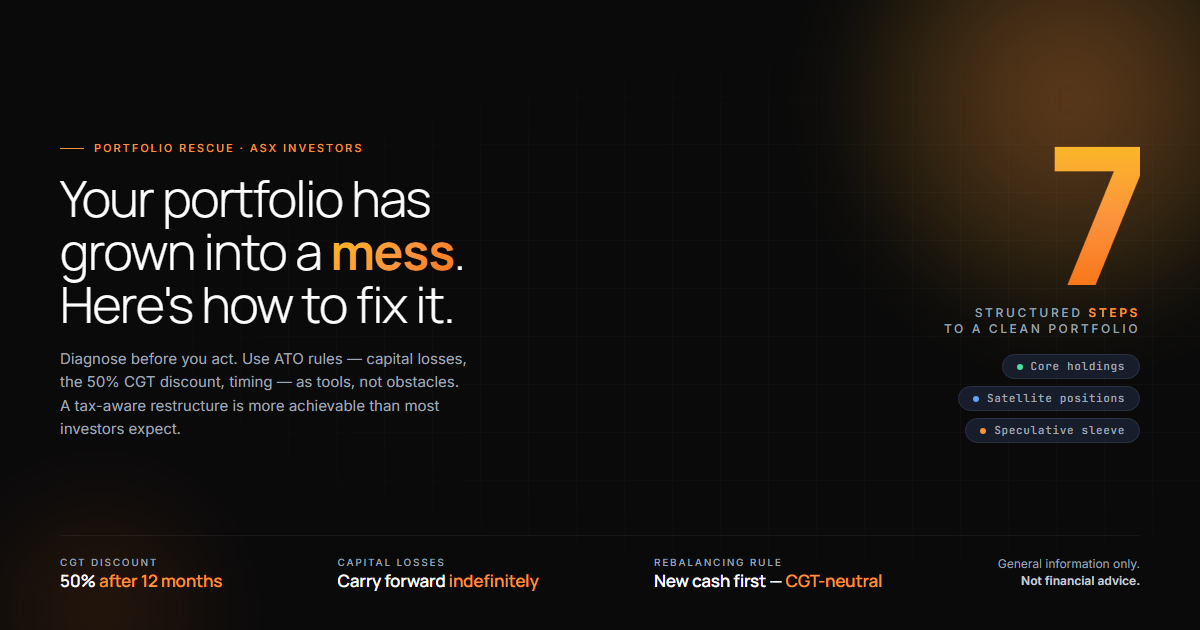
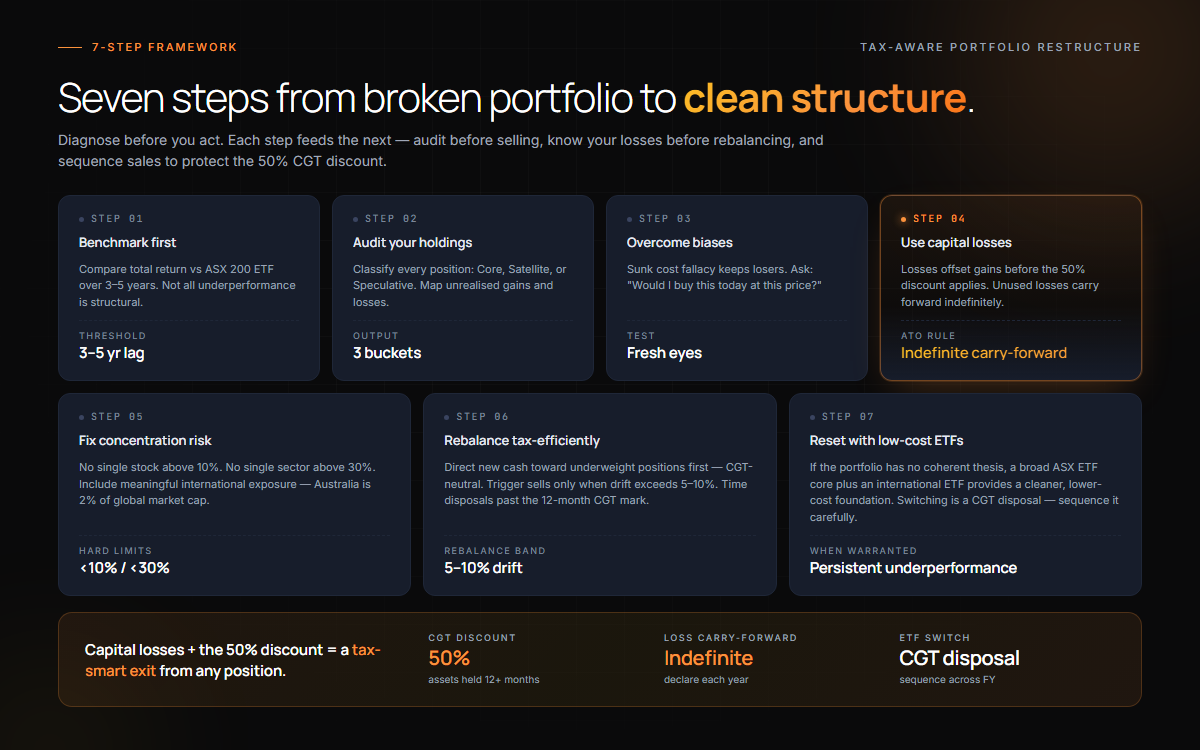
To fix a bad share portfolio in Australia, diagnose underperformance against an ASX 200 ETF benchmark over three to five years, classify holdings into core, satellite, and speculative buckets, overcome behavioural biases like sunk cost fallacy, use capital losses to offset gains, address concentration risk with diversification limits, rebalance using new contributions first, and consider a structural reset with low-cost ASX ETFs.
Fixing a bad share portfolio is entirely achievable. Done in a structured, tax-aware way, you do not need to blow up your CGT position to get there. Diagnose before you act, and treat the process as both a financial and behavioural exercise.
Step 1: Benchmark First — Is Your Portfolio Actually Broken?
Before selling anything, measure your portfolio’s actual performance. Calculate your total return — capital growth plus dividends received — over a three-to-five-year period, then compare it against a simple ASX 200 ETF over the same timeframe.
Not every underperforming portfolio is broken. Short-term volatility is normal. Structural underperformance shows up as persistent lag across multiple financial years, positions that never recover during broad ASX rallies, and chronic losses that compound over time.
The diagnosis determines everything that follows.
What are the steps to rescue an investment portfolio?
Export your full holdings and classify each position into one of three buckets:
- Core holdings: long-term, diversified exposure aligned with your strategy
- Satellite positions: higher-conviction picks with a clear investment thesis
- Speculative holdings: small caps, thematic bets, or forum tips
This forces clarity about what you actually own versus what you intended to own.
Before selling anything, know the cost base of each parcel and calculate unrealised gains and losses. This directly shapes your decision-making sequence when planning sales. The ATO requires investors to retain purchase records, CHESS statements, and dividend reinvestment plan (DRP) records for a minimum of five years.
Step 3: Identify and Overcome Behavioural Biases
The purchase price of a share has no bearing on whether it belongs in your portfolio today. The sunk cost fallacy causes many ASX retail investors to hold chronic underperformers indefinitely while waiting for a breakeven that may never arrive. The loss already exists. Selling makes it visible — it does not create it.
The disposition effect leads investors to sell strong performers too quickly and cling to losers too long. Over time, this leaves a portfolio of underperformers with the winners stripped out.
A useful reframe: ask yourself, “Would I buy this share today at this price, given what I now know?” If the answer is no, that is a signal worth acting on.
Step 4: Use Capital Losses as a Tax Planning Tool
Capital losses realised on ASX shares offset capital gains in the same financial year. The sequencing rule matters: losses must be applied against gains before the 50% CGT discount applies to any remaining gains.
Example: An AUD $8,000 capital loss offsets an AUD $8,000 gain. Net CGT liability: zero.
Unused capital losses carry forward indefinitely under ATO rules. Document all capital losses on your tax return each year, even with no gains to offset, to preserve the carried-forward balance.
Australian individuals and trusts receive a 50% CGT discount on assets held for more than 12 months before disposal. Waiting a few extra weeks past the 12-month mark before selling a profitable position can substantially reduce your tax bill.
Be aware of wash sale arrangements — selling a share to realise a capital loss then immediately repurchasing the same or substantially similar asset. The ATO’s anti-avoidance provisions under Part IVA apply. Allow a genuine change in economic exposure before repurchasing, and seek advice from a registered tax agent if uncertain.
Step 5: Address Concentration Risk and Sector Overexposure
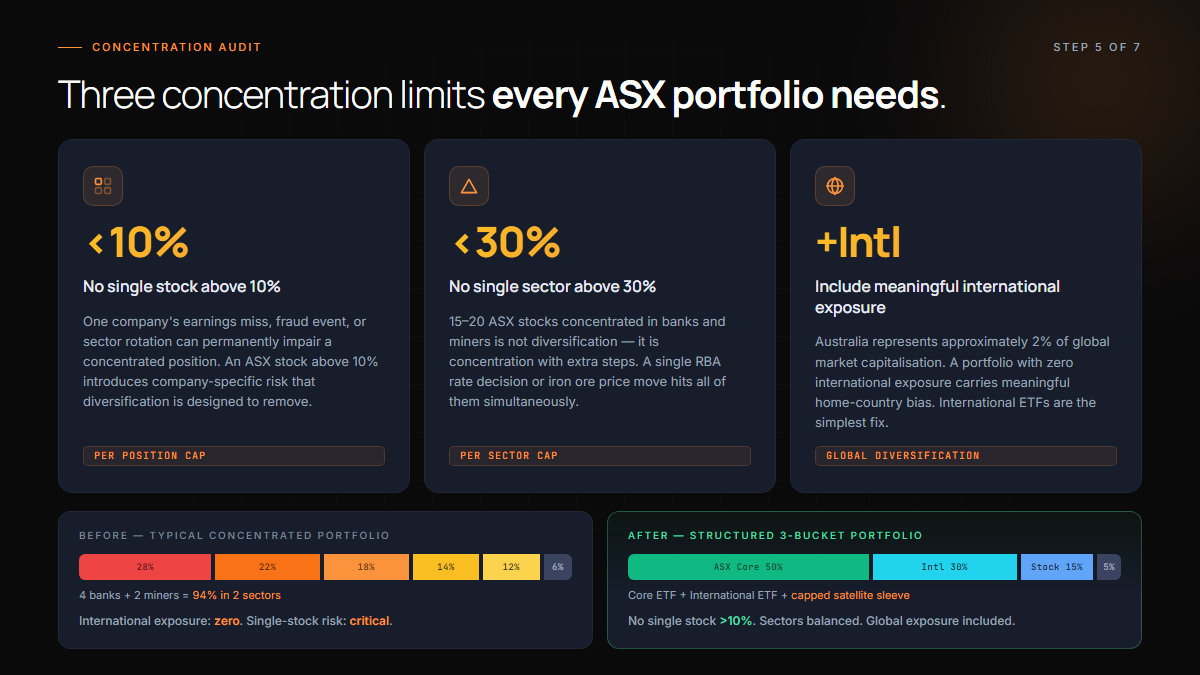
A common trap is holding 15 to 20 positions that are predominantly Australian banks, miners, and domestic consumer stocks. That is concentration with extra steps — not diversification.
Check your portfolio’s sector breakdown using GICS categories. When resources fall or the big four banks reprice, a concentrated portfolio falls with them.
Genuine diversification spans domestic equities, international equities, fixed income, and real assets. Australia represents approximately 2% of global market capitalisation — a portfolio with no international exposure carries meaningful domestic bias risk.
A practical concentration checklist:
- No single stock above 10% of your portfolio
- No single sector above 30%
- Meaningful international exposure included
How to rebalance a concentrated portfolio ASX?
Set a written target asset allocation as the anchor for all rebalancing decisions. Use a rebalancing band of approximately 5 to 10% drift before triggering a sell. This reduces unnecessary CGT events and brokerage costs.
Directing new cash toward underweight asset classes is the most tax-efficient rebalancing tool available. It is CGT-neutral and avoids the friction of selling. When contribution-only rebalancing is insufficient, use accumulated capital losses to offset any gains triggered by a partial sell.
SMSF investors must update their investment strategy document to reflect any material changes to asset allocation. The ATO requires trustees to give genuine consideration to diversification in their written strategy. The super fund tax rate on capital gains — 15%, or 10% with the one-third discount for assets held 12 months or more — differs materially from personal marginal rates, which changes the rebalancing calculation relative to personally held shares.
Step 7: Consider Resetting with Low-Cost ASX ETFs
Signs your portfolio needs a structural reset include persistent underperformance across the full portfolio, excessive time monitoring individual positions, and no coherent investment thesis across your holdings.
Broad-market ASX ETFs and internationally diversified ETFs offer a cleaner, lower-cost foundation. The drag of brokerage, research time, and emotional decision-making often exceeds the cost of a simple index ETF management fee.
Switching from individual shares to ETFs is a disposal event for CGT purposes — not a like-for-like rollover. Use accumulated capital losses to offset gains, sequence the transition across multiple financial years, and weigh the franking credit profile of the shares you are exiting before acting.
A practical reset framework:
- A broad ASX ETF as the domestic core
- An internationally diversified ETF for global exposure
- A small, defined allocation to individual positions only where a genuine written investment thesis exists
Keep the speculative sleeve ring-fenced from the core. Commit to a simple one-page written investment plan to prevent the same accumulation pattern recurring.
Frequently asked questions
How do I know if my portfolio is genuinely underperforming or going through a rough patch?
Compare total returns over three to five years against an ASX 200 ETF benchmark. Consistent lag across multiple financial years and different market conditions points to a structural problem rather than a cyclical one.
Can I carry forward capital losses if I have no capital gains this year?
Yes. Unused capital losses carry forward indefinitely. Declare the loss on your tax return in the year it occurs — even with no gains to offset — to establish and preserve the balance.
How do I rebalance without triggering a large CGT bill?
Direct new contributions toward underweight positions first. When selling is unavoidable, use accumulated capital losses to offset gains, time disposals to qualify for the 50% CGT discount, and spread the transition across multiple financial years.
Should I switch from individual shares to ETFs?
Switching triggers a CGT disposal event on each parcel. Sequence the transition carefully, use capital losses where available, and factor in the franking credit profile of the shares you are exiting.