
How does the Fed set the global rate cycle?
Fed rate cuts ASX ETFs through three channels: falling Treasury yields lift bond ETF prices, lower discount rates boost growth equity valuations, and a weaker USD reduces unhedged global ETF returns in AUD terms. These moves flow within hours via yields, discount rates, and the AUD/USD exchange rate.
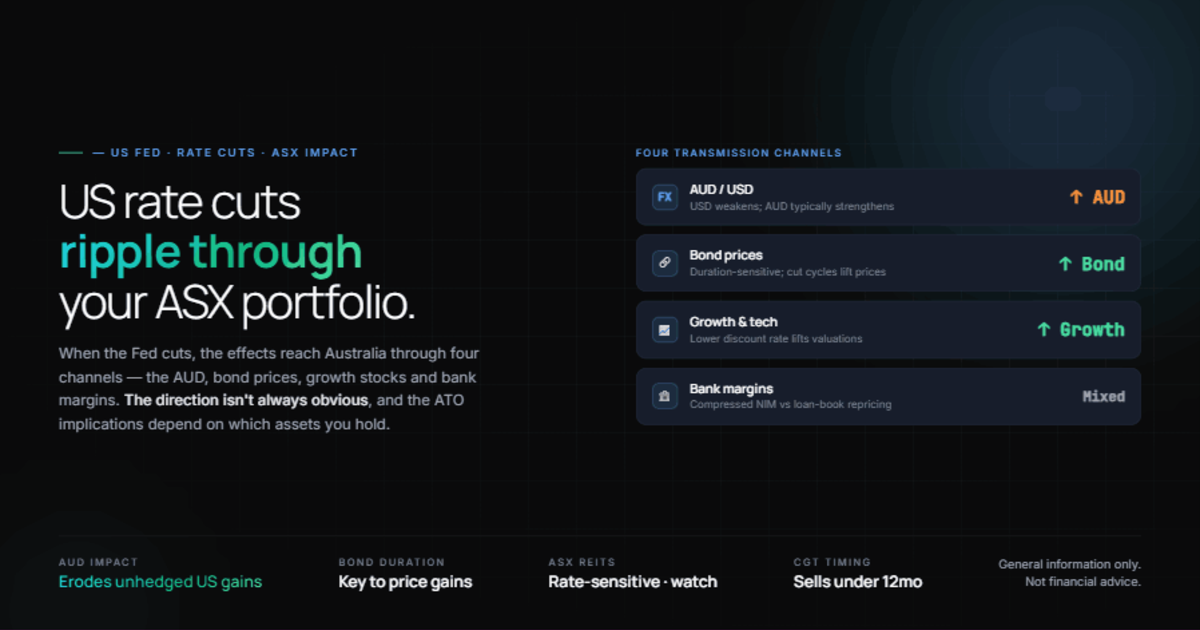
US rate cuts lower the federal funds rate, the benchmark borrowing cost for US banks, and those moves travel through global markets within hours. They reach your ASX ETF portfolio through three channels: Treasury yields reprice bond ETFs, equity discount rates shift growth valuations, and the AUD/USD rate moves unhedged global ETF returns.
The US dollar is the world’s reserve currency. US Treasury yields act as the risk-free rate against which almost every other asset is priced. When those yields shift, so do valuations for equities, bonds and currencies worldwide, including on the ASX.
Three channels carry Fed decisions into your ETF portfolio. First, Treasury yields move, repricing bond ETF values directly. Second, equity discount rates shift, compressing or expanding growth stock valuations. Third, interest rate differentials between the US and Australia affect the AUD/USD exchange rate, which flows straight into unhedged global ETF returns.
What can we learn from the Greenspan era?
The Greenspan era offers a lesson in how investor expectations of a central-bank backstop took hold. Alan Greenspan chaired the Federal Reserve from 1987 to 2006, a tenure spanning the 1987 crash, the dot-com bust and the early stages of the GFC. Research from the Richmond Federal Reserve shows that since the mid-1990s the Fed tended to lower rates by roughly 1.2 percentage points in the year following a 10% stock-market decline, and investors came to believe the Fed would always step in — an expectation known as the “Greenspan put”. Between February 1994 and February 1995 Greenspan nearly doubled the federal funds rate across seven increases, markets sold off, and the subsequent easing cycle rewarded those who held on. That pattern — hike until something breaks, then cut — repeated across cycles and still influences how investors price risk in global equity ETFs today, though it is a behavioural pattern, not a guarantee.
Alan Greenspan chaired the Federal Reserve from 1987 to 2006. His tenure included the 1987 crash, the dot-com bust and the early stages of the GFC. Research from the Richmond Federal Reserve shows that since the mid-1990s, the Fed tended to lower rates by roughly 1.2 percentage points in the year following a 10% stock market decline. Investors came to believe the Fed would always step in — an expectation known as the Greenspan put.
Between February 1994 and February 1995, Greenspan nearly doubled the federal funds rate across seven increases. Markets sold off sharply. The subsequent easing cycle rewarded investors who held on. That pattern — hike until something breaks, then cut — repeated across multiple cycles and hardened the belief that the Fed would rescue markets from deep drawdowns.
That inherited expectation of a Fed backstop still influences how investors price risk in global equity ETFs today. Understanding this is a behavioural pattern, not a guarantee, is essential before you position your portfolio around it.
How do US rate cuts flow through to your ASX ETF portfolio?
US rate cuts flow through to your ASX ETF portfolio differently depending on what you hold. For equity ETFs, lower discount rates support higher valuations for growth stocks, and rate cuts fuel risk-on sentiment that tends to favour growth, technology and emerging-markets exposures — so global equity ETFs with heavy US technology weightings are particularly sensitive. For bond ETFs, falling Treasury yields lift the prices of existing bonds, so a Fed cutting cycle should push the net asset value of a global bond ETF higher even before distributions, while rising rates do the reverse. Duration measures this sensitivity: because high-grade bond indices carry low coupons, even a modest rise in yields can erase a year’s income, so check a bond ETF’s stated duration before buying. Currency matters too — when the Fed eases the USD often weakens, reducing unhedged AUD returns.
Equity ETFs
When the Fed cuts rates, lower discount rates support higher valuations for growth stocks. Rate cuts fuel risk-on sentiment and tend to support growth, technology and emerging markets exposures. Global equity ETFs with heavy US technology weightings are particularly sensitive to this dynamic.
Bond ETFs
When Treasury yields fall, the prices of existing bonds rise. If you hold a global bond ETF, a Fed cutting cycle should push the net asset value of your units higher, even before distributions are paid. The reverse applies equally: rising rates reduce bond ETF prices.
Duration measures how sensitive a bond’s price is to rate changes. Because many high-grade bond indices carry low coupons, even a modest rise in yields can wipe out a year’s income and push total returns negative. Long-duration bond ETFs held through a hiking cycle can generate meaningful capital losses. Before buying or holding a bond ETF, check its stated duration in the product disclosure statement.
Hedged versus unhedged ETFs: which do you hold?
When the Fed eases, the USD often weakens. For Australian investors holding unhedged global ETFs, a weaker USD reduces your returns in AUD terms even if the underlying assets rise. A hedged ETF removes most of that currency risk but typically charges a slightly higher fee. Knowing which type you hold is essential before a rate cycle shifts.
How do rate cycle phases map to ETF asset classes?
Different phases of the rate cycle favour different ETF asset classes. In the early stages of an easing cycle, longer-duration bond ETFs, growth equity ETFs and emerging-markets ETFs have historically benefited most, because falling yields compress discount rates and boost the present value of future earnings, while a weaker USD reduces the cost of emerging-market USD-denominated debt. Before the pivot arrives, by contrast, long-duration bond ETFs and high-multiple growth stocks face the most pressure, and short-duration bond ETFs and value or dividend-focused equity ETFs tend to hold up better. The practical step is to pull the product disclosure statement for each ETF you hold, check the modified duration for bond ETFs and the sector weights for equity ETFs: a global equity ETF with a 30% technology weighting behaves very differently from a dividend-focused Australian equity ETF when the Fed moves rates.
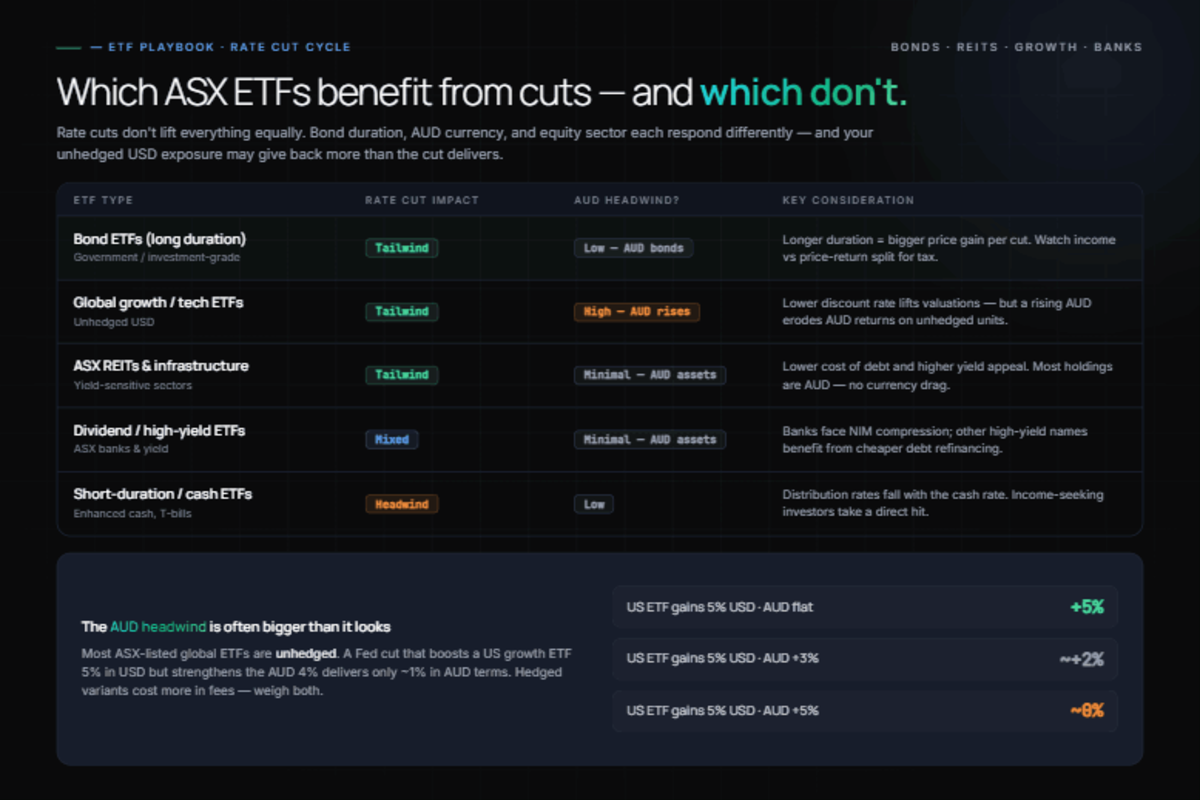
In the early stages of an easing cycle, longer-duration bond ETFs, growth equity ETFs and emerging markets ETFs have historically benefited most. Falling yields compress discount rates and boost the present value of future earnings. Emerging market economies also benefit from a weaker USD reducing the cost of their USD-denominated debt.
Before the pivot arrives, long-duration bond ETFs and high-multiple growth stocks face the most pressure. Short-duration bond ETFs and value or dividend-focused equity ETFs tend to hold up better.
Pull the product disclosure statement for each ETF you hold. Check the modified duration for bond ETFs and the sector weights for equity ETFs. A global equity ETF with a 30% technology weighting behaves very differently to a dividend-focused Australian equity ETF when the Fed moves rates.
What is the Australian tax dimension?
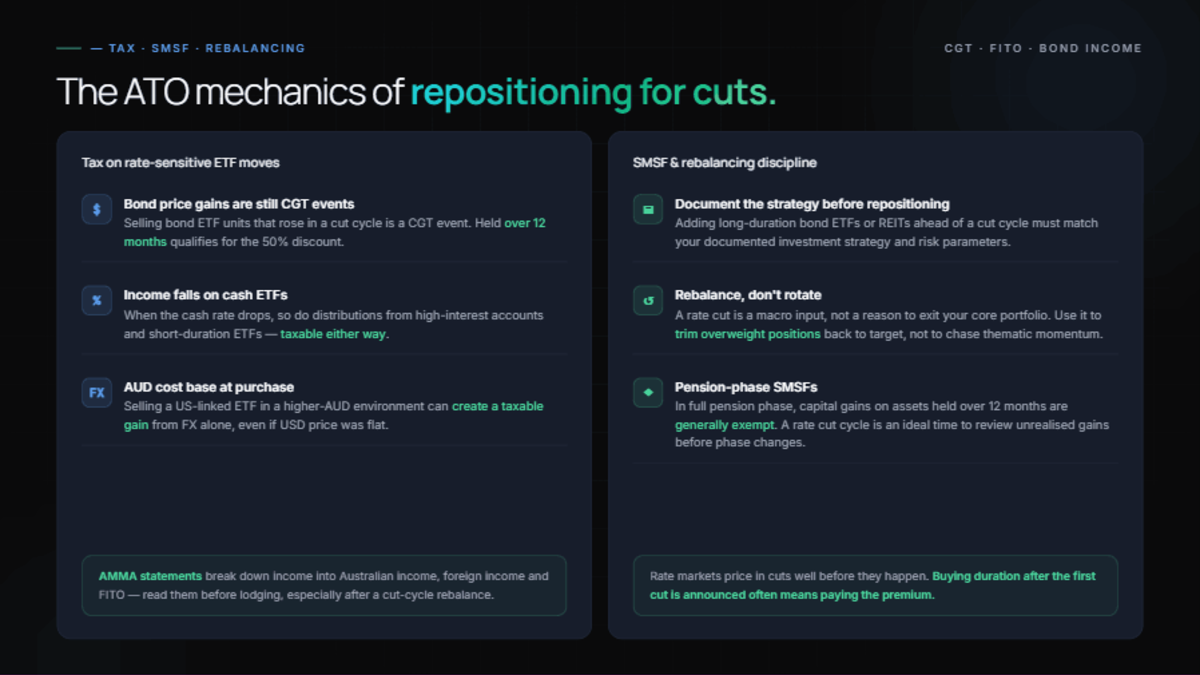
The Australian tax dimension shapes whether acting on Fed news is worthwhile. Selling ETF units triggers a CGT event under ATO rules — whether you are rotating from bond to equity ETFs, switching between hedged and unhedged versions, or moving into a sector tilt — so calculate the gain or loss on your current units before acting. Individuals and trusts receive a 50% CGT discount on gains from assets held more than 12 months, while units held under 12 months have the full gain included in assessable income, so avoid selling just before the 12-month mark unless the case is compelling. Distributions also matter: global bond ETF distributions typically include interest and foreign income taxed at your marginal rate, global equity ETF distributions carry foreign withholding-tax credits but rarely franking credits, and any allocation shift inside an SMSF must be reflected in its documented investment strategy.
How do CGT events and the 12-month discount work?
Selling ETF units triggers a CGT event under ATO rules. This applies whether you are rotating from bond ETFs to equity ETFs, switching between hedged and unhedged versions, or moving into a sector tilt. Calculate the capital gain or loss on your current units before acting on Fed news.
Individual investors and trusts receive a 50% CGT discount on gains from assets held for more than 12 months. If you sell units held for under 12 months, the full gain is included in your assessable income for that financial year. Avoid selling just before the 12-month mark unless the case for doing so is compelling.
How are distributions taxed?
Distributions from global bond ETFs typically include interest and foreign income, both taxed at your marginal rate. Distributions from global equity ETFs include foreign dividends and often carry foreign withholding tax credits but rarely franking credits. Australian equity ETF distributions frequently carry franking credits, which offset your tax liability directly.
When a global ETF receives dividends from US or European companies, foreign withholding tax is deducted at source. The ETF provider passes through a foreign income tax offset in your annual tax statement. Keep those statements, as the breakdown between interest, dividends, foreign income and capital gains determines how each dollar is taxed.
What are the SMSF obligations?
Any shift in asset allocation driven by Fed policy expectations must be reflected in your SMSF’s investment strategy document. The ATO expects trustees to document how they consider risk, return, liquidity and diversification. A macro-driven tilt toward bond or gold ETFs ahead of an easing cycle should be recorded with the rationale at the time of the decision.
Pension-phase members face sequencing risk: a sharp drawdown reduces the balance from which future returns compound. Pension-phase SMSF members should hold a more conservative duration profile in bond ETFs and review unhedged currency exposure before a volatile rate cycle.
How do gold ETFs hedge against Fed policy uncertainty?
Gold ETFs can act as a hedge against Fed policy uncertainty. State Street’s analysis shows gold has historically provided a buffer during periods of Fed leadership uncertainty and late-cycle policy shifts, tending to perform well when real yields fall and when confidence in the Fed’s policy path is low. Australian investors can access gold through ASX-listed ETFs that hold physical gold or gold futures, without needing an international brokerage account or currency conversion, which keeps the exposure simple and AUD-denominated. For tax, a gold ETF is treated as a standard CGT asset under ATO rules, and gains on units held for more than 12 months qualify for the 50% CGT discount for individuals. Be aware that rebalancing back from gold into equities or bonds after a run-up itself triggers a CGT event, so factor that into your rebalancing decisions rather than trading reactively on headlines.
State Street’s analysis shows gold has historically provided a buffer during periods of Fed leadership uncertainty and late-cycle policy shifts. Gold tends to perform well when real yields fall and when confidence in the Fed’s policy path is low. Australian investors can access gold through ASX-listed ETFs that hold physical gold or gold futures, without needing an international brokerage account or currency conversion.
A gold ETF is treated as a standard CGT asset under ATO rules. Gains on units held for more than 12 months qualify for the 50% CGT discount for individuals. Rebalancing back from gold into equities or bonds after a run-up triggers a CGT event, so factor that into your rebalancing decisions.
What is a practical framework for your ASX ETFs?
A practical framework for your ASX ETFs starts with knowing what you already own rather than trying to time the Fed. Before the next meeting, list every global ETF you hold and confirm whether each is hedged or unhedged, check the duration of any bond ETFs and the sector composition of your equity ETFs — a review that takes less than an hour and tells you exactly where your rate sensitivity sits. Rather than predicting the exact pivot, use dollar-cost averaging to build positions across a rate cycle, since regular contributions over six to twelve months smooth your entry point and reduce the risk of buying at the peak of a rate-cut rally. Keep records of every CGT event, including acquisition dates, cost bases and proceeds, remembering that each reinvested distribution creates a new parcel with its own cost base and holding period.
Before the next Fed meeting, list every global ETF you hold and confirm whether it is hedged or unhedged. Check the duration of any bond ETFs and the sector composition of your equity ETFs. This review takes less than an hour and tells you exactly where your rate sensitivity sits.
Rather than trying to time the exact pivot, use dollar cost averaging to build positions across a rate cycle. Regular contributions into a growth or bond ETF across six to twelve months smooth your entry point and reduce the risk of buying at the peak of a rate-cut rally.
The ATO requires you to keep records of every CGT event, including acquisition dates, cost bases and sale proceeds. If you reinvest distributions through a distribution reinvestment plan, each reinvestment creates a new parcel with its own cost base and holding period. A portfolio tracker like Crowdfolio helps Australian DIY investors maintain these records automatically and estimate CGT across different rotation scenarios.
Before making any change based on a Fed announcement, ask yourself:
- Does this trade create a CGT event, and is the 50% discount available?
- Am I switching from an unhedged to a hedged ETF, and do I understand why?
- Is my bond ETF duration appropriate for the current rate environment?
- Have I updated my SMSF investment strategy if applicable?
- Am I reacting to a headline or acting on a pre-planned allocation decision?
Frequently asked questions
Does the RBA always follow the Fed when cutting rates?
No. The RBA sets the cash rate based on domestic inflation and employment conditions. Large moves in US rates affect the AUD/USD exchange rate and global financial conditions, which the RBA considers. The two central banks often move in the same direction but not always at the same time or magnitude.
If I switch from a bond ETF to an equity ETF because the Fed is cutting, do I pay CGT?
Yes. Selling bond ETF units is a CGT event regardless of why you sell. Units held for more than 12 months attract the 50% CGT discount for individual investors. Units held for under 12 months are assessed at your full marginal rate.
How does the AUD/USD rate affect my unhedged global ETF returns when the Fed eases?
When the Fed eases, the USD often weakens against the AUD. Your returns are calculated by converting USD-denominated gains back into AUD. A stronger AUD reduces your return. If a global equity ETF rises 8% in USD terms but the AUD strengthens 5% over the same period, your AUD return is closer to 3%.
Can my SMSF shift allocation based on Fed policy decisions, and what documentation is required?
Yes, provided the shift is consistent with the fund’s investment strategy and your trustee obligations under the Superannuation Industry (Supervision) Act. Document the rationale in writing at the time of the decision, update the investment strategy if the new allocation sits outside existing ranges, and retain records for audit purposes.