
How do UK elections move markets, and why does the noise fade quickly?
UK general elections rarely get much coverage in Australian financial media. Yet for any Australian investor holding a globally diversified ETF, the outcome flows directly into two things: the British pound against the Australian dollar, and the value of UK equities inside your portfolio.
This article covers what UK election cycles do to markets, why sterling is the real lever for Australian investors, and how to think about UK exposure in your ASX portfolio without overreacting to short-term noise.
Research confirms volatility around UK elections is real. One cross-country analysis found equity market volatility doubles during election weeks, with returns showing more than 20% higher volatility across a 51-day window surrounding the vote.
That volatility is mostly driven by uncertainty, not the outcome itself. Once a result is clear, markets tend to reprice quickly and stabilise. The bulk of election-related price movement occurs before the result is known.
Post-election, FTSE 100 performance over 6–12 months typically reflects global growth conditions, commodity cycles, and interest rate movements far more than the colour of the new government.
Labour vs Conservative: Does the Winner Actually Matter?
Longer-term evidence finds no statistically meaningful difference in FTSE 100 returns under Labour versus Conservative governments. Broad macroeconomic forces consistently dominate domestic political outcomes.
Policy differences do surface at the sector level — energy and utilities, banks, and healthcare are most sensitive. For Australian investors in broadly diversified global ETFs, these sensitivities are diluted across hundreds of holdings and rarely move the overall portfolio.
Why is the FTSE 100 not a domestic index?
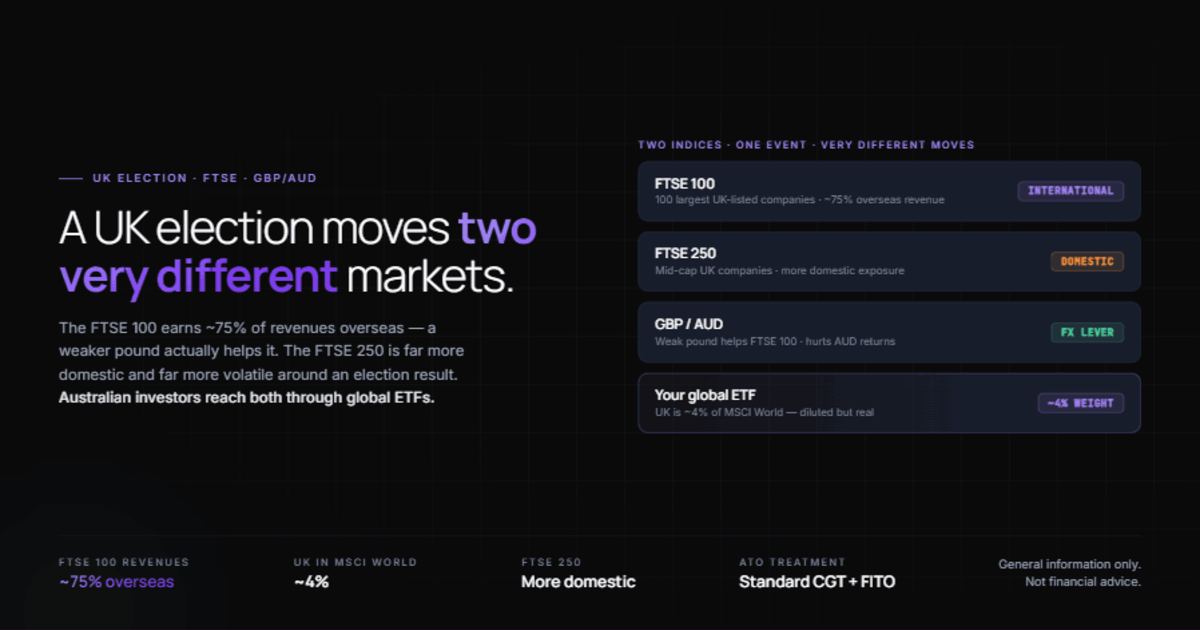
The FTSE 100 is not a domestic UK index, which is why a change of government affects it less than headlines imply. Approximately 75–80% of FTSE 100 constituent revenues are earned outside the UK, and the index is dominated by globally oriented multinationals in mining, energy, pharmaceuticals, consumer staples and financials; the FTSE 250 is far more domestically oriented, and that contrast matters when assessing election sensitivity. A change of government in Westminster has limited direct impact on Shell’s upstream operations, AstraZeneca’s global drug sales or HSBC’s Asian banking revenues, because these companies earn in US dollars, euros and other currencies rather than primarily in sterling. As a result, USD strength and global commodity prices drive FTSE 100 performance with far greater force than domestic UK fiscal policy, so for Australian investors holding global ETFs with UK weighting, exposure to Westminster outcomes is structurally smaller than the headlines suggest.
Approximately 75–80% of FTSE 100 constituent revenues are earned outside the UK. The index is dominated by globally-oriented multinationals in mining, energy, pharmaceuticals, consumer staples, and financials. The FTSE 250 is far more domestically oriented — that contrast matters when assessing election sensitivity.
A change of government in Westminster has limited direct earnings impact on Shell’s upstream operations, AstraZeneca’s global drug sales, or HSBC’s Asian banking revenues. These companies earn in USD, EUR, and other currencies, not primarily sterling.
USD strength and global commodity prices drive FTSE 100 performance with far greater force than domestic UK fiscal policy. For Australian investors in global ETFs with UK weighting, exposure to Westminster outcomes is structurally smaller than the headlines suggest.
Why is sterling the real variable in AUD/GBP dynamics?
Sterling, not the FTSE result, is the real variable for Australian investors in UK exposure. The pound tends to weaken in the lead-up to UK elections as capital flows respond to policy ambiguity, because uncertainty over fiscal direction, tax policy and regulatory settings makes sterling-denominated assets less attractive to international investors. AUD/GBP volatility is also typically asymmetric: surprise outcomes such as hung parliaments or unexpectedly large majorities produce larger and faster currency moves than anticipated results. If you hold an unhedged international ETF with UK equity exposure, AUD/GBP movements affect your AUD-denominated returns on top of any movement in underlying share prices. As a worked example, if UK equities are 4% of an unhedged global ETF and sterling falls 5% against the AUD after an election surprise, that sleeve delivers a negative AUD return even if UK share prices are flat in GBP terms — the currency move, not the equity market, drove the outcome.
Sterling tends to weaken in the lead-up to UK elections as capital flows respond to policy ambiguity. Uncertainty over fiscal direction, tax policy, and regulatory settings makes sterling-denominated assets less attractive to international investors.
AUD/GBP volatility is typically asymmetric. Surprise outcomes — hung parliaments, unexpectedly large majorities — produce larger and faster currency moves than anticipated results.
What does a stronger or weaker pound mean for your portfolio?
If you hold an unhedged international ETF with UK equity exposure, AUD/GBP movements affect your AUD-denominated returns on top of any movement in underlying share prices.
Worked example: You hold an unhedged global ETF. UK equities represent 4% of the fund. Sterling falls 5% against the AUD following an election surprise. Even if UK share prices are flat in GBP terms, that 4% sleeve delivers a negative AUD return. The currency move, not the equity market, drove the outcome.
This is why sterling dynamics deserve more attention than the FTSE result itself.
Is UK exposure already inside your global ETF?
For most Australian investors, UK exposure is already sitting inside their global ETF. Developed-market and global equity ETFs listed on the ASX typically allocate 3–6% of the fund to UK shares via market-capitalisation weighting, so you do not need a dedicated UK product to have FTSE exposure. ASX investors access UK equities through two main routes: broadly diversified international ETFs with embedded UK weighting, or dedicated FTSE 100 ETFs providing targeted exposure. Key structural considerations when comparing them include CHESS-sponsored versus custodian-held structures, expense ratios and distribution frequency. A dedicated FTSE 100 ETF suits a deliberate overweight — for example, diversifying away from US-heavy global funds — but for most Australian DIY investors, UK exposure through a broad international fund is sufficient. The most useful first step before any election is simply to check each fund’s factsheet or PDS for its current UK weighting.
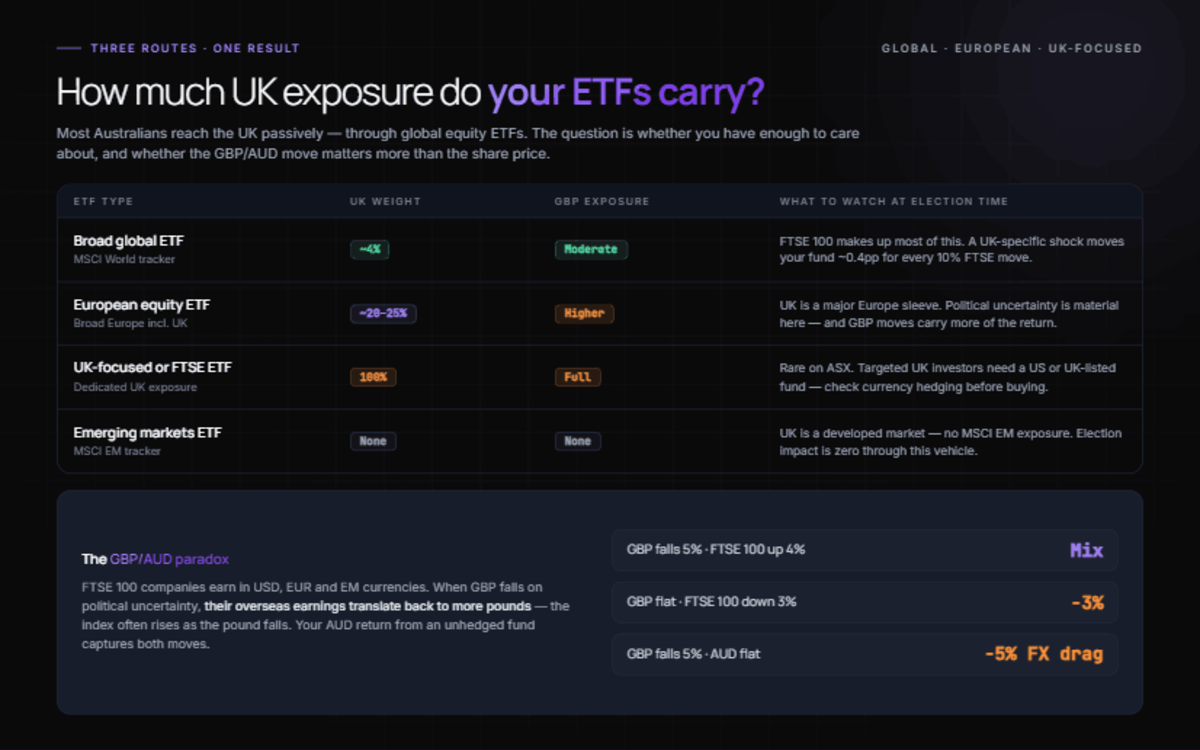
Most Australian investors with globally diversified ETFs already hold UK equities. Developed market and global equity ETFs listed on the ASX typically allocate 3–6% of the fund to UK shares via market capitalisation weighting. You do not need a dedicated UK product to have FTSE exposure.
ASX investors access UK equities through two main routes: broadly diversified international ETFs with embedded UK weighting, or dedicated FTSE 100 ETFs providing targeted exposure.
Key structural considerations when comparing these include CHESS-sponsored versus custodian-held structures, expense ratios, and distribution frequency. A dedicated FTSE 100 ETF suits deliberate overweight exposure — for example, diversifying away from US-heavy global funds. For most Australian DIY investors, UK exposure through a broad international fund is sufficient.
Hedged vs unhedged: which structure should you choose?
Choosing between hedged and unhedged structures depends on your horizon and currency view, not on a single election. A hedged ETF removes the AUD/GBP currency variable by using forward contracts to lock in the exchange rate, so your return tracks the underlying equity market in local-currency terms — but the cost of hedging is real, with management expense, roll cost on currency contracts and drag on long-term compounding all reducing net returns versus an equivalent unhedged structure. Unhedged structures benefit Australian investors when the AUD weakens against sterling and create headwinds when it strengthens. A binary political event is a poor basis for switching, because predicting short-term AUD/GBP direction around an election is a low-probability exercise, and transaction costs — including potential CGT events — reduce expected value further. Dollar-cost averaging is a practical alternative, spreading purchases over several weeks to reduce entry-timing risk without requiring a currency call.
A hedged ETF removes the AUD/GBP currency variable from your return, using forward contracts to lock in the exchange rate so your return tracks the underlying equity market in local currency terms. The cost of hedging is real — management expense, roll cost on currency contracts, and drag on long-term compounding all reduce net returns versus an equivalent unhedged structure.
Unhedged structures benefit Australian investors when the AUD weakens against sterling. They create headwinds when the AUD strengthens against GBP.
A binary political event is a poor basis for switching between hedged and unhedged structures. Predicting short-term AUD/GBP direction around an election is a low-probability exercise, and transaction costs — including potential CGT events — reduce expected value further.
Dollar cost averaging (DCA) is a practical alternative. Spreading purchases over several weeks reduces entry-point timing risk without requiring a currency call.
What tax obligations does the ATO expect?
When you sell an internationally focused ETF, the ATO calculates your capital gain in AUD: your cost base is the AUD value at purchase and your proceeds the AUD value at disposal, with the AUD/GBP rate at both dates relevant for UK-denominated holdings. Individuals and trusts holding the ETF for 12 months or more are eligible for the 50% CGT discount, and because UK election cycles rarely align neatly with 12-month holding periods, an election-driven price spike is not a straightforward reason to sell without first checking your discount eligibility. The ATO requires transaction records — including exchange rates at purchase and disposal — for a minimum of five years. UK dividends received through international ETFs attract withholding tax at the fund level, and depending on the structure a foreign income tax offset may reduce double taxation; for SMSF trustees, FITO eligibility should be assessed at the fund level.
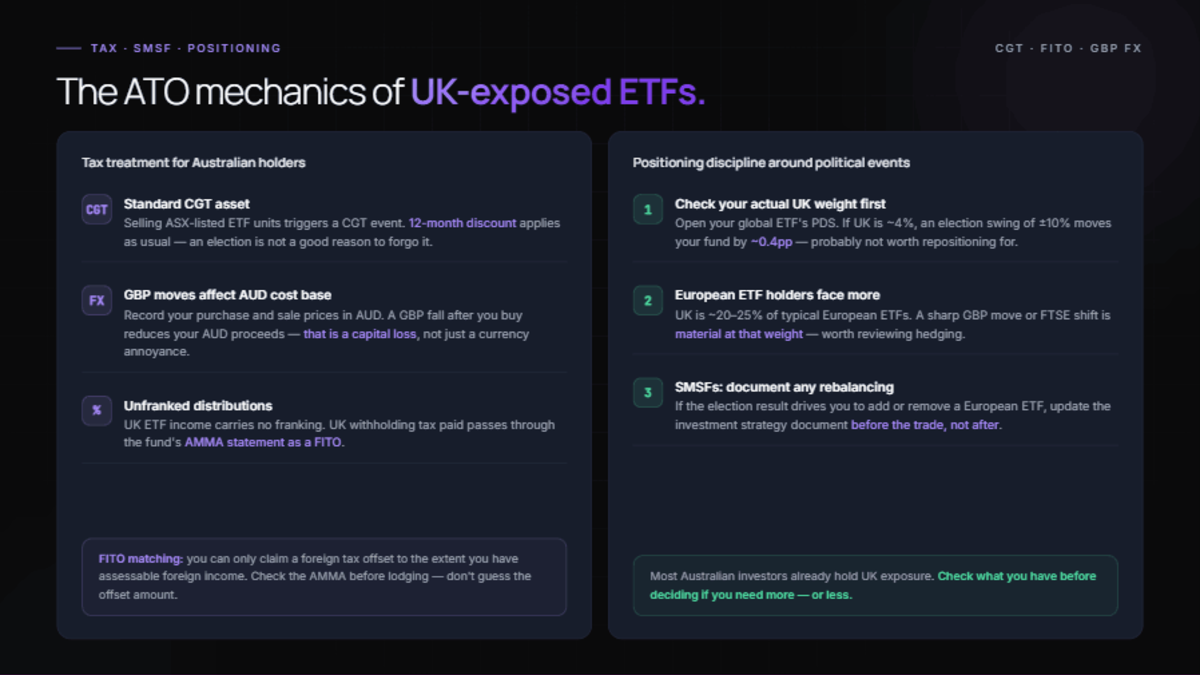
When you sell an internationally-focused ETF, the ATO calculates your capital gain in AUD. Your cost base is determined by the AUD value at purchase; your proceeds by the AUD value at disposal. The AUD/GBP rate at both dates is relevant for UK-denominated holdings.
Individuals and trusts holding the ETF for 12 months or more are eligible for the 50% CGT discount. UK election cycles rarely align neatly with 12-month holding periods, so an election-driven price spike is not a straightforward reason to sell without first checking your discount eligibility. The ATO requires transaction records — including exchange rates at purchase and disposal — for a minimum of five years.
UK dividends received through international ETFs attract withholding tax at the fund level. Depending on the ETF structure and your circumstances, a foreign income tax offset (FITO) may reduce double taxation in your annual return.
For SMSF trustees, foreign withholding tax treatment and FITO eligibility should be assessed at the fund level, as tax treatment differs between accumulation and retirement phase.
Tax obligations do not change with the political cycle. Making a CGT-crystallising disposal based on short-term election noise is one of the more common and avoidable mistakes Australian investors make.
How should you position your portfolio around binary political events?
Positioning around a binary political event usually means doing less, not more. Academic evidence consistently shows the cost of being out of the market during post-election relief rallies outweighs the benefit of avoiding short-term volatility, and once you add transaction costs, the bid-ask spread and a potential CGT event, the expected value of tactical repositioning falls further. Before making any change, work through four questions: how much UK exposure you already hold, checking each international ETF’s factsheet for UK weighting; whether that exposure is hedged or unhedged, which determines how directly AUD/GBP movements affect returns; your investment horizon, since shorter horizons increase sensitivity to near-term currency moves; and your current CGT position, since selling to reduce exposure crystallises a gain or loss. The most useful action around a UK election is not repositioning — it is understanding what you already own.
Academic evidence consistently shows the cost of being out of the market during post-election relief rallies outweighs the benefit of avoiding short-term volatility. Add transaction costs, bid-ask spread, and a potential CGT event, and the expected value of tactical repositioning falls further.
Before making any change, work through these questions:
- How much UK exposure do you already hold? Check the factsheet or PDS of each international ETF for UK weighting.
- Is that exposure hedged or unhedged? This determines how directly AUD/GBP movements affect your returns.
- What is your investment horizon? Shorter horizons increase sensitivity to near-term currency moves.
- What is your current CGT position? Selling to reduce exposure crystallises a gain or loss.
Tools like Crowdfolio let Australian DIY investors aggregate holdings across brokers and ETFs, making it easier to see total international exposure — including UK weighting — without manually tracking each fund.
The most useful action around a UK election is not repositioning. It is understanding what you already own.
Frequently asked questions
How does a UK general election affect the AUD/GBP exchange rate?
Election uncertainty adds a risk premium to sterling, typically weakening it in the lead-up to the result. A clear majority usually stabilises GBP quickly. A hung parliament or surprise result produces sharper and more sustained moves in AUD/GBP.
Which ASX-listed ETFs give Australian investors UK exposure?
Dedicated FTSE 100 ETFs provide direct UK market exposure. Broadly diversified developed market and global equity ETFs also carry UK allocations, typically 3–6% of the fund. Check the PDS or factsheet for the current UK weighting and whether the fund is CHESS-sponsored or custodian-held.
Should I hedge currency exposure when investing in UK ETFs from Australia?
The hedged versus unhedged decision depends on your investment horizon, your view on AUD/GBP direction, and your willingness to pay hedging costs. A single political event is not sufficient reason to switch structures. For long-term investors, DCA into your chosen structure reduces the significance of short-term entry timing.
What are the ATO CGT implications of selling an international ETF after an election-driven price spike?
Selling triggers a CGT event. Your gain is calculated in AUD using the exchange rate at purchase and disposal. If you have held the ETF for fewer than 12 months, you do not qualify for the 50% CGT discount. FITO eligibility for withholding tax paid at the fund level is assessed separately in your annual return.