
Why does SpaceX command attention from Australian investors?
The SpaceX IPO — the largest in history — completed on 12 June 2026, and the stock now trades on the Nasdaq as SPCX. For Australian DIY investors that changes everything: instead of chasing restricted pre-IPO access, you can now buy SpaceX directly through a US brokerage, alongside ETF routes and the tax rules covered below.
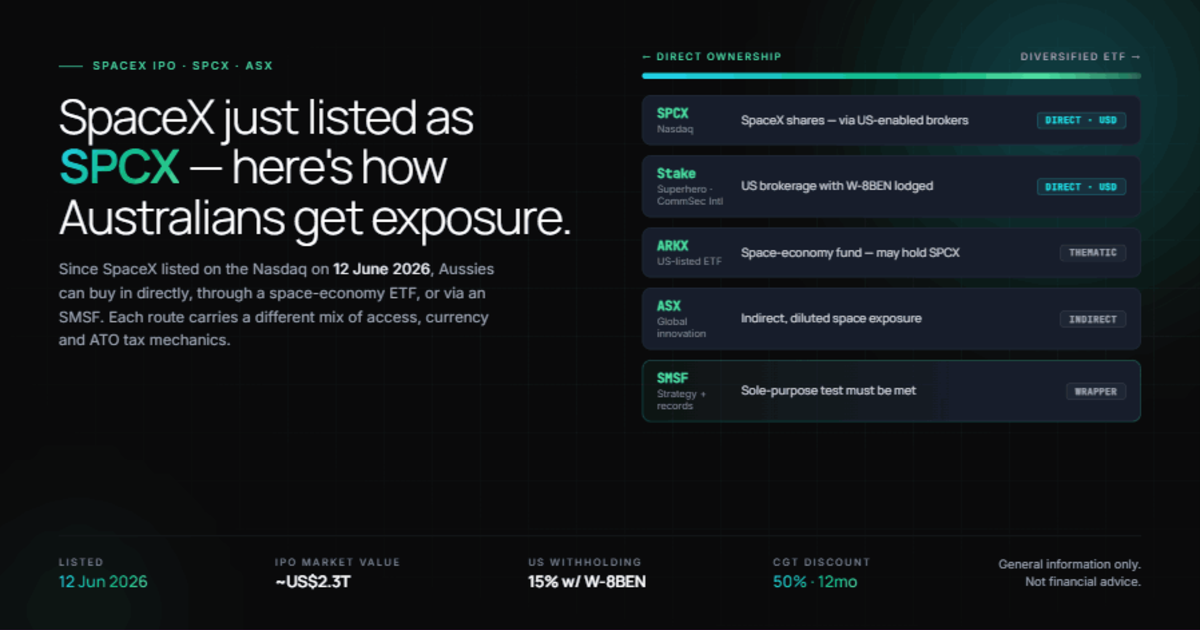
SpaceX priced its offering at USD $135 a share, opened at $150 and finished its first session up about 19%, raising roughly USD $75 billion and briefly pushing Elon Musk’s estimated net worth above the trillion-dollar mark. Since listing the stock has swung between the high USD $140s and above USD $220; in early July 2026 it trades around USD $160, for a market capitalisation just above USD $2 trillion — one of the largest listed companies in the United States and worth more than the combined value of the biggest companies on the ASX.
Three business divisions drive that valuation. The Falcon rocket program holds dominant market share in commercial launches and carries major NASA contracts. Starlink has reached millions of subscribers globally and supplies the recurring revenue investors prize. Starship, still in development, represents the long-duration upside that underpinned the IPO’s premium pricing.
Can Australians Buy SpaceX Shares Directly?
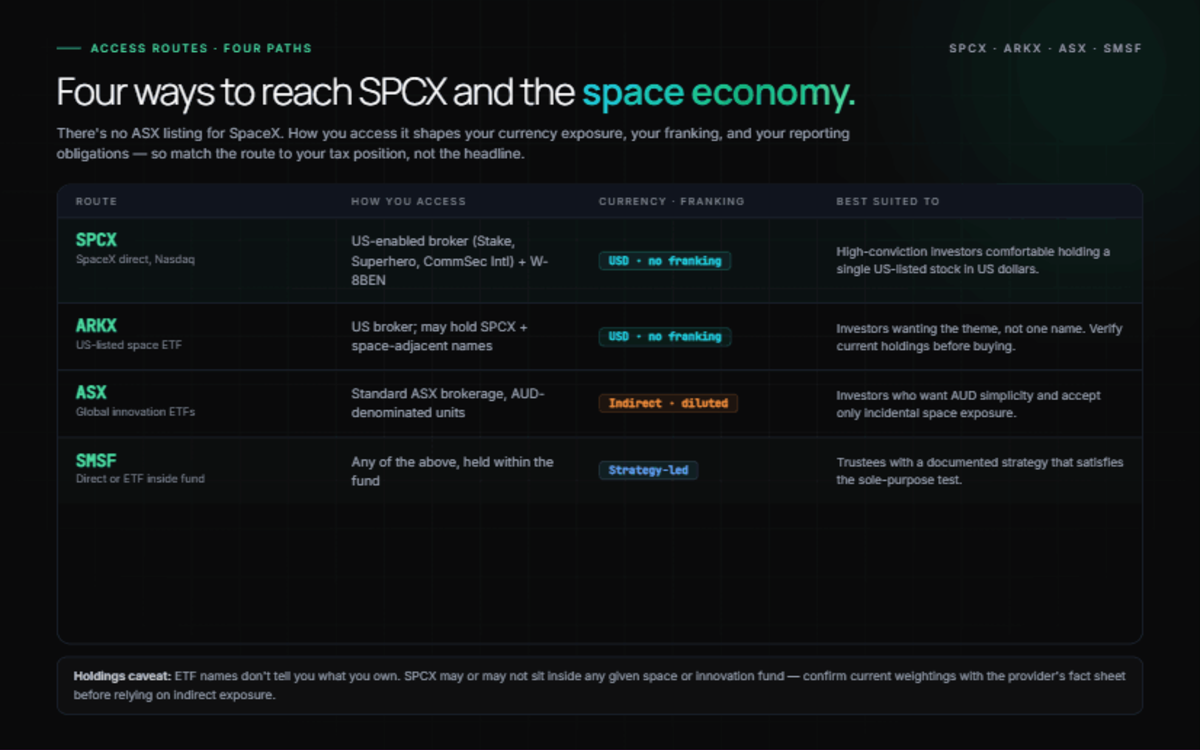
Yes — now that SpaceX has listed on the Nasdaq as SPCX, Australians can buy its shares directly through international broker platforms such as Stake, Superhero or CommSec International, the same way they would any other US-listed stock. This is a major change from the pre-IPO period, when access was restricted to institutional and US-accredited investors and most Australian retail investors did not qualify. A few things still warrant care in the months after listing: early shareholders and employees are often subject to lock-up periods that can affect share supply and volatility once they expire, and SpaceX’s dual-class share structure means ordinary retail shareholders carry limited or no meaningful voting rights. There is still no ASX listing or CDI, so you trade SPCX in US dollars on a US exchange, which brings the currency and tax considerations covered later in this guide.
What changed when SpaceX went public?
For years Elon Musk kept SpaceX private to avoid short-term shareholder pressure, and the company still uses a dual-class share structure that concentrates voting control. The June 2026 listing changed access, not control: retail shareholders can now buy SPCX freely on the open market, but the dual-class structure means they hold limited voting rights regardless of stake size.
Do pre-IPO secondary markets still matter?
Before the listing, the only access was through private secondary markets and tender offers, largely restricted to institutional and US-accredited investors. Now that SPCX trades publicly, that route is unnecessary for most investors — buying on the open market is simpler, more liquid and more transparent. Be cautious of any platform still marketing “pre-IPO SpaceX allocations”. Before engaging with any private or derivative product, ask:
- Is the platform regulated by ASIC or an equivalent overseas authority?
- Are you buying actual shares or a derivative instrument?
- What are the lock-up terms and exit conditions?
- How is the share price determined, and by whom?
Liquidity risk and pricing opacity remain the two core dangers of off-market routes.
What did the SpaceX IPO mean for Australians?
Now that the listing has happened, Australian investors with US broker accounts through platforms such as Stake, Superhero or CommSec International can buy SPCX in the open market just like any US share. Retail investors received little or no stock at the $135 IPO price; like most, Australians are buying in the aftermarket, where the stock has traded well above the issue price. An ASX listing or CDI structure remains possible but has not been signalled by SpaceX.
How do space economy ETFs give indirect SpaceX exposure?
Even with SpaceX now listed, space-economy ETFs remain a useful, diversified way to gain exposure without betting on a single stock. ETFs can now hold SPCX directly as a listed security — previously some US-listed funds held SpaceX only as an unlisted private position — so always check a fund’s current holdings on its factsheet to see whether, and how much, SpaceX it owns. The ARK Space and Defence ETF (ARKX) is the most cited option for aerospace and technology exposure; when assessing any US-listed space ETF, review its top-ten holdings and weightings, SPCX’s weighting if held, the expense ratio, liquidity and fund size. ASX-listed global innovation ETFs from BetaShares and VanEck offer indirect, AUD-denominated exposure with CHESS sponsorship and simpler tax record-keeping, though pure-play space exposure on the ASX remains limited.
How do thematic ETFs provide a practical proxy?
Thematic ETFs let you spread risk across many space and aerospace companies rather than concentrating in one. Several US-listed funds hold SpaceX, and now that SPCX is publicly traded a fund can hold it as a normal listed security rather than an unlisted private stake.
Important: holdings change frequently, so always verify the current portfolio on the fund provider’s factsheet before assuming exposure exists, and check the weighting rather than relying on the fund’s name.
US-Listed ETFs Accessible to Australian Investors
The ARK Space and Defence ETF (ARKX) is the most cited option for aerospace technology exposure. When assessing any US-listed space ETF, review:
- Top-ten holdings and percentage weighting
- Whether SPCX appears as a holding and at what weight
- Expense ratio and liquidity
- Fund size in USD
Confirm current holdings directly on the fund provider’s disclosure page before investing. Holdings change frequently.
ASX-Listed Options
ASX-listed global innovation ETFs from providers such as BetaShares and VanEck provide indirect exposure to companies adjacent to the space economy. Pure-play space exposure through ASX-listed products is limited, but these options offer AUD-denominated settlement, CHESS sponsorship, and simpler tax record-keeping.
Use ASX-listed options as a starting point and supplement with US-listed products — or SPCX shares directly — where a specific thematic weighting is required.
How do you access US-listed ETFs from Australia?
Australian investors reach US-listed ETFs and shares such as SPCX through international broker platforms such as Stake, Superhero and CommSec International. Account setup requires proof of identity, a Tax File Number and a completed W-8BEN form, with onboarding usually taking one to three business days. The W-8BEN matters for tax: without it, US dividend withholding defaults to 30%, while the Australia–US tax treaty reduces this to 15% for investors who lodge the form. Franking credits do not apply to US-sourced income, so retain your submission confirmation for ATO record-keeping. Dollar cost averaging — spreading purchases across multiple dates — is a practical way to build a position in SPCX or a volatile thematic ETF while reducing timing risk. SMSFs can hold US-listed ETFs or shares provided the investment satisfies the sole-purpose test and the fund’s documented investment strategy, which trustees must update before transacting if international assets are not already covered.
Broker Platforms
Platforms including Stake, Superhero, and CommSec International allow Australian investors to buy US-listed ETFs and shares, including SPCX. Account setup requires proof of identity, a Tax File Number, and completion of the W-8BEN form. Onboarding typically takes one to three business days.
Dollar cost averaging (DCA) is a practical approach when building a position in a newly listed stock or thematic ETF. Spreading purchases across multiple dates reduces timing risk in a volatile sector.
The W-8BEN Form
Every Australian investor using a US broker must complete the W-8BEN form. Without it, US dividend withholding tax defaults to 30%. The Australia–US tax treaty reduces this to 15% for investors who have lodged the form.
Franking credits do not apply to US-sourced income. Retain your W-8BEN submission confirmation for ATO record-keeping purposes.
SMSF Investors
An SMSF can hold US-listed ETFs or SPCX shares, provided the investment satisfies the sole purpose test and aligns with the fund’s documented investment strategy. Trustees must update strategy documentation before transacting in international shares or thematic ETFs if this asset class is not already covered.
Record-keeping obligations include cost base in AUD, transaction dates, FX rates at purchase, and a full audit trail of brokerage confirmations.
How does the ATO tax SpaceX and US ETF investments?
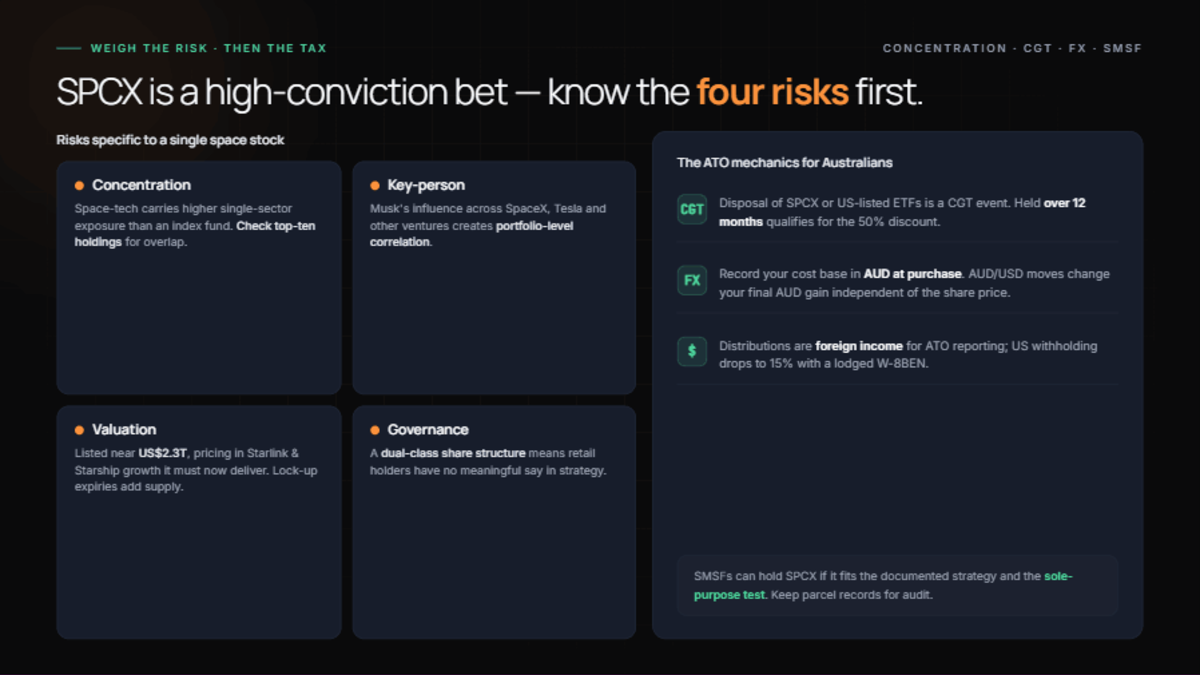
Selling SPCX shares or US-listed ETFs triggers a CGT event for Australian tax residents, and your cost base must be recorded in AUD at the date of purchase — a step that is non-negotiable and often overlooked. Gains on assets held for more than 12 months qualify for the 50% CGT discount for individuals and trusts, and you should retain all transaction records, including brokerage confirmations and FX rates, for five years. AUD/USD movements between purchase and sale affect your AUD-denominated gain: a 20% USD gain can shrink to roughly 4% in AUD terms once currency moves are applied, and the ATO treats this FX difference as part of the cost base calculation rather than a separate income event. Distributions from US-listed ETFs are treated as foreign income, with treatment depending on whether they are qualified dividends, return of capital or ordinary income.
How is capital gains tax applied to foreign shares and ETFs?
Selling SPCX shares or US-listed ETFs triggers a CGT event for Australian tax residents. Your cost base must be recorded in AUD at the date of purchase. This step is non-negotiable and often overlooked.
Gains on assets held for more than 12 months qualify for the 50% CGT discount for individuals and trusts. Retain all transaction records for five years, including brokerage confirmations and FX rates applied.
Foreign Exchange Risk as a Tax Variable
AUD/USD movements between your purchase and sale dates affect your AUD-denominated capital gain or loss.
Example: You buy a US-listed asset at USD $50 when AUD/USD is 0.65 (cost base: AUD $76.92 per unit). You sell at USD $60 when AUD/USD is 0.75 (proceeds: AUD $80.00 per unit). Your USD gain is 20%, but your AUD gain is approximately 4% after currency movement. The ATO treats this FX difference as part of the cost base calculation, not a separate income event.
How do you report foreign income to the ATO?
Distributions from US-listed ETFs are treated as foreign income in your Australian tax return. Treatment depends on whether distributions are classified as qualified dividends, return of capital, or ordinary income. A tax agent with international investing experience adds real value here.
Key Risks to Weigh
- Concentration risk: Space-technology stocks and ETFs carry higher single-sector exposure than diversified index funds. Check top-ten holdings to avoid unintended overlap.
- Key-person risk: Musk’s influence across SpaceX, Tesla, and other ventures creates portfolio-level correlation.
- Valuation risk: SPCX listed at an implied valuation of about USD $1.8 trillion and quickly traded above USD $2 trillion, pricing in significant future growth from Starlink and Starship that the company must now deliver as a public company. Post-IPO lock-up expiries can also add share supply and volatility.
- Governance risk: The dual-class share structure means retail shareholders have no meaningful say in strategic direction.
Frequently asked questions
Can Australians buy SpaceX shares now?
Yes. Since SpaceX listed on the Nasdaq as SPCX on 12 June 2026, Australians can buy it directly through US-enabled brokers such as Stake, Superhero or CommSec International, trading in US dollars. There is no ASX listing, and a completed W-8BEN form is required.
Which ETFs give Australian investors exposure to SpaceX or the space economy?
US-listed funds such as ARKX may hold SPCX or space-adjacent companies, and some ASX-listed global innovation ETFs carry indirect exposure. Verify current holdings and weightings with each fund provider before investing.
What are the ATO tax implications?
Disposal of SPCX shares or US-listed ETFs is a CGT event. Record your cost base in AUD at purchase. Gains held over 12 months qualify for the 50% CGT discount. FX movements affect your final AUD gain. Distributions are foreign income for ATO reporting.
Can an SMSF invest in SPCX shares or US-listed ETFs?
Yes, provided it aligns with the fund’s documented investment strategy and satisfies the sole purpose test. Maintain detailed records for ATO audit compliance.