
When comparing shares and property in Australia, neither asset class is universally superior: ASX shares have historically returned 9–10% p.a. including dividends, while residential property averaged 6–7% p.a., but property’s higher leverage (up to 80% LVR) can amplify gains in rising markets. The best choice depends on your tax bracket, existing assets, and leverage tolerance.
Shares versus property Australia: which yields higher returns?
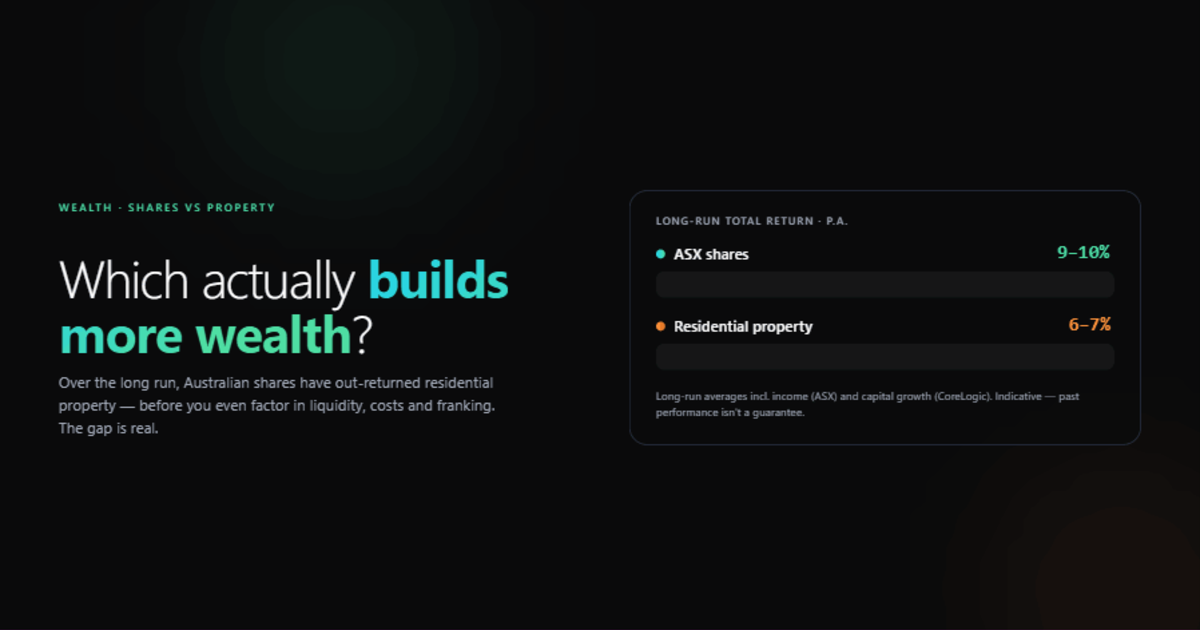
The ASX has delivered approximately 9 to 10 per cent per annum including dividends over the long term. Australian residential property has averaged around 6 to 7 per cent per annum based on Cotality data. That is a meaningful gap before you adjust for anything else.
Australian shares generate income yields of around 4 per cent, much of it carrying franking credits. Gross rental yields in major capitals typically sit between 2 and 4 per cent for houses, with units slightly higher.
Why Costs and Timing Transform the Comparison
Headline property returns are almost always overstated because most comparisons ignore stamp duty, maintenance, land tax, vacancy periods and management fees. Once you subtract these, net rental income is frequently well below the gross figure.
Shares carry costs too — brokerage and ETF management expense ratios — but these are substantially lower than the ongoing costs of a physical asset.
The Compounding Effect Over 20 to 30 Years
A 3 per cent annual difference in net returns compounded over 30 years produces a dramatically different outcome. On a $500,000 starting investment, 10 per cent per annum produces roughly $8.7 million. At 7 per cent, you get approximately $3.8 million. Costs are not trivial details — they determine your final number.

Is property investment better than stocks?
Stamp duty alone adds 4 to 6 per cent to the purchase price in most states. Add conveyancing, inspections and loan establishment costs, and your upfront burden often exceeds $30,000 to $50,000 on a median-priced property before you receive a single dollar of rent.
Council rates, water charges, landlord insurance, strata levies and property management fees (typically 7 to 10 per cent of rent) stack up quickly. Land tax applies in most states once your investment property value crosses a threshold and is assessed annually.
A property returning $30,000 in gross rent each year might deliver net income of $15,000 to $18,000 after ongoing costs. Even a two-week vacancy per year reduces your effective yield by around 4 per cent. Renovation costs, which rarely appear in return calculations, are often significant.

Tax treatment differences between shares and property in Australia
Capital Gains Tax: The 50 Per Cent Discount Applies to Both
Both shares and investment property are CGT assets under ATO rules. Individuals and trusts holding either for more than 12 months are entitled to a 50 per cent CGT discount on any capital gain. Complying superannuation funds receive a one-third discount instead.
Your cost base for property includes stamp duty, legal fees and certain capital improvements. For shares, it includes brokerage paid on purchase.
Negative Gearing on Shares vs Property
The ATO allows investors to deduct interest on loans used to acquire income-producing assets — including shares. Negative gearing is not exclusive to property. If your deductible interest and other costs exceed your investment income, the net loss offsets your other assessable income in both cases.
The practical difference is leverage capacity. Residential investment property allows LVRs of 80 per cent or more. Margin loans for shares typically cap at 30 to 50 per cent depending on the security.
Franking Credits: A Tax Advantage Unique to Australian Shares
Franking credits attached to fully franked dividends represent company tax already paid at 30 per cent. You include the grossed-up dividend in your assessable income, then use the franking credit as a tax offset against your liability.
For investors in lower tax brackets, and for SMSFs in pension phase, excess franking credits are refundable in cash. This advantage has no equivalent in property investment.
How does leverage affect shares vs property?
With an 80 per cent LVR, a $100,000 deposit controls a $500,000 property. A 10 per cent increase in property value produces a $50,000 gain on a $100,000 investment — a 50 per cent return on equity before costs. This amplification effect is why property appears to outperform shares in rising markets when leverage is factored in.
Margin loans allow you to gear into shares, but lenders impose lower LVRs and margin call triggers. A sharp sharemarket fall can force you to sell at the worst possible time to meet a margin call, crystallising losses that a property investor under the same stress would not face short term.
Higher interest rates compress cash flow for both strategies. A negatively geared property that was cashflow-neutral at 3 per cent becomes meaningfully cashflow-negative at 6 per cent.
What is the best investment: property or shares?
An SMSF using a Limited Recourse Borrowing Arrangement (LRBA) to acquire a single property concentrates both asset risk and liquidity risk inside the fund. If the property is illiquid or falls in value, the fund has limited ability to meet pension payments or rebalance.
A diversified portfolio of ASX ETFs or Listed Investment Companies paying fully franked dividends inside an SMSF generates tax-effective income at the 15 per cent accumulation rate — and zero tax in pension phase, with excess franking credits refunded. This delivers broad market exposure without the administrative and liquidity burdens of a single property, and is simpler to administer and rebalance.
Concentration Risk, Diversification and Behavioural Traps
One investment property means one suburb, one tenant and one set of structural risks. If the local economy weakens or flood mapping changes, your entire investment suffers. An ASX share portfolio spread across hundreds of companies and sectors does not carry that single-point vulnerability.
If you own your principal place of residence, you already hold substantial property exposure. Adding an investment property compounds that concentration. Allocating new savings to shares provides genuine diversification across asset classes, sectors and sometimes geographies.
Sharemarket volatility, while highly visible, does not translate to permanent capital loss for investors who hold through downturns. Panic selling during a correction is a behavioural choice, not an asset class characteristic.
Regulatory Risk: Neither Asset Class Has a Guaranteed Future
Negative gearing and the 50 per cent CGT discount have both been targeted for reform in recent federal election cycles. The refundability of excess franking credits was also targeted for removal in 2019. None of these changes passed, but the political risk is real.
A portfolio that works across multiple scenarios — with or without negative gearing deductions, with or without full franking credit refunds — is more robust than one that depends on a single tax setting remaining unchanged.
A Practical Framework for Australian DIY Investors
Start with your marginal tax rate and your current balance sheet. If you already own a home, you carry significant property exposure. Your starting position shapes which asset class adds the most efficiency.
Build a comparison using net figures, not gross ones. For property, deduct stamp duty amortised over your holding period, all ongoing costs and your time. For shares, include MER, brokerage and the tax impact of dividends including franking credits. Use the same time horizon for both.
For most Australian DIY investors, the answer is not shares or property — it is a considered allocation to both, matched to your cash flow, leverage tolerance and time horizon. A 20-year investor with stable income and no existing property faces different trade-offs from a 50-year-old SMSF trustee with two investment properties and limited liquidity.
Crowdfolio is built for Australian DIY investors who want to track shares and other assets in one place, monitor after-fee income, and keep a clear view of their overall portfolio allocation as their strategy evolves.
Frequently asked questions
Is it better to invest in shares or property in Australia for long-term wealth?
Neither asset class is universally superior. Shares have historically delivered higher raw returns before costs, but property’s accessibility to high-ratio lending amplifies gains in rising markets. Your tax bracket, existing assets and leverage tolerance determine which suits you.
Can you negatively gear shares in Australia the same way as investment property?
Yes. The ATO allows deductions on interest paid for loans used to acquire income-producing shares. The practical difference is that residential property allows LVRs up to 80 per cent or more, while margin loans typically cap at 30 to 50 per cent.
Do franking credits apply to property investments in Australia?
No. Franking credits are attached to dividends paid by Australian companies that have already paid corporate tax. Investment property generates rental income and capital gains, neither of which carries franking credits. This is a meaningful tax advantage unique to Australian shares.
Is buying an investment property inside an SMSF a good strategy compared to holding ASX shares?
It depends on fund size, investment objective and risk tolerance. An SMSF using a limited recourse borrowing arrangement to hold a single property concentrates both asset and liquidity risk. A diversified portfolio of franked-dividend-paying ETFs or LICs inside the same SMSF delivers comparable returns with lower regulatory complexity, particularly once the fund moves into pension phase.