
Which ASX ETFs hold Samsung shares?
Australian investors can access Samsung ASX ETFs through three main funds: Global X SEMI (ASX: SEMI) for concentrated semiconductor exposure, iShares IEM (ASX: IEM) for diversified emerging-markets access, and Global X GXAI (ASX: GXAI) for AI-infrastructure weighting. Each offers different Samsung weightings, fees, and tax profiles under ATO rules.
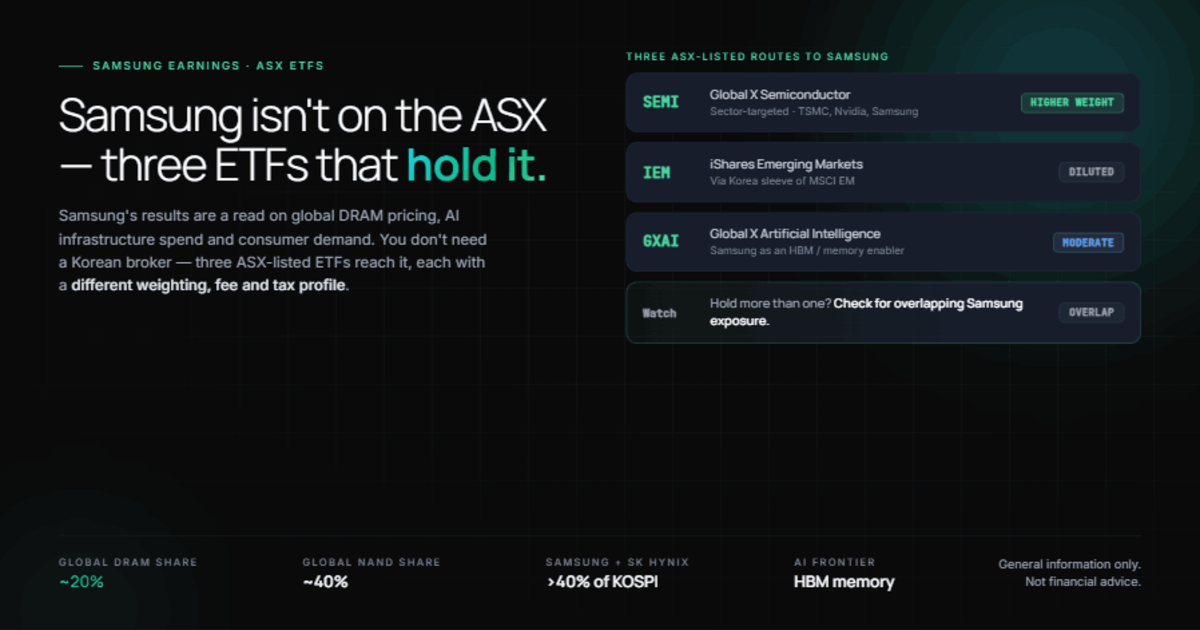
Accessing Samsung’s earnings story does not require a Korean brokerage account. Several ASX-listed ETFs hold Samsung as an underlying position, each with a different risk profile, fee structure, and degree of exposure. This article works through your practical options, what Samsung’s quarterly results signal for the broader market, and what the ATO requires when you hold internationally-focused ETFs.
Why does Samsung matter to Australian investors?
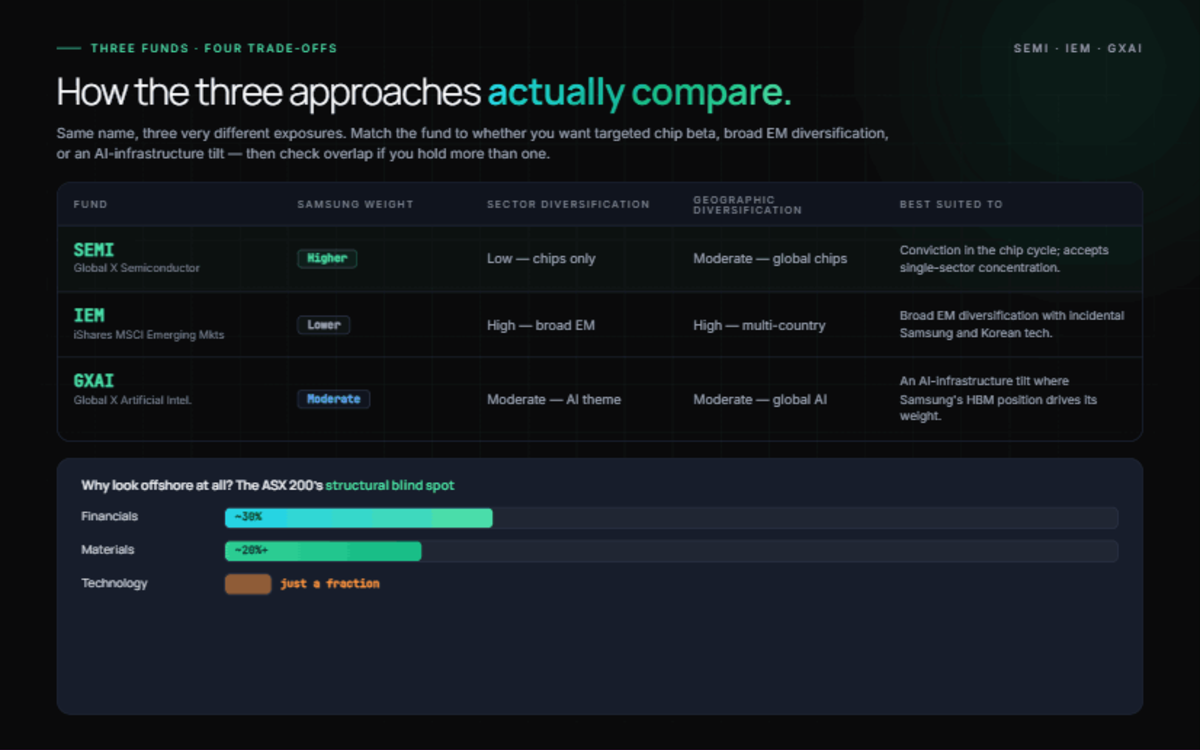
Samsung matters to Australian investors because it is one of the most consequential companies in the global technology supply chain, yet it does not trade on the ASX. The ASX 200 allocates roughly 30% to financials and over 20% to materials, with technology only a fraction, so domestic-only portfolios are largely absent from the global chip cycle that has driven returns elsewhere. By contrast, Samsung and SK Hynix together represent over 40% of the KOSPI’s market capitalisation. Samsung holds approximately a third of the global DRAM market and is among the leading NAND flash suppliers at roughly 30%, and uniquely both manufactures chips and builds the devices that consume them. That dual role makes its quarterly results a simultaneous read on global DRAM pricing, AI infrastructure spending and consumer electronics demand, which is why watching Samsung is about far more than a single company.
What is the ASX’s structural blind spot?
The ASX 200 allocates roughly 30% to financials and over 20% to materials. Technology accounts for a fraction of that. By contrast, Samsung Electronics and SK Hynix together represent over 40% of the KOSPI’s market capitalisation. US technology indices skew even further toward semiconductors and AI infrastructure.
This structural gap means Australian investors with only domestic equity exposure are largely absent from the chip cycle that has driven significant outperformance in Korean and US technology markets. Watching Samsung’s earnings is not just about one company. It is a read on global DRAM pricing, AI infrastructure spending, and consumer electronics demand simultaneously.
What is Samsung’s position in the global semiconductor supply chain?
Samsung holds approximately a third of the global DRAM market and is among the leading NAND flash suppliers at roughly 30%. It occupies a unique dual role: manufacturing chips and building the devices that consume them. This distinguishes Samsung from pure-play foundries like TSMC and from memory-focused peers like SK Hynix and Micron.
High bandwidth memory (HBM) chips have become the most watched frontier within Samsung’s results. HBM is the specialised memory architecture required to train and run large AI models at scale. SK Hynix has led the market supplying Nvidia’s H100 and H200 accelerators, but Samsung’s ability to close that gap carries direct implications for the AI infrastructure investment thesis in 2025 and beyond.
How do Samsung’s earnings function as a market signal?
Samsung’s earnings function as a leading indicator for the entire semiconductor sector. Memory-chip pricing moves in cycles driven by supply-capacity decisions and demand from data centres, smartphones and consumer electronics, so when Samsung reports quarterly guidance on DRAM and NAND pricing, institutional investors treat it as a read on the whole industry. Inventory build-ups signal oversupply and coming price corrections, while inventory drawdowns indicate tightening conditions and potential margin recovery — both directly affecting the earnings outlook of nearly every company in a semiconductor-themed ETF. High-bandwidth memory (HBM), the specialised architecture required to train and run large AI models, has become the most watched frontier; SK Hynix has led in supplying Nvidia’s accelerators, and Samsung’s ability to close that gap carries direct implications for the AI infrastructure thesis. Samsung is also the world’s largest smartphone maker, so its Mobile Experience division signals global upgrade cycles.
How do you read the DRAM and NAND cycle?
Memory chip pricing moves in cycles driven by supply capacity decisions and demand from data centres, smartphones, and consumer electronics. When Samsung reports quarterly guidance on DRAM and NAND pricing, institutional investors treat it as a leading indicator for the entire semiconductor sector.
Inventory build-ups signal oversupply and coming price corrections. Inventory drawdowns indicate tightening conditions and potential margin recovery. For Australian investors holding semiconductor-themed ETFs, these signals affect the earnings outlook of nearly every company in those funds.
Why are smartphone volumes a secondary signal?
Samsung is the world’s largest smartphone manufacturer by volume. Its Mobile Experience division earnings reflect the pace of global smartphone upgrade cycles, which feed back into component pricing across the broader supply chain. Weak smartphone volumes depress demand for memory chips, screens, and processors — assets held across multiple ETF categories relevant to Australian retail investors.
How do you access Samsung through ASX-listed ETFs?
Accessing Samsung does not require a Korean brokerage account; several ASX-listed ETFs hold it as an underlying position, each with a different risk profile. The Global X SEMI ETF (ASX: SEMI) targets the global semiconductor sector and typically holds Samsung at a higher weighting than a diversified fund, alongside TSMC and Nvidia, at the cost of concentration in a single sector. The iShares IEM ETF (ASX: IEM) reaches Samsung through its South Korean allocation within the MSCI Emerging Markets Index, giving broad geographic diversification but a diluted Samsung weighting. The Global X GXAI ETF (ASX: GXAI) is built around AI-infrastructure themes and includes Samsung as an AI enabler through its HBM and memory business, weighting it by AI relevance. Investors holding more than one of these should check for overlapping Samsung exposure using each provider’s current fact sheet.
Semiconductor-Focused ETFs: Global X SEMI
The Global X SEMI ETF (ASX: SEMI) targets the global semiconductor sector and typically holds Samsung Electronics as a meaningful position alongside TSMC, Nvidia, and others. Because the fund’s mandate is sector-specific, Samsung’s weighting tends to be higher than in a diversified global equity fund.
The trade-off is concentration. A semiconductor ETF carries higher single-sector risk. For investors with strong conviction in the chip cycle, this precision is the point. For those seeking diversification alongside Samsung exposure, it requires pairing with broader holdings.
Emerging Markets ETFs: iShares IEM
The iShares IEM ETF (ASX: IEM) reaches Samsung through its South Korean country allocation. South Korea represents a meaningful slice of the MSCI Emerging Markets Index, and Samsung is the index’s largest Korean constituent.
The dilution is significant. An investor wanting meaningful Samsung exposure through IEM also acquires exposure to China, Taiwan, India, Brazil, and others. This suits investors who want broad EM diversification with incidental Samsung and Korean tech exposure rather than targeted chip positioning.
AI Infrastructure ETFs: Global X GXAI
The Global X GXAI ETF (ASX: GXAI) is constructed around AI infrastructure themes. Samsung qualifies for inclusion as an AI enabler through its HBM and memory chip business. The index construction logic weights companies by their relevance to AI infrastructure build-out, which means Samsung’s HBM competitive position directly influences its weighting.
How do the three approaches compare?
| Samsung Weight | Sector Diversification | Geographic Diversification | |
|---|---|---|---|
| SEMI | Higher | Low (chips only) | Moderate (global chips) |
| IEM | Lower | High (broad EM) | High (multi-country) |
| GXAI | Moderate | Moderate (AI theme) | Moderate (global AI) |
Investors building positions across more than one of these ETFs should check for overlapping Samsung exposure using each provider’s current fact sheet.
What are the Australian tax considerations?
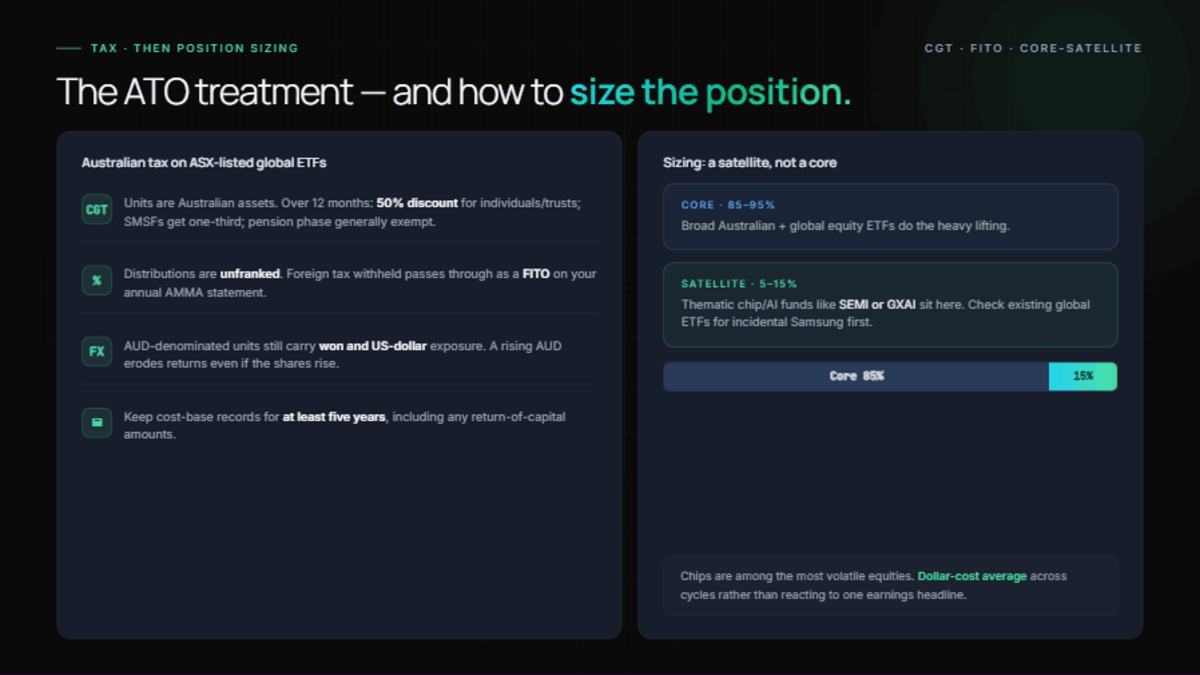
ASX-listed ETFs are treated as Australian assets for CGT purposes, so selling units triggers CGT event A1. Individual investors and trusts holding units for more than 12 months qualify for the 50% CGT discount, SMSFs in accumulation phase receive a one-third discount at a 15% base rate, and pension-phase assets are generally exempt up to the transfer balance cap. The ATO requires investors to retain cost-base records for at least five years, including purchase dates, prices and any distributions treated as returns of capital. Distributions from global technology ETFs are unfranked, which investors accustomed to fully franked ASX dividends should factor into income planning, though foreign tax withheld at the fund level may pass through as a foreign income tax offset on annual AMMA statements. AUD-denominated ETFs still carry won and US-dollar currency exposure that affects real returns.
What is the CGT treatment of ASX-listed ETFs?
ASX-listed ETFs are treated as Australian assets for CGT purposes. When you sell ETF units, CGT event A1 applies. Individual investors and trusts holding units for more than 12 months qualify for the 50% CGT discount under ATO rules. SMSFs in accumulation phase receive a one-third discount at a 15% base rate. Pension-phase assets in an SMSF are generally exempt from CGT up to the transfer balance cap.
The ATO requires investors to retain cost base records for a minimum of five years, including purchase dates, prices, and any distributions treated as returns of capital.
Foreign Income, Withholding Tax, and Franking Credits
Distributions from global technology ETFs are unfranked. Investors accustomed to fully franked ASX dividends should factor this into their income planning.
Foreign tax withheld at the fund level — for example, Korean or US dividend withholding tax — may be passed through to unitholders as a foreign income tax offset (FITO) on your Australian tax return. ETF providers issue annual AMMA tax statements itemising these components.
How does currency risk affect AUD-denominated ETFs?
AUD-denominated ASX ETFs still carry underlying currency exposure to the Korean won and US dollar. Most retail-focused ASX ETFs in this category are unhedged. AUD/KRW and AUD/USD movements affect your real returns independently of the underlying equity performance. A rising Australian dollar erodes returns from unhedged foreign holdings even when the underlying shares appreciate.
How should you size semiconductor exposure in a portfolio?
Semiconductor and AI-themed ETFs suit a satellite position rather than a core holding for most Australian DIY investors. A practical structure places a broad Australian equity ETF and a broad global equity ETF at the core, with a 5% to 15% satellite allocation to thematic funds such as SEMI or GXAI. Because investors already holding a broad global equity ETF likely have incidental Samsung exposure, it pays to check existing holdings before adding a dedicated semiconductor fund, to avoid unintentional over-concentration. Semiconductor stocks are among the most volatile in global equity markets due to the cyclical nature of chip pricing, so a disciplined dollar-cost-averaging approach — regular smaller purchases across market cycles — reduces timing risk and smooths your entry price over time. Sizing the position deliberately, rather than reacting to a single earnings headline, is the key discipline.
How does core-satellite thinking apply?
Semiconductor and AI-themed ETFs suit a satellite position rather than a core holding for most Australian DIY investors. A practical structure places a broad Australian equity ETF and a broad global equity ETF at the core, with a 5% to 15% satellite allocation to thematic funds like SEMI or GXAI.
Investors already holding a broad global equity ETF likely have some incidental Samsung exposure. Check your existing holdings before adding a dedicated semiconductor ETF to avoid unintentional over-concentration.
How does dollar cost averaging help with volatile themes?
Semiconductor stocks are among the most volatile in global equity markets due to the cyclical nature of chip pricing. A disciplined dollar cost averaging approach reduces the impact of timing risk. Regular smaller purchases across market cycles smooth your entry price over time.
Frequently asked questions
Which ASX ETFs have Samsung as a significant holding?
Global X SEMI, iShares IEM, and Global X GXAI all hold Samsung to varying degrees. Check current fact sheets on each provider’s website for up-to-date weightings.
What is the CGT treatment when I sell units in an ASX ETF holding international shares?
The ETF units are treated as Australian assets. The 50% CGT discount applies to individuals and trusts holding units for more than 12 months. Standard ATO CGT rules apply on disposal.
Is a semiconductor ETF or an emerging markets ETF better for Samsung exposure?
A semiconductor ETF like SEMI gives you a higher and more targeted Samsung weighting. An emerging markets ETF like IEM gives you broader geographic diversification with diluted Samsung exposure. The right choice depends on whether you want targeted chip exposure or broader EM diversification.