
Australian investors seeking Netflix ETF ASX exposure cannot buy NFLX directly on the ASX, but can access it through four ASX-listed ETFs: broad S&P 500 (IVV), Nasdaq-100 (NDQ), FANG-style (FANG), and global quality (QUAL) funds. Each offers different Netflix weightings, costs, and diversification trade-offs.
Why do Netflix and Disney matter to your portfolio?
Netflix and Disney matter to your portfolio because you are probably already a customer — and you can be an owner without the hassle most people assume. You pay for Netflix every month and watch Disney+ on weekends, yet many Australian investors believe they need an international brokerage account to buy Netflix (NFLX) or Disney shares, and that assumption stops a lot of people from acting. The reality is that several ASX-listed ETFs already hold these companies as underlying constituents, giving you indirect exposure without a US account, a W-8BEN form or currency-conversion headaches. That reframes the question from how do I buy a single US stock to which ASX ETF gives me the streaming and tech exposure I want. The four pathways covered here range from broad, low-cost market funds where Netflix is a small slice, to concentrated thematic funds where it carries real weight — each with different diversification, cost and tax implications.
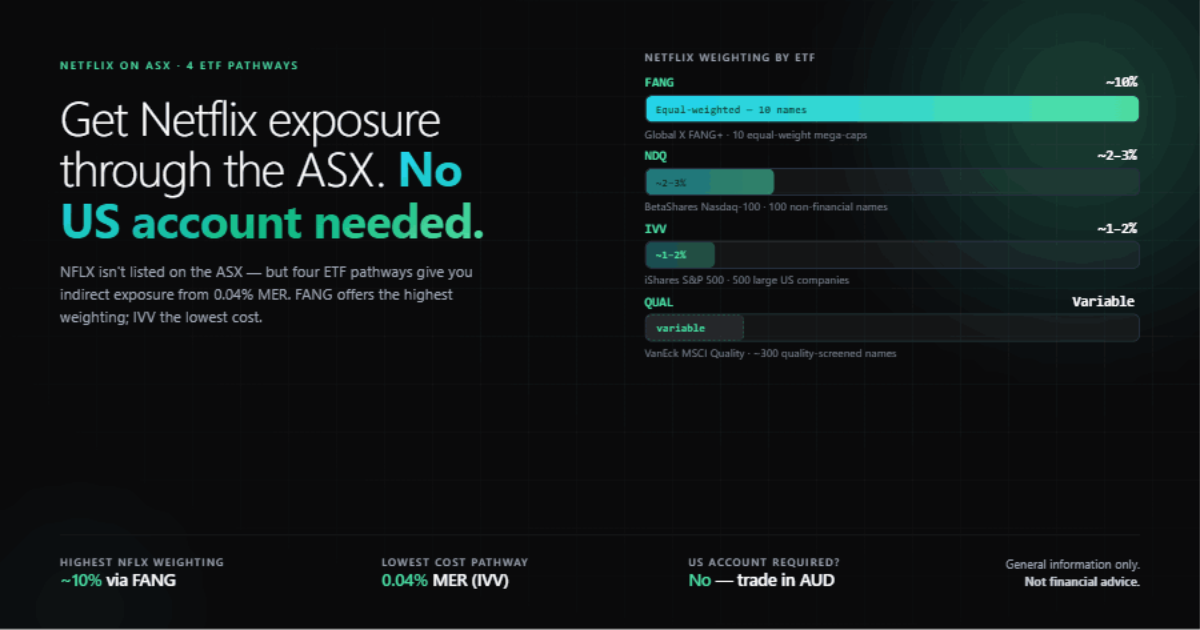
Most Australian investors assume they need an international brokerage account to buy Netflix (NFLX) or Disney shares. That assumption stops a lot of people from acting. Several ASX-listed ETFs already hold these companies as underlying constituents, giving you indirect exposure without a US account, a W-8BEN form, or currency conversion headaches.
This article maps four ASX ETF pathways to Netflix share price exposure in Australia, compares key metrics, and covers the ATO tax treatment you need to understand before you invest.
Netflix crossed 300 million paid subscribers globally in early 2025. Disney's combined streaming services have surpassed 220 million subscribers at peak periods. The investment thesis is straightforward. Streaming represents a structural shift in media consumption. Advertising-supported tiers, password-sharing crackdowns, and price increases have pushed these platforms toward sustained profitability. Subscriber growth and revenue per user are the key signals to watch.
What is the problem with buying Netflix shares directly?
Buying NFLX or DIS on the NASDAQ requires an international brokerage account, currency conversion costs, a W-8BEN form, and foreign income reporting on your Australian tax return. For many DIY investors, that friction is enough to stop them acting.
ASX-listed ETFs solve this. They wrap US securities inside a familiar, locally traded structure. You buy and sell ETF units on the ASX exactly as you would any other listed security. The fund manager handles the W-8BEN filing and US dividend withholding tax at the fund level. At year end, you receive one Australian annual tax statement per ETF.
How much Netflix do you already own indirectly?
Indirect exposure means your return tracks the underlying holdings, including the effect of AUD/USD exchange rate movements. If NFLX rises 20% in USD terms but the Australian dollar strengthens 5% against the USD over the same period, your AUD-denominated return will be lower than the headline figure.
The weighting of Netflix within any given ETF determines how concentrated your streaming bet is. Always check current holdings disclosures on the ETF provider's website before investing, as weightings shift with market movements.
What are the 4 ASX ETF pathways to streaming exposure?
There are four practical ASX ETF pathways to streaming exposure, trading breadth for concentration. Pathway 1 is a broad S&P 500 ETF such as IVV.AX, which tracks the 500 largest US companies; Netflix and Disney are both constituents but with a combined weighting typically under 2%, and at an MER around 0.04% it offers outstanding diversification with only a modest streaming tilt. Pathway 2 is a Nasdaq-100 ETF such as NDQ.AX, holding the 100 largest non-financial Nasdaq companies, where Netflix carries a somewhat larger weighting alongside the other mega-cap tech names. Pathway 3 is a FANG-style concentrated tech ETF such as FANG.AX, where Netflix can represent around 10% of the fund — the most direct exposure, but also the most concentrated. Pathway 4 is a global quality ETF such as QUAL.AX, which holds companies screened for quality metrics and includes streaming names at a variable weighting. The right pathway depends on how much targeted streaming exposure you want versus how much diversification you give up.
Pathway 1 — Broad S&P 500 ETFs (e.g., IVV.AX)
The iShares S&P 500 ETF (ASX: IVV) tracks the 500 largest US companies. Netflix and Disney are both constituents, with a combined weighting typically under 2%. The MER is around 0.04% per annum. Diversification is outstanding, but streaming exposure is diluted across 500 holdings.
Best suited to: investors who want a low-cost core holding with a modest, passive streaming tilt.
Pathway 2 — NASDAQ-100 ETFs (e.g., NDQ.AX)
The Betashares Nasdaq 100 ETF (ASX: NDQ) tracks the 100 largest non-financial NASDAQ companies. Netflix is a constituent with a weighting typically around 2–3%. The MER is around 0.48% per annum. You accept greater technology sector concentration in exchange for more meaningful Netflix exposure.
Best suited to: investors comfortable with tech concentration who want NFLX exposure without a single-stock bet.
Pathway 3 — FANG-Style Concentrated Tech ETFs (e.g., FANG.AX)
The Global X FANG+ ETF (ASX: FANG) holds an equal-weighted basket of ten mega-cap technology and growth names. Netflix is a named constituent, receiving roughly 10% of the fund at each rebalance — the highest direct NFLX weighting of any broadly available ASX ETF. The MER is around 0.35% per annum. Disney is generally not a FANG+ constituent.
Best suited to: investors seeking maximum Netflix share price exposure via an ETF wrapper, with full tolerance for concentration risk and higher volatility.
Pathway 4 — Global Quality ETFs (e.g., QUAL.AX)
The VanEck MSCI International Quality ETF (ASX: QUAL) screens for companies with high return on equity, stable earnings growth, and low financial leverage. Netflix has improved significantly on profitability metrics in recent years. The MER sits around 0.40% per annum. Your streaming exposure sits within a portfolio selected for financial strength, not just market capitalisation.
Best suited to: investors who want streaming names within a disciplined, fundamentals-based selection framework.
How do the four ETF options compare?
| ETF | MER (approx.) | Netflix weighting | Holdings count | Currency hedged |
|---|---|---|---|---|
| IVV | ~0.04% p.a. | ~1–2% | ~500 | No |
| NDQ | ~0.48% p.a. | ~2–3% | ~100 | No |
| FANG | ~0.35% p.a. | ~10% | 10 | No |
| QUAL | ~0.40% p.a. | Variable | ~300 | No |
Comparing the four side by side, the trade-off between cost, concentration and diversification becomes clear. IVV runs at roughly 0.04% per year with Netflix at about 1–2% of around 500 holdings; NDQ sits near 0.48% with Netflix around 2–3% of about 100 holdings; FANG charges approximately 0.35% with Netflix near 10% across just 10 holdings; and QUAL is around 0.40% with a variable Netflix weighting across roughly 300 holdings. In short, as you move from IVV to FANG you pay more and accept far less diversification, but you get materially higher Netflix weighting. All four are generally unhedged, which means AUD/USD movements affect your returns directly — a strengthening Australian dollar reduces the AUD value of returns from these US-denominated assets, while a weakening dollar amplifies them, and most long-term investors accept this as an inherent feature of unhedged global investing. Because index weightings drift over time, always verify the current Netflix weighting on the provider website before investing.
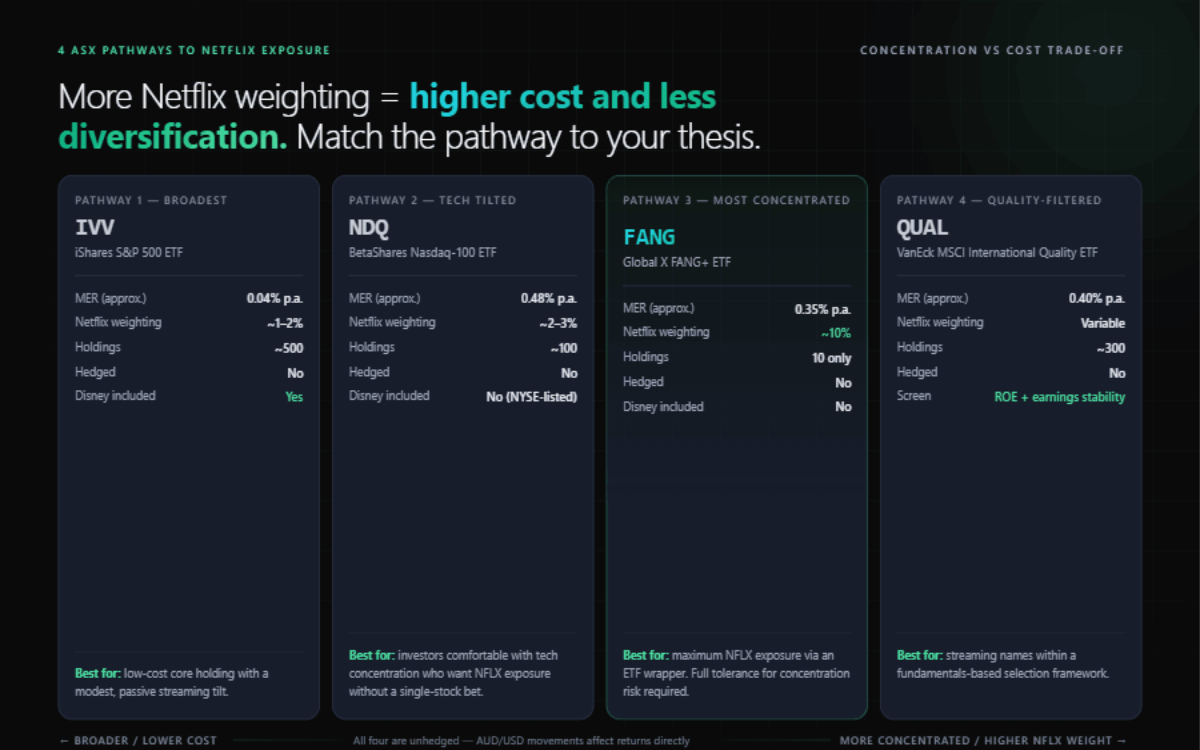
All four ETFs are generally unhedged, meaning AUD/USD movements affect your returns directly. A strengthening Australian dollar reduces the AUD value of returns from US-denominated assets; a weakening dollar amplifies them. Most long-term investors accept this as an inherent feature of unhedged global ETF investing.
How does the ATO tax these ETFs?
These ETFs are taxed as ordinary CGT assets under Australian law, with the familiar discounts applying. When you sell units, a CGT event arises: individual investors who have held units for more than 12 months are eligible for the 50% CGT discount, so only half the net capital gain is included in their assessable income. SMSF trustees receive a one-third CGT discount on assets held beyond 12 months, and in retirement phase the earnings supporting pensions are generally taxed at 0%, subject to the transfer balance cap rules. The detail that trips investors up is cost-base maintenance: capital-gains distributions and any return-of-capital events require adjustments to your cost base, so the figure you bought at is not always the figure you use to calculate your gain. Keeping accurate, parcel-level cost-base records — including every distribution statement — is what lets you apply the right discount and report the correct gain when you eventually sell.
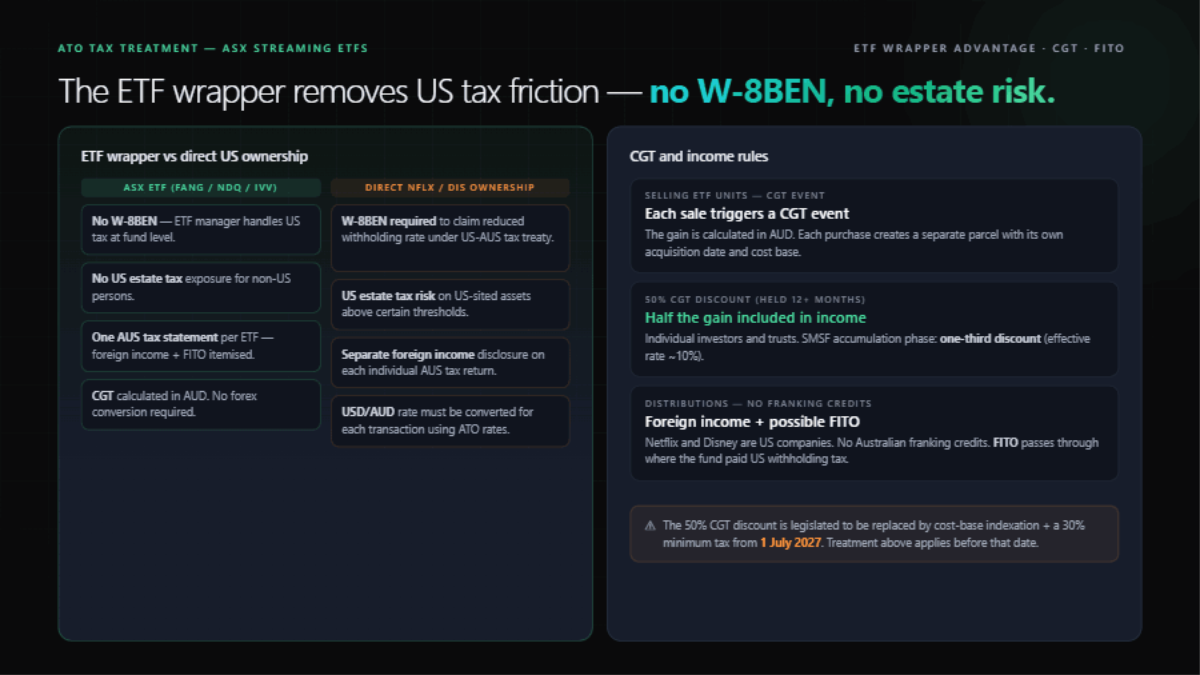
Note: the 50% CGT discount is legislated to be replaced by cost-base indexation and a 30% minimum tax on net capital gains from 1 July 2027; the treatment described here applies to disposals before that date.
How does the 50% CGT discount apply?
ASX ETF units are CGT assets under Australian tax law. When you sell units, a CGT event arises. Individual investors who hold units for more than 12 months are eligible for the 50% CGT discount — only half the net capital gain is included in assessable income.
SMSF trustees receive a one-third CGT discount on assets held beyond 12 months. In retirement phase, earnings supporting pensions are generally taxed at 0%, subject to transfer balance cap rules.
Keep accurate cost base records. Capital gains distributions and any return-of-capital events require cost base adjustments. The ATO requires you to retain records for five years from the date the CGT event occurs.
How do distributions and the foreign income tax offset work?
Distributions from global ETFs are generally unfranked. Netflix and Disney are US companies — they do not generate Australian franking credits.
Where the fund has paid foreign withholding tax on underlying US dividends, this flows through to your annual tax statement. You may be eligible for a Foreign Income Tax Offset (FITO) under ATO rules, capped at the Australian tax you would otherwise pay on that foreign income. Your ETF provider's annual tax statement will itemise the FITO-eligible components.
Direct ownership vs ETF wrapper: which is better for tax?
Holding NFLX directly requires separate foreign income disclosures and potential US estate tax exposure for non-US persons holding US-sited assets above certain thresholds. Neither applies when you hold ASX ETF units instead. The ETF wrapper consolidates foreign tax administration at the fund level — one annual tax statement per ETF, no US tax forms to manage yourself.
How should you size your streaming allocation?
Sizing a streaming allocation is best handled with a core-satellite framework that keeps the position disciplined. Your core holds broad Australian and global equities, generating diversified returns and franking-credit income; your satellite holds smaller, more concentrated positions — such as a FANG-style or Nasdaq-100 ETF — for targeted global growth exposure to companies like Netflix. The key is proportion: thematic satellite allocations should stay modest relative to the core, because overweighting a single sector in pursuit of a specific thesis is one of the most common portfolio-construction errors DIY investors make. A concentrated streaming bet can pay off, but it should never be large enough to dominate your outcomes if that thesis is wrong. Dollar-cost averaging is a practical way to build the position over time, investing a fixed amount at regular intervals so you are not trying to time entry into a volatile, concentrated theme. In short, treat streaming exposure as a satellite that complements a diversified core.
How does a core-satellite framework apply here?
Keep your portfolio disciplined with a core-satellite approach. Your core holds broad Australian and global equities, generating diversified returns and franking credit income. Your satellite holds smaller, more concentrated positions — such as a FANG-style or NASDAQ-100 ETF — for targeted global growth exposure.
Keep thematic satellite allocations proportionate. Overweighting a single sector in pursuit of a specific thesis is one of the more common portfolio construction errors among DIY investors.
Dollar cost averaging (DCA) is a practical way to build a position over time. Investing a fixed amount at regular intervals reduces timing risk in a sector sensitive to earnings results and interest rate movements.
What must SMSF trustees document?
Before allocating to a global technology ETF inside an SMSF, the fund's investment strategy must reference the asset class, expected return profile, liquidity characteristics, and diversification rationale. This is an ATO compliance requirement, not optional.
Keep records of the investment decision, entry price, and evidence of ongoing review. Streaming-themed ETFs are exchange-traded and generally liquid, but your strategy should confirm the fund retains sufficient liquidity to meet pension payments and operational expenses without forced selling.
Frequently asked questions
Can I buy Netflix shares directly on the ASX?
Netflix (NFLX) is listed on the NASDAQ and is not directly available on the ASX. Australian investors gain indirect exposure through ASX-listed ETFs such as NDQ, FANG, IVV, or QUAL.
Which ASX ETF gives the highest Netflix weighting?
The Global X FANG+ ETF (ASX: FANG) typically offers the highest Netflix weighting due to its equal-weighted structure across ten holdings. Verify current weightings on the provider's website before investing.
Do I pay CGT when I sell ASX ETF units that hold US stocks?
Yes. ASX ETF units are CGT assets. Individual investors holding units for more than 12 months may access the 50% CGT discount on any net capital gain. The CGT event arises when you dispose of your ETF units, not when the fund manager trades the underlying US holdings.
What is the AUD/USD currency risk?
All four ETF pathways discussed here are generally unhedged. A stronger Australian dollar reduces your AUD-denominated returns from US assets, even if the underlying stocks performed well. A weaker AUD amplifies returns. Factor this into your risk assessment.