
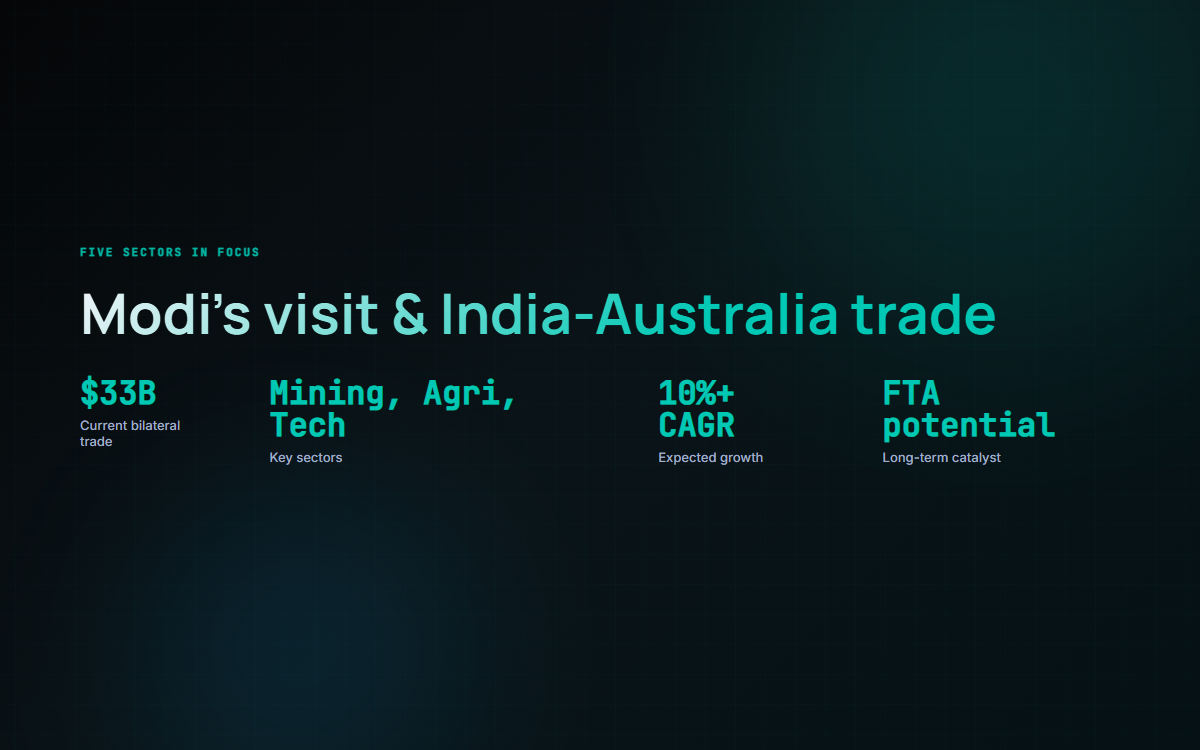
Narendra Modi’s engagement with Australia has moved well beyond diplomatic courtesy. The two countries share democratic values, a Quad alliance partnership, and a shared interest in reducing economic dependence on China. For ASX investors, that geopolitical alignment has a practical dimension: it underpins the durability of the India–Australia trade theme.
The Australia–India Economic Cooperation and Trade Agreement (ECTA) entered into force in December 2022, eliminating tariffs on more than 85% of Australian goods entering India. A fuller Comprehensive Economic Cooperation Agreement (CECA) is in negotiation and would add deeper services liberalisation and investment protections. Understanding what is locked in now versus what remains aspirational matters before you build a position.
Which portfolio management software is best in Australia?
Australia and India spent decades with a thin relationship despite sharing democratic systems and Commonwealth ties. The Quad alliance — bringing together Australia, the United States, India, and Japan — changed that dynamic. China’s economic coercion of Australia in 2020 accelerated it further, pushing both governments to treat the bilateral relationship as strategically essential.

For ASX investors, trade themes backed by geopolitical logic tend to last longer than those driven by commodity cycles alone. The structural drivers here — Quad alignment, China diversification, and India’s growth trajectory — are not going away quickly.
ECTA delivers immediate, binding tariff relief. Critical minerals including zirconium, titanium, cobalt, and nickel entered India tariff-free from December 2022. LNG is bound at 0%. Bituminous coal phases to zero over four years. These are locked in now. CECA would go further, covering deeper service liberalisation across 85+ categories and expanded investment protections — but CECA negotiations stall. Build your thesis around ECTA certainties first, and treat CECA as optionality.
Sector 1 — Critical Minerals and Mining
India has set a target of 100 gigawatts of nuclear energy capacity, creating sovereign-backed demand for uranium. Australia holds some of the world’s largest uranium reserves, and the bilateral uranium export agreement unlocks a long-dated demand signal for ASX-listed producers that retail investors have been slow to price in.
Beyond nuclear, India’s industrial growth requires lithium, cobalt, and rare earths at scale — structural requirements for its electrification and manufacturing ambitions.
ECTA tariff cuts directly improve margin and revenue visibility for ASX resource exporters across uranium, lithium, cobalt, rare earths, manganese, copper, aluminium, and nickel. The structural demand tailwind is real, but commodity price cycles remain. Lithium’s price collapse between 2022 and 2024 is a useful reminder that demand growth and spot prices do not always move together.
Australian-domiciled miners pay Australian company tax on global profits, meaning shareholders receive imputation credits regardless of where revenue originates. If India-linked demand supports higher earnings, the result is likely larger franked dividends — a meaningful compound benefit for SMSF trustees in accumulation phase.
Sector 2 — Energy Exports (LNG and Coal Transition)
ECTA binds LNG at 0% tariff, removing a structural cost disadvantage for Australian exporters competing in the Indian market. India’s energy transition timeline keeps fossil fuels in the mix for the medium term, and Australian LNG producers retain a pricing advantage unavailable before December 2022.
Bituminous coal phasing to zero tariff over four years represents a short-to-medium term revenue benefit for Australian thermal coal exporters. The tension is clear: India’s near-term demand for coal is real, but ESG-conscious capital on the ASX is increasingly reluctant to re-rate coal producers regardless of demand signals. Treat the coal tariff benefit as finite and weigh it against capital market pressure on fossil fuel valuations.
Sector 3 — Education Services and Student Accommodation
Under ECTA, Australian higher education and skills providers are guaranteed treatment at least as favourable as India extends to any future FTA partner across more than 85 service categories. Indian student enrolments in Australia have grown steadily, and the most-favoured-nation clause creates a structural floor for further expansion. This sector receives almost no attention in mainstream ASX investing commentary — an information gap worth filling.
ASX companies with exposure include private higher education providers, vocational training operators, and purpose-built student accommodation REITs. Earnings from Indian campuses or offshore operations attract less Australian corporate tax, which reduces franking credit levels. These are re-rating plays based on revenue growth, not high-yield income stories.
Sector 4 — Infrastructure and Engineering Services
India’s National Infrastructure Pipeline spans urban development, water, energy, and transport. ECTA guarantees Australian engineering and construction services firms improved market access across 31 Australian services categories.
ASX-listed companies with credible India exposure include engineering consultancies, project management firms, and water and environmental services providers. Long-duration infrastructure contracts add earnings visibility, which tends to attract more stable valuation multiples.
The cash flow profile matters: milestone-based payments and high working capital intensity affect dividend sustainability. Companies billing in Indian rupees face INR/AUD translation risk that flows directly into reported earnings. Offshore-derived income also reduces the proportion of Australian tax paid, diluting franking credit levels over time. When reviewing companies with significant India operations, check the effective Australian tax rate in company disclosures — that rate is a better proxy for future franking credit availability than the statutory rate.
Sector 5 — Agriculture, Food, and Beverage Exports
ECTA eliminates tariffs on wool, lobsters, select horticultural products, and premium food and beverage categories. India’s growing middle class is driving demand for premium imported food, and Australian agricultural products are well-positioned to serve that trend.
ASX companies positioned to benefit include wool processors, aquaculture and fisheries operators, premium food producers, and rural services companies. Agricultural earnings are seasonal and weather-dependent. Investors in this sector need a longer horizon and tolerance for earnings variability. Franking levels for agribusiness companies tend to be lower than large-cap miners, which matters for income-focused investors and SMSF retirees relying on imputation credits.
How to start under-18s investing in the ASX share market?
If ECTA and CECA catalyse earnings upgrades across miners, education, and infrastructure stocks, capital gains on disposal will be larger. The 50% CGT discount remains available for assets held more than 12 months by individuals and trusts. Timing disposals around the ATO financial year, your income level, and your super phase all affect the after-tax outcome. The ATO requires investors to retain cost base records for five years.
SMSF trustees must document why an allocation to India-leveraged ASX sectors is consistent with the fund’s risk profile and member retirement objectives. Spreading exposure across miners, education, infrastructure, and agriculture strengthens the diversification rationale and reduces the appearance of a concentrated thematic bet. Dollar cost averaging is a practical entry strategy for volatile sectors like critical minerals.
Risks and Realistic Expectations
Policy risk is the most significant. CECA stalling would remove a major growth assumption from the thesis. Indian regulatory conditions and domestic political cycles introduce friction that is difficult to model from Australia.

Commodity cycle risk is real and separate from trade policy. Lithium’s price trajectory from 2022 to 2024 is the clearest recent example. INR/AUD and USD/AUD movements add another layer of volatility to Australian dollar returns.
Geopolitical tail risks include Quad alliance dynamics tied to US foreign policy continuity and regional security flashpoints that could disrupt trade flows or investor sentiment.
Frequently asked questions
What does the ECTA trade deal mean for ASX resource stocks?
ECTA eliminates tariffs on critical minerals immediately and phases bituminous coal to zero over four years. This improves margin and revenue visibility for ASX exporters, though commodity price cycles remain a separate risk.
Does earning revenue from India affect franking credits?
No. Franking credits are based on Australian corporate tax paid, not where revenue is earned. Australian-domiciled exporters retain access to imputation credits. Companies with large offshore operations may have lower effective Australian tax rates, which reduces franking levels over time.
How should SMSF trustees document India-linked exposures?
Document the diversification rationale, expected return horizon, and liquidity considerations in the fund’s written investment strategy. Spreading exposure across multiple sectors reduces concentration risk and satisfies the balanced approach requirement.