
Which ASX ETFs hold iPhone 18 Pro chip suppliers?
Australian investors cannot buy Apple directly but can access the ASX iPhone supply chain through ASX-listed ETFs holding chip, display, and component suppliers like TSMC. This article details five supply-chain themes, tax mechanics, concentration risks, and SMSF rules for investing around the iPhone 18 Pro launch.
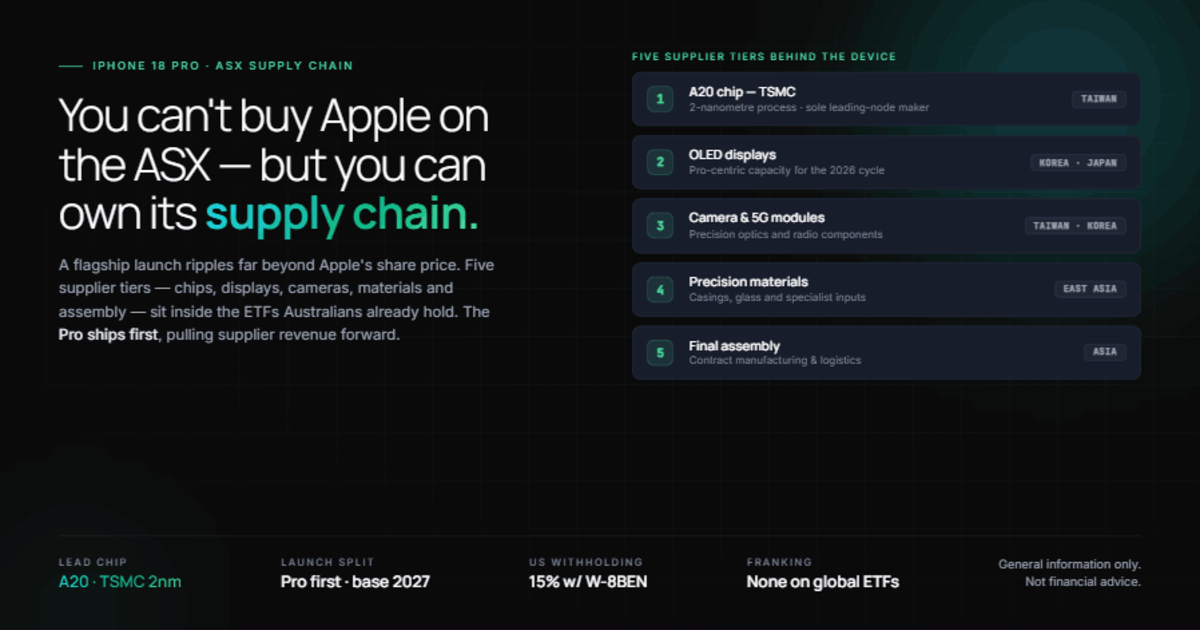
The iPhone 18 Pro and Pro Max are set to ship first, with standard models pushed into 2027. That split schedule concentrates early supply chain orders into the Pro cycle, which affects when supplier revenues appear in earnings reports. Understanding that timing matters when you are thinking about entry and exit points.
1. Why does the iPhone 18 Pro matter to ASX investors?
The iPhone 18 Pro matters to ASX investors because a flagship Apple launch ripples far beyond Apple’s own share price, lifting demand and revenue expectations across a global network of listed suppliers. Chip fabricators, display manufacturers, camera-module makers and logistics providers all sit in this chain, and many appear inside the ETFs and global equity funds that Australian retail and SMSF investors already hold. Because Apple trades on the NASDAQ rather than the ASX, the practical question for Australians is not whether to buy Apple directly but whether the supply-chain theme is worth a deliberate tilt. The iPhone 18 Pro and Pro Max are also set to ship first, with standard models pushed into 2027, which concentrates early orders into the Pro cycle and changes when supplier revenues show up in earnings reports — useful context when weighing entry and exit timing.
A major iPhone launch does not move Apple’s share price alone. It flows through chip fabricators, display manufacturers, camera module suppliers, and logistics networks. Each of those tiers includes listed companies that appear in ETFs and global equity funds accessible to Australian retail and SMSF investors.
Apple is not listed on the ASX. Australian investors must access it through international brokers offering direct NASDAQ access, ASX-listed ETFs with global technology or semiconductor holdings, or unlisted managed funds with global tech mandates. Each route carries different cost, tax, and concentration implications.
Apple’s decision to release the Pro models first concentrates supply chain orders into a narrower window. Suppliers with heavy Pro-tier exposure are likely to see revenue recognition earlier than those servicing the standard range. A supplier’s earnings report may reflect the Pro launch before the broader market has fully processed the news.
2. What is inside the iPhone 18 Pro supply chain?
The iPhone 18 Pro supply chain spans several tiers of specialised, geographically concentrated suppliers. At its core is an A20 chip expected to be manufactured by TSMC on a 2-nanometre process; as the sole manufacturer at leading process nodes, TSMC captures a disproportionate share of value per device and appears across semiconductor ETFs and broader global equity funds. Advanced OLED displays are supplied primarily by South Korean and Japanese manufacturers, with Pro-centric OLED capacity planned for the 2026 cycle and standard-model production pushed to early 2027. Camera modules, 5G components and precision materials round out the picture, with suppliers clustered in Taiwan, South Korea and Japan — a concentration that introduces geopolitical and natural-disaster risk. Contract manufacturers handle final assembly, and disruption at any tier, from component shortages to trade restrictions, can affect multiple listed companies at once.
2.1 What is the A20 chip and TSMC’s 2-nanometre process?
The iPhone 18 Pro is expected to run an A20 chip manufactured by TSMC on a 2-nanometre process node. TSMC’s role as the sole manufacturer at leading process nodes means it captures a disproportionate share of value added per device. Investors interested in chip themes will find TSMC appearing across semiconductor ETFs and broader global equity funds.
2.2 Which displays, cameras, and key components are used?
The iPhone 18 Pro is expected to use advanced OLED displays supplied primarily by South Korean and Japanese manufacturers, with Pro-centric OLED capacity planning for the 2026 cycle and standard model production pushed to early 2027. Camera modules, 5G components, and precision materials round out the picture. These suppliers are geographically concentrated in Taiwan, South Korea, and Japan, which introduces risk from geopolitical tension or natural disaster.
2.3 How does assembly create interconnected risk?
Contract manufacturers handle final assembly. Disruption at any tier — whether from component shortages, trade restrictions, or weather events — can affect multiple listed companies at once. That interconnected risk is worth understanding before tilting a portfolio toward supply chain themes.
3. How can ASX investors access supply chain exposure?
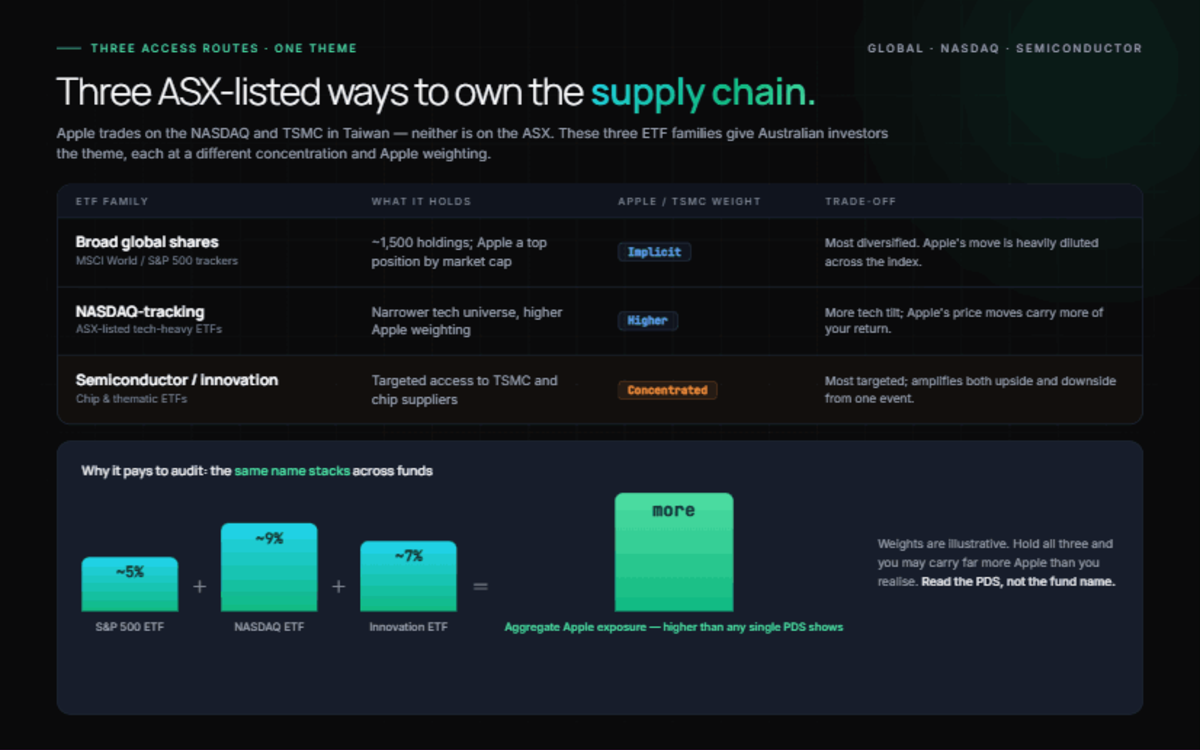
ASX investors cannot buy the supply chain directly, because Apple trades on the NASDAQ and TSMC on the Taiwan Stock Exchange (and as an NYSE ADR) — neither is listed in Australia. Three main routes provide exposure: international brokers offering direct access to NASDAQ or NYSE-listed securities; ASX-listed ETFs with technology, semiconductor or global-equity holdings; and unlisted managed funds with global technology mandates. Broad global-shares ETFs tracking the MSCI World or S&P 500 typically hold Apple as a top position by market weight, while NASDAQ-tracking ETFs carry heavier technology weighting and higher Apple concentration. Semiconductor or innovation-themed ETFs offer more targeted access to TSMC and other chip suppliers, but are more concentrated, amplifying both upside and downside. Before investing, review each fund’s Product Disclosure Statement and current holdings, since the name alone does not tell you what you own.
3.1 Why is there no direct ASX route?
Apple (AAPL) trades on the NASDAQ. TSMC trades on the Taiwan Stock Exchange and as an ADR on the NYSE. Neither is listed on the ASX. Australian investors have three main access routes:
- International brokers offering direct access to NASDAQ or NYSE-listed securities
- ASX-listed ETFs with technology, semiconductor, or global equity holdings
- Unlisted managed funds with global technology mandates
3.2 Which ASX-listed ETFs have relevant exposure?
Broad global shares ETFs tracking indices such as the MSCI World or S&P 500 typically include Apple as a top holding by market weight. Apple represents a significant share of the S&P 500, so any fund tracking that index carries meaningful implicit Apple exposure.
NASDAQ-tracking ETFs listed on the ASX provide heavier technology weighting and higher Apple concentration. Semiconductor or innovation-themed ETFs offer a more targeted way to access TSMC and other chip-related suppliers, though they tend to be more concentrated, which amplifies both upside and downside from any single supply chain event.
Before investing in any ETF, review the current Product Disclosure Statement (PDS) and published holdings list. Weightings shift over time, and the fund name alone does not tell you what you own.
3.3 How do you check for concentration risk?
Holding several technology-focused ETFs at once creates unintended concentration. Apple appears as a top holding in S&P 500 ETFs, NASDAQ ETFs, and many global innovation funds simultaneously. An investor holding three of these funds may have far more Apple exposure than any single PDS suggests. Audit your combined holdings by reviewing each fund’s holdings list and calculating your aggregate position size. Tools like Crowdfolio are built for exactly this kind of portfolio-wide view, helping Australian DIY investors see where their real exposures sit across multiple holdings.
4. What tax mechanics do Australian investors need to understand?
Australian investors in global tech ETFs face several tax mechanics worth understanding before trading around a launch. The ATO allows individuals and eligible trusts a 50 per cent CGT discount on assets held at least 12 months before disposal, so buying ETF units ahead of a September 2026 launch and selling shortly after will likely mean full marginal rates on any gain. US dividends paid by Apple, or passed through certain ETF structures, may attract US withholding tax, generally reduced to 15 per cent for investors who have lodged a W-8BEN under the Australia-US tax treaty, with the foreign income tax offset available against Australian liability. Distributions from global tech ETFs carry no Australian franking credits, which matters for higher-bracket investors comparing them with franked Australian shares. SMSF trustees must also document a current investment strategy before adding concentrated thematic ETFs.
4.1 How does CGT timing and the 12-month discount work?
The ATO allows individuals and eligible trusts a 50 per cent CGT discount on assets held for at least 12 months before disposal. If you buy ETF units ahead of a September 2026 launch and sell shortly after, you will likely face full marginal rates on any capital gain. Disposal timing across financial years can also affect when a gain is assessed.
4.2 How do foreign income tax offsets and US withholding tax apply?
US dividends paid by Apple, or passed through certain ETF structures, may attract US withholding tax at source. Australian investors who have completed a W-8BEN form are generally subject to a 15 per cent withholding rate under the Australia-US tax treaty. The foreign income tax offset (FITO) mechanism allows you to offset that foreign tax against your Australian tax liability. The ATO requires records of foreign tax paid to be kept for at least five years.
4.3 Are there franking credits on global tech ETFs?
Distributions from global tech ETFs do not carry Australian franking credits. For investors in higher marginal tax brackets, or those who rely on franking credit refunds, this affects after-tax income comparisons materially. Any comparison with fully-franked Australian shares must be made on a like-for-like after-tax basis.
4.4 What are the SMSF trustee obligations?
SMSF trustees must maintain a current, documented investment strategy before adding thematic or sector-concentrated ETFs to the fund. The strategy must address diversification, liquidity, and how a tech-heavy allocation fits the fund’s stated risk tolerance and retirement objectives. Auditors will expect this documentation on file. Trustees should seek advice from a licensed financial adviser before making material changes.
5. What are the investment risks specific to supply chain plays?
Supply-chain plays carry risks that differ from owning a diversified index fund. The most familiar is “buy the rumour, sell the news”: supplier share prices often rise in anticipation of a major iPhone launch and fall once the product ships, and weaker-than-expected sales, launch delays or supply constraints can compound the downside even when the product is strong. Geopolitical risk is significant because the iPhone supply chain is heavily concentrated in Taiwan and broader East Asia, so a single disruption can hit multiple ETF holdings simultaneously. Currency risk applies to Australians holding US-denominated assets: a strengthening Australian dollar erodes returns from US-listed holdings once converted back to AUD, though currency-hedged ETF variants exist at their own cost. Concentration risk also builds quietly when several technology ETFs hold the same names, so audit your aggregate exposure first.
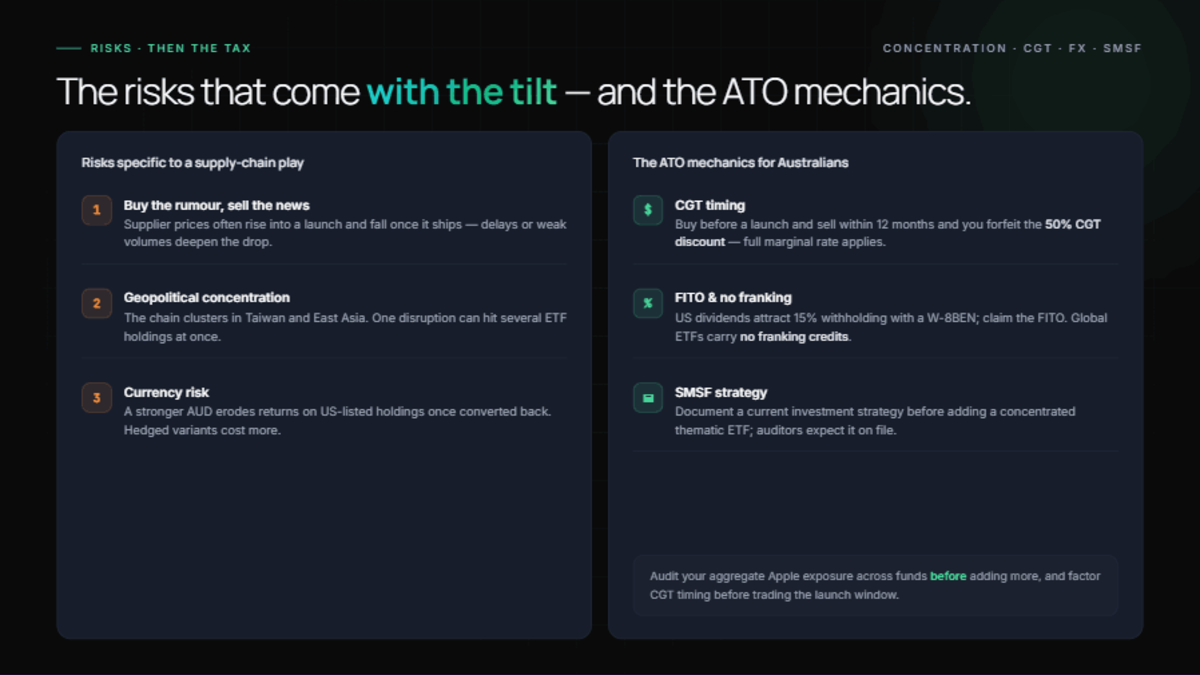
“Buy the rumour, sell the news” — supplier share prices often rise in anticipation of a major iPhone launch and fall once the product ships. Weaker-than-expected sales volumes, launch delays, or supply constraints can compound the downside even when the product is technically strong.
Geopolitical risk — the iPhone supply chain is heavily concentrated in Taiwan and broader East Asia. ETFs exposed to Asian technology manufacturers can be affected by supply chain disruption across multiple holdings at once.
Currency risk — Australian investors holding US-denominated assets face AUD/USD currency risk. A strengthening Australian dollar erodes returns from US-listed assets when converted back to AUD. Currency-hedged ETF variants exist as one way to manage this exposure, though they carry their own costs.
6. Frequently Asked Questions
Q: Which ASX ETFs give exposure to supply chain companies like TSMC?
Semiconductor-themed ETFs, NASDAQ-tracking ETFs, and broad global shares ETFs listed on the ASX may hold TSMC and other supply chain companies. Review the current holdings list and PDS for each ETF rather than relying on the fund name alone.
Q: How does the CGT discount apply if I buy before the iPhone 18 Pro launch and sell shortly after?
If you hold ETF units for fewer than 12 months before disposal, any capital gain is taxed at your full marginal rate. Holding for 12 months or more entitles individual investors and eligible trusts to the 50 per cent CGT discount on the net capital gain.
Q: Do I need to update my SMSF investment strategy before adding a semiconductor ETF?
Yes. The fund’s documented investment strategy must reflect any new allocation, addressing diversification, liquidity, and alignment with the fund’s retirement objectives. An auditor will expect this documentation to be current.
The iPhone 18 Pro supply chain spans chips, displays, and precision components — none of it listed on the ASX directly. Australian investors can access these themes through global shares ETFs, NASDAQ-tracking ETFs, and semiconductor-focused funds. The access routes are straightforward. The tax mechanics, concentration risks, and SMSF obligations require more care. Review your actual holdings, audit your aggregate Apple exposure before adding more, and factor in CGT timing before trading around the launch window.