
Global semiconductor sales are projected to reach US$975 billion in 2026, driven by AI data centres, GPU buildout, and high-performance computing. The companies powering this growth — NVIDIA, TSMC, ASML — do not trade on the ASX. Until recently, getting exposure meant opening an international brokerage account. That has changed.
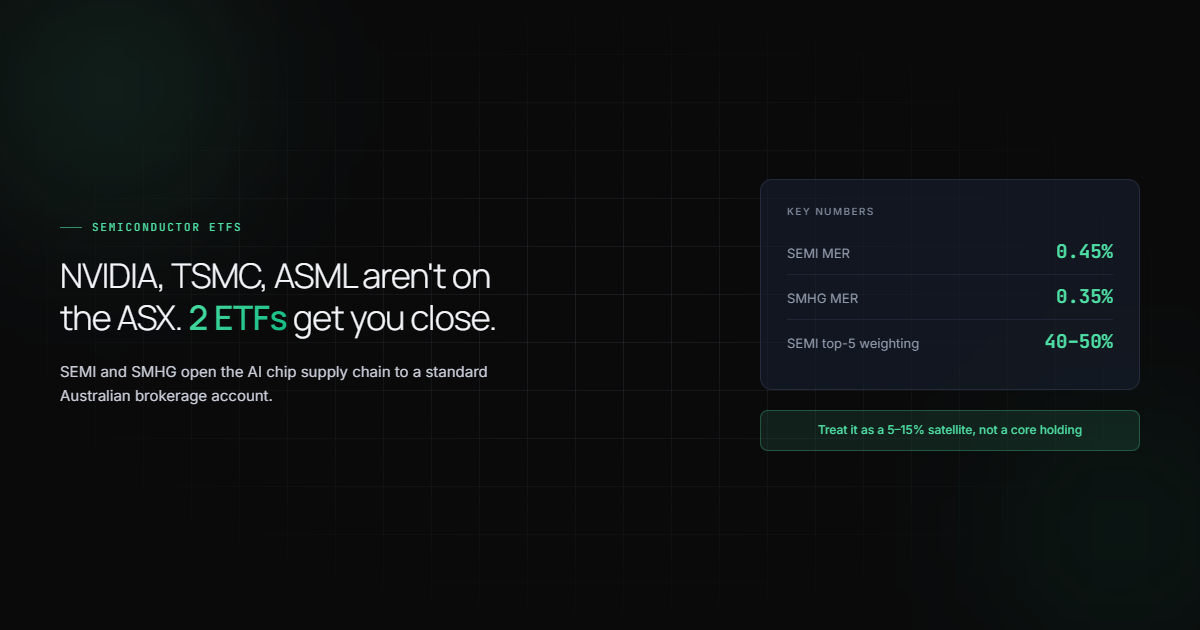
Two ASX-listed semiconductor ETFs now give DIY investors direct access to global chip stocks from a standard Australian brokerage account. Before you buy, there are five things worth understanding: which products exist, how currency risk works in both directions, what concentration risk looks like inside a 30-stock thematic ETF, how the ATO taxes these holdings, and where this kind of investment sits in a broader portfolio.
Why Semiconductors Matter for Australian Investors Right Now
AI infrastructure requires enormous quantities of specialised chips. Every large language model, every data centre GPU cluster, every autonomous system runs on semiconductors. Global chip revenue grew approximately 22% in 2025, with AI and high-performance computing chips alone forecast to exceed US$150 billion in annual sales.
NVIDIA designs the GPUs that train AI models. TSMC manufactures them. ASML produces the lithography equipment that makes advanced chip fabrication possible. None of these companies list on the ASX, which means Australian investors need a structured vehicle to access the theme.
Semiconductors are no longer a speculative play. They sit at the foundation layer of AI, cloud computing, electric vehicles, and defence technology. That said, the sector has a well-documented boom/bust history driven by inventory cycles. AI demand is reshaping the cycle, but it has not eliminated it.
Your ASX Options: SEMI and SMHG Head-to-Head
Global X Semiconductor ETF (ASX: SEMI)
SEMI tracks the Solactive Global Semiconductor 30 Index, holding 30 global semiconductor companies. Top holdings include NVIDIA, TSMC, ASML, and Broadcom, with the top five names representing roughly 40–50% of the portfolio. The fund carries a management expense ratio (MER) of 0.45% per annum and holds approximately $1.01 billion in assets under management. It has meaningful trading history and strong liquidity for a thematic product.
VanEck Global Semiconductor ETF (ASX: SMHG)
SMHG listed on the ASX in August 2026 and tracks the MarketVector Global Semiconductor Index, covering chip designers, foundries, equipment suppliers, and materials companies. Its MER is 0.35% per annum, making it the lower-cost option. Because it is a newer entrant, it has limited performance history compared to SEMI. Fee-sensitive investors with a longer time horizon may favour SMHG, while those who prefer an established track record and higher liquidity may lean toward SEMI.
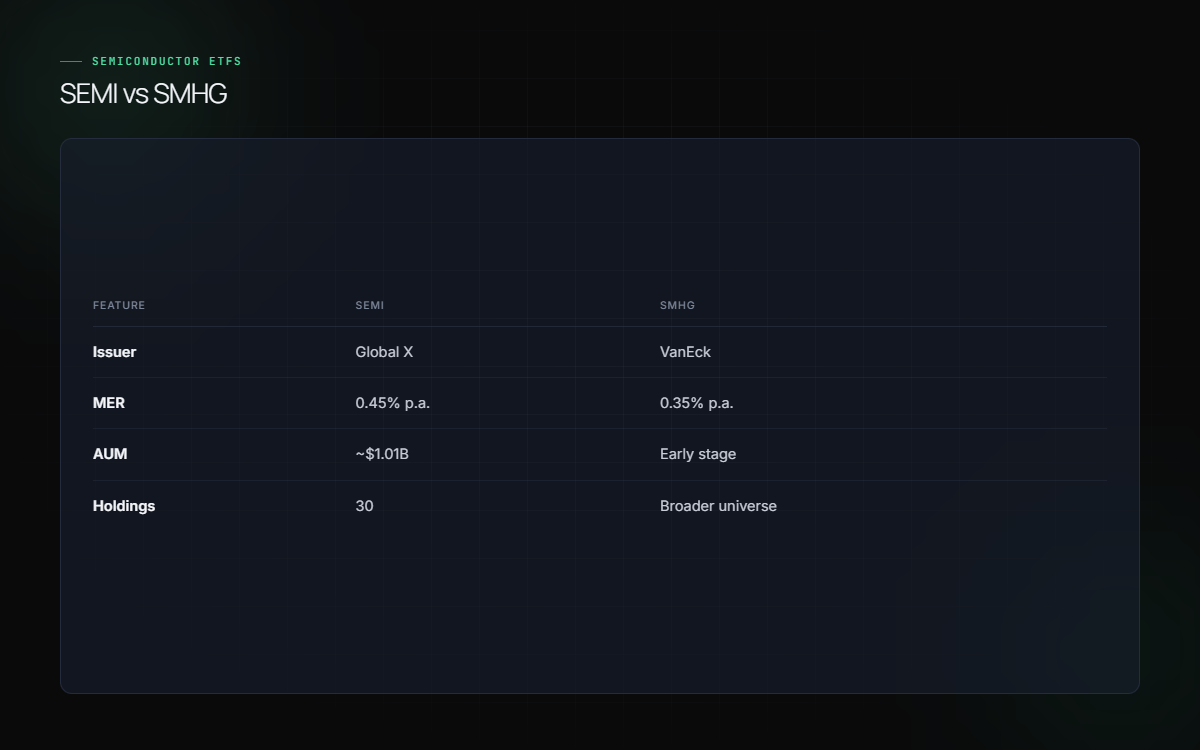
Comparison: SEMI vs SMHG
| Feature | SEMI | SMHG |
|---|---|---|
| Issuer | Global X | VanEck |
| MER | 0.45% p.a. | 0.35% p.a. |
| AUM | ~$1.01B | Early stage |
| Index tracked | Solactive Global Semiconductor 30 | MarketVector Global Semiconductor |
| Holdings | 30 | Broader universe |
| Currency hedged | No | No |
Going Offshore: US-Listed ETFs via International Brokers
The iShares Semiconductor ETF (SOXX) and VanEck Semiconductor ETF (SMH) are the US-listed benchmarks for this sector. Both offer a wider holdings universe, deeper liquidity, and a longer performance history than their ASX-listed counterparts. Australians can access these via brokers such as Interactive Brokers or Stake.
To invest in US-listed ETFs, you need to complete a W-8BEN form. This establishes your status as a non-US person and reduces the standard US dividend withholding tax rate from 30% to 15% under the Australia-US tax treaty. With ASX-listed ETFs like SEMI or SMHG, the fund manager handles foreign withholding tax obligations internally. Regardless of where your ETF is listed, the ATO still requires you to declare all foreign income and capital gains in your Australian tax return.
For most DIY retail investors, ASX-listed SEMI or SMHG is the lower-friction path:
- CHESS sponsorship — holdings registered in your name on the ASX
- AUD settlement — no need to convert currency before investing
- Simpler tax reporting — no W-8BEN, no foreign tax credit calculations
- Standard brokerage — accessible via any Australian platform
AUD/USD Currency Risk: The Return Factor Most Investors Underestimate
Both SEMI and SMHG are unhedged, meaning your AUD return equals the underlying stock performance adjusted for AUD/USD movements. If the AUD strengthens against the USD, your returns fall even if chip stocks rise. If the AUD weakens, your returns rise even if chip stocks are flat.
Worked example:
- Scenario A: Holdings rise 15%, AUD falls 5% vs USD → AUD return ≈ +20%
- Scenario B: Holdings rise 15%, AUD rises 5% vs USD → AUD return ≈ +10%
- Scenario C: Holdings fall 10%, AUD falls 8% → AUD return ≈ –2%
Scenario C reveals the counterintuitive angle most commentary ignores. During global risk-off events, the AUD typically weakens at the same time tech stocks sell off. For holders of unhedged semiconductor ETFs, that AUD weakness acts as a partial natural hedge, softening the AUD-denominated drawdown.
No hedged semiconductor ETF currently exists on the ASX. Over longer time horizons, currency movements tend to be less significant than underlying stock performance. Factor AUD/USD expectations into your position sizing rather than waiting for a hedged alternative that does not yet exist.
Concentration Risk: Understanding What You Actually Own
SEMI’s 30-stock universe means its top five holdings likely represent 40–50%+ of the entire portfolio. Compare this to a broad global equities ETF like Vanguard’s VGS, which holds thousands of companies across many sectors. During market drawdowns, concentrated thematic ETFs tend to fall harder and faster than broad index funds.
NVIDIA’s weighting inside SEMI means the ETF’s unit price tracks NVIDIA’s share price closely. NVIDIA has delivered extraordinary returns over three years, but it has also experienced drawdowns of 30–50% at various points in its history. If you already hold a broad global tech ETF such as NDQ, check for NVIDIA overlap before adding SEMI — you may have more single-stock concentration than you realise.
Treat a semiconductor ETF as a thematic satellite position, not a core holding. A typical thematic sleeve runs 5–15% of the total portfolio depending on your risk tolerance. For SMSF trustees, document the rationale for holding a concentrated thematic position in your fund’s investment strategy, including how it fits within the fund’s broader risk and diversification objectives.
Tax Considerations for Australian Investors
Distributions from SEMI and SMHG are largely classified as foreign income by the ATO, because the underlying holdings are offshore companies. Expect minimal or no franking credits. You must declare distributions in the financial year they are paid. The ETF issuer provides an annual tax statement breaking down income components — keep this alongside your tax records.
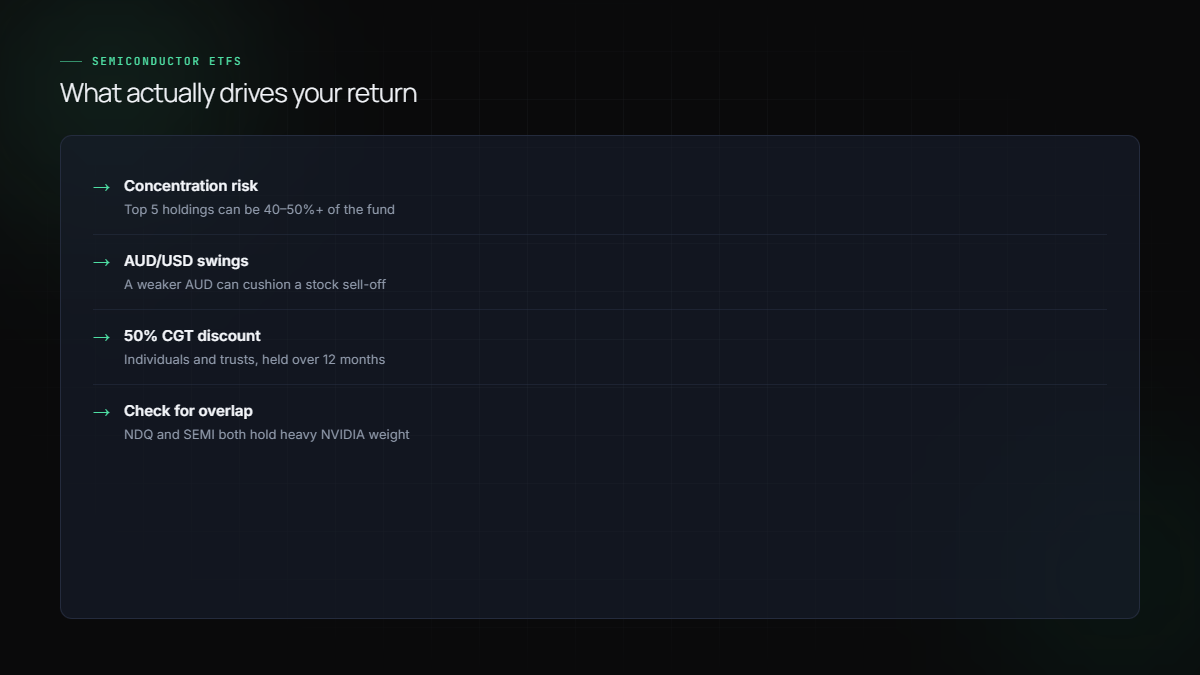
Selling units triggers a CGT event. Your capital gain equals sale proceeds minus your cost base. Individuals and trusts who have held units for more than 12 months are eligible for the 50% CGT discount. This discount does not apply inside superannuation — super funds use a one-third discount instead. The ATO requires you to retain records of purchase price, acquisition date, and brokerage costs for five years.
If you buy SEMI or SMHG in multiple tranches, each purchase creates a separate CGT lot with its own cost base and acquisition date. Tracking each parcel accurately is essential for correct CGT calculations. Portfolio tracking tools like Crowdfolio are built for exactly this — recording each acquisition lot, distribution, and sale so your CGT position stays accurate without manual spreadsheets.
Frequently asked questions
What is the best semiconductor ETF on the ASX?
There is no single answer without knowing your goals. SEMI offers an established track record and higher AUM. SMHG offers a lower MER and a broader index. Fee-sensitive investors with a longer horizon may prefer SMHG; those who prioritise liquidity and history may prefer SEMI.
How does AUD/USD currency risk affect my returns?
Both ETFs are unhedged. Your AUD return reflects chip stock performance plus or minus AUD/USD movements. A falling AUD amplifies your returns; a rising AUD reduces them, even if the underlying holdings perform well.
How are ASX-listed semiconductor ETFs taxed in Australia?
Distributions are largely foreign income with little to no franking credits. Selling units triggers a CGT event. The 50% CGT discount applies if you hold units for more than 12 months (individuals and trusts only). All income and gains must be reported to the ATO.
Is a semiconductor ETF too concentrated to hold as a core position?
Yes. A 30-stock thematic ETF behaves very differently to a broad global equities fund. Use it as a satellite position, check for overlap with existing tech ETFs, and size the position relative to your overall risk tolerance.