
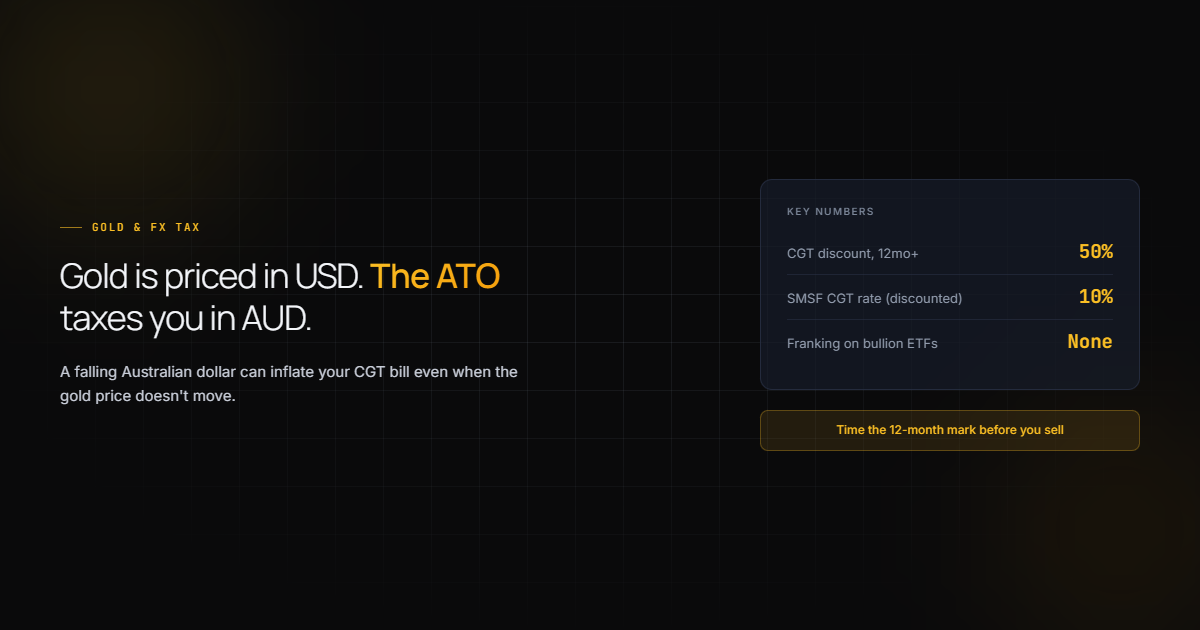
Gold has been climbing steadily in USD terms, and Australian investors are taking notice. But there is a complication most articles skip: you track gold in USD, and the ATO taxes you in AUD. That gap alone can significantly change your after-tax outcome.
Whether you are looking at ASX-listed gold ETFs, gold mining shares, or holding gold inside an SMSF, the structure you choose and the timing of your sales will determine how much of your gain you keep.
This article covers how to invest in gold from Australia in a tax-aware way, with worked examples, franking credit comparisons, and practical ATO record-keeping guidance.
How Australian Investors Can Access Gold on the ASX
ASX-Listed Gold Bullion ETFs
Gold bullion ETFs hold physical gold or track a gold price index. They trade on the ASX like shares and give you direct exposure to the gold price without storing metal yourself. Most ASX-listed bullion ETFs are priced in AUD but track an underlying USD gold price, so your return is shaped by both gold and the AUD/USD exchange rate.
ASX Gold Mining Shares
Gold mining companies listed on the ASX give you exposure to gold through their earnings rather than direct ownership of bullion. Miners carry operational risk — cost blowouts, production issues, management decisions — but they also pay dividends, sometimes with franking credits attached.
Choosing Between Bullion ETFs and Miners
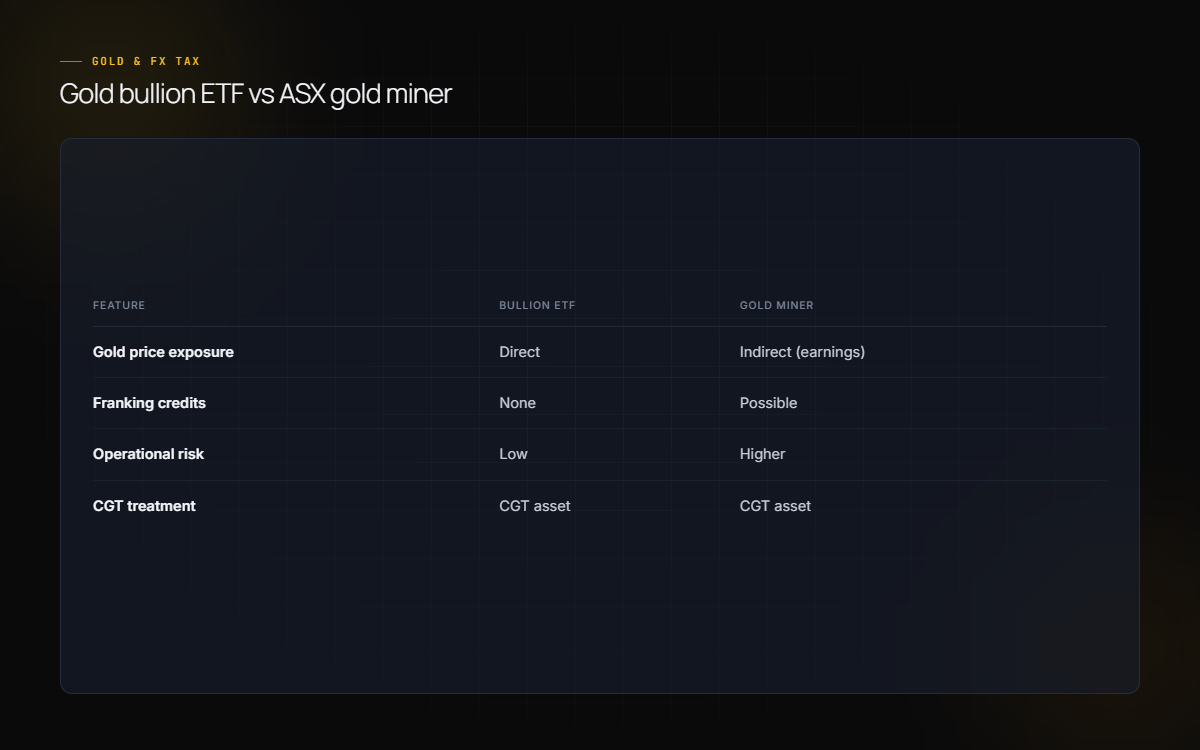
| Feature | Gold Bullion ETF | ASX Gold Miner |
|---|---|---|
| Gold price exposure | Direct | Indirect (earnings-driven) |
| Income | Rarely distributes | Dividends possible |
| Franking credits | None | Possible |
| Operational risk | Low | Higher |
| CGT treatment | CGT asset | CGT asset |
How the ATO Taxes Gold Investments
Gold ETF Units Are CGT Assets
The ATO treats ETF units as CGT assets. You do not pay tax while you hold them. A taxable event occurs when you sell, so your disposal strategy matters.
The 50% CGT Discount and the 12-Month Holding Rule
Individual investors who hold ASX gold ETFs or gold mining shares for more than 12 months before selling are eligible for the 50% CGT discount. Sell before 12 months and CGT applies to the full capital gain at your marginal rate. For complying SMSFs, the discount is one-third, not 50%.
Worked Example: CGT on a Gold ETF Sale (Individual Investor)
- Purchase: 500 units at $20.00 = $10,000 cost base
- Sale (14 months later): 500 units at $28.00 = $14,000 proceeds
- Gross capital gain: $4,000
- After 50% discount: $2,000 assessable gain
- Tax at 37% marginal rate: $740
Selling at month eight would have meant tax on the full $4,000 at 37%, or $1,480 — double the liability.
The AUD/USD FX Effect on Your CGT Calculation
Why a Falling Australian Dollar Increases Your Taxable Gain
Gold is priced in USD globally. If the AUD falls between the date you buy and the date you sell, your AUD-denominated proceeds rise even if the USD gold price stays flat. This FX gain is fully embedded in your CGT calculation.
How the ATO Requires FX Translation
The ATO requires all CGT amounts to be converted to AUD using the exchange rate at the date of each transaction. The RBA publishes daily exchange rates the ATO accepts for this purpose. There is no separate FX gain or loss to report — it is absorbed into the capital gain or loss on the ETF itself.
Worked Example: Same Gold Price, Different AUD Outcome
- Buy: USD gold ETF unit at USD 60.00, AUD/USD = 0.75 → cost base AUD 80.00
- Sell: same unit at USD 60.00, AUD/USD = 0.60 → proceeds AUD 100.00
- Capital gain: AUD 20.00 per unit — despite no change in the USD gold price
A weakening AUD amplifies your AUD-denominated return and your CGT bill simultaneously.
Franking Credits, Dividends, and Gold Mining Shares
Why Bullion ETFs Cannot Carry Franking Credits
Gold bullion ETFs hold physical gold, not shares in Australian companies. They do not pay Australian corporate tax, so they have no franking credits to attach to distributions. Any distribution from a bullion ETF arrives unfranked.
How Franked Dividends From ASX Gold Miners Work
Australian-listed gold mining companies pay corporate tax at up to 30% and attach franking credits to dividends. You include both the cash dividend and the franking credit in your assessable income, then claim the credit against your tax liability. If your marginal rate is below the company tax rate, the ATO refunds the excess.
After-Tax Income Comparison: Bullion ETF vs Franked Gold Miner
- $1,000 unfranked distribution (bullion ETF), 37% rate: $630 after tax
- $700 cash dividend + $300 franking credit = $1,000 assessable income, 37% rate: $70 net tax payable
- After-tax income from miner: $930
The franking credit closes much of the gap even when the cash dividend appears smaller.
Investing in Gold Through an SMSF
SMSF Tax Rates on Gold Investments
A complying SMSF pays 15% tax on investment income. On capital gains for assets held more than 12 months, the fund receives a one-third CGT discount, reducing the effective CGT rate to 10%. That compares favourably to an individual on a 37% or 45% marginal rate.
Franking Credit Refunds Inside Super
Franking credits from ASX gold miners offset the SMSF’s 15% tax liability. If the credits exceed the fund’s total tax bill — common for funds in pension phase paying 0% tax — the ATO refunds the excess. This makes fully franked gold miner dividends particularly efficient inside super.
In-Specie Transfers of Gold ETFs Into an SMSF: The CGT Trap
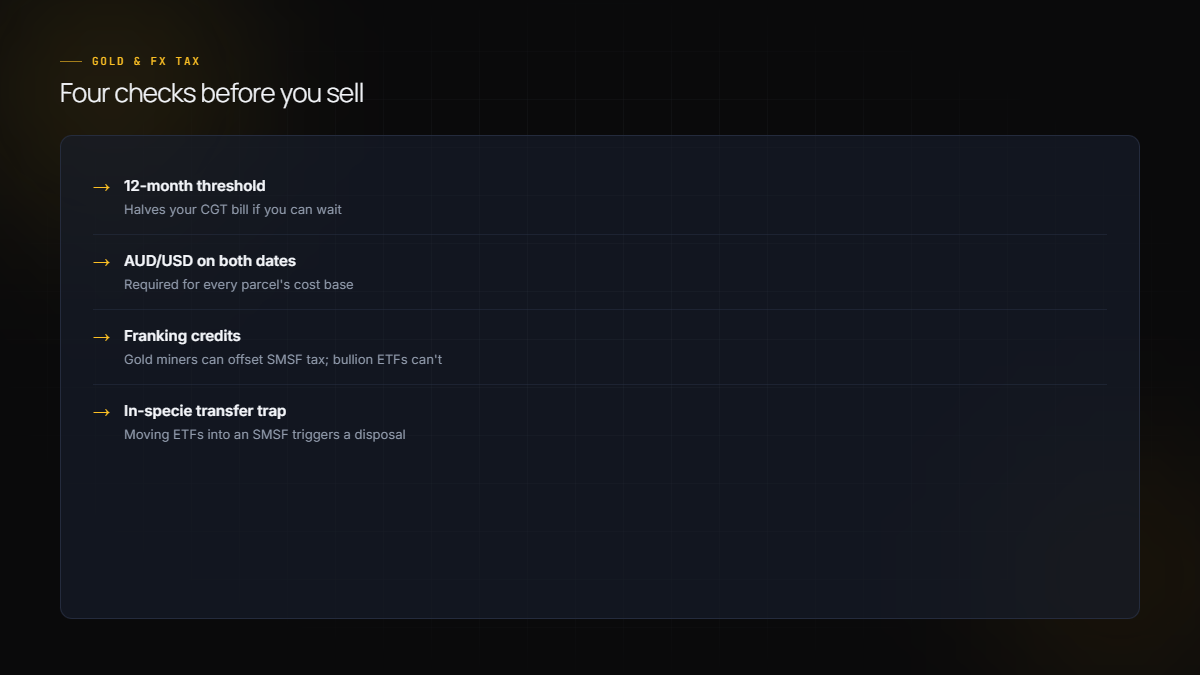
Transferring personally held gold ETFs into your SMSF is treated as a disposal at market value on the transfer date. Any accrued capital gain is assessable in your hands at that point. Plan this carefully before acting.
Worked Example: SMSF vs Individual Investor After-Tax Comparison
| Scenario | Individual (37% rate) | SMSF (accumulation) |
|---|---|---|
| Capital gain (held 14 months) | $10,000 | $10,000 |
| After discount | $5,000 | $6,667 |
| Tax payable | $1,850 | $1,000 |
| After-tax gain | $8,150 | $9,000 |
ATO Record-Keeping Requirements for Gold Investors
Parcel-Level Records
For every parcel of gold ETF units, record the acquisition date, number of units, price per unit, total cost in AUD, and any brokerage included in the cost base. Each parcel has its own acquisition date for the 12-month discount test.
Tracking DRP Units and Reinvested Distributions
If your gold miner or ETF operates a dividend reinvestment plan (DRP), each set of new units is a separate parcel with its own cost base and acquisition date. Missing these parcels is one of the most common errors the ATO finds.
FX Rate Records for Foreign-Currency Gold ETFs
For any gold ETF transacting in USD, record the AUD/USD exchange rate on both the acquisition and disposal date. The RBA exchange rate table is the standard reference. Store this alongside your broker confirmation for each trade.
Five-Year Retention Rule
The ATO requires you to keep CGT records for five years after you lodge the return in which the CGT event is reported. If you buy a gold ETF in 2024 and sell it in 2027, your acquisition records need to survive until at least 2032.
Practical CGT Timing Strategies
Waiting for the 12-Month Threshold
If your gold ETF holding is approaching the 12-month mark and you are sitting on a significant gain, waiting to cross that threshold before selling halves your CGT liability.
Tax-Loss Harvesting Against Gold Gains
If you hold other investments sitting at a loss, crystallising those losses in the same financial year as a gold ETF sale reduces your net capital gain. Capital losses must be applied before the 50% discount is calculated, so a $2,000 loss against a $10,000 gain leaves $8,000, discounted to $4,000 assessable.
Dollar Cost Averaging and Cost Base Management
Buying gold ETFs in regular smaller amounts creates multiple parcels, each with its own cost base and acquisition date. This gives you flexibility when selling — you choose which parcels to dispose of first to manage your CGT outcome. If you do not identify specific parcels, the ATO defaults to FIFO (first in, first out).
Frequently asked questions
Is gold a good investment for Australians right now?
Gold attracts Australian investors as a portfolio hedge, particularly when equity markets are volatile or the AUD is weakening. A weaker AUD amplifies USD gold returns in Australian dollar terms — but it also increases your CGT bill if you sell. Understand your after-tax outcome before acting, not after.
Do ASX gold ETFs pay dividends or distributions?
Physical gold bullion ETFs generally do not distribute income because gold produces no yield. Some ETFs make occasional capital distributions, which affect your cost base rather than acting as income. Gold mining shares are different — they pay dividends that are franked or unfranked depending on the company’s tax position.
How do I calculate CGT when I sell an ASX gold ETF?
Convert your acquisition cost to AUD using the exchange rate on the purchase date. Convert your sale proceeds to AUD using the rate on the sale date. Subtract the cost base from the proceeds to get your capital gain. If held more than 12 months, apply the 50% discount. Add the net gain to your assessable income for the financial year.
Can I hold gold ETFs inside my SMSF?
Yes. A complying SMSF can hold ASX-listed gold ETFs as an investment asset, provided the fund’s investment strategy explicitly permits gold exposure. The CGT discount inside super is one-third, not 50%. Watch the in-specie transfer trap if you are moving personally held ETFs into the fund, and ensure your records are audit-ready from day one. Tools like Crowdfolio help SMSF trustees track parcels, FX rates, and CGT positions across their full portfolio without building spreadsheets from scratch.