
Why Copper Is Having a Structural Moment
Copper is the defining metal of electrification. Every solar panel, wind turbine, EV, and grid upgrade requires significant quantities of it. The International Energy Agency projects copper demand from clean energy technologies alone will double by 2040.
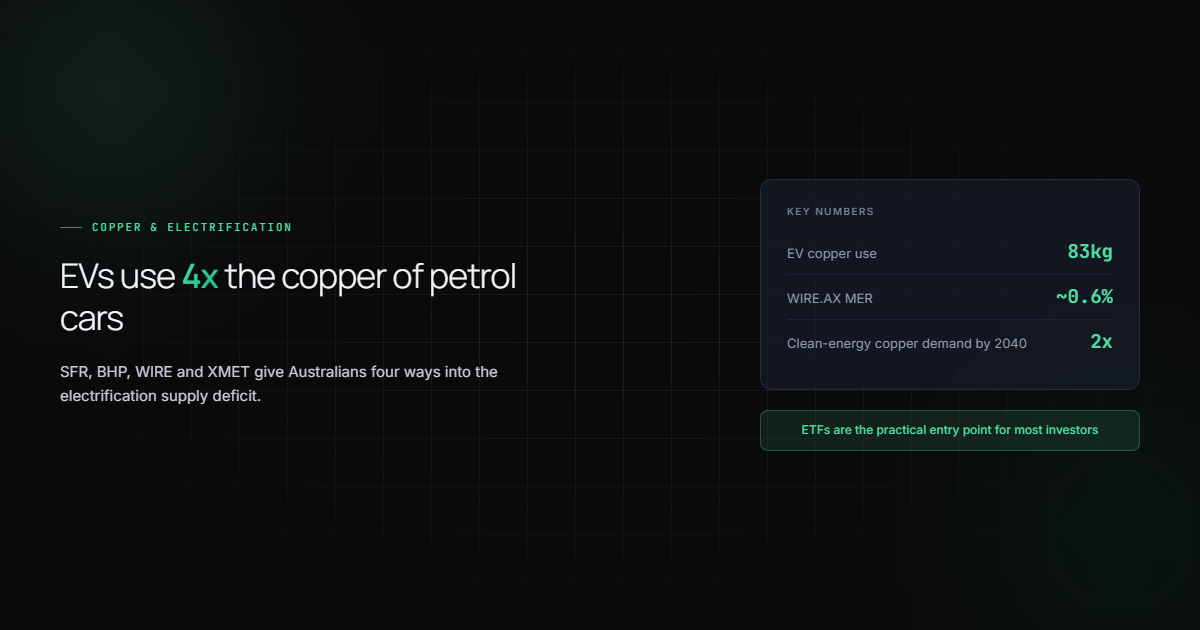
An electric vehicle uses roughly 83 kg of copper — about four times more than a petrol car. Offshore wind installations require up to 15 tonnes per megawatt of capacity. Grid upgrades, which every country needs to support higher renewable penetration, are copper-intensive at scale.
AI data centres are an emerging demand driver most investors miss. Each large-scale facility requires substantial copper wiring, cooling systems, and power infrastructure. As hyperscalers expand globally, this segment adds a non-cyclical layer to the structural case.
Electrification is a policy-driven, capital-committed transition. Governments across Europe, the US, and Asia have legislated targets requiring decades of infrastructure build. This distinguishes copper from typical commodity cycles driven by short-term industrial activity.
The Copper Supply Deficit
Average copper ore grades have declined significantly over the past 20 years. Miners are processing more rock to extract less copper, raising costs and limiting output growth. The pipeline of major new projects is thin.
A new copper mine takes 10 to 20 years from discovery to production. Many of the largest undeveloped deposits sit in politically complex jurisdictions including the Democratic Republic of Congo, Peru, and Chile, which adds supply uncertainty.
When demand grows steadily and supply cannot keep pace, the structural bias for prices is upward over time. This does not eliminate short-term volatility, but it supports the long-term investment case for copper exposure in a diversified portfolio.
Four Ways to Invest in Copper on the ASX
1. Pure-Play ASX Copper Miners
Pure-play miners give you direct leverage to the copper price. Sandfire Resources (SFR.AX) is the most prominent ASX-listed example, with copper operations in Australia, Botswana, and Spain. Smaller exploration and development companies offer higher upside but considerably more risk.
2. Diversified Majors With Significant Copper Exposure
BHP (BHP.AX) and Rio Tinto (RIO.AX) both have substantial copper divisions. BHP recently reported record group copper production exceeding two million tonnes, linked directly to urbanisation, digitisation, and electrification. These stocks dilute your copper exposure but reduce single-asset risk.
3. Dedicated Copper ETFs Listed on the ASX
The Global X Copper Miners ETF (WIRE.AX) holds approximately 44 global copper mining stocks and charges a management fee in the mid-0.6% range per annum. It gives you broad exposure to the copper mining sector without selecting individual companies — and it is the option most retail investors overlook.
4. Broader Energy Transition ETFs That Include Copper
ETFs such as the BetaShares Energy Transition Metals ETF (XMET.AX) bundle copper alongside lithium, rare earths, silver, and other critical minerals. If you want thematic exposure to electrification broadly rather than copper specifically, these products offer a blended approach.
Comparing Your Options
Pure-play miners amplify both gains and losses relative to the copper price. A single mine closure, resource downgrade, or operational delay moves the share price sharply. These suit investors with higher risk tolerance and genuine conviction in specific companies.
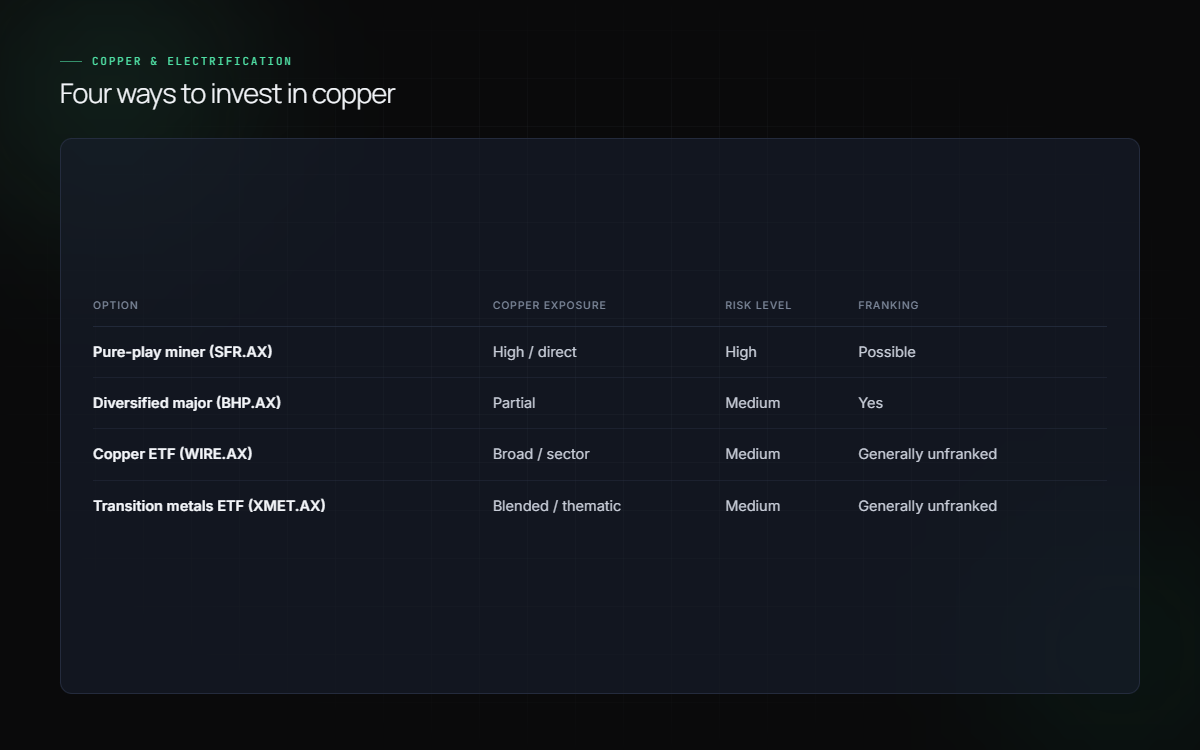
Diversified majors give you copper alongside iron ore, aluminium, and other commodities. Your portfolio is less volatile, but your copper thesis is diluted. These suit investors who want resources exposure with lower concentration risk.
ETFs remove stock-selection risk and are easy to trade through any ASX broker. The trade-off is the management fee and owning the average of the sector rather than the best performers. For most retail investors starting out with copper, an ETF is the most practical entry point.
If you are investing for five years or more and believe in the structural demand story, the CGT discount makes a long-term hold in any of these vehicles tax-efficient. Your risk profile should guide whether you choose a single miner, a major, or an ETF.
| Option | Copper Exposure | Risk Level | Franking Credits | Management Fee |
|---|---|---|---|---|
| Pure-play miner (e.g. SFR.AX) | High / direct | High | Possible | None (brokerage only) |
| Diversified major (e.g. BHP.AX) | Partial | Medium | Yes (typically franked) | None (brokerage only) |
| Copper ETF (e.g. WIRE.AX) | Broad / sector | Medium | Generally unfranked | ~0.6% p.a. |
| Transition metals ETF (e.g. XMET.AX) | Blended / thematic | Medium | Generally unfranked | Varies |
How the ATO Taxes Copper Investments
CGT on ASX Shares and ETF Units
Both ASX-listed shares and ETF units are CGT assets under ATO rules. When you sell at a profit, your capital gain is your sale proceeds minus your cost base. Your cost base includes the purchase price plus brokerage on both the buy and the sell.
The 50% CGT Discount
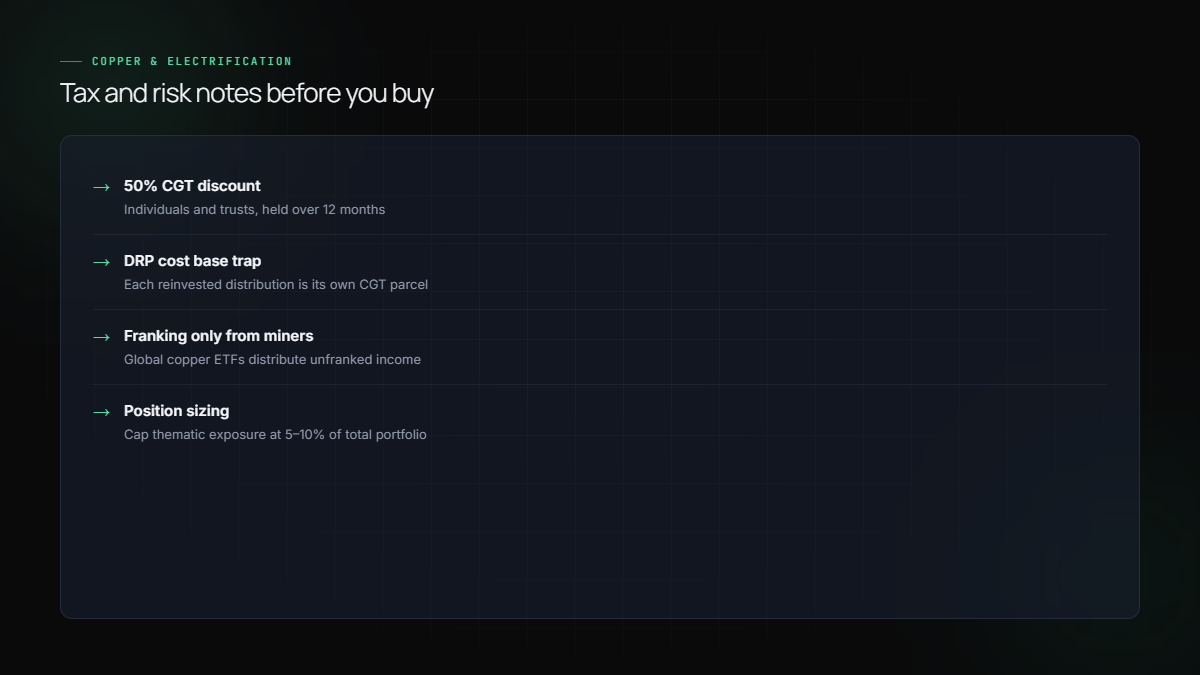
If you hold shares or ETF units for at least 12 months before selling, you are eligible for the 50% CGT discount as an individual investor. Only half your net capital gain is added to your assessable income. Holding copper investments beyond 12 months is one of the most straightforward ways to improve your after-tax return.
ETF Distributions and Unfranked Income
ETF distributions — including amounts reinvested through a distribution reinvestment plan (DRP) — are assessable income in the financial year they are paid. Global copper ETFs like WIRE.AX typically distribute unfranked income, meaning no franking credits attach to offset your tax liability.
Franking Credits From ASX Miners
When BHP or Rio Tinto pay franked dividends, those dividends carry imputation credits that reduce the tax you owe. If your marginal rate is below the corporate tax rate, the ATO refunds the excess. This is a genuine after-tax advantage of holding large ASX miners directly that globally-focused copper ETFs do not replicate.
The DRP Cost Base Trap
When you participate in a DRP, each parcel of new units acquired has its own acquisition date and cost base equal to the distribution amount declared as income. Many investors fail to track these parcels separately, which leads to incorrect CGT calculations at tax time. Keep records of every DRP allotment.
ATO Record-Keeping
The ATO requires you to keep records of every acquisition and disposal, including brokerage receipts, DRP statements, and annual tax statements from your ETF provider. Retain these for five years after you lodge the tax return in which the relevant gain or loss is reported.
Copper Investing Inside an SMSF
SMSF trustees can hold ASX-listed copper shares and ETFs provided the investment aligns with the fund’s documented investment strategy. The strategy must reflect the risk, return, liquidity, and diversification characteristics of the fund’s overall holdings.
In accumulation phase, the fund pays 15% tax on investment income and 10% tax on capital gains for assets held longer than 12 months. In pension phase, both income and capital gains are generally tax-free, making the timing of disposals especially important for trustees approaching retirement.
SMSF trustees must maintain records of all trades, income, and distributions to support the fund’s annual audit. Every DRP allotment, distribution statement, and brokerage confirmation needs to be filed and retained.
Risks Every Copper Investor Should Understand
- Commodity price cyclicality: Copper prices are sensitive to global growth and China’s industrial activity. Short-term drawdowns of 20–30% are common even in structural bull markets.
- Geopolitical risk: Supply disruptions in Chile, Peru, or the DRC affect global copper prices and company-level production.
- Project execution risk: Mine development delays, cost overruns, and permitting issues regularly affect smaller pure-play miners.
- Position sizing: Avoid concentrating more than 5–10% of your total portfolio in a single sector or stock, even in high-conviction thematic positions.
Frequently asked questions
What ASX stocks give exposure to copper?
Sandfire Resources (SFR.AX) is the leading pure-play ASX copper miner. BHP (BHP.AX) and Rio Tinto (RIO.AX) offer significant copper exposure alongside other commodities.
Is there a copper ETF on the ASX?
Yes. The Global X Copper Miners ETF (WIRE.AX) holds approximately 44 global copper mining companies. The BetaShares Energy Transition Metals ETF (XMET.AX) also includes copper alongside other critical minerals.
How does the ATO treat capital gains from copper shares and ETF units?
Both are CGT assets. Gains on disposal are assessable, and the 50% CGT discount applies if you hold for 12 months or more. ETF distributions, including DRP units, are assessable income in the year paid.
How does copper compare to lithium and other transition metals on the ASX?
Copper has a more established and liquid market than lithium, with broader industrial demand beyond EVs. Lithium prices have been more volatile due to recent oversupply. Copper’s demand base — spanning construction, grid infrastructure, and AI — is more diversified, which many investors view as a lower-risk entry into the critical minerals theme.