
How Australian Investors Access AI Exposure on the ASX
Pure-play AI shares listed on the ASX
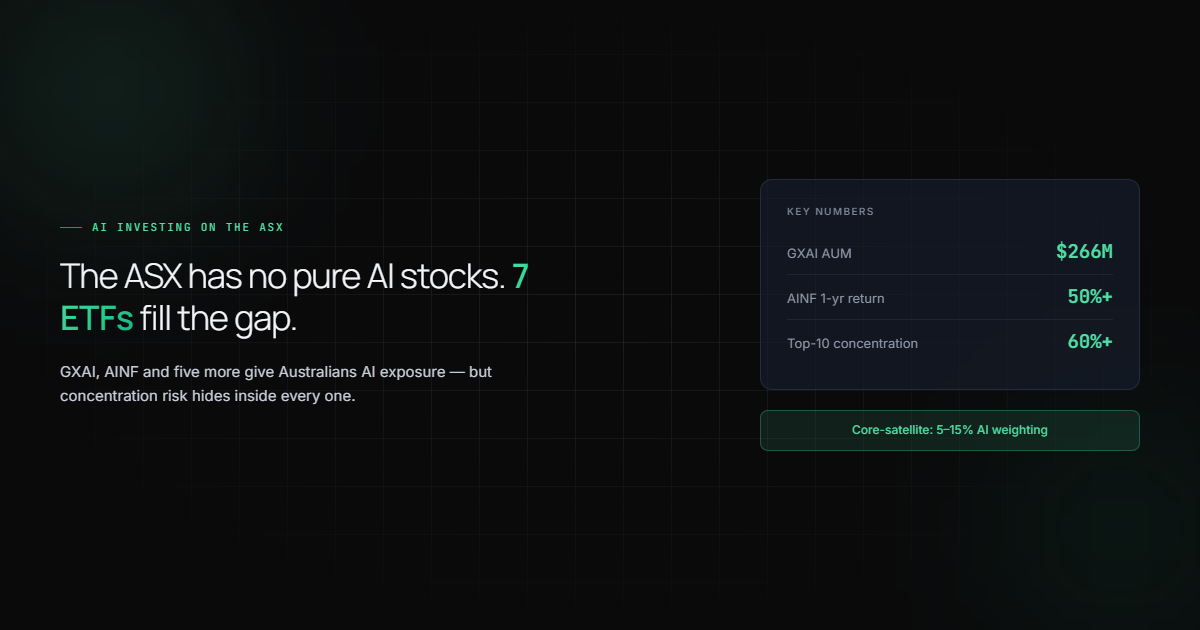
The ASX has limited direct AI listings. A small number of technology companies touch AI in areas like data analytics and cloud infrastructure, but none are pure-play AI businesses at global scale. For genuine AI exposure, most Australian investors turn to ETFs.
Dedicated AI thematic ETFs trading on the ASX
Two funds lead this category in 2026:
- GXAI (Global X Artificial Intelligence ETF) — MER 0.57%, AUM approximately $266M, focused on companies directly involved in AI development and deployment
- AINF (Global X AI Infrastructure ETF) — MER 0.57%, AUM approximately $143M, targets the physical and digital infrastructure supporting AI workloads, including data centres and power
Both are unhedged and USD-denominated in their underlying holdings. AINF delivered returns above 50% in its first year since launching April 2025. Strong recent numbers reflect concentrated sector exposure, not diversification.
Broader technology ETFs with significant AI weighting
- NDQ (BetaShares Nasdaq 100) — AUM around $8.96B, 1-year return approximately 27%, unhedged
- HNDQ (hedged version of NDQ) — AUM near $973M, 1-year return approximately 39.5%
- RBTZ (BetaShares Global Robotics & AI ETF) — MER 0.57%, AUM around $328M
Semiconductor and data infrastructure ETFs
SEMI (Global X Semiconductor ETF) — MER 0.45%, AUM approximately $903M — tracks companies making the chips that power AI systems. Cybersecurity funds such as HACK provide indirect exposure to AI-adjacent infrastructure spending.
ASX AI and technology ETF comparison
| ETF | Focus | MER | Hedged | AI Purity |
|---|---|---|---|---|
| GXAI | AI thematic | 0.57% | No | High |
| AINF | AI infrastructure | 0.57% | No | High |
| RBTZ | Robotics & AI | 0.57% | No | Medium |
| SEMI | Semiconductors | 0.45% | No | Medium (indirect) |
| NDQ | Nasdaq 100 | 0.38% | No | Lower (broad) |
| HNDQ | Nasdaq 100 hedged | 0.38% | Yes | Lower (broad) |
| HACK | Cybersecurity | 0.57% | No | Low (adjacent) |
Understanding Concentration Risk in AI Thematic ETFs
Nvidia, Microsoft, Alphabet, and Meta sit at the top of most AI ETF holdings. These companies are large enough to dominate any index that selects for AI relevance, meaning your thematic fund often behaves like a concentrated US tech fund.
Many AI ETFs apply a cap of 4–5% per stock at rebalance, but fast-moving prices push weights above those caps between rebalancing dates. In practice, your top five holdings frequently represent 30–50% of the fund.
Check the fund’s top 10 holdings as a percentage of total assets. If they exceed 60%, your portfolio has significant single-sector and single-country exposure. Overlapping holdings across GXAI and NDQ are common — owning both does not double your diversification.
A core-satellite approach works well here. Keep your core in diversified Australian and global index funds, then allocate a defined satellite position to AI thematic ETFs. A 5–15% satellite weighting gives meaningful exposure without making your overall returns hostage to a single sector.
ATO CGT Rules for AI Shares and ETF Investors
What triggers a CGT event
A CGT event occurs when you sell units or shares. When an ETF rebalances its internal holdings, you do not trigger a CGT event — a frequent point of confusion for DIY investors.
The 12-month 50% CGT discount
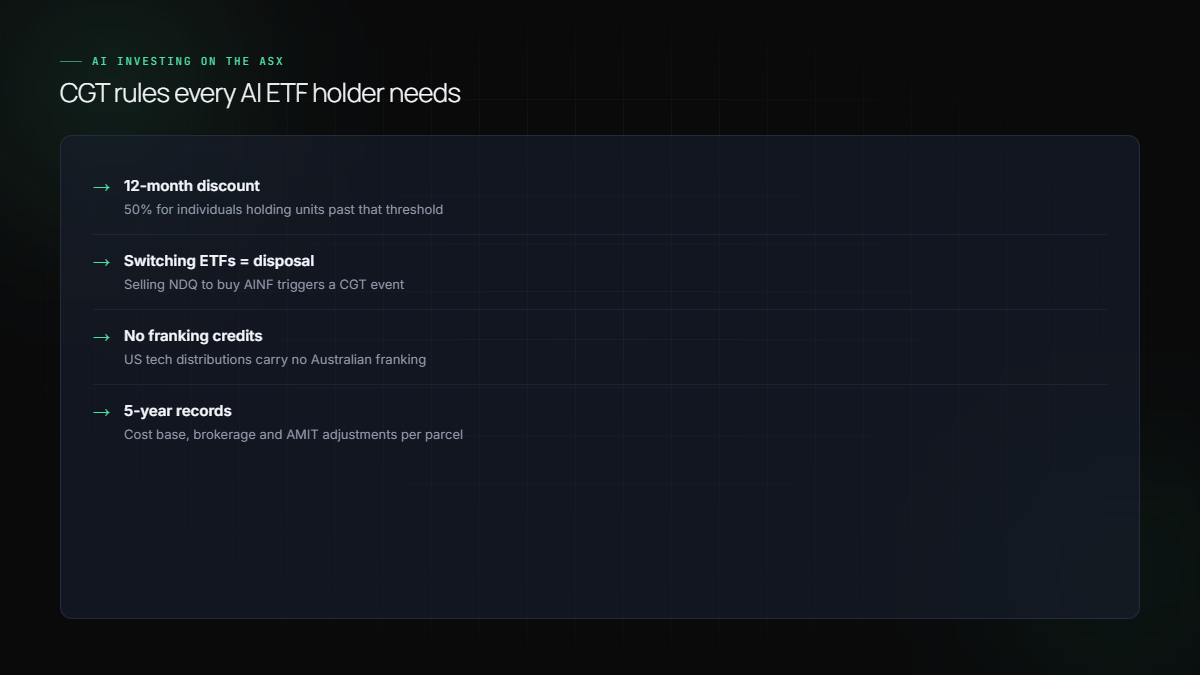
Individual Australian investors who hold ASX-listed ETF units for more than 12 months before selling are generally eligible for the 50% CGT discount on any net capital gain. Selling before 12 months means the full gain is added to your assessable income for that financial year.
CGT on ETF distributions
Annual ETF distributions often include foreign income and attributed capital gains passed through from the fund. These are assessable in the year they are paid and reported on your annual tax statement from the fund manager.
Switching between AI ETFs triggers CGT
Selling NDQ units to buy AINF is a disposal. You must calculate your capital gain or loss on the NDQ units and report it in your tax return. The 50% discount applies if you held those units for more than 12 months. This interaction between sector rotation and CGT creates a structural disincentive to frequent rebalancing.
Cost base record-keeping requirements
The ATO requires you to maintain records of:
- Acquisition date and cost of each parcel
- Brokerage paid on purchase and sale
- Any cost base adjustments from AMIT (Attribution Managed Investment Trust) statements
Keep these records for five years after disposal, or five years after you lodge the relevant tax return, whichever is later.
AUD/USD Currency Risk for Unhedged AI Investments
Nearly all AI ETF holdings are US-listed companies priced in USD. When you hold an unhedged ASX ETF, your AUD return reflects both the performance of the underlying index and AUD/USD movements.
The AUD tends to rise when global risk appetite is strong — the same environment that often lifts AI and technology stocks. When AI optimism drives US tech higher, the AUD often strengthens simultaneously, reducing your AUD-denominated return even as the underlying index gains.
Real-world example: Suppose an AI ETF’s underlying index rises 20% in USD terms over 12 months. If the AUD strengthens from 0.65 to 0.72 against the USD during the same period, your AUD return falls to approximately 9%. You were right about AI. You still underperformed because of currency movement.
HNDQ hedges AUD/USD exposure using rolling currency forward contracts, removing most exchange rate movement from your return but introducing a hedging cost of typically 1–2% annually. Hedging makes most sense when you expect the AUD to strengthen or when currency volatility is a concern.
Franking Credits and AI ETFs
Franking credits attach only to dividends paid by Australian companies that have paid Australian corporate tax. US technology companies pay no Australian tax, so distributions from GXAI, AINF, NDQ, and similar ETFs carry no franking credits.
For retirees and SMSF members in pension phase, franking credits from Australian equities represent genuine after-tax value. A heavy allocation to AI ETFs means that income stream disappears — worth factoring into your income planning if you rely on refundable franking credits.
Compare your total after-tax return across asset classes, not just headline yield. An unfranked AI ETF returning 8% and a fully franked Australian equity returning 5% deliver different after-tax outcomes depending on your marginal tax rate or superannuation phase.
SMSF Trustees and AI Exposure: Compliance Considerations
Your SMSF investment strategy must address risk, return, diversification, and liquidity for every asset class held. Adding GXAI or AINF requires the strategy to acknowledge their concentration, currency exposure, and growth orientation — and explain how they fit within the fund’s objectives.
Auditors look for evidence that trustees considered the risk profile of each holding against the fund’s membership profile. A fund with members approaching retirement holding 30% in AI thematic ETFs needs clear documentation of why that allocation remains appropriate.
Practical steps for SMSF trustees:
- Update your investment strategy before purchasing AI ETFs
- Record the rationale for the allocation in trustee minutes
- Review the strategy annually or whenever your allocation shifts materially
- Retain distribution statements and annual tax statements from each ETF provider
Practical Record-Keeping for AI ETF Investors
Maintain a clear record for every parcel of units: date of acquisition, number of units, total cost including brokerage, and AMIT tax statement adjustments for each year you hold the fund.
Some ETF distributions include a return of capital component that reduces your cost base. A lower cost base means a larger capital gain when you eventually sell. Tracking this annually prevents a surprise at disposal.
If you participate in a distribution reinvestment plan (DRP), the ATO treats each reinvestment as receiving a cash distribution (taxable in that financial year) and immediately purchasing new units. Each reinvestment creates a new parcel with its own acquisition date for CGT purposes.
Tracking multiple AI ETF parcels across financial years, each with distribution adjustments and different acquisition dates, is complex in a spreadsheet. Crowdfolio is built for Australian DIY investors and handles ETF cost base tracking, distribution records, and CGT calculations in one place.
Frequently asked questions
What ASX ETFs give Australian investors AI exposure in 2026?
Dedicated AI ETFs include GXAI and AINF. Broader technology funds with strong AI weighting include NDQ and HNDQ. SEMI offers semiconductor exposure and HACK covers cybersecurity infrastructure. Compare them on MER, AI purity, hedging status, and AUM before investing.
Does the 50% CGT discount apply if I hold an ASX-listed AI ETF for more than 12 months?
Yes. Individual Australian investors who hold ETF units for more than 12 months before disposal are generally eligible for the 50% CGT discount on any net capital gain. Selling before 12 months means the full gain is included in assessable income at your marginal tax rate.
How does AUD/USD currency risk affect my returns when investing in US AI ETFs?
Unhedged AI ETFs reflect both index performance and AUD/USD movements. If the AUD strengthens 10% while the underlying index rises 20%, your AUD return is roughly 9% rather than 20%. A hedged alternative like HNDQ removes most of this currency movement at a cost of approximately 1–2% annually.
Does switching from one AI ETF to another trigger a CGT event?
Yes. Selling one ETF and purchasing another is a disposal for CGT purposes. Calculate the capital gain or loss on the units sold, apply the 50% discount if you held them for more than 12 months, and report the result in your tax return for the financial year in which the sale occurred.