
Why are fuel prices rising in Australia?
The link between global crude oil and the Australian bowser
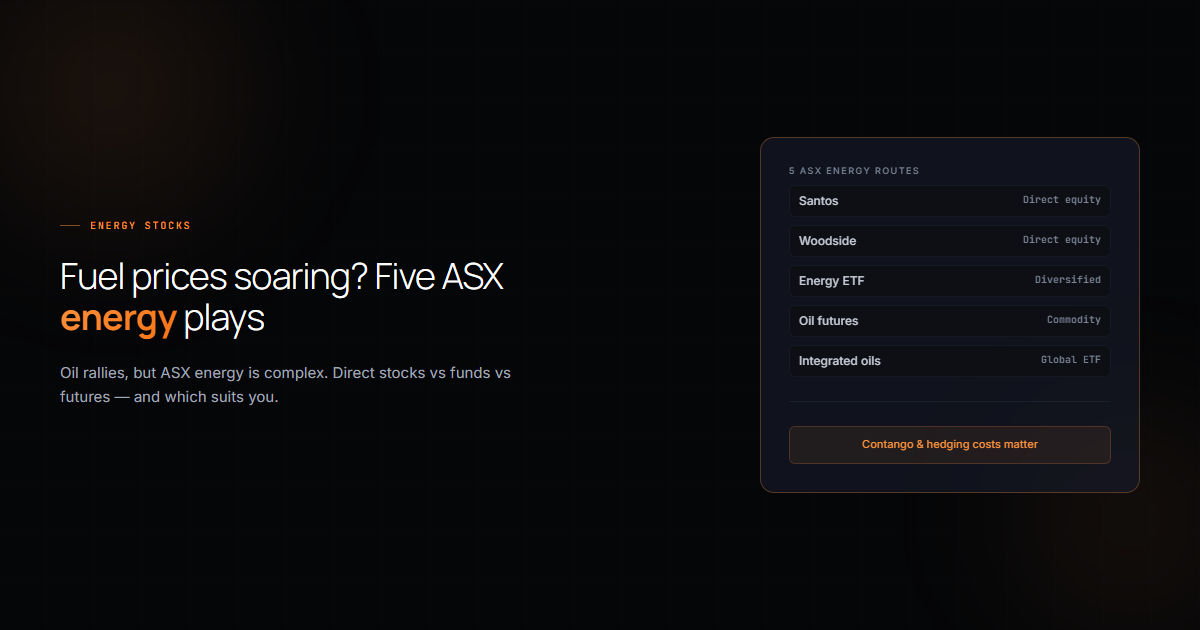
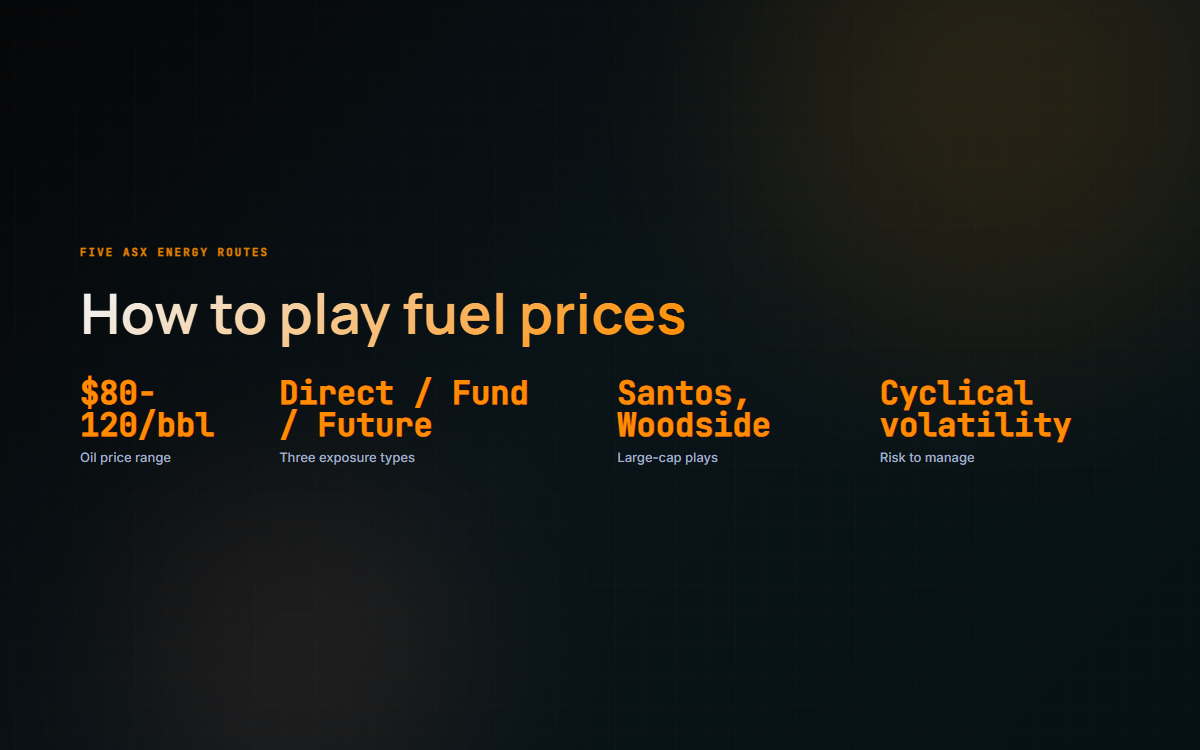
When fuel prices soar, five types of ASX energy stocks benefit: upstream producers with direct crude exposure, integrated companies balancing upstream and downstream, fuel distributors with franked dividends, LNG producers on long-term contracts, and smaller high-risk plays. Each offers different volatility and income profiles for investors seeking energy exposure.
How the AUD/USD exchange rate amplifies or cushions price moves
Because crude is priced in USD, a weaker Australian dollar makes imports more expensive even if oil prices stay flat. A falling AUD amplifies fuel cost increases for Australian households. A stronger AUD softens them. Both dynamics affect the profitability of ASX energy companies operating in the same USD-denominated commodity markets.
Why fuel price spikes are a leading signal for ASX energy sector activity
When Brent crude approaches levels like US$110 per barrel during geopolitical stress events, ASX energy stocks move fast. The S&P/ASX 200 Energy index often diverges sharply from the broader ASX 200 during oil spikes. Watching crude price trends gives you early warning before share prices fully adjust.
Which ASX energy stocks benefit from high oil prices?
Upstream producers: direct commodity exposure and sharp price swings
Upstream oil and gas producers sell crude or gas at or near spot market prices. When oil rises, revenue lifts quickly and margins expand. The Australian energy sector moves approximately 13% per week and is more volatile than 75% of all Australian stocks, so the upside during oil spikes is real, but so is the downside when prices fall.
Downstream distributors and fuel retailers: softer link, lower volatility
Fuel distributors and retailers buy refined product and sell it to end customers. Their margins depend on the spread between wholesale and retail prices, not the crude price itself. This gives them a softer, more indirect connection to bowser prices and generally lower share price volatility than upstream names.
Transport and logistics stocks: caught in the margin squeeze
Listed transport, freight and logistics companies face higher input costs when fuel prices rise. Some recover costs through fuel surcharges, but the pass-through is rarely complete or immediate. Watch margin trends and surcharge clauses in earnings reports to assess how well individual companies protect profitability during price spikes.
Consumer discretionary companies: the indirect casualty of higher fuel costs
Higher fuel prices reduce household disposable income. That spending pressure flows through to retailers, hospitality and leisure businesses. When petrol is expensive, investors in consumer discretionary stocks should expect earnings headwinds even in companies with no direct fuel exposure.
What are the best ASX energy stocks to buy now?
Key metrics for evaluating ASX energy stocks
Look at production volume, reserve life, break-even oil price, free cash flow yield, and dividend history. For downstream names, focus on distribution margins and franking credit consistency. Given weekly volatility of around 13%, energy holdings warrant smaller allocations than lower-risk sectors.
Stock 1: Upstream oil and gas producer with direct crude exposure
A major ASX-listed upstream producer gives you the most direct link to crude price moves. Revenue rises and falls with the oil price. These stocks suit investors who want full commodity exposure and accept sharp short-term swings.
Stock 2: Integrated energy company with upstream and downstream operations
An integrated company spans production, refining and sometimes retail distribution. The downstream segment partly offsets upstream volatility, making earnings less erratic. This structure suits investors who want energy exposure with a slightly smoother ride.
Stock 3: Fuel distribution and retail with franked dividend history
Fuel distribution businesses with consistent franking credit histories offer income alongside energy exposure. The franking credits reduce your income tax payable, and the dividend stream is less dependent on day-to-day crude prices than an upstream producer’s earnings.
Stock 4: LNG-focused producer benefiting from global energy demand
Liquefied natural gas producers sell into long-term contracts with Asian buyers, often at prices linked to oil. Revenue is more predictable than spot-market oil producers, and LNG demand from Japan, South Korea and China supports valuations during global energy crunches.
Stock 5: Smaller ASX energy play for higher-risk, higher-reward exposure
Smaller ASX energy companies carry exploration risk, limited production history and tighter liquidity. In an oil spike, they move sharply. Keep allocations small, set a clear exit plan, and treat these as satellite positions, not core holdings.
Position sizing discipline: why ~13% weekly volatility demands smaller allocations
In a sector this volatile, a 10% portfolio allocation to energy can easily become 15% or more during an oil spike. Set your target band before you invest, not after prices move.
Should you invest in energy stocks when fuel prices soar?
How Betashares FUEL works: global majors, AUD-hedged returns
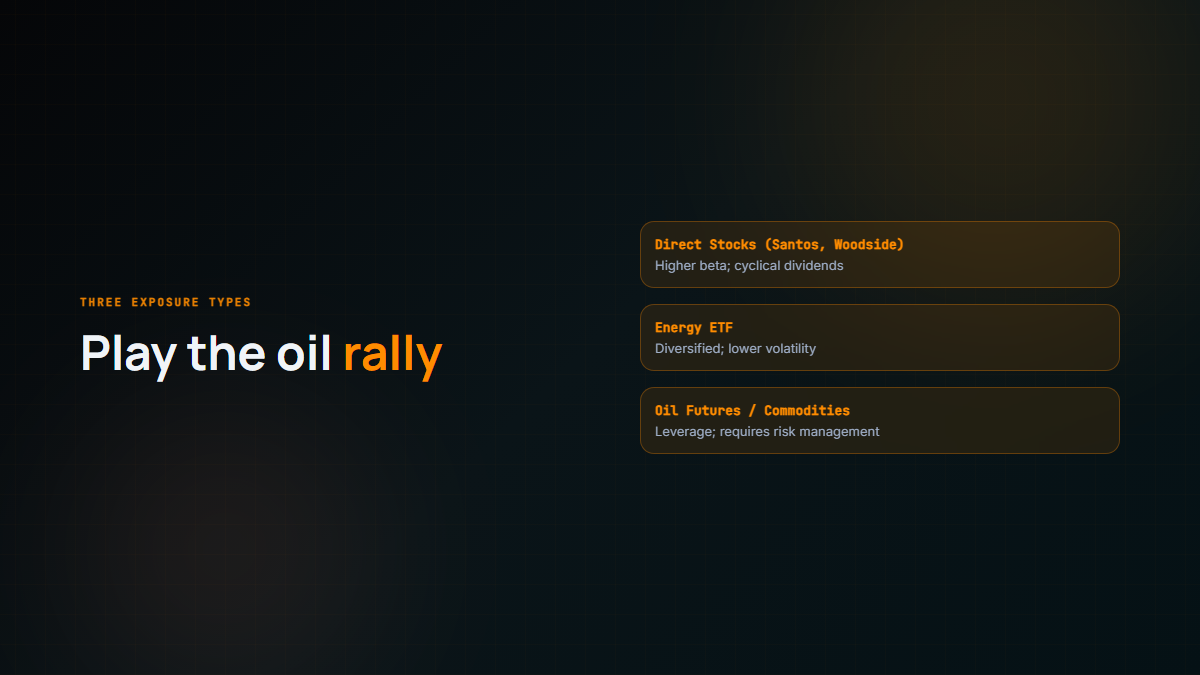
The Betashares FUEL ETF tracks the largest global energy companies outside Australia, with returns converted into AUD. These companies are larger, more geographically diversified and more vertically integrated than most ASX-listed names. FUEL gives you exposure to integrated oil majors in a single ASX-traded position.
The tracking mismatch between FUEL and Australian bowser prices
FUEL tracks global energy equities, not the retail petrol price. Share prices of integrated majors reflect refining margins, dividend policy, buybacks and long-term capital allocation, not just crude spot prices. The correlation to your weekly servo bill is real but imperfect.
When an energy ETF suits a DIY investor better than individual stocks
If you lack confidence in stock selection or want to avoid concentration in one or two names, FUEL gives you diversified exposure without the research overhead. It suits investors who want energy in their portfolio but prefer a single position to manage.
ETF distributions: tax treatment inside and outside an SMSF
FUEL distributions include foreign income and are generally unfranked. Inside an SMSF in accumulation phase, the 15% tax rate applies. In pension phase, earnings are tax-free. Outside super, foreign income distributions are included in your assessable income and taxed at your marginal rate without a franking offset.
Tax Considerations for ASX Energy and Transport Investments
CGT and the 12-month discount rule: why reactive trading is costly in a volatile sector
Selling an ASX energy stock within 12 months of purchase means you pay CGT on the full nominal gain. Hold for 12 months or more and the ATO’s 50% CGT discount applies for individuals and trusts. In a sector with weekly moves of around 13%, chasing short-term price spikes destroys a significant portion of real returns through tax drag.
Franking credits from energy and fuel distribution stocks
Fully franked dividends from downstream energy or fuel distribution companies carry a tax offset equal to the 30% corporate tax already paid. If your marginal tax rate is below 30%, the ATO refunds the excess. These credits partially offset the household pain of higher fuel bills by reducing the tax you owe on investment income.
Record-keeping obligations under ATO rules
The ATO requires you to keep records of acquisition cost, purchase date, sale proceeds and transaction costs for every trade. Accurate cost-base records let you correctly apply the CGT discount and offset capital losses against gains.
SMSF trustees: monitoring sector concentration, unrealised CGT and franking credit income
During an oil spike, energy holdings grow as a share of an SMSF portfolio quickly. Trustees must review whether the fund’s investment strategy still permits the resulting sector concentration. Unrealised CGT builds up during price rises and becomes a realised liability when you sell. Track franking credit income separately, as it reduces the fund’s tax payable and forms part of the overall return picture.
Building a Rules-Based Framework for Energy and Transport Exposure
Setting predefined allocation bands for energy sector holdings
Decide in advance what percentage of your portfolio sits in energy and transport. A common approach is a target weight with a tolerance band of plus or minus 3 to 5 percentage points. This gives you a trigger to act without second-guessing every price move.
Reviewing positions against fuel price moves, not daily headlines
Check your energy allocation when crude oil moves by a meaningful threshold, such as 10% in either direction, rather than reacting to every news story. This keeps your review process systematic and reduces emotional decision-making.
Dollar cost averaging into ASX energy stocks during price volatility
Rather than buying a full position in one trade, spread purchases over several weeks. This reduces the impact of short-term price swings and lowers your average entry cost if prices fall further after your first purchase.
When to rebalance: triggers based on sector weight drift, not emotion
Rebalance when your energy sector weight moves outside your predefined band, not because you feel nervous about oil prices. Tools like Crowdfolio let Australian DIY investors track sector weights, unrealised CGT and franking credit income in one place, so you see when a rebalance trigger has been hit rather than guessing.
Frequently asked questions
Do Australian fuel prices directly determine how ASX energy stocks perform?
Not directly. ASX energy stocks respond primarily to global crude oil prices in USD, with the AUD/USD exchange rate acting as an additional variable. Local bowser prices follow with a lag and are also shaped by refinery margins, taxes and retail competition, so the relationship is real but not one-to-one.
Are franking credits available on ASX energy stocks?
Some downstream energy and fuel distribution companies pay fully franked dividends, giving Australian resident investors a tax offset equal to the corporate tax already paid. Upstream producers with volatile earnings often pay lower or unfranked dividends, so check each company’s dividend history before assuming franking credit availability.
How does the ATO’s 50% CGT discount apply if I sell an ASX energy stock during a price spike?
If you have held the shares for at least 12 months before selling, individual investors and trusts reduce the taxable capital gain by 50% under ATO rules. Selling during a fuel price spike within that 12-month window means paying CGT on the full nominal gain, which erodes real returns in a high-volatility sector.
Can my SMSF invest in ASX energy stocks or energy ETFs like Betashares FUEL?
Yes, provided the investment is permitted under the fund’s investment strategy and trust deed and satisfies the sole purpose test. SMSF trustees should monitor sector concentration risk during oil price spikes, as energy holdings can drift to an outsized portfolio weighting quickly, and should document their rationale for compliance purposes.