
You do not need a US brokerage account to own Apple, Microsoft and Nvidia — ASX big tech ETFs such as NDQ and IVV give Australian investors that exposure in a single ASX trade. Here is how the main funds compare on index methodology, fees, currency hedging and ATO tax treatment.
Why are ASX-listed ETFs the easiest path to big tech?
For most Australian investors, ASX-listed ETFs are the easiest way into global big tech because they remove the friction of going direct. Apple, Microsoft and Nvidia dominate global equity returns, but owning them does not require a US brokerage account, W-8BEN paperwork or converting Australian dollars into US dollars. An ASX-listed ETF gives you access to the world largest technology companies through your standard broker, settled in AUD, trading like any ordinary share. The real challenge, then, is not access — it is choosing the right vehicle, understanding how much big tech you already own through existing holdings, and knowing how the ATO treats the income and capital gains that flow through. Because these ETFs settle in Australian dollars with no foreign-currency transfer and no US tax forms, the practical barrier to entry is low. That shifts the decision from how do I buy this to which fund, at what cost, and with what currency and tax consequences.
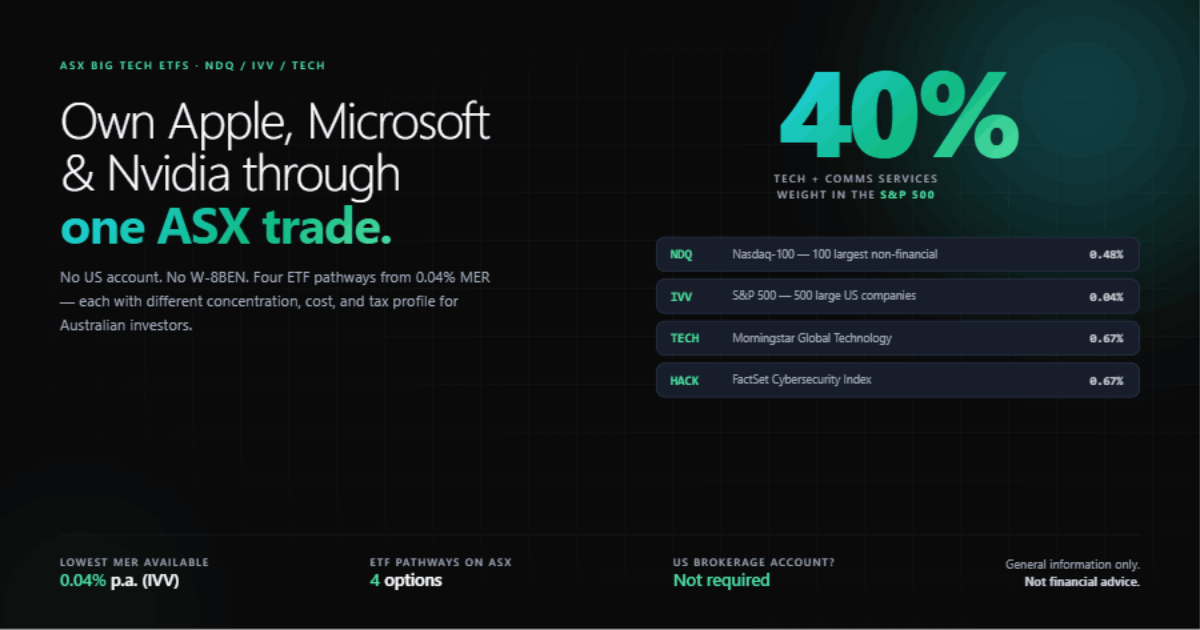
The challenge isn’t access. It’s choosing the right vehicle, understanding what you already own, and knowing how the ATO treats income and gains that flow through.
ASX-listed ETFs trade like ordinary shares. You buy and sell in AUD through your existing broker. No foreign currency transfer, no US tax form, no overseas account.
Most ASX-listed ETFs are CHESS-sponsored, meaning units are held in your name on the Clearing House Electronic Subregister System. You receive a Holder Identification Number (HIN) and full legal ownership, with every transaction linked directly to your HIN for ATO reporting.
Australian investors now have access to broad global equity ETFs, US market ETFs, dedicated Nasdaq-100 ETFs, and thematic ETFs focused on artificial intelligence, semiconductors, and cybersecurity. Each tracks a different index with a different concentration profile.
Do you already own more big tech than you realise?
Probably yes — and it is worth checking before you buy more. A standard global equity ETF tracking the MSCI World index allocates around 70% to US equities, with information technology and communication services together making up roughly 30%, and Apple, Microsoft, Nvidia, Amazon and Alphabet typically sitting in the top ten holdings. So if you already hold something like IVV.AX or VGS.AX, you have significant big-tech exposure before buying a single dedicated fund. The trap is the word diversified: it refers to the number of holdings, not to sector balance. Because these indices are market-cap weighted, the largest companies receive the largest allocations — and today those companies are overwhelmingly US technology firms. That means adding a concentrated tech ETF on top can quietly double up your exposure to the same handful of mega-caps. The disciplined first step is to look through your existing ETFs to their top holdings and sector weights, so any new tech position is deliberate rather than accidental.
If you hold IVV.AX or VGS.AX, you have significant big tech exposure before buying anything else.
“Diversified” refers to the number of holdings, not sector balance. Market-cap weighting means the largest companies receive the largest allocations, and in 2025 those companies are overwhelmingly US technology firms. Adding a dedicated tech ETF on top of a broad global ETF pushes your effective technology exposure to 35–45% of your equities portfolio. That’s concentration, not diversification.
Before buying a tech-focused ETF, check the top ten holdings and sector breakdown in each fund’s Product Disclosure Statement. A portfolio tracker like Crowdfolio helps Australian investors see their true sector exposure across all ASX holdings in one place.
How does index methodology affect your tech exposure?
Index methodology quietly determines how much technology you actually get, even when two funds sound similar. The Nasdaq-100 holds the 100 largest non-financial companies listed on the Nasdaq, the S&P 500 covers 500 large US companies across all sectors, and the MSCI World extends across 23 developed countries while the US still dominates. Beyond coverage, the way providers classify sectors matters: Alphabet and Meta sit inside communication services in the S&P 500, not information technology, which means an ETF stated technology weight can understate its true exposure to tech-driven businesses. Weighting rules add another layer — the Nasdaq-100 applies a modified market-cap weighting that caps individual stocks above certain thresholds, preventing any single mega-cap from completely dominating the fund. The lesson is not to take a label at face value: a fund headline tech percentage, its index rules and its capping methodology together decide your real concentration in companies like Apple, Microsoft and Nvidia, so compare the construction, not just the name.
Index providers define sectors differently. Alphabet and Meta sit inside “communication services” in the S&P 500, not “information technology.” This means an ETF’s stated technology weight understates its actual exposure to tech-driven businesses.
The Nasdaq-100 applies modified market-cap weighting that caps individual stocks above certain thresholds, but a single stock can still represent 8–10% of the index. Thematic ETFs vary significantly — some use equal weighting, others apply fundamental screens. Understanding the methodology tells you whether you’re getting genuine sector breadth or a handful of large-cap names packaged differently.
How do the major ASX big tech ETFs compare?
The major ASX big tech ETFs differ most on cost, concentration and which index they track. NDQ.AX, the BetaShares Nasdaq-100 ETF, is the most direct ASX-listed route to Nasdaq-100 exposure; its top holdings consistently include Apple, Microsoft, Nvidia, Amazon and Meta, it runs at a management expense ratio of approximately 0.48% per year, and it is unhedged, so returns move with the AUD/USD rate. IVV.AX, the iShares S&P 500 ETF, tracks the S&P 500 at an MER of roughly 0.04% per year — one of the cheapest options on the ASX — holding around 500 stocks, though its largest positions are still the same mega-cap tech names, with technology and communication services together about 40% of the index; it is also unhedged. The choice is not simply cheapest-wins: NDQ offers more concentrated, tech-tilted exposure at a higher fee, while IVV offers broad, low-cost market exposure that still captures big tech through its top holdings.
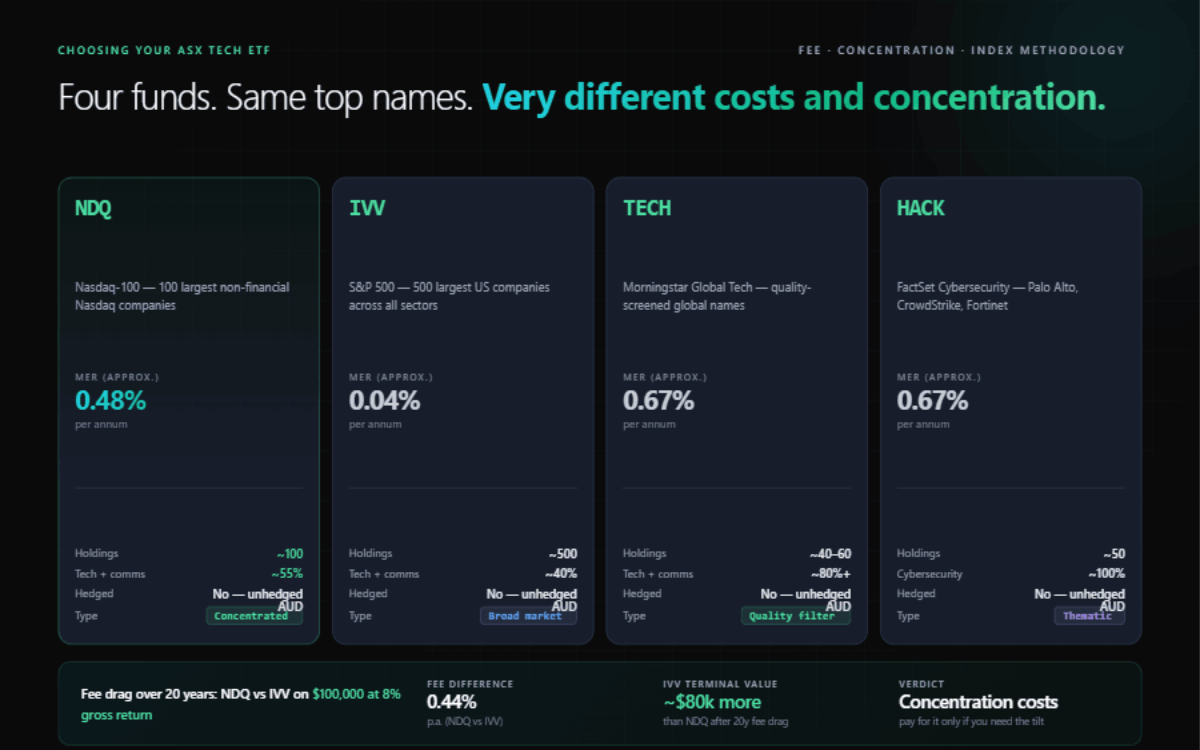
IVV.AX (iShares S&P 500 ETF) tracks the S&P 500 at an MER of approximately 0.04% per year, making it one of the cheapest options on the ASX. It holds around 500 stocks, but its top positions are still the same mega-cap tech names. Technology and communication services together represent roughly 40% of the index. Also unhedged.
TECH.AX (Global X Morningstar Global Technology ETF) uses a Morningstar-developed methodology to screen for companies with durable competitive advantages in technology. It extends beyond US companies to include global tech names. The MER is approximately 0.67% per year, with a quality filter that distinguishes it from pure index-tracking ETFs.
Thematic ETFs such as HACK.AX (cybersecurity) and Global X’s AI and robotics funds offer targeted sub-sector exposure. MERs typically range from 0.57–0.67%, and portfolios are narrower. These suit investors with a specific tech thesis rather than broad sector coverage.
| ETF | Index Tracked | Approx. MER | Hedged | Key Tech Names |
|---|---|---|---|---|
| NDQ.AX | Nasdaq-100 | 0.48% | No | Apple, Microsoft, Nvidia, Amazon, Meta |
| IVV.AX | S&P 500 | 0.04% | No | Apple, Microsoft, Nvidia, Amazon, Alphabet |
| TECH.AX | Morningstar Global Tech | 0.67% | No | Global tech screened for quality |
| HACK.AX | FactSet Cybersecurity | 0.67% | No | Palo Alto, CrowdStrike, Fortinet |
MERs are approximate figures based on publicly available issuer data. Verify current fees in each fund’s PDS before investing.
Hedged vs unhedged: how does the AUD/USD rate affect returns?
Most ASX-listed international tech ETFs do not hedge currency, so your return is driven by two things: how the underlying stocks perform in US dollars and how the AUD/USD rate moves. If the Australian dollar falls against the US dollar, your unhedged units are worth more in AUD terms even if the underlying stocks did not move; if the AUD rises, the opposite happens and currency eats into your return. There is a useful historical quirk here: the AUD tends to fall during global risk-off periods, which often softens losses in unhedged global ETFs precisely when markets are weak. Hedged ETFs use forward contracts to strip out most of the currency return, leaving you with the underlying market result in steadier AUD terms; they tend to suit investors with shorter time horizons or those who do not want currency adding noise. For a long-term holder, unhedged exposure adds volatility but also a natural cushion during downturns — so the right choice depends on horizon, not just preference.
If the AUD falls against the USD, your unhedged ETF units are worth more in AUD terms even if the underlying stocks didn’t move. The opposite applies when the AUD rises. Historically, the AUD tends to fall during global risk-off periods, which often softens losses in unhedged global ETFs for Australian investors.
Hedged ETFs use forward contracts to remove most currency return. They suit investors with shorter time horizons or those who want pure stock exposure without AUD noise. Over 10 to 20 years, currency movements tend to mean-revert and the cost of hedging erodes returns. Long-term investors generally accept the currency exposure.
How does the ATO tax ASX-listed international tech ETFs?
The ATO treats ASX-listed international tech ETFs as foreign-income investments, which changes what lands on your tax return. These ETFs do not pay franking credits — their distributions are foreign income. Where the fund has paid withholding tax on dividends received from underlying US companies, it passes on a foreign income tax offset to unitholders, and your annual tax statement from the issuer shows the breakdown, which you report under foreign income in your ATO return. On the capital side, selling ETF units is a CGT event: holding the units for more than 12 months makes individual investors eligible for the 50% CGT discount, while short-term gains receive no discount. Because there are no franking credits to offset tax — unlike Australian shares — the after-tax profile of these funds leans on the foreign income tax offset and the CGT discount instead. Keeping complete records of every purchase, distribution statement and sale is essential.
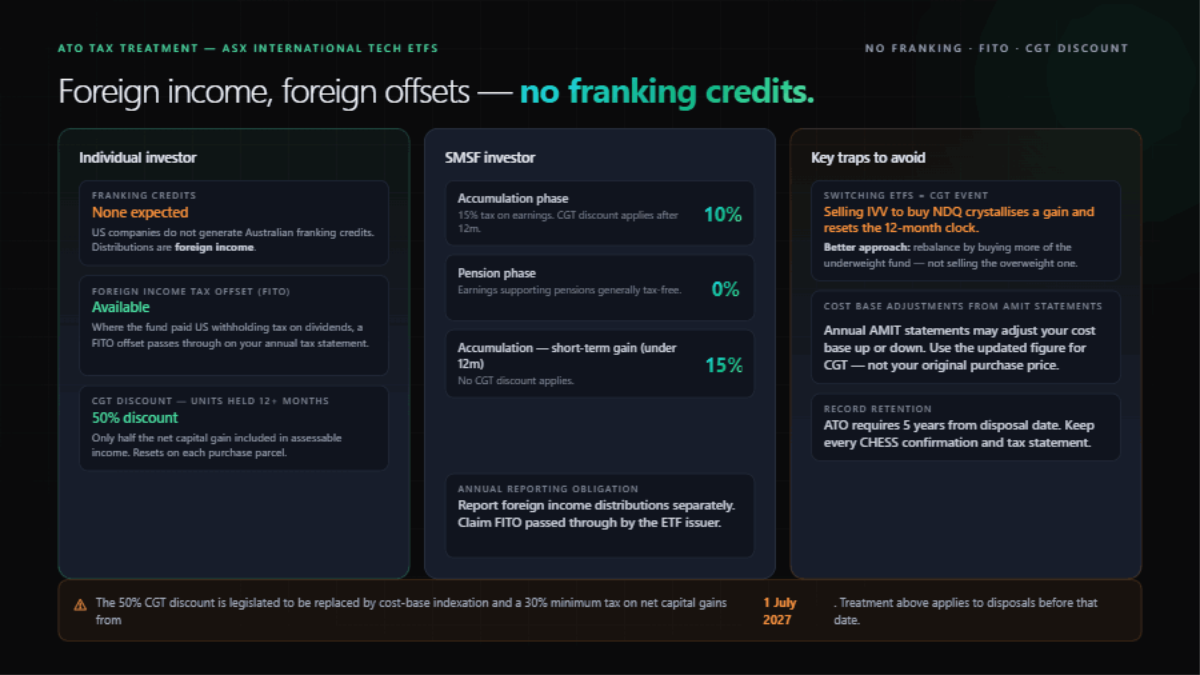
Note: the 50% CGT discount is legislated to be replaced by cost-base indexation and a 30% minimum tax on net capital gains from 1 July 2027; the treatment described here applies to disposals before that date.
When you sell ETF units, the ATO treats the gain as a capital gains event. Holding units for more than 12 months makes you eligible for the 50% CGT discount as an individual investor. Short-term gains receive no discount.
Keep records of all ETF transactions for five years after lodging the relevant tax return. Retain every CHESS confirmation and issuer tax statement.
Switching from one ETF to another is a CGT event. Rebalancing by buying more of the underweight ETF, rather than selling the overweight one, avoids triggering CGT.
Can SMSF investors hold global tech ETFs in their fund?
Yes — an SMSF can hold ASX-listed international tech ETFs, provided the fund written investment strategy references international equity exposure as a permitted asset class. The tax outcome then depends on the fund phase. In accumulation phase, an SMSF pays 15% tax on capital gains, but for assets held more than 12 months it applies a one-third discount, reducing the effective CGT rate to about 10%. In pension phase, the fund generally pays zero tax on the income and capital gains attributable to retirement income streams, which makes these foreign-income ETFs more tax-efficient there. Either way, the fund must report foreign income distributions separately in its annual return and can claim any foreign income tax offset passed through by the issuer. For trustees, the practical steps are to confirm the strategy permits international equities, keep the distribution statements detailing foreign income and offsets, and recognise that the same fund holds these ETFs far more tax-effectively in pension phase than in accumulation.
An SMSF in accumulation phase pays 15% tax on capital gains. For assets held more than 12 months, the fund applies a one-third discount, reducing the effective CGT rate to 10%. In pension phase, the fund generally pays zero tax on income and capital gains attributable to retirement income streams.
SMSFs must report foreign income distributions separately in the fund’s annual tax return and claim any foreign income tax offsets passed through by the ETF. Trustees must also value ETF holdings at market value at 30 June each year. Your SMSF administrator needs the issuer’s annual tax statement for each ETF to complete year-end reporting.
How much do management fees cost over the long term?
Management fees look tiny but compound into real money over decades. The management expense ratio (MER) is deducted daily from the fund net asset value — you never receive a separate invoice; the cost simply shows up as a drag on the unit price relative to the benchmark. A worked example makes the scale clear: take two portfolios, each starting at AUD 100,000 with identical gross returns of 8% per year, where one pays 0.04% (like IVV) and the other 0.48% (like NDQ). After 20 years, the lower-fee portfolio is worth roughly AUD 14,000 more, purely from the fee difference. That said, lowest fee is not automatically the right answer. A thematic or more concentrated ETF with a higher MER can give you a specific investment thesis — such as targeted Nasdaq-100 exposure — that a broad, ultra-cheap market fund cannot replicate. The real question is whether the extra cost buys exposure you actually want, or whether you are paying more for something a cheaper fund already delivers.
Consider two portfolios, each starting at AUD 100,000, with identical gross returns of 8% per year. One pays 0.04% (IVV), the other 0.48% (NDQ). The lower-fee portfolio is worth approximately AUD 14,000 more after 20 years, purely from the fee difference.
That said, lowest fee isn’t always the right answer. A thematic ETF with a higher MER gives you a specific investment thesis a broad-market ETF can’t replicate. The question is whether that precision is worth the cost relative to your portfolio goals and time horizon.
How do you buy a global tech ETF on the ASX?
Buying a global tech ETF on the ASX works just like buying any share, through a standard broker. CommSec, Pearler and SelfWealth are among the most common platforms for Australian investors, and all three support CHESS sponsorship, meaning the units are registered in your own name. Costs and design differ: SelfWealth charges a flat AUD 9.50 per trade, while Pearler is built for long-term index investors with built-in automation for regular investing. When you place an order, using a limit order lets you specify the maximum price you are willing to pay, which protects you from wide bid-ask spreads during low-liquidity periods rather than accepting whatever the market offers. Beyond the mechanics, the method matters: investing a fixed AUD amount at regular intervals — dollar-cost averaging — removes the pressure of timing your entry into a volatile sector, since you automatically buy more units when prices are lower and fewer when they are higher.
When placing an order, a limit order lets you specify the maximum price you’re willing to pay, protecting you from wide spreads during low-liquidity periods.
Investing a fixed AUD amount at regular intervals — dollar cost averaging — removes the pressure of timing entry into a volatile sector. You buy more units when prices are lower and fewer when prices are higher, smoothing your average purchase cost over time.
Frequently asked questions
What is the best ASX ETF for exposure to Apple, Microsoft, and Nvidia?
NDQ.AX gives the most concentrated exposure through the Nasdaq-100. IVV.AX includes the same companies within the broader S&P 500 at a significantly lower MER. The right choice depends on how much concentration you want and what fee you’re willing to pay.
How does NDQ compare to IVV on fees?
NDQ carries an MER of approximately 0.48% and is more concentrated in technology. IVV charges approximately 0.04% and holds 500 companies. Both hold the same top tech names. The trade-off is concentration versus breadth, not just fee.
Are ASX international tech ETF distributions franked?
No. Distributions are foreign income. Report them under foreign income in your ATO return. If the ETF passes through a foreign income tax offset, claim it to reduce the tax owed on that foreign income.
Can I hold a global technology ETF in my SMSF?
Yes. In accumulation phase, capital gains on holdings held over 12 months attract an effective 10% tax rate after the one-third discount. In pension phase, gains attributable to retirement income streams are generally tax-free. Your SMSF administrator will need the annual tax statement from the ETF issuer for year-end reporting.