
This guide details a five-step screening framework for identifying promising ASX small cap stocks, covering quantitative filters, ASX announcement analysis, cash runway calculation, dilution risk audits, and the ASX Equity Research Scheme. It also addresses position sizing rules, CGT implications, franking credit impacts, and SMSF compliance requirements for speculative holdings.
What Counts as an ASX Small Cap?
Small cap generally refers to companies sitting outside the S&P/ASX 100 or ASX 200 by market capitalisation. Most definitions place them below AUD $2 billion, with micro caps falling below AUD $300 million. The S&P/ASX Small Ordinaries Index tracks this segment formally.
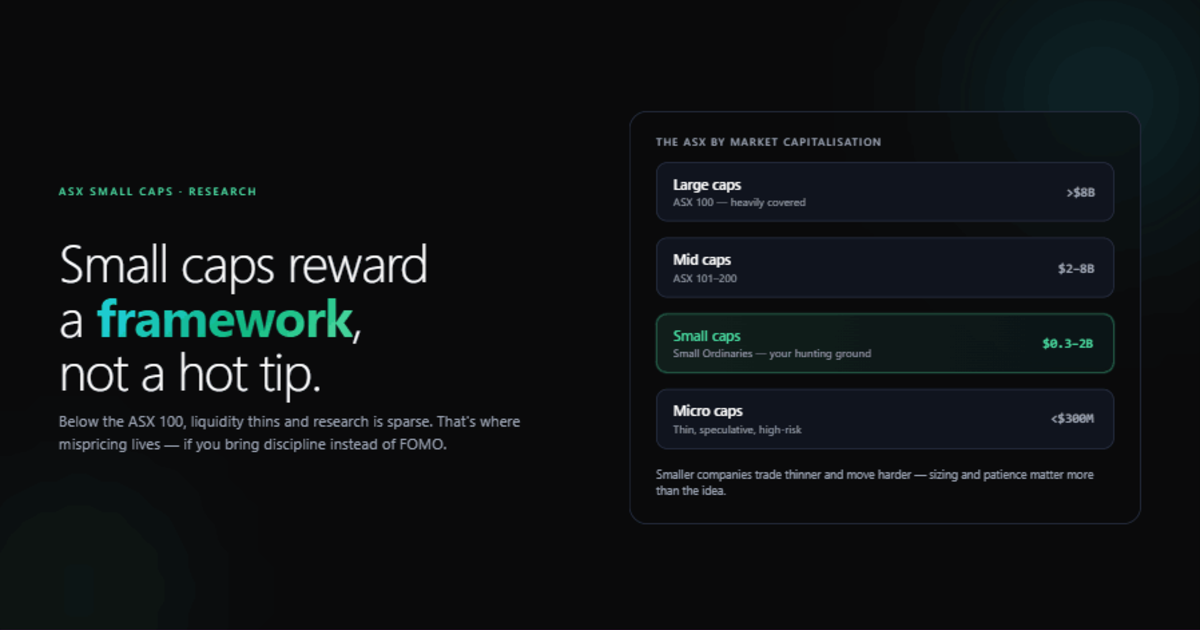
Smaller companies trade with lower daily dollar volume, attract less broker coverage, and carry more information asymmetry. A single announcement can move the share price 30 to 50 per cent in either direction. That volatility cuts both ways and is not comparable to holding BHP Group (BHP.AX) or Commonwealth Bank (CBA.AX).
The ASX small-cap segment is also heavily skewed toward mining, exploration, and early-stage technology. Sector risk is more concentrated than it first appears. When commodity prices fall or a funding cycle tightens, a broad swath of small caps declines simultaneously, regardless of individual company quality.
What are the best ASX small cap stocks to watch right now?
Step 1 — Apply Quantitative Filters Before Reading Any Pitch Deck
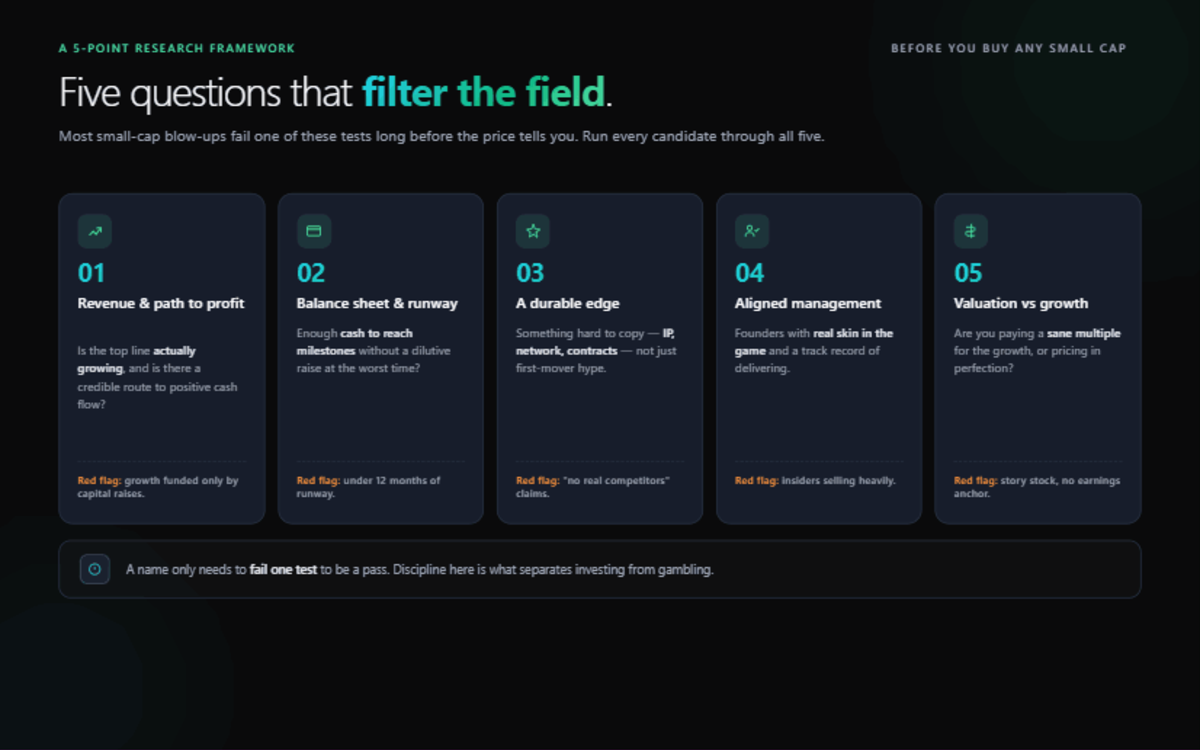
Screen by market capitalisation, daily dollar volume, cash balance, and revenue status before reading a single investor presentation. A company trading less than AUD $200,000 per day is difficult to exit cleanly. Set a minimum liquidity threshold and apply it without exception.
Step 2 — Go Straight to ASX Announcements
Your first source is always the ASX announcement feed, not a fund manager wire or stock-tip newsletter. Read the most recent annual report, Appendix 4C quarterly cash flow report, capital raising documents, and any formally filed investor presentations. For miners, read JORC statements and drilling results in full.
Step 3 — Calculate Cash Runway for Pre-Revenue Companies
Divide the cash balance by the quarterly cash burn rate from the Appendix 4C. If a company holds AUD $4 million in cash and burns AUD $1.5 million per quarter, it has roughly 2.6 quarters of runway. Less than two quarters with no clear path to revenue or a capital raise changes the risk profile materially.
Step 4 — Audit the Capital Structure for Dilution Risk
Check shares on issue over the past two to three years. Look for outstanding options, performance rights, and placement history. ASX small caps raise capital frequently. Each raising dilutes existing shareholders, and the current share price may not reflect your true entry cost if further dilution is likely.
Step 5 — Use the ASX Equity Research Scheme
The ASX operates an Equity Research Scheme that funds independent research on under-covered small caps. Reports are free and available on the ASX website. This reduces reliance on promotional content and is a practical starting point for companies with limited broker coverage.
Position Sizing and Risk Management for High-Volatility Holdings
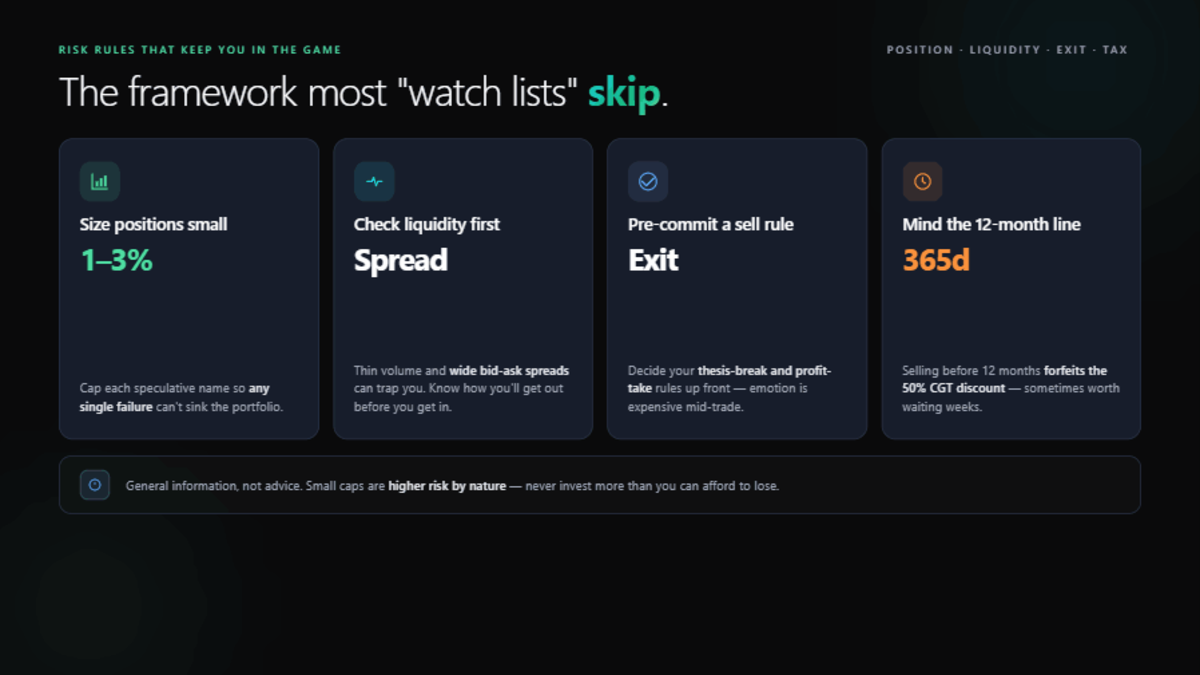
Small caps belong in the satellite portion of your portfolio, not the core. A 40 to 60 per cent drawdown on a single announcement is not unusual. Allocate only what you are genuinely prepared to lose entirely, and make sure your total small-cap sleeve does not dominate the overall portfolio.
Write down the specific conditions that would invalidate your investment thesis before you buy. Examples: cash runway falls below one quarter, a key contract is not renewed, or a capital raise occurs at a significant discount. Thesis-based rules remove emotion from exit decisions.
A quarterly cash flow report, a failed drill result, or a regulatory setback releases at 8:00am AEST and the market reprices instantly. You cannot exit ahead of that move as a retail investor. Position sizing is your primary risk control, not a stop-loss order.
What tax considerations apply to ASX small caps in an SMSF?
CGT and the 12-Month Discount Rule
Shares held for less than 12 months do not qualify for the 50 per cent CGT discount available to individuals and trusts. Fast-moving small caps tempt frequent trading, which means a larger share of your gains become fully assessable income in the financial year ending 30 June. A gain that looks attractive pre-tax shrinks considerably if you have held the stock for eight months.
Using Capital Losses — and the ATO’s Wash-Sale Warning
Failed small-cap positions generate capital losses that offset capital gains elsewhere in your portfolio. Unused losses carry forward indefinitely. The ATO does not accept arrangements where you dispose of and quickly reacquire essentially the same asset purely to crystallise a loss. This is a wash-sale arrangement, and the ATO treats it as a scheme to obtain a tax benefit.
Franking Credits and Small Caps
Most small caps pay little or no dividends, let alone fully franked dividends. Returns are driven almost entirely by capital gains. For SMSF members or retirees who rely on franking credits to supplement cash flow, a heavy small-cap sleeve reduces franked income significantly and shifts tax outcomes.
SMSF Trustees: Documentation, Compliance, and Speculative Holdings
Your Investment Policy Statement (IPS) must articulate the risk rationale for holding speculative small caps, the maximum allocation permitted, and the criteria for selection. Vague references to “growth assets” are insufficient. An auditor reviewing speculative holdings will expect a clear policy.
Keep written research notes for each holding, including the thesis, key risks identified, and the catalysts you intended to monitor. Date-stamp these records. Evidence of due diligence matters at audit time, particularly for pre-revenue companies where the risk is self-evident.
SMSF trustees have a legal obligation to act in the best financial interests of members and to consider diversification and liquidity. A concentrated position in illiquid small caps is difficult to defend at audit if it comes at the expense of member retirement outcomes. Review your IPS against your actual holdings at least annually.
Keeping Track: Portfolio Tools, Cost Bases, and CGT Records
A 10 to 20 stock small-cap watchlist with frequent activity generates a large number of CGT events each financial year. Tracking cost bases, unrealised gains, and position sizing in a spreadsheet is error-prone, especially when placements and rights issues adjust your cost base.
A purpose-built tool should tag holdings by sector and risk category, track your entry price and thesis notes, show your exposure to high-risk small caps as a percentage of total portfolio, and export CGT reports you send directly to your accountant or SMSF auditor. Crowdfolio is built for Australian DIY investors and handles exactly this workflow, including CGT event tracking aligned to ATO rules.
The ATO requires you to keep records of every CGT event for five years after the relevant tax return is lodged. For shares, this means purchase confirmation, sale confirmation, and any corporate action documents that adjusted your cost base. Broker statements alone are not always sufficient if cost bases have been affected by placements, splits, or bonus issues.
Frequently asked questions
What is considered a small cap stock on the ASX?
A small cap is generally a company outside the ASX 100 or ASX 200 by market capitalisation, typically below AUD $2 billion. The S&P/ASX Small Ordinaries Index is the formal benchmark most investors reference.
How do I find reliable research on ASX small caps not covered by major brokers?
Start with the ASX Equity Research Scheme, which provides free independent reports on under-covered companies. Independent platforms such as Under the Radar Report also offer dedicated small-cap coverage for Australian investors.
Do I still pay CGT if my small cap investment makes a loss?
No. A capital loss does not trigger a CGT liability. You record the loss and carry it forward to offset future capital gains. You cannot offset capital losses against ordinary income such as salary or wages.
Can I hold speculative small cap stocks inside my SMSF?
Yes, within limits. Your IPS must address the rationale, your fund must maintain adequate liquidity and diversification, and you must keep documented evidence of your due diligence. Speculative holdings attract closer scrutiny at audit, so documentation standards need to be higher, not lower.