
How much does Amazon affect my ASX ETF?
When Amazon makes headlines, many Australian investors holding ASX-listed global equity ETFs ask the same question: does this affect my portfolio? The honest answer is: it depends. Your real exposure to Amazon varies significantly depending on which ETF you own, how it is constructed, and whether it is hedged against the AUD/USD rate.
With roughly 400 ETFs now listed on the ASX, your Amazon exposure could range from zero to a meaningful portfolio slice. Before you react to any news headline, it pays to understand the mechanics behind your specific fund.
How is Amazon’s weight in your ETF determined?
Amazon’s weight in your ETF is determined by the index it tracks and that index’s construction rules. Most broad global ETFs use market-capitalisation weighting, so the largest companies by market value receive the largest allocations — and Amazon, as one of the world’s biggest companies, features prominently. Not every global ETF holds Amazon, though: quality-screened ETFs apply filters beyond market cap, and Amazon does not currently meet the MSCI World Quality Index definition used by some ASX-listed quality funds, which screens for high return on equity, stable earnings growth and low leverage. NASDAQ-focused or tech-thematic ETFs sit at the opposite end, holding a narrower set of stocks at higher Amazon weightings. The fastest way to know your exposure is to check the top-ten holdings disclosure on your provider’s website, which is updated regularly and shows Amazon’s weight today.
How does index methodology decide your exposure?
Every ASX-listed global ETF tracks an index, and that index determines which stocks it holds and at what weight. Most broad global ETFs use market capitalisation weighting, meaning the largest companies by market value receive the largest allocations. Amazon, as one of the world’s biggest companies by market cap, features prominently in these funds.
How do broad market, thematic, and quality-screened ETFs differ?
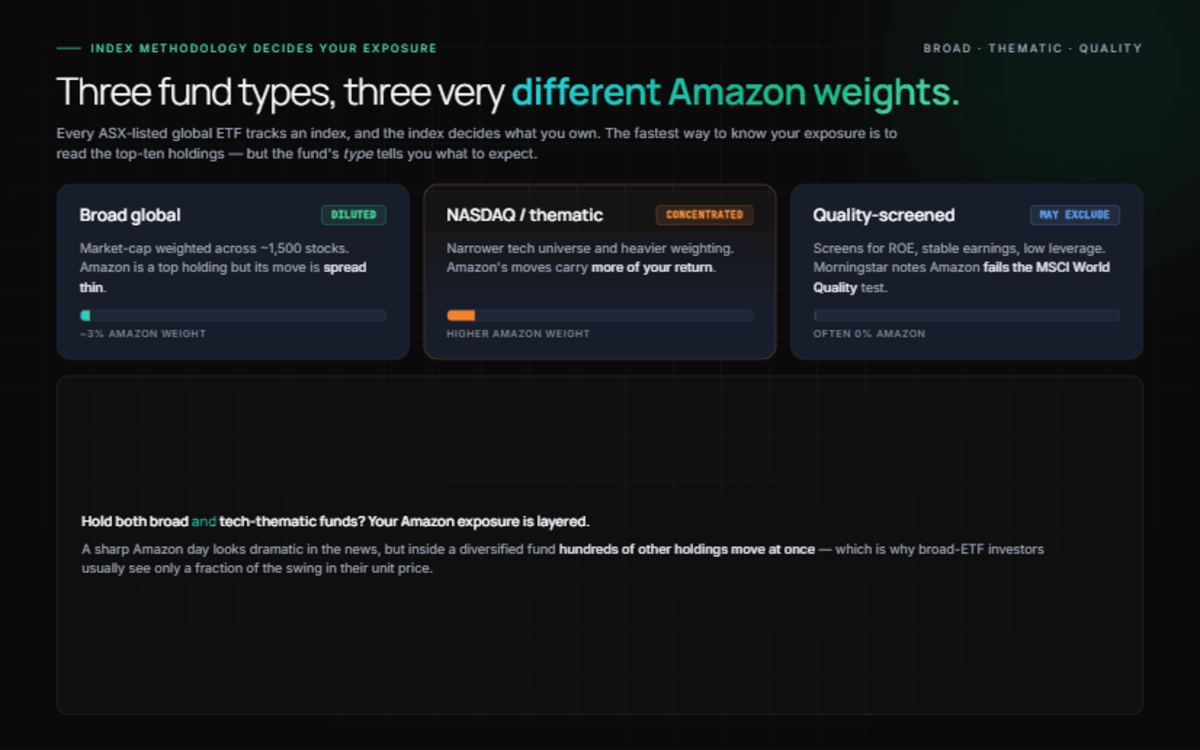
Not all global ETFs hold Amazon. Quality-screened ETFs apply filters beyond market cap. Amazon does not currently meet the MSCI World Quality Index definition used by some ASX-listed quality funds, which screens for high return on equity, stable earnings growth, and low financial leverage. A broad global ETF tracking the MSCI World Index is a materially different product from a quality-focused ETF, even though both hold international shares.
NASDAQ-focused or tech-thematic ETFs sit at the opposite end of the spectrum, holding a narrower set of stocks, often with higher Amazon weightings than broad market alternatives.
Why is checking the top 10 holdings your first step?
The fastest way to understand your Amazon exposure is to check the top 10 holdings disclosure on your ETF provider’s website. This is updated regularly and tells you exactly what weight Amazon holds in your fund today.
How Much Can One Stock Actually Move a Diversified ETF?
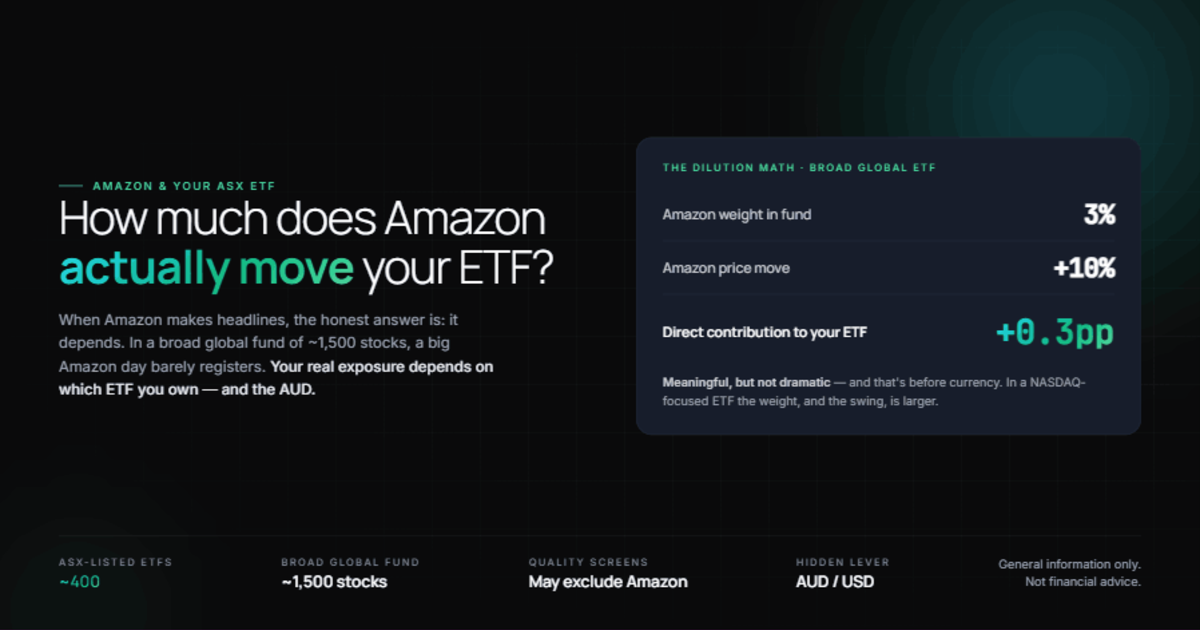
A single stock moves a diversified ETF far less than the headlines suggest. A broad global ETF holding around 1,500 stocks naturally dilutes the impact of any one holding: if Amazon represents 3% of your fund and its share price rises 10%, the direct contribution to your ETF’s return is roughly 0.3 percentage points before currency effects — meaningful, but not dramatic. The picture changes in a NASDAQ-focused ETF, where a narrower universe gives Amazon a larger weight and more influence over your unit price, and holding both broad and tech-thematic ETFs layers that exposure. A sharp Amazon move looks significant in isolation, but inside a diversified fund hundreds of other holdings move simultaneously in different directions. This dilution effect is the primary reason broad-ETF investors usually see only a fraction of a single stock’s price swing reflected in their unit price.
A broad global ETF holding 1,500 stocks naturally dilutes the impact of any single holding. If Amazon represents 3% of your ETF and its share price rises 10%, the direct contribution to your ETF’s return is roughly 0.3 percentage points before currency effects. Meaningful, but not dramatic.
The picture changes in a NASDAQ-focused ETF. With a narrower universe, Amazon’s weight increases and its price movements carry more influence over your unit price. If you hold both broad global and tech-thematic ETFs, you likely have layered Amazon exposure across your portfolio.
A sharp Amazon move looks significant in the news. Inside a diversified fund, hundreds of other holdings are moving simultaneously in different directions. The dilution effect is real, and it is the primary reason broad ETF investors often see only a fraction of a single stock’s price swing in their unit price.
How does the AUD/USD exchange rate multiply your returns?
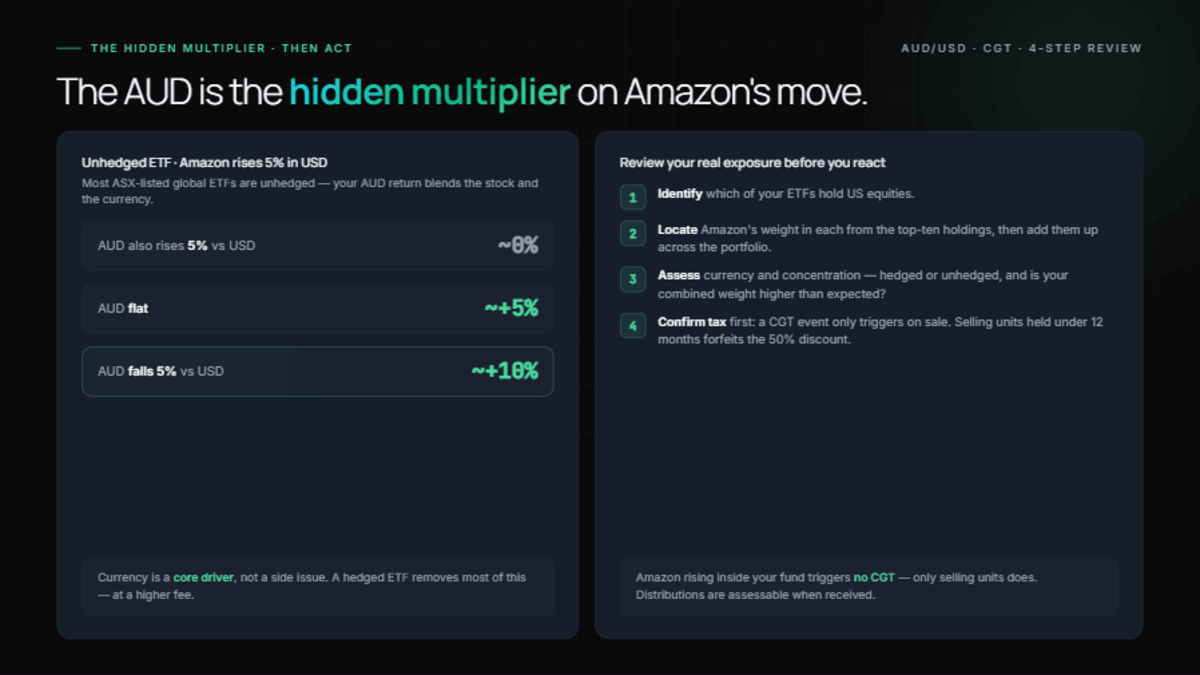
The AUD/USD exchange rate acts as a hidden multiplier on your returns because most ASX-listed global ETFs are unhedged. When you buy units priced in Australian dollars but the underlying assets are priced in foreign currencies, your AUD return reflects both the performance of the underlying stocks and the movement of the exchange rate. If Amazon rises 5% in USD terms while the AUD also rises 5% against the USD, your net return in AUD terms is close to zero; conversely, if the AUD falls while Amazon rises, your AUD return exceeds the USD gain. Currency is therefore a core driver of returns, not a side issue. Hedged ETFs use currency contracts to remove most of the AUD/USD movement, giving you closer to pure underlying performance in AUD terms, but hedging carries a cost and added complexity, so the choice should reflect your view on currency and your time horizon.
Why are most ASX-listed global ETFs unhedged?
When you buy an ASX-listed global ETF, you buy units priced in Australian dollars, but the underlying assets are priced in foreign currencies. Most ASX-listed global ETFs are unhedged, meaning the fund does not use contracts to neutralise currency fluctuations. Your return in AUD terms reflects both the performance of the underlying stocks and the movement of the AUD/USD exchange rate.
If Amazon rises 5% in USD terms and the AUD also rises 5% against the USD over the same period, your net return in AUD terms is close to zero. Conversely, if the AUD falls while Amazon rises, your AUD return exceeds the USD gain. Currency is not a side issue for Australian investors in unhedged global ETFs. It is a core driver of returns.
Hedged ETFs use currency contracts to remove most of the AUD/USD movement from your return, giving you closer to the pure underlying stock performance in AUD terms. Hedging carries a cost and introduces its own complexity. Your choice between hedged and unhedged exposure should reflect your view on currency risk and your investment time horizon.
What CGT and ATO rules does Amazon’s move trigger?
Amazon’s price movement inside your fund triggers no CGT for you on its own. Under ATO rules a CGT event occurs when you dispose of an asset, so holding an ETF while Amazon rises or falls does not crystallise anything — you realise a capital gain or loss only when you sell your ETF units, and if you have held them for more than 12 months you are entitled to the 50% CGT discount as an individual or trust. ETF distributions are different: your fund periodically distributes income, which the ATO treats as assessable in the year received regardless of whether you reinvest, and some distributions include a capital-gains component taxable even though you have not sold units. The ATO requires you to keep records of every purchase, including date, units and cost base; each reinvested distribution creates a new parcel with its own acquisition date and cost.
When a CGT Event Does — and Does Not — Occur
Under ATO rules, a CGT event occurs when you dispose of an asset. Holding an ETF while Amazon rises or falls inside the fund does not trigger CGT for you. You crystallise a capital gain or loss only when you sell your ETF units. If you have held those units for more than 12 months, you are entitled to the 50% CGT discount as an individual or trust.
What are the tax implications of ETF distributions?
ETF distributions are different. Your fund periodically distributes income, which the ATO treats as assessable in the income year you receive it, regardless of whether you reinvest it. Some distributions include a capital gains component, which is taxable even though you have not sold any units. Always review your annual tax statement before lodging.
The ATO requires you to keep records of every ETF purchase, including the date, number of units, and cost base. If you receive distribution reinvestment units, each reinvestment creates a new parcel with its own acquisition date and cost.
How do you read your ETF tax statement at EOFY?
Reading your ETF tax statement correctly at end of financial year matters because the headline distribution figure is not what you report. Global ETFs often distribute foreign income from overseas holdings such as US dividends, some of which has had foreign withholding tax deducted before reaching the fund; you report the gross foreign income and claim a foreign income tax offset for the withholding paid. Your provider issues an annual tax statement after 30 June that breaks the distribution into components — Australian income, foreign income, withholding-tax offsets, capital gains and tax-deferred amounts — and you should use these figures, not the raw distribution amount, when completing your return. If you hold global ETFs inside an SMSF, the treatment differs again: SMSFs pay 15% tax on investment income in accumulation phase, with a one-third CGT discount on assets held more than 12 months.
Global ETFs often distribute foreign income from overseas holdings like US dividends. Some of this income will have had foreign withholding tax deducted before it reaches the fund. You report the gross foreign income to the ATO and claim a foreign income tax offset for the withholding tax paid.
Your ETF provider issues an annual tax statement after 30 June each year. This document breaks down your distribution into components: Australian income, foreign income, withholding tax offsets, capital gains, and tax-deferred amounts. Use these figures, not the raw distribution amount, when completing your tax return.
If you hold global ETFs inside a self-managed super fund (SMSF), the tax treatment differs. SMSFs pay 15% tax on investment income in accumulation phase, with a one-third CGT discount applying to assets held more than 12 months. The tax statement components still apply, but your fund’s accountant needs to allocate them correctly within the fund’s records.
How do you review your Amazon exposure?
Reviewing your Amazon exposure is a four-step process you can run before reacting to any headline. First, identify which of your ETFs hold US equities, since any global or international shares ETF is likely to include some. Second, locate the current Amazon weighting in each fund from the provider’s top-ten holdings, then add these up across your portfolio weighted by how much you hold in each ETF to estimate total exposure. Third, assess currency and concentration risk by checking whether each fund is hedged or unhedged and whether your combined Amazon weighting is higher than expected. Fourth, confirm your tax position before acting: selling units held for less than 12 months forfeits the 50% CGT discount, so a short-term reaction to news could increase your tax liability. The detailed checklist below walks through each step.
- Step 1: Identify which of your ETFs hold US equities. List every ETF in your portfolio and confirm whether it holds US-listed stocks. Any global or international shares ETF is likely to include some US equity.
- Step 2: Locate the current Amazon weighting in each fund. Visit each ETF provider’s website and check the current portfolio holdings or top 10 positions. Add these up across your whole portfolio, weighted by how much you hold in each ETF, to estimate your total Amazon exposure.
- Step 3: Assess your currency and concentration risk. Check whether each global ETF is hedged or unhedged. If you hold multiple ETFs with US tech exposure, check whether your combined Amazon weighting is higher than you expect. Tools like Crowdfolio let Australian DIY investors track holdings across multiple ETFs in one place.
- Step 4: Confirm your tax position before acting. Before selling ETF units in response to Amazon news, check your acquisition dates. Selling units held for less than 12 months forfeits the 50% CGT discount. A short-term reaction to a headline could increase your tax liability significantly.
Frequently asked questions
Does Amazon’s share price move directly affect my ASX ETF unit price?
Yes, but the size of the effect depends on Amazon’s weighting in your specific ETF. In a broad global fund, the impact is diluted across hundreds of holdings.
How do I find out exactly how much Amazon exposure I have?
Check the holdings disclosure on your ETF provider’s website. The top 10 holdings and their percentage weights are published regularly.
If my global ETF gains value because Amazon rises, do I owe CGT immediately?
No. CGT applies when you sell your ETF units, not when the underlying holdings move. Distributions carry separate tax obligations.
Does a falling AUD mean I benefit more from Amazon’s gains in my unhedged ETF?
Yes. A falling AUD increases the AUD value of your unhedged US holdings, amplifying returns from any USD-denominated gains.