
The CGT 50% discount Australia allows eligible investors to halve capital gains on ASX shares held over 12 months. To use it strategically, hold parcels for 12+ months, offset losses against short-term gains first, select parcels carefully, time sales to lower-income years, and consider trust or super structures for added tax efficiency.

What Is the CGT 50% Discount?
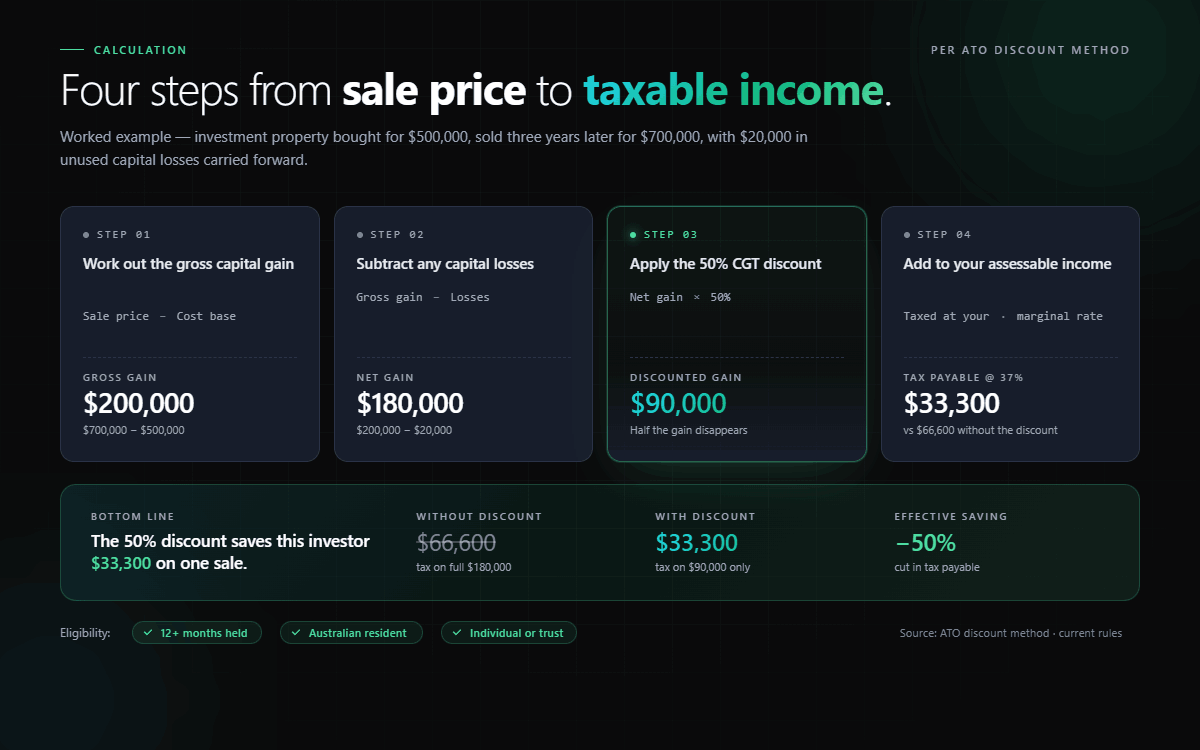
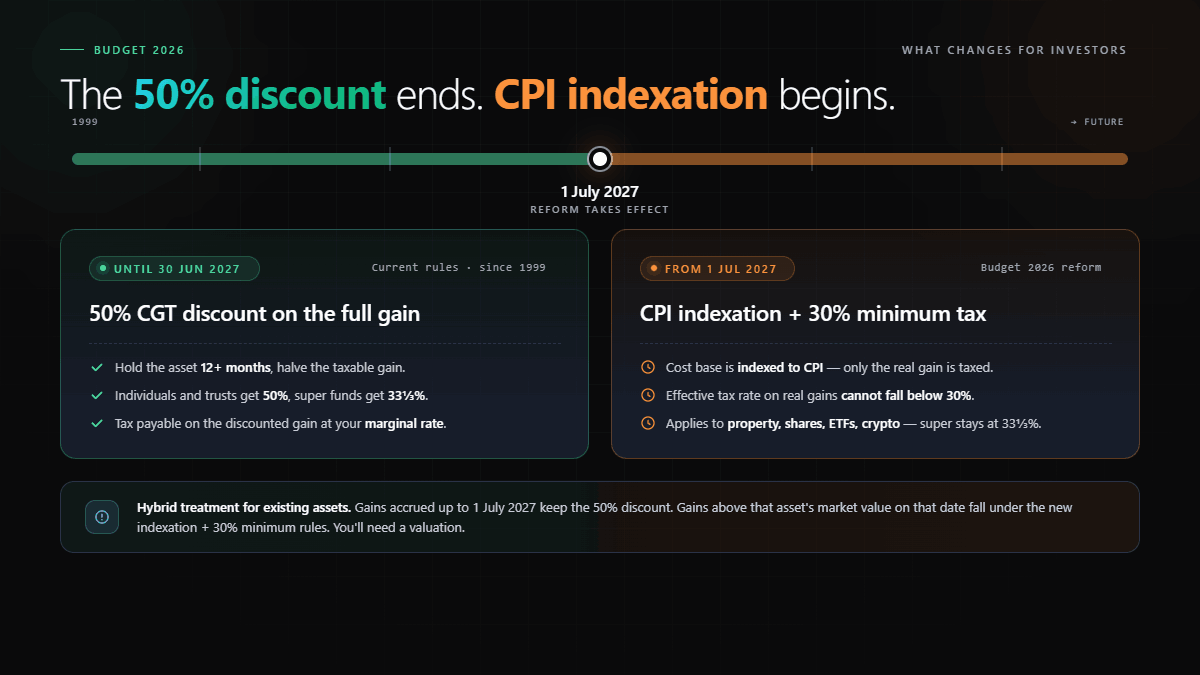
The CGT 50% discount is a concession provided under Australian tax law that allows eligible taxpayers to reduce a capital gain by half before it is included in their assessable income. Rather than paying tax on the full amount of a capital gain, you only include 50% of the gain in your tax return, with the other 50% effectively disregarded.
For example, if you sell ASX shares and realise a capital gain of $20,000, only $10,000 would be added to your taxable income after applying the discount. At a marginal tax rate of 37%, that means paying roughly $3,700 in tax rather than $7,400 — a significant difference that rewards patient, long-term investors.
ATO Eligibility: Who Qualifies and What Assets Are Covered?
Not every investor or every asset automatically qualifies for the CGT 50% discount. The ATO sets out specific eligibility conditions that must all be satisfied.
First, you must be an Australian resident for tax purposes at the time of the CGT event. Non-residents are generally not eligible for the discount on Australian assets, particularly following rule changes affecting residential property.
Second, and most importantly for share investors, you must have owned the asset for at least 12 months before the CGT event occurs — that is, before you sell or otherwise dispose of the asset. The ATO excludes both the day of acquisition and the day of the CGT event when counting this period, so in practice you need to hold the asset for at least 12 months and one day.
In terms of who can use the discount, eligible entities include individuals, Australian trusts, and complying superannuation funds. Notably, companies cannot access the 50% CGT discount. This is a critical structural consideration if you are thinking about how to hold your investments.
For ASX investors, the discount most commonly applies to:
- ASX-listed shares
- Exchange traded funds (ETFs)
- Units in listed investment trusts
- Managed fund units
- Some cryptocurrency holdings where the asset has been held for more than 12 months and otherwise qualifies
The 12-Month Rule: More Important Than You Think
The 12-month holding requirement is the cornerstone of the CGT discount strategy, and it pays to understand it carefully.
For ASX investors, each parcel of shares is treated separately. If you have bought the same stock at different times and in different quantities, each parcel has its own acquisition date and its own 12-month clock. Selling shares that have been held for less than 12 months means those gains are fully taxable at your marginal rate, with no discount applied.
Dividend reinvestment plan (DRP) shares are also treated as separate parcels, each with their own acquisition date based on when the DRP allocation occurred. This can create complexity when calculating whether each parcel qualifies for the discount.
A common mistake investors make is assuming that buying in one financial year and selling in the next automatically satisfies the 12-month rule. That is not necessarily true. If you purchased shares on 1 March 2024 and sold them on 28 February 2025, you would fall just short of the 12-month threshold and miss out on the discount entirely. In that scenario, waiting just a few more days could meaningfully reduce your tax liability.
What is the CGT 50% discount in Australia?
One of the most misunderstood aspects of the CGT discount is the order in which the ATO requires gains and losses to be applied. Getting this wrong can lead to costly errors in your tax return.
The correct order is:
- Calculate all capital gains and capital losses for the income year
- Offset capital losses against capital gains
- Apply the 50% discount to any remaining eligible gains
This means you cannot halve a gain first and then apply your losses. Losses are always applied before the discount is calculated. This ordering has a practical implication: if you have a large loss to offset, it reduces your eligible gain before the discount is applied, which means the discount acts on a smaller remaining figure.
For example, suppose you have a $30,000 discountable gain on ASX shares held for 18 months, and a $10,000 capital loss on another parcel sold in the same year. The ATO requires you to first offset the $10,000 loss against the $30,000 gain, leaving a $20,000 gain. The 50% discount then applies to that $20,000, giving you a taxable capital gain of $10,000. You cannot apply the discount to the full $30,000 and then offset the loss.
Who qualifies for the CGT discount on ASX investments?
Understanding the rules is only the beginning. The real value comes from applying them strategically as part of your overall investment approach.
Hold for at least 12 months wherever possible
This is the simplest and most impactful strategy. If you are considering selling a position that is approaching the 12-month mark, waiting until the threshold is met can halve the taxable portion of your gain. For long-term investors, building a habit of patience naturally aligns with CGT efficiency.
Harvest capital losses strategically — prioritise offsetting short-term gains first
If you hold underperforming ASX positions or ETFs that are sitting below your cost base, selling them in the same income year as you realise gains allows you to offset losses against gains before the discount is applied. This is often called tax-loss harvesting and is a legitimate and widely used strategy. One nuance that many investors miss: because losses must be applied before the 50% discount, each dollar of capital loss reduces your eligible gain on a one-for-one basis — but after the discount, that same dollar would only reduce your taxable gain by 50 cents. This means capital losses are more valuable when applied against short-term, non-discounted gains (assets held under 12 months, taxable in full) than against long-term discounted gains. If you have both short-term and long-term gains in the same year, structure your loss harvesting to offset the short-term gains first where possible — this maximises the effective value of both your losses and your discount. The key is also to ensure the sales are genuine investment decisions and not solely motivated by tax, particularly given the ATO’s wash sale guidance.
Carry forward unused losses — they never expire
Unused capital losses can be carried forward indefinitely under Australian tax law. There is no expiry on accumulated losses. This makes it worthwhile to crystallise losses in a year when you have few or no gains — the losses are preserved in full and can be applied against larger capital gains in a future year when you realise a more significant position. For ASX investors building a long-term portfolio, this means losses from poorly timed trades or underperforming stocks need not be wasted: they carry through to reduce future taxable gains, whether or not those future gains are discountable.
Select parcels carefully
When you have multiple parcels of the same ASX stock at different prices and acquisition dates, you have flexibility in choosing which parcel to sell. Selecting a parcel held for more than 12 months with a lower cost base might produce a larger discountable gain, while selling a newer parcel at a loss could offset other gains. Good record-keeping is essential here, and using accounting software or working with a tax adviser helps manage parcel selection correctly.
Time realisations to lower-income years
Because the discount reduces the taxable portion of a gain but does not eliminate it, your marginal tax rate still matters. If you are expecting a lower-income year — perhaps due to career changes, parental leave, or retirement — crystallising gains in that year can reduce the effective tax rate applied to the discounted gain. Platforms like Crowdfolio can help investors track their portfolios and identify opportunities for strategic rebalancing with this kind of tax timing in mind.
Review your entity structure
Whether you hold assets in your personal name, through a family trust, inside superannuation, or via a company makes a substantial difference to your CGT outcomes. A family trust can distribute discounted gains to beneficiaries on lower marginal rates, potentially multiplying the benefit of the discount. Superannuation funds can access a one-third discount (equivalent to paying tax on two-thirds of a gain at the 15% super tax rate), which produces an effective CGT rate of just 10%. Companies receive no discount at all, though they may benefit from a flat 25% or 30% company tax rate depending on their size.
How do you calculate the CGT discount on shares?
It is important to understand that the CGT 50% discount does not apply universally. Several exclusions and limitations exist under ATO rules.
Certain collectables and personal-use assets are subject to different treatment. Assets acquired before CGT commenced on 20 September 1985 are generally exempt from CGT entirely under a different set of rules. Foreign residents face specific restrictions, particularly on residential property following changes introduced in 2012 and further tightened in subsequent years.
The 50% discount is also entirely separate from the small business CGT concessions, which can apply to business assets under additional eligibility conditions. These concessions can be more generous than the general discount but involve considerably more complexity, including tests relating to net asset value and active asset status.
If any of these more complex scenarios apply to your situation, specialist tax advice is strongly recommended.
When can you apply the CGT discount to ETFs?
For many Australians, superannuation is where the CGT discount delivers its most consistent benefit. Inside a complying super fund, the effective CGT rate on assets held for more than 12 months is just 10% — far lower than most investors would face personally. This makes superannuation a highly efficient long-term investment vehicle, particularly for building wealth over decades.
For investors outside super, the discount rewards the same behaviour: buying quality assets and holding them for the long term. Frequent trading not only risks missing the 12-month threshold but also generates more taxable events, creates additional record-keeping obligations, and may attract ATO scrutiny if losses are harvested in patterns that resemble wash sales.
The CGT discount is not a loophole or a workaround. It is a deliberate policy concession designed to encourage long-term investment and capital formation in the Australian economy. Using it effectively simply means aligning your investment behaviour with the conditions the ATO has set out.
Key Takeaways
- The CGT 50% discount allows eligible Australian investors to halve a capital gain before it is included in assessable income, provided the asset has been held for at least 12 months.
- Eligibility is available to individuals, Australian trusts, and complying super funds — but not companies.
- The ATO requires capital losses to be offset against gains before the 50% discount is applied, not after.
- Each ASX share parcel has its own 12-month clock, so careful parcel tracking and record-keeping is essential.
- Capital losses are more valuable when applied against short-term, non-discounted gains than against long-term discounted gains — structure your tax-loss harvesting accordingly when you have both types of gain in the same year.
- Unused capital losses carry forward indefinitely under Australian tax law — there is no expiry — making it worthwhile to crystallise losses even in years when you have no current gains to offset.
- Strategies such as tax-loss harvesting, parcel selection, timing sales to lower-income years, and choosing the right ownership structure can all enhance the benefit of the discount.
- The discount does not apply to all assets or all situations — foreign residents, certain collectables, and pre-CGT assets are subject to different rules.
- Inside superannuation, the effective CGT rate on discountable gains is just 10%, making it one of the most tax-efficient structures for long-term investors.
- Always consult a registered tax agent or financial adviser before making decisions based on CGT strategy, as individual circumstances vary significantly.