
How does a discretionary trust work in Australia?
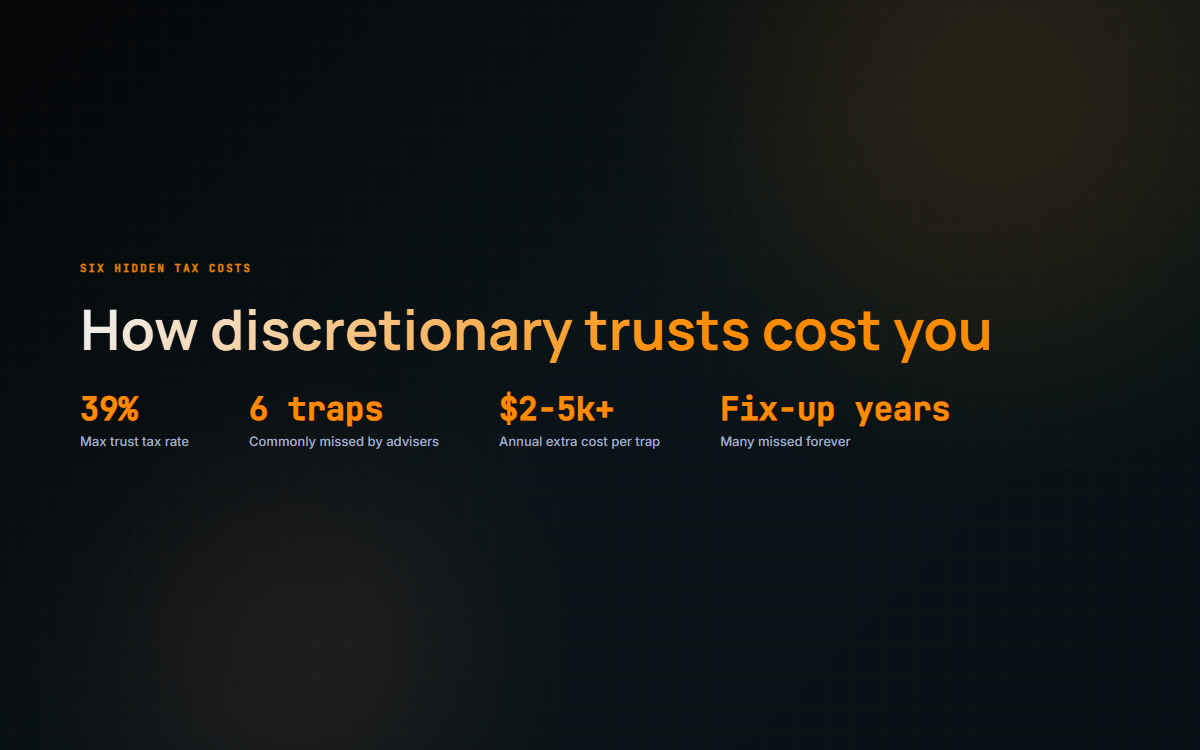
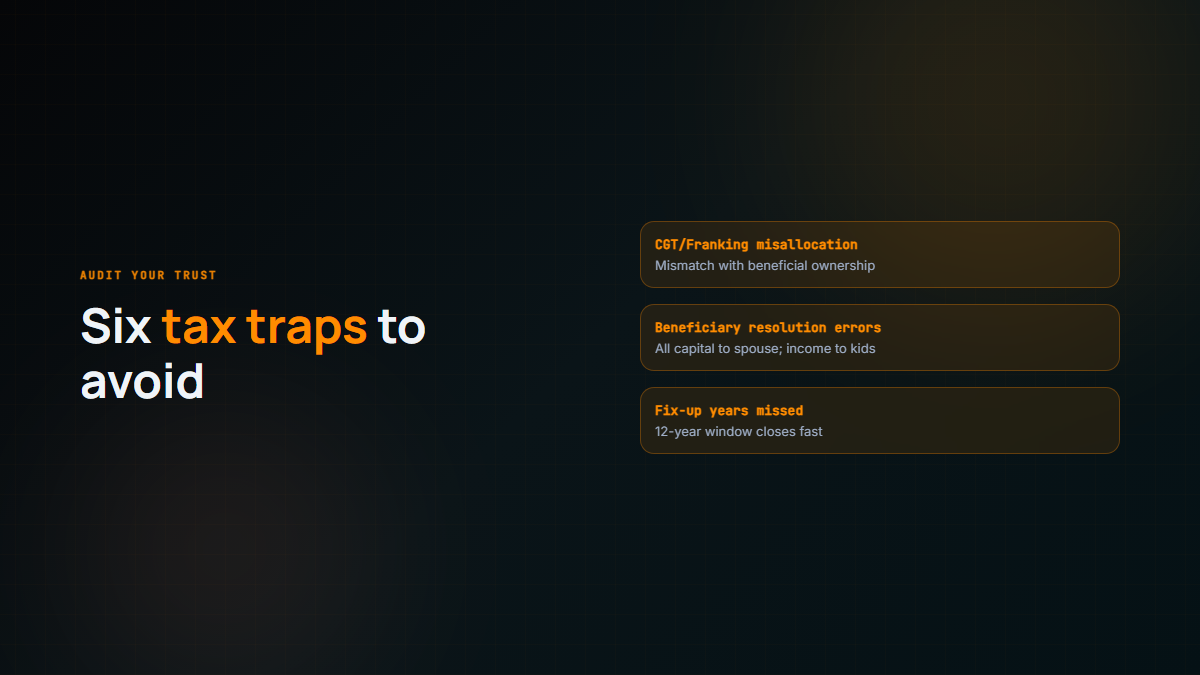
A discretionary trust in Australia holding ASX shares faces six tax traps: a 30% minimum trustee tax from 1 July 2028 consuming franking credits, CGT events on transfers, 47% trustee tax if distributions miss the 30 June deadline, no CGT discount for corporate beneficiaries, Division 7A deemed dividends on unpaid entitlements, and compliance costs eroding benefits for portfolios under $200,000.
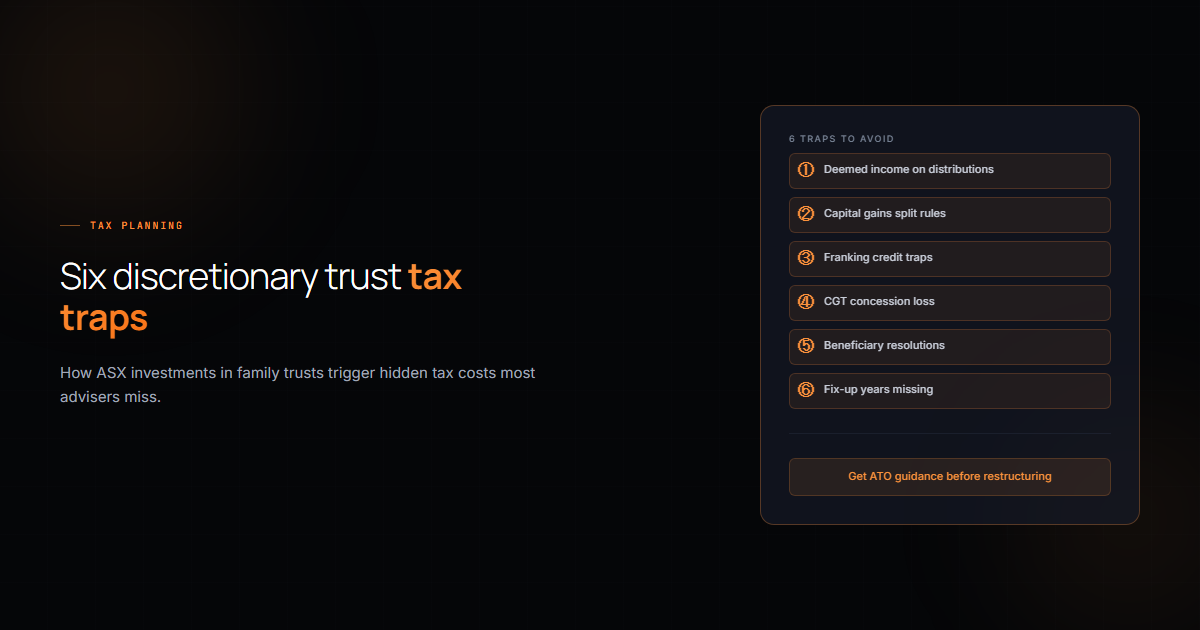
That picture is shifting. The 2026–27 Federal Budget announced a 30% minimum tax on discretionary trust income from 1 July 2028. Combined with existing ATO scrutiny on income-splitting arrangements, the structural advantages that made family trusts attractive for share investors are narrowing. Here is what you need to know.
A discretionary trust holds assets — including ASX shares — on behalf of a class of beneficiaries. The trustee legally owns the shares. The trust deed sets the rules governing who qualifies as a beneficiary and how distributions work. The appointor holds the power to remove and replace the trustee, a critical succession mechanism.
Each financial year, the trustee decides how to allocate trust income — dividends, capital gains, interest — across eligible beneficiaries. The trustee must resolve and document distributions before 30 June each year or face a severe tax consequence (covered under CGT Trap 2 below).
A corporate trustee provides continuity when individual trustees die or change roles and limits personal liability for trust debts. For a share portfolio spanning decades, a corporate trustee is generally preferred, though it adds ASIC registration costs and an extra compliance layer.
What are the tax traps of discretionary trusts for ASX investing?
When a trust receives fully-franked dividends, the trustee allocates that income to beneficiaries at lower marginal rates — adult children studying part-time, or a spouse with minimal other income.
Worked example: $30,000 in franked dividends ($12,857 in franking credits; grossed-up: $42,857)
Distributed to an adult child earning $18,000:
- Total taxable income: $60,857
- Tax payable (2024–25 rates, including Medicare levy): approximately $11,700
- Less franking credit offset: $12,857
- Net outcome: refund of approximately $1,157
Distributed to a high-income parent earning $180,000:
- Tax on $42,857 at 47%: approximately $20,143
- Less franking credit: $12,857
- Net tax: approximately $7,286
The ATO applies Part IVA — the general anti-avoidance provision — to arrangements where the dominant purpose is tax minimisation. Distributing income to beneficiaries who perform no role in generating it, or who redirect funds back to the founder, attracts scrutiny. Document the commercial rationale for each year’s distribution resolution.
What is a discretionary trust in Australia?
A discretionary trust holding ASX shares for more than 12 months qualifies for the 50% CGT discount — but only when the gain is distributed to a natural person beneficiary or a complying superannuation fund.
Worked example: The trust sells shares for a $40,000 capital gain. After the 50% discount, the discounted gain is $20,000. Distributed to a beneficiary on a 30% marginal rate: tax payable is $6,000.
A corporate beneficiary pays 25–30% on the full $40,000 with no CGT discount. At 25%, that is $10,000 — compared to $6,000 for the individual above. The bucket company strategy only makes sense when you intend to retain profits long-term, and the numbers need careful review after 2028.
Discretionary trading trust vs discretionary investment trust: what’s the difference?
Moving ASX shares into a discretionary trust — or out of one into an SMSF, company, or personal name — is a CGT event A1. The ATO treats the transfer as a disposal at current market value, regardless of the original cost base. Any unrealised gain crystallises immediately.
Investors who transfer a portfolio containing both unrealised gains and accumulated losses must assess each parcel separately. You cannot selectively transfer loss positions to offset gains inside the trust without attracting ATO scrutiny under wash-sale provisions.
The 2026–27 Budget flagged rollover relief for eligible restructures ahead of the 2028 minimum tax. As of the date of this article, the relief has not been legislated. Do not restructure your portfolio in anticipation of relief that does not yet exist.
CGT Trap 2: The 30 June Distribution Deadline and Trustee Tax at 47%
If the trustee fails to document a valid distribution resolution before 30 June, the trust’s net income is assessed in the trustee’s hands at 47% — applying to every dollar of income, including fully-franked dividends and capital gains.
Practical checklist:
- Confirm net income estimates with your accountant by mid-June
- Execute and sign the distribution resolution before 30 June (not after)
- Ensure the resolution identifies each beneficiary’s entitlement by name or class
- Retain the signed resolution for ATO record-keeping purposes
Note: trust losses cannot be distributed to beneficiaries to reduce their personal income. They remain trapped in the trust and carry forward — a common surprise for investors who expect to offset trust losses against personal income.
Streaming Franking Credits and Capital Gains to Specific Beneficiaries
Under the Tax Laws Amendment (2011 Measures No. 5) Act, trustees with appropriate deed powers can stream capital gains and franked amounts to specific beneficiaries. This allows the trustee to direct fully-franked dividends to a lower-income beneficiary — who receives a refund of excess franking credits — while directing unfranked income elsewhere.
The streaming rules are not automatic. Your trust deed must explicitly permit the trustee to stream franked distributions and capital gains. Many older deeds do not.
A Family Trust Election (FTE) is required if the trustee wants to access certain trust loss concessions and stream franking credits under the ATO’s rules. Making an FTE restricts eligible beneficiaries to a defined family group. Distributions outside that group attract family trust distribution tax at the top marginal rate. The FTE is not reversible without consequences.
Worked example: The trust receives $20,000 in fully-franked dividends (grossed-up: $28,571) and $15,000 in unfranked interest. The trustee streams the franked amount to a retired beneficiary on a 15% rate — who receives a franking credit refund. The unfranked interest goes to a working adult child on 30%. Both outcomes are more tax-efficient than a pro-rata split.
How to use a discretionary trust for ASX share portfolio?
From 1 July 2028, trustees of discretionary trusts will pay 30% tax on trust taxable income before distributions. Individual beneficiaries receive non-refundable credits for the trustee-level tax. There is no carry-forward and no refund if a beneficiary’s marginal rate is below 30%.
Franking credits on fully-franked ASX dividends will offset the trustee’s 30% liability first. For a trust holding major bank shares — where franking credits typically represent 30 cents per dollar of grossed-up income — the credits are largely consumed at trustee level. Beneficiaries lose the refund benefit they currently receive.
Budget commentary confirms corporate beneficiaries will not receive credits for the trustee-level tax, which breaks the economics of the trust-to-company distribution model.
For beneficiaries with marginal rates above 30%, the trust still reduces total tax — they pay top-up tax on the difference rather than their full marginal rate. For low-income beneficiaries below 30%, the advantage largely disappears. Asset protection and estate planning benefits remain unaffected.
Discretionary Trust vs SMSF, Company, and Personal Name
| Structure | Tax Rate | CGT Discount | Franking Credits | Compliance Cost |
|---|---|---|---|---|
| Discretionary Trust (pre-2028) | Beneficiary rate | Yes (natural persons) | Flow-through, refundable | Medium–High |
| Discretionary Trust (post-2028) | 30% minimum + top-up | Yes (natural persons) | Non-refundable at trustee level | Medium–High |
| SMSF (accumulation) | 15% | Yes (one-third reduction) | Refundable | High |
| Company | 25–30% | No | Refundable to shareholders | Medium |
| Personal Name | Marginal rate | Yes | Refundable | Low |
An SMSF suits investors wanting the lowest long-term tax rate on share income and gains. A company suits investors retaining profits for reinvestment who do not need CGT discount access. Personal name suits smaller portfolios where compliance costs erode any tax saving. A discretionary trust remains relevant post-2028 where at least some beneficiaries have marginal rates above 30% and asset protection or succession flexibility has genuine value.
When a corporate beneficiary receives a distribution but funds are not paid out — remaining as an unpaid present entitlement — Division 7A deems this a loan from the company to the trust. The loan must be placed on a complying Division 7A loan agreement or repaid, or it becomes a deemed dividend.
Compliance Costs and Record-Keeping
Ongoing costs typically include accountant fees for the annual trust tax return and distribution resolutions ($1,500–$3,500 per year) and ASIC annual review fees for a corporate trustee (approximately $310 per year). For portfolios under approximately $200,000, fixed compliance costs frequently erode the tax benefit of the structure entirely.
The ATO requires trust records to be kept for five years from when they are prepared or the transaction occurs. For share investments with long holding periods, this effectively means retaining cost base records, distribution resolutions, and trust tax returns for the life of the investment plus five years.
If you hold the same ETF across a discretionary trust, an SMSF, and a personal account, you maintain three separate cost base records for the same security. A portfolio tracking tool supporting multiple entities helps consolidate CGT records and simplifies the data your accountant needs at year-end.
Frequently asked questions
Can a discretionary trust claim the 50% CGT discount on ASX shares held for more than 12 months?
Yes, but only when the capital gain is distributed to a natural person beneficiary. If the gain flows to a corporate beneficiary or another trust, the 50% discount is not available at that level.
How do franking credits flow through a discretionary trust to individual beneficiaries?
Under current rules, franking credits pass through to beneficiaries in proportion to their share of the trust’s net income. From 1 July 2028, under the proposed minimum tax, credits will first offset the trustee’s 30% tax liability, with only non-refundable residual credits flowing to beneficiaries.
What is a Family Trust Election and does a discretionary trust need one to invest in ASX shares?
A Family Trust Election is not compulsory for general share investing, but it is required if the trustee wants to stream franking credits to specific beneficiaries and access certain trust loss concessions. Distributions outside the defined family group attract family trust distribution tax.
What are the annual compliance costs of running a discretionary trust for an ASX share portfolio?
Typical ongoing costs include accountant fees for the annual trust tax return and distribution resolutions ($1,500–$3,500 per year depending on complexity), plus ASIC fees if a corporate trustee is used. For portfolios under approximately $200,000, fixed compliance costs can materially erode the tax benefit of the structure.