
What Is the Wegovy Pill and Why Does It Matter to Investors?
Five Wegovy ASX ETFs — IXJ, VGS, DRUG, WXOZ, and HLTH — provide indirect exposure to Novo Nordisk and Eli Lilly, the makers of Wegovy and rival GLP-1 drugs, through global healthcare or broad-market index holdings accessible via any Australian brokerage account.
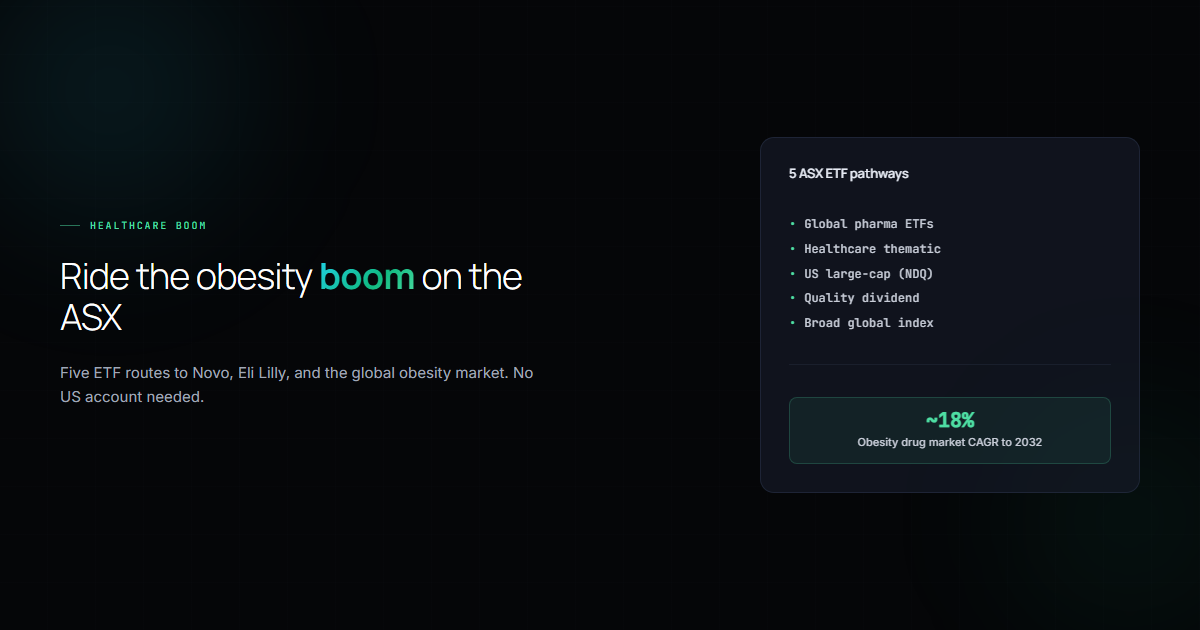
The short answer is through global healthcare ETFs. Novo Nordisk and Eli Lilly, the two dominant GLP-1 players, are not listed on the ASX. The Wegovy pill has not yet received TGA approval in Australia. But several ASX-listed ETFs hold meaningful positions in both companies, accessible through any standard Australian brokerage account.
Semaglutide is the active ingredient in both Ozempic (type 2 diabetes) and Wegovy (weight management). Both have been available as weekly injections. The oral pill changes delivery to a once-daily tablet — no needle required.
The injectable form of Wegovy is already TGA-registered in Australia for weight management in adults and adolescents aged 12 and over, and for treatment of non-cirrhotic MASH with moderate to advanced liver fibrosis. The pill form remains under regulatory review.
A significant portion of patients who would benefit from GLP-1 therapy decline injections. The oral format removes that barrier, making treatment far more accessible for needle-averse patients — a large untapped market segment. This is a structural expansion of the patient population Novo Nordisk can reach, re-accelerating a revenue curve previously constrained partly by injectable supply limitations.
| Drug | Company | Active Ingredient | Primary Use |
|---|---|---|---|
| Wegovy | Novo Nordisk | Semaglutide | Weight management |
| Ozempic | Novo Nordisk | Semaglutide | Type 2 diabetes |
| Mounjaro | Eli Lilly | Tirzepatide | Type 2 diabetes |
| Zepbound | Eli Lilly | Tirzepatide | Weight management |
Which Australian ETFs hold obesity drug makers?
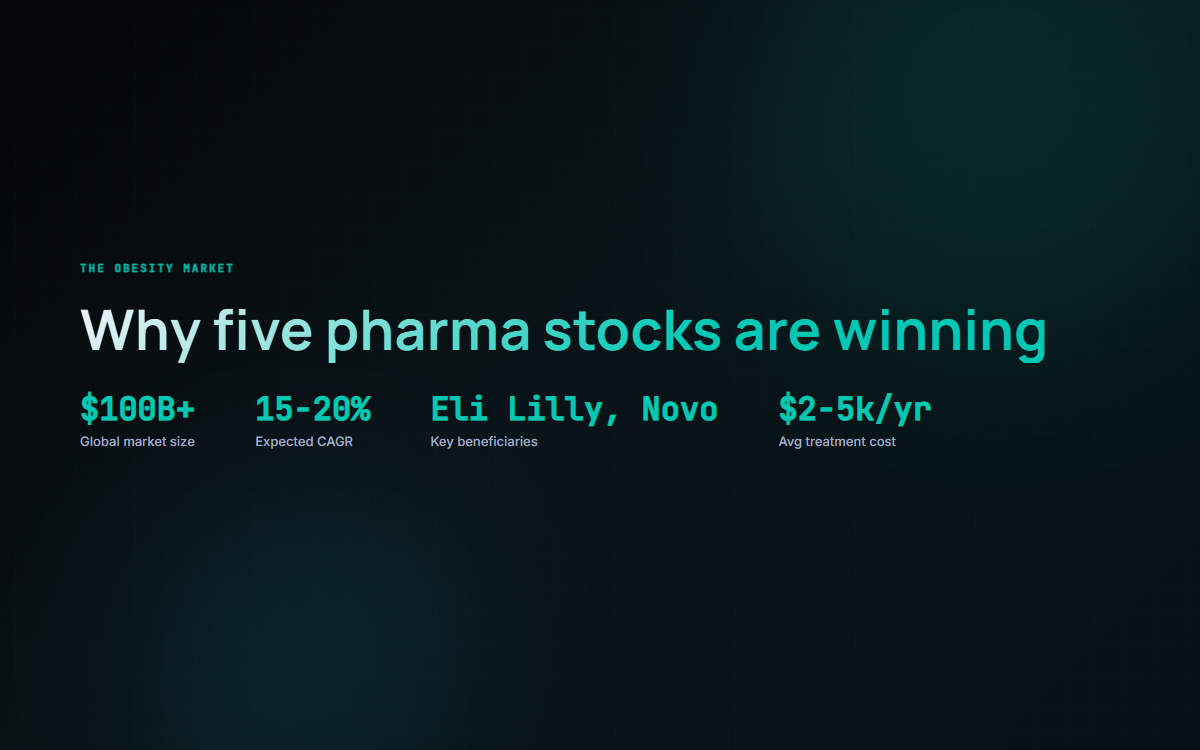
Analyst forecasts from major investment banks place the global GLP-1 market at over USD $130 billion annually by 2030. Expansion into cardiovascular and liver disease indications has broadened the total addressable market considerably.
Between 2021 and 2024, Novo Nordisk shares rose approximately 82% and Eli Lilly shares approximately 97% on the back of GLP-1 demand. Both stocks have since experienced volatility as investors weigh valuation risk against ongoing pipeline expansion.
According to the Australian Bureau of Statistics, over 67% of Australian adults are overweight or obese. Wegovy’s existing TGA approval for MASH extends the clinical and commercial case well beyond weight loss alone.
The Australian Regulatory Picture
The oral Wegovy pill is not yet approved in Australia. The TGA must conduct its own review before the product is registered here. Novo Nordisk has flagged Australia as a high-priority market, with industry commentary from mid-2025 suggesting TGA approval is anticipated in the near term.
TGA approval gives the pill legal status to be sold in Australia. PBS listing is an entirely separate process administered by the Pharmaceutical Benefits Advisory Committee (PBAC). Without PBS subsidisation, out-of-pocket costs will limit uptake significantly.
Key domestic catalysts to watch:
- TGA registration of the oral semaglutide formulation
- PBAC recommendation on PBS listing
- Novo Nordisk’s manufacturing capacity to supply Australia
- Government budget announcements on obesity drug subsidisation
Is now a good time to invest in obesity treatment ETFs?
Novo Nordisk trades on the Copenhagen Stock Exchange and as an ADR on the NYSE. Eli Lilly trades on the NYSE. Neither has an ASX listing. Without a US brokerage account, direct share purchases are not straightforward for most retail investors.
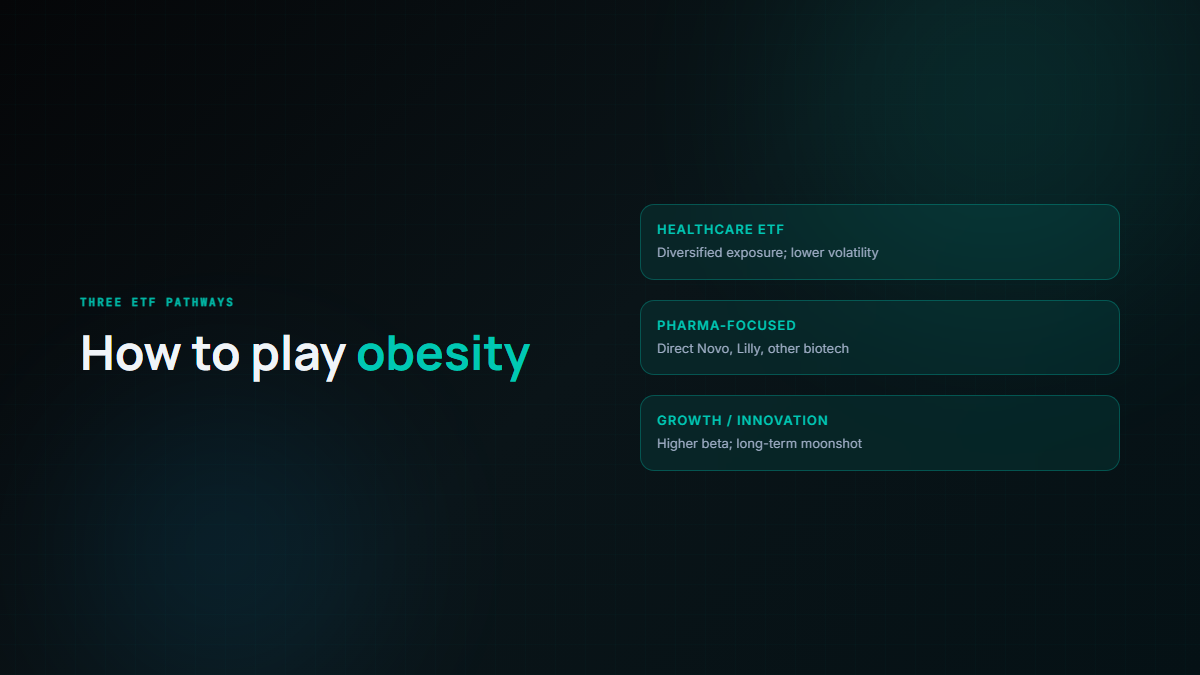
ASX-listed global healthcare ETFs hold diversified baskets of international pharmaceutical and biotech companies. Several carry meaningful weightings in both Novo Nordisk and Eli Lilly, giving Australian investors indirect GLP-1 exposure through a standard ASX brokerage account.
What ASX ETFs give exposure to Wegovy?
iShares Global Healthcare ETF (IXJ.AX) tracks the S&P Global 1200 Healthcare Sector Index across 100-plus global healthcare companies. Eli Lilly is typically a top-five holding. It is unhedged to AUD/USD, so currency movements affect your returns.
Vanguard MSCI Index International Shares ETF (VGS.AX) tracks the MSCI World ex-Australia Index across all sectors. Both Eli Lilly and Novo Nordisk appear within its holdings due to their global market capitalisation. VGS offers broader diversification at a low management cost.
BetaShares Global Healthcare ETF — Currency Hedged (DRUG.AX) focuses on global healthcare and is hedged to AUD, removing currency risk. This suits investors who want healthcare sector exposure without taking a view on the AUD/USD rate. Its pharmaceutical holdings include major GLP-1 producers.
SPDR S&P World ex-Australia Fund (WXOZ.AX) tracks a broad developed-world index excluding Australia. Healthcare forms a meaningful portion of the index weight. Like VGS, it provides GLP-1 exposure as a by-product of market-cap weighting rather than a targeted sector bet.
VanEck Global Healthcare Leaders ETF (HLTH.AX) holds a concentrated portfolio of large-cap global healthcare companies across pharmaceutical, biotech, and medical device segments. For SMSF trustees seeking focused healthcare exposure within a managed ETF structure, HLTH offers a more targeted option than broad world funds.
What are the risks of investing in weight loss drug ETFs?
Valuation risk. Novo Nordisk and Eli Lilly have already posted enormous share price gains. Much of the near-term GLP-1 growth may already be priced in.
Generic competition and pipeline risk. GLP-1 patents will not last forever. Generic semaglutide versions are in development globally, and oral formulations from competing companies could compress margins over a 5–10 year horizon.
AUD/USD currency exposure. Most ASX-listed global healthcare ETFs are unhedged. If the Australian dollar strengthens against the US dollar, your AUD returns fall even if underlying holdings perform well. DRUG.AX is the notable hedged exception.
Supply chain and manufacturing risk. Novo Nordisk has faced supply constraints on injectable Wegovy. The oral pill requires different manufacturing at scale. Delays in production ramp-up could slow revenue recognition and disappoint investors.
Australian Tax Considerations
CGT on ETF unit disposals. When you sell ASX-listed ETF units at a profit, you trigger a capital gains event. Individuals and trusts holding units for more than 12 months are eligible for the 50% CGT discount. Companies and SMSFs in accumulation phase are not eligible for this discount, though SMSFs in accumulation phase access a one-third reduction on eligible gains.
Unfranked distributions and foreign tax offsets. Global healthcare ETF distributions are typically unfranked. Foreign withholding tax is often deducted at the fund level before distributions reach you. A foreign tax offset may be available on your ATO tax return to avoid double taxation. Check your annual ETF tax statement carefully.
SMSF investors. In retirement phase (pension mode), earnings on assets backing retirement pensions are generally tax-free, subject to transfer balance cap rules. SMSF trustees should ensure any global healthcare ETF allocation aligns with the fund’s documented investment strategy.
ATO record-keeping. The ATO requires records of purchase dates, cost base per unit, distribution reinvestment plan transactions, and sale proceeds for each ETF parcel. Crowdfolio tracks parcel-level cost bases, holding periods, and distribution history across your ASX ETF portfolio so your CGT position is clear at tax time.
Portfolio Strategy
GLP-1 exposure via global healthcare ETFs is a thematic satellite position, not a portfolio foundation. An allocation of around 5–10% of a diversified portfolio is more disciplined than concentrating heavily in a single sector trend, particularly within an SMSF. Spreading purchases across several months reduces the impact of entry timing on your overall return — especially relevant when entering a sector that has already re-rated strongly.
Frequently asked questions
Which ASX-listed ETFs give exposure to Novo Nordisk and Eli Lilly without a US brokerage account?
IXJ, VGS, DRUG, WXOZ, and HLTH all hold global healthcare companies including both. Verify current holdings and weightings on the ETF provider’s website before investing.
Has the Wegovy oral pill been approved by the TGA, and when is PBS listing likely?
The oral pill has not yet received TGA approval in Australia as of mid-2025. PBS listing is a separate process involving PBAC review that follows TGA approval.
What are the CGT implications for buying and selling global healthcare ETF units?
Capital gains on ETF unit disposals are taxable. Individuals and trusts holding units for more than 12 months qualify for the 50% CGT discount. Keep records of every purchase parcel and DRP transaction to calculate your cost base accurately.
Is it too late to invest in the GLP-1 boom after the big share price runs?
Valuation risk is real. Both stocks have already delivered large gains. Whether the investment thesis still holds depends on your view of long-term GLP-1 adoption, pipeline depth, and competitive dynamics — not just recent share price momentum.