
How does Iran conflict move Australian markets?
For the Iran crisis ASX ETFs, investors can consider three gold ETF types — physical, mining, and covered-call — plus two energy ETF forms: global equity and crude oil futures. Each carries distinct tax, volatility, and compliance implications for Australian portfolios when positioning for geopolitical risk.
What is the risk-off rotation pattern on the ASX?
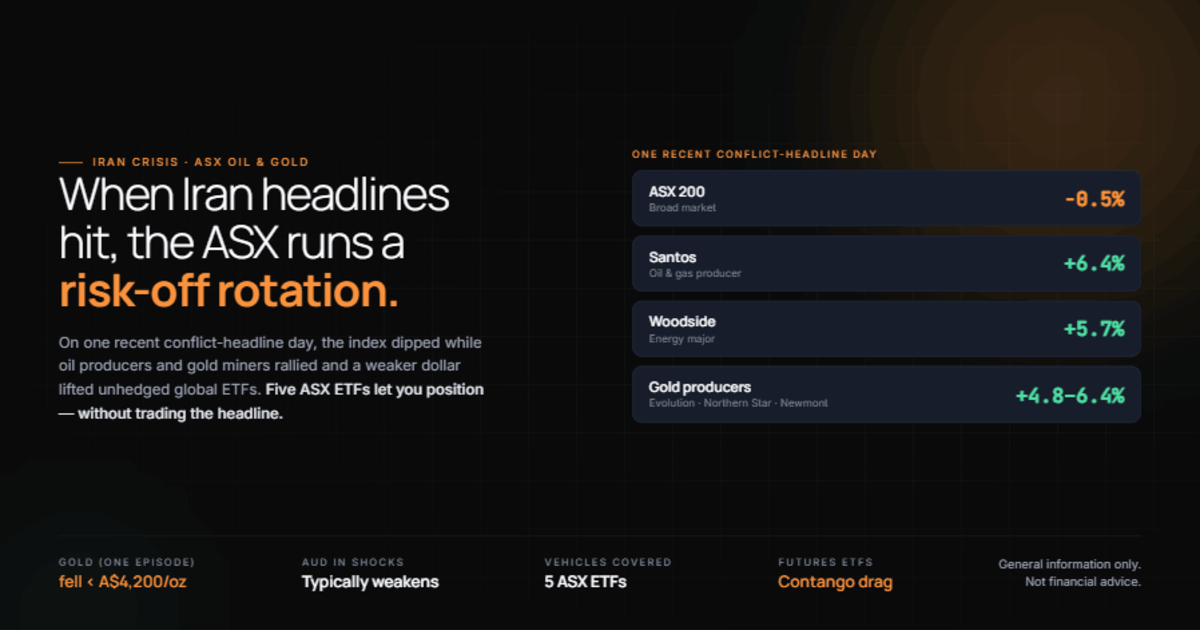
When Iran conflict news breaks, the ASX 200 follows a clear rotation. On one conflict-headline day in June 2026, the ASX 200 fell around 0.5% while Santos rose 6.4%, Woodside gained 5.7%, and ASX gold producers including Evolution Mining, Northern Star, and Newmont climbed 4.8–6.4%. Banks and consumer discretionary names bore the selling pressure.
| Asset | Move on a recent conflict-headline day |
|---|---|
| ASX 200 | −0.5% |
| Santos | +6.4% |
| Woodside | +5.7% |
| Gold producers (Evolution, Northern Star, Newmont) | +4.8% to +6.4% |
Why do energy and gold rally while banks fall?
Higher oil prices lift revenue for ASX energy producers directly. Gold benefits from a flight to perceived safe-haven assets, though the relationship is not mechanical. Gold is not a one-way bet either: a stronger US dollar or delayed rate-cut expectations can drag it lower even while a conflict is running, and the geopolitical premium tends to unwind quickly once tensions ease.
How does the AUD/USD dynamic shift during geopolitical shocks?
The AUD typically weakens during geopolitical risk events as investors move toward USD-denominated assets. For unhedged global ETFs, a weaker AUD amplifies returns in local currency terms. Currency-hedged ETFs remove this effect, which matters when comparing products.
What gold ETF options do ASX investors have?
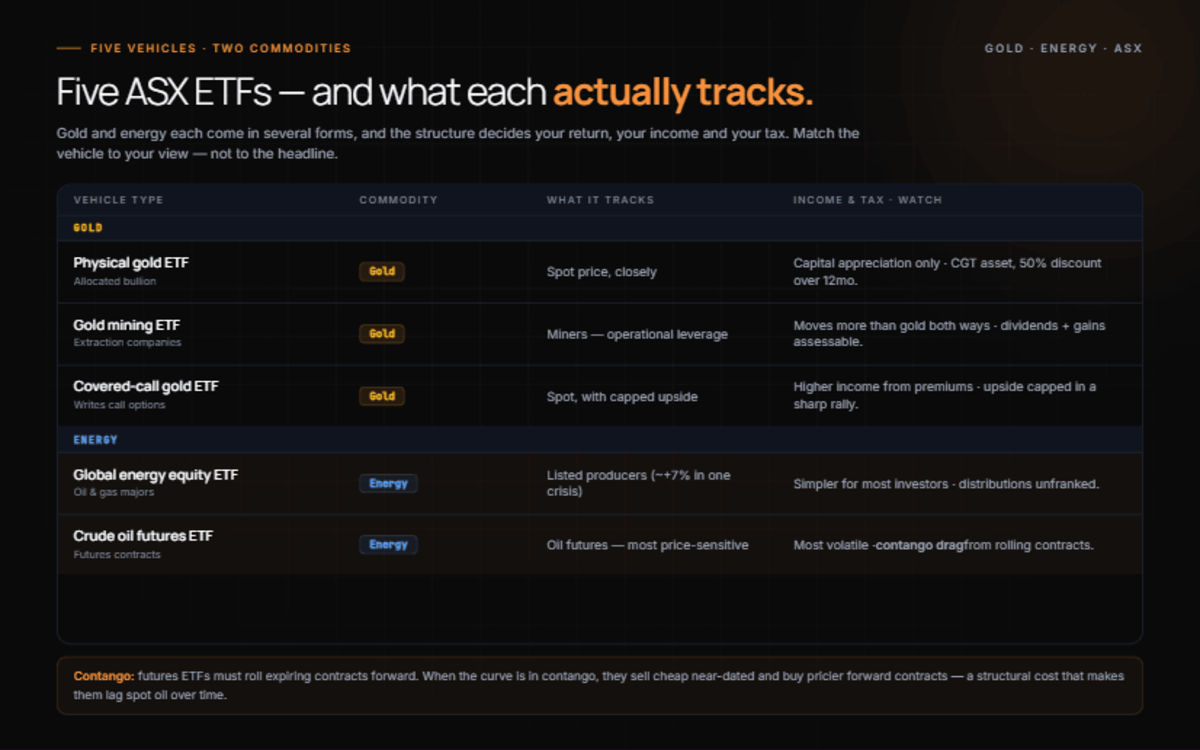
ASX investors can choose between three broad types of gold ETF, each with a different return and tax profile. Physical gold ETFs hold allocated bullion and track the spot price closely, with returns coming almost entirely through capital appreciation; for Australian tax purposes the units are CGT assets, and the 50% CGT discount applies to individuals who hold for more than 12 months. Gold mining ETFs hold shares in extraction companies and carry operational leverage — production costs, hedging policies and management decisions all amplify or dampen the link to spot gold, so they move more than gold in both directions and distribute dividends, foreign income and realised gains. Covered-call gold ETFs write call options to generate premium paid out as higher income, but cap upside during a sharp rally. Morningstar frames gold as a long-term strategic allocation, not a reactive crisis trade.
Physical Gold ETFs: Direct Spot Price Exposure
Physical gold ETFs hold allocated bullion and track the spot price closely. Returns come almost entirely through capital appreciation. For Australian tax purposes, units are CGT assets. The 50% CGT discount applies to individuals who hold units for more than 12 months.
Gold Mining ETFs: Operational Leverage and Higher Volatility
Gold mining ETFs own the diggers, not the metal. That brings operational leverage — costs, hedging, management calls — all of which stretch or shrink the link to spot gold. Miners swing harder than bullion both ways. Distributions mix dividends, foreign income, and sometimes realised capital gains, all taxable.
Covered-Call Gold ETFs: Trading Upside for Income
Covered-call gold ETFs sell call options on their gold holdings and hand you the premium as extra income. The catch: your upside gets a ceiling — right when a crisis typically blows the roof off gold prices. They’re built for sideways markets, not for catching the rocket.
Why is gold a strategic allocation, not a crisis trade?
Morningstar argues gold belongs in a portfolio as a long-term strategic sleeve, not a panic buy when headlines scream. A 5–15% precious-metals allocation hedges systemic and geopolitical risk over time. Jumping in on conflict news usually means chasing a spike that’s already reversing.
What do ASX investors need to know about energy ETFs?
Energy ETFs come in two very different forms, and the distinction matters for Australian investors. Global energy equity ETFs hold shares in international oil and gas majors; one BetaShares global energy companies ETF rose approximately 7% during a recent Iran crisis period — well below the move in spot crude. Crude oil futures ETFs instead track an index of futures contracts directly and are far more sensitive to short-term oil-price moves, but also significantly more volatile and complex. A key drag on futures ETFs is contango: because they must continuously roll expiring contracts forward, when the futures curve sits in contango — future prices above spot — the fund sells cheaper near-term contracts and buys more expensive ones, creating a structural cost. This is why a crude oil futures ETF often underperforms spot oil over time, making equity-based energy ETFs simpler for most investors.
Global Energy Equity ETFs vs Crude Oil Futures ETFs
Global energy equity ETFs hold shares in international oil and gas majors. A BetaShares global energy companies ETF rose approximately 7% during a recent Iran crisis period — well below the move in spot crude. Crude oil futures ETFs track an index of futures contracts directly and are far more sensitive to short-term oil price moves. They are also significantly more volatile and complex.
What is contango risk and why do energy ETFs lag spot oil?
Crude oil futures ETFs must roll expiring contracts forward continuously. When the futures curve is in contango — where future prices exceed spot — the fund sells cheaper near-term contracts and buys more expensive ones, creating a drag on returns. This is why a crude oil futures ETF often underperforms spot oil over time.
What are the tax considerations for Australian investors?
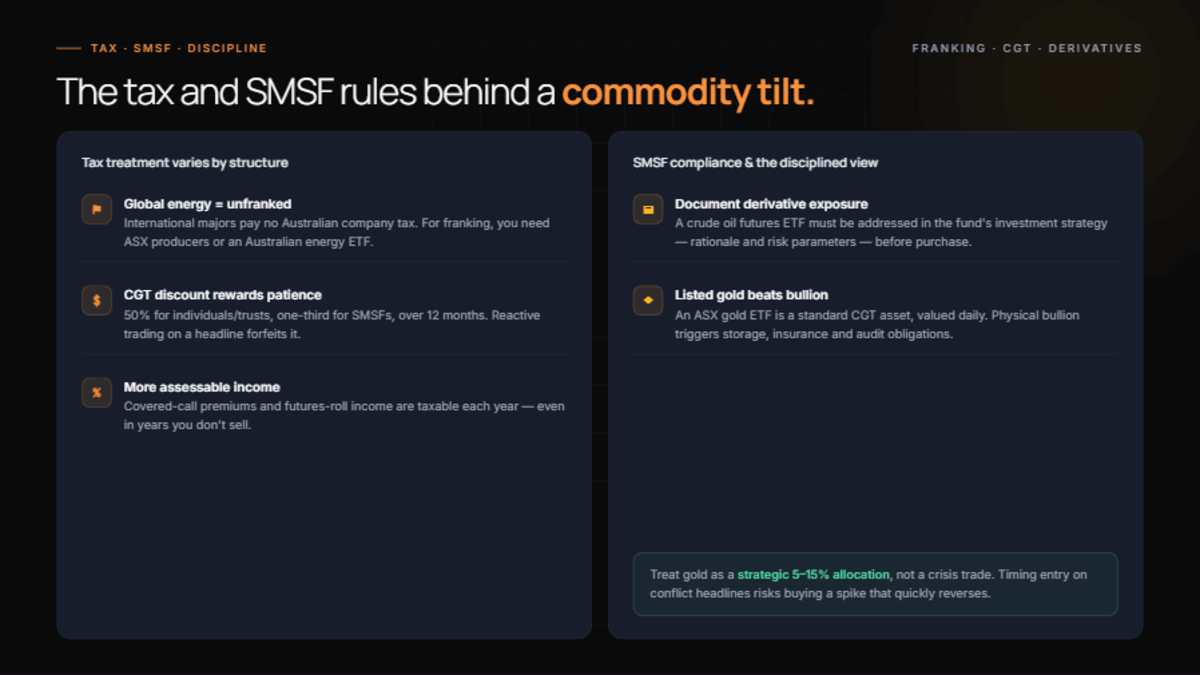
Tax treatment varies meaningfully across commodity ETFs. Global energy equity ETFs hold international oil majors that pay no Australian company tax, so their distributions are generally unfranked; accessing franking credits through energy exposure requires direct ASX-listed producers or an Australian-focused energy ETF, which affects after-tax returns for higher-bracket investors. The ATO’s 50% CGT discount applies to individuals and trusts holding ETF units for more than 12 months, with SMSFs receiving a one-third discount, while reactive trading — buying on a headline and selling weeks later — forfeits the discount and realises a gain taxed at your full marginal rate. Covered-call gold ETFs and crude oil futures ETFs both tend to generate more assessable income, the former through option premiums and the latter through the rolling process, so each can produce higher annual taxable income even in years you hold without selling.
Why do global energy ETFs pay unfranked distributions?
Global energy equity ETFs hold international oil majors that pay no Australian company tax. Distributions are generally unfranked. To access franking credits through energy exposure, you need direct ASX-listed energy producers or an Australian-focused energy ETF. This has a real impact on after-tax returns, particularly for investors in higher tax brackets.
CGT Planning: The 12-Month Discount Rule
The ATO’s 50% CGT discount applies to individuals and trusts holding ETF units for more than 12 months before disposal. SMSFs receive a one-third discount under the same condition. Reactive trading — buying on a headline and selling weeks later — forfeits this discount entirely and realises a short-term gain taxed at your full marginal rate.
How Covered-Call and Futures ETFs Generate More Assessable Income
Covered-call gold ETFs pass option premiums to investors as trust distributions, assessable in the year received regardless of whether you sell units. Crude oil futures ETFs similarly distribute income through the rolling process. Both structures tend to produce higher annual taxable income than a pure price-return ETF, affecting your tax position even in years you hold without selling.
What compliance obligations do SMSF trustees face?
SMSF trustees face additional compliance obligations when holding commodity ETFs. An SMSF’s investment strategy must explicitly address derivative-linked exposures, so if you hold a crude oil futures ETF the strategy should explain the rationale, acceptable risk parameters and how the holding contributes to overall objectives — and that documentation should be reviewed before purchase, not after. The choice of gold vehicle also matters for compliance: ASX-listed gold ETFs satisfy SMSF requirements more cleanly than physical bullion, which triggers storage, insurance and audit obligations that add cost and complexity. A listed ETF, by contrast, is a standard CGT asset that settles through the exchange, is independently valued daily and requires no separate custodial arrangements. Keeping parcel-level records of cost base, holding periods and the rationale for each macro-driven tilt supports both the audit trail and CGT planning.
Documenting Derivative-Heavy ETFs in Your Investment Strategy
An SMSF’s investment strategy must explicitly address derivative-linked exposures. If you hold a crude oil futures ETF, the strategy should explain the fund’s rationale, acceptable risk parameters, and how the holding contributes to overall objectives. Review this documentation before purchase, not after.
Why are ASX-listed gold ETFs cleaner than physical bullion?
ASX-listed gold ETFs satisfy SMSF compliance requirements more cleanly than physical gold bars. Physical bullion triggers storage, insurance, and audit obligations that add cost and complexity. A listed ETF is a standard CGT asset, settles through the exchange, is independently valued daily, and requires no separate custodial arrangements.
How do you size commodity exposure sensibly?
Sizing commodity exposure sensibly means deciding allocations before a crisis, not after one. Concentrating heavily in gold and energy after a price spike risks buying high and holding through a reversal, and VanEck notes Iran-related disruption intersects with structural supply constraints — supporting steady, diversified exposure rather than a concentrated tactical bet placed once prices have already moved. Morningstar’s framework treats about 15% of assets as the upper bound for gold and precious metals for investors seeking a meaningful geopolitical hedge, while more moderate portfolios might hold around 5% in gold and a small energy tilt through an equity ETF. Buying in regular instalments through dollar-cost averaging removes the pressure of timing a single entry and smooths your average cost base across market cycles, which also simplifies CGT record-keeping. The discipline is to set position sizes in advance and rebalance back toward them rather than chase headlines.
Why avoid concentrated positions built on headlines?
Concentrating heavily in gold and energy after a spike risks buying high and holding through a reversal. VanEck notes that Iran-related disruption intersects with structural supply constraints — supporting a steady, diversified exposure rather than a concentrated tactical bet placed after prices have already moved.
A Practical Allocation Framework
Morningstar’s framework treats about 15% of assets as the upper bound for gold and precious metals for investors seeking a meaningful geopolitical hedge. More moderate portfolios might hold 5% in gold and a small energy tilt through an equity ETF. Size these positions before a crisis, not after one.
How does dollar cost averaging work for commodity ETFs?
Buying in regular instalments removes the pressure of timing a single entry and smooths your average cost base across market cycles, which simplifies CGT record-keeping. Crowdfolio lets Australian DIY investors track parcel-level cost bases and holding periods across gold ETFs, energy ETFs, and direct shares in one place — useful for both CGT planning and SMSF strategy documentation.
Frequently asked questions
Do ASX gold ETFs automatically rise when Iran conflict news breaks?
Not reliably. Gold can fall even during a conflict episode, weighed down by a stronger USD and delayed rate-cut expectations. A strategic long-term allocation is more dependable than a reactive trade.
What is the difference between a physical gold ETF and a gold mining ETF?
A physical gold ETF tracks the spot gold price directly. A gold mining ETF holds shares in mining companies, adding operational leverage and increasing volatility relative to spot gold.
How are crude oil futures ETFs taxed compared with equity-based energy ETFs?
Crude oil futures ETFs tend to generate more frequent assessable income through the rolling process, affecting your annual tax position even without selling units. The ATO’s 50% CGT discount applies to both on disposal after 12 months for individuals.
Can an SMSF hold an oil futures ETF listed on the ASX?
Yes, but the fund’s investment strategy must explicitly document the derivative-linked exposure and the rationale for holding it. Review this documentation before purchasing.