
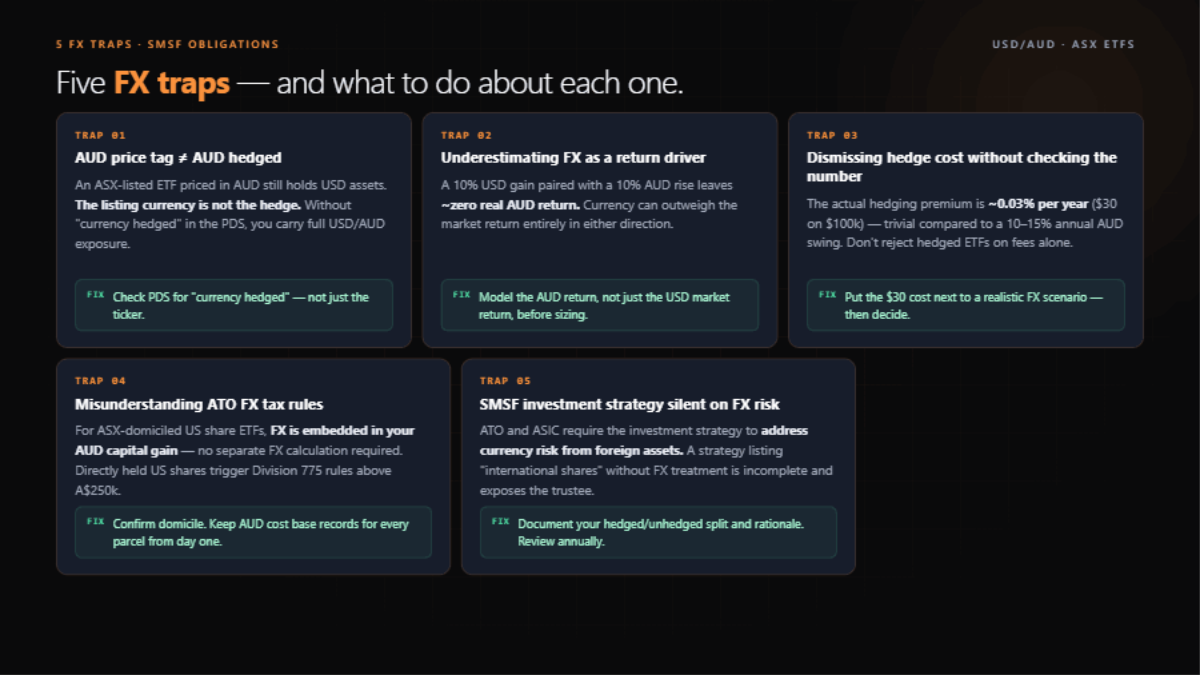
Five USD AUD ETF hedging traps catch Australian investors: assuming ASX-listed AUD-priced ETFs are currency-hedged, underestimating how FX swings can dominate returns, dismissing hedged ETFs over a ~0.03% fee premium, overlooking ATO CGT rules where FX is embedded in ETF gains but separate for direct shares, and failing to document currency risk in SMSF investment strategies.
Trap 1: does an ASX-listed ETF protect you from USD/AUD FX risk?
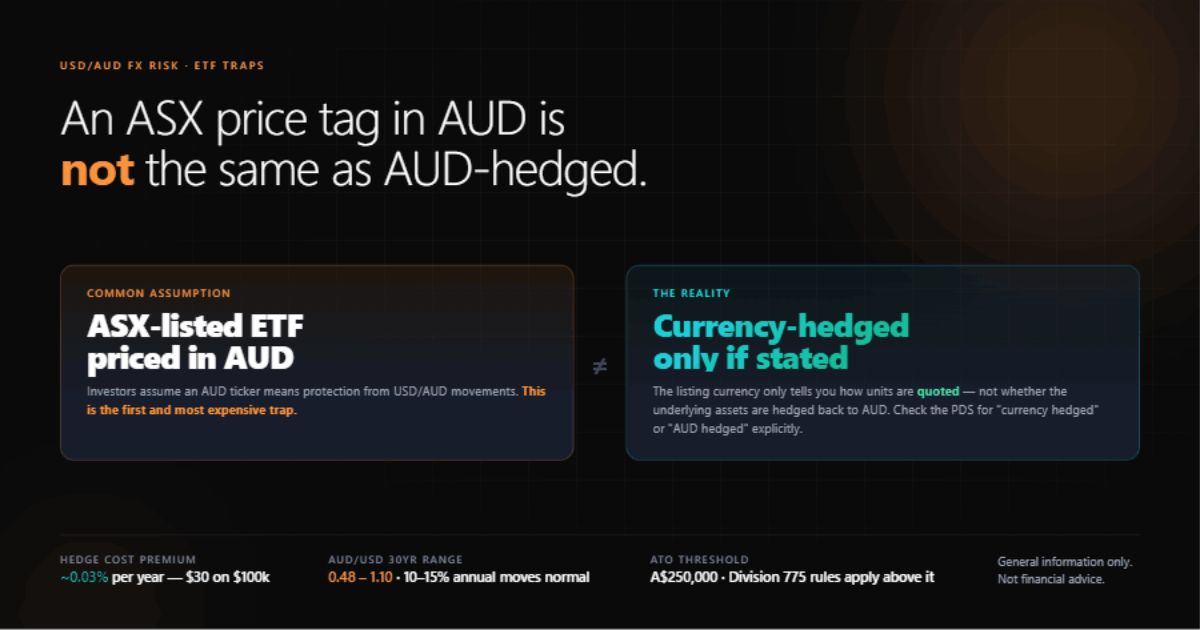
No — and assuming it does is the first and most expensive trap. An ETF listed on the ASX and priced in AUD is not automatically shielded from USD/AUD FX risk. The listing currency only tells you how the units are quoted; it says nothing about whether the underlying assets are hedged back to Australian dollars. Unless the ETF name, product disclosure statement or ISIN explicitly includes currency hedged or AUD hedged, you carry full US-dollar exposure. The reason is mechanical: when you buy an unhedged US share ETF on the ASX, the fund holds US equities priced in USD, and the manager translates that USD value into AUD each day to strike the unit price. So your daily return blends two moving parts — how the US stocks performed and how the AUD moved against the USD. Buying in Australian dollars through your local broker feels like it removes currency risk, but it simply hides it inside the unit price.
Is AUD-denominated the same as AUD-hedged?
An ETF listed on the ASX and priced in AUD is not automatically shielded from USD/AUD FX risk. The listing currency tells you how units are quoted. It says nothing about whether the underlying assets are hedged back to AUD.
Unless the ETF’s name, product disclosure statement, or ISIN includes the words “currency hedged” or “AUD hedged,” you carry full USD exposure.
How do underlying USD assets drive your returns?
When you buy an unhedged US share ETF on the ASX, the fund holds US equities priced in USD. The manager translates that USD value into AUD each day to produce the unit price you see. If the AUD rises against the USD, your unit price falls in AUD terms, even if the underlying shares went nowhere.
Your AUD return is a product of two separate forces: the USD return of the underlying assets and the movement in the AUD/USD exchange rate.
How do you check the PDS for currency exposure?
Download the PDS for any US share ETF you hold. Search for the words “currency” and “hedged.” If the PDS states the fund does not hedge foreign currency exposure, you are fully exposed to USD/AUD movements. BetaShares HNDQ is explicitly hedged; its unhedged counterpart NDQ is not. The ticker alone does not tell you this.
Trap 2: how much can FX movements dominate your return?
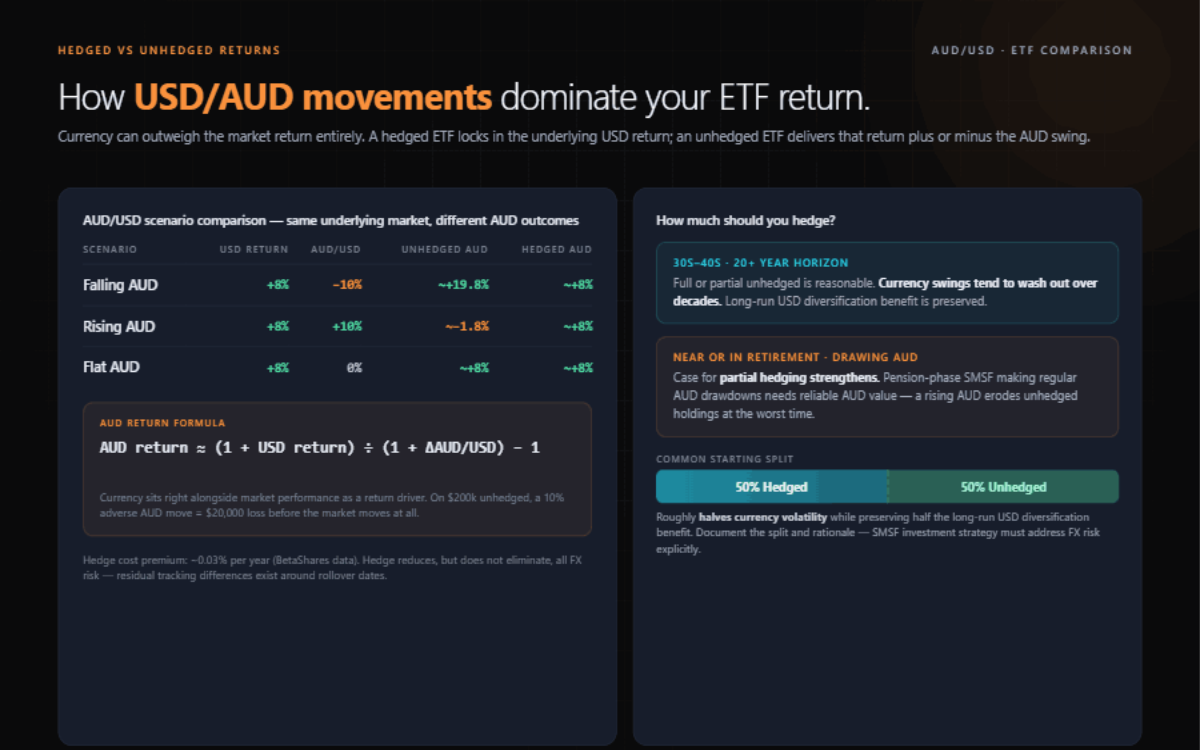
Currency can dominate your return entirely — sometimes more than the underlying market. Morningstar documented a case where a slight USD loss in the underlying market turned into a 7.8% gain in AUD terms, simply because the Australian dollar fell far enough to more than offset the negative US return. The reverse is just as real: a 10% gain in USD paired with a 10% rise in the AUD leaves you with roughly zero real gain in Australian-dollar terms. The relationship can be approximated with a formula — AUD return is roughly (1 + USD return) divided by (1 + change in AUD/USD), minus 1 — which shows currency sitting right alongside market performance as a driver. History makes it concrete: between 2011 and 2013 the AUD/USD rate fell from above 1.10 to around 0.88, which materially flattered the AUD returns of investors holding unhedged US assets. Underestimating this means mistaking a currency swing for investing skill.
What does a worked AUD/USD scenario look like?
Morningstar documented a case where a slight USD loss in the underlying market turned into a 7.8% AUD gain because the Australian dollar fell sharply enough to more than offset the negative USD return. The reverse applies equally. A 10% USD gain paired with a 10% AUD rise leaves you with roughly zero real gain in AUD terms.
The formula: AUD Return ≈ (1 + USD Return) ÷ (1 + Change in AUD/USD) − 1.
When do currency moves flatter or destroy performance?
Between 2011 and 2013, the AUD/USD rate fell from above 1.10 to around 0.88. Australian investors in unhedged US ETFs received a significant currency tailwind on top of their market return. Investors who attributed that outperformance entirely to stock selection missed the fact that the falling AUD did much of the work.
What do three decades of data show?
Over 30 years, the AUD/USD rate has traded between roughly 0.48 and 1.10 with no stable long-run anchor. A 10–15% move in any given year is entirely normal. For a portfolio with $200,000 in unhedged US share ETFs, a 10% adverse AUD move represents a $20,000 AUD-denominated loss before the market does anything.
Trap 3: are currency-hedged ETFs worth the cost?
Often yes, but only after you check the numbers rather than dismissing hedging on cost alone. A currency-hedged ETF uses rolling forward exchange contracts to offset AUD/USD movements: the fund agrees to sell USD and buy AUD at a set rate for a future date, typically one month forward, then closes that contract and opens a new one at each rollover. This neutralises most of the currency movement for the period, leaving you exposed mainly to the underlying US market return. The hedge is never perfect — small residual tracking differences appear around rollover dates. On cost, BetaShares data shows the management-expense-ratio premium for a hedged ETF over its unhedged equivalent is only about 0.03% per year, roughly $30 on a $100,000 investment. The real question is not whether that small premium exists, but whether removing currency volatility is worth it for your time horizon and risk tolerance.
How do rolling forward contracts work in a hedged ETF?
A currency-hedged ETF uses rolling forward exchange contracts to offset AUD/USD movements. The fund enters a contract to sell USD and buy AUD at a set rate for a future date, typically one month forward. At rollover, the contract is closed and a new one is opened. This neutralises most currency movement for the period, leaving you exposed mainly to the underlying USD market return. The hedge is never perfect — short-term residual tracking differences exist around rollover dates.
What is the real cost of hedging?
BetaShares data shows the management expense ratio premium for a hedged ETF over its unhedged equivalent is approximately 0.03% per year. On a $100,000 investment, that is $30 per year. Do not dismiss hedged ETFs purely on fees without putting that number in context against potential FX-driven volatility.
Hedged vs unhedged: how do return profiles compare?
| Scenario | USD Market Return | AUD/USD Change | Unhedged AUD Return | Hedged AUD Return |
|---|---|---|---|---|
| Falling AUD | +8% | −10% | ~+19.8% | ~+8% |
| Rising AUD | +8% | +10% | ~−1.8% | ~+8% |
| Flat AUD | +8% | 0% | ~+8% | ~+8% |
The hedged ETF delivers consistent exposure to the US market return. The unhedged ETF delivers that return plus or minus the currency swing.
Trap 4: how does the ATO tax FX gains?
For most Australian-domiciled US share ETFs on the ASX, the ATO tax treatment is simpler than investors fear: you do not calculate a separate foreign-exchange gain or loss. The FX effect is already embedded in the AUD unit price, so when you sell, your capital gain is simply the AUD proceeds minus your AUD cost base under standard CGT rules — including the 50% CGT discount for units held more than 12 months by individuals and trusts. Your annual tax statement from the fund reports any attributed gains or losses in AUD, and no separate FX calculation is required for the ETF itself. Where it gets more complex is Division 775 of the ITAA 1997, which can impose separate FX rules in particular circumstances, and the A$250,000 threshold that carries its own record-keeping obligations. For the typical investor in an AUD-priced US share ETF, currency is captured inside the normal capital gain.
How are FX effects embedded in CGT for US share ETFs?
For most Australian-domiciled US share ETFs on the ASX, you do not calculate a separate foreign exchange gain or loss. The FX effect is already embedded in the AUD unit price. When you sell, your capital gain is the AUD proceeds minus your AUD cost base. Standard CGT rules apply, including the 50% CGT discount for units held 12 months or more by individuals and trusts.
Note: the 50% CGT discount is legislated to be replaced by cost-base indexation and a 30% minimum tax on net capital gains from 1 July 2027; the treatment described here applies to disposals before that date.
Your annual tax statement from the fund will report any attributed gains or losses in AUD. No separate FX calculation is required for the ETF itself.
When do Division 775 FX rules apply?
The position changes when you hold US shares directly rather than through an Australian-domiciled ETF. Division 775 of the Income Tax Assessment Act 1997 contains specific rules for foreign currency gains and losses. The ATO treats the USD/AUD conversion as a separate taxable event in certain circumstances, particularly for USD cash balances used to buy and sell shares.
What is the A$250,000 FX record-keeping threshold?
The ATO provides simplified tax treatment for individuals whose foreign currency transactions fall below the A$250,000 threshold. Below this level, you are not required to recognise separate foreign exchange gains or losses on ordinary transactions. Above the threshold, or where you hold significant USD cash balances, Division 775 rules apply and separate FX gains or losses must be calculated and reported.
Keep records of every AUD/USD conversion, including brokerage platform FX conversions, with the exchange rate and date.
Trap 5: are you ignoring FX risk inside your SMSF?
Inside an SMSF, ignoring FX risk is not just an investment oversight — it is a compliance gap. SMSF trustees are legally required to maintain a written investment strategy, and both the ATO and ASIC expect that document to address the risk and likely return of each asset class, including foreign assets. If your fund holds US share ETFs, the strategy must specifically acknowledge currency risk and explain how the fund manages it. A strategy that simply lists international shares without addressing USD/AUD FX risk is incomplete and can leave trustees exposed during an audit. The exposure is practical, too: a pension-phase SMSF making regular AUD drawdowns needs reliable Australian-dollar cash flow, and a rising AUD can erode the value of unhedged US holdings just as withdrawals are due. The fix is straightforward — document how currency risk is addressed, decide on a deliberate hedged/unhedged split appropriate to the fund members, and revisit it at each strategy review.
What must SMSF trustees address on currency risk?
SMSF trustees are legally required to have a written investment strategy. The ATO and ASIC both expect this document to address the risks and likely return of each asset class, including foreign assets. If your SMSF holds US share ETFs, your investment strategy must acknowledge currency risk and explain how the fund manages it. A strategy that lists “international shares” without addressing USD/AUD FX risk is incomplete and leaves trustees exposed during an audit.
How does a rising AUD affect pension-phase SMSFs?
A pension-phase SMSF with regular AUD drawdown needs faces a specific danger. If the AUD rises sharply, the AUD value of USD-denominated assets falls. The fund must still make pension payments in AUD, which forces the trustee to sell assets at a reduced AUD value, locking in FX losses. Accumulation-phase funds have time to recover from an adverse AUD move. Pension-phase funds drawing down regularly do not always have that option.
What hedging approaches suit SMSFs?
The most practical approach for an SMSF in or near pension phase is to allocate a portion of US share exposure to a currency-hedged ETF. A common starting point is 50% hedged and 50% unhedged. This reduces AUD volatility without eliminating long-run USD diversification. The trustee documents this split in the investment strategy and reviews it at least annually.
How much of your US exposure should be hedged?
There is no single right answer, but the trade-offs are clear enough to choose deliberately. Fully unhedged exposure gives you maximum long-run currency diversification and the simplest structure, at the cost of higher AUD return volatility. Fully hedged delivers the underlying market return in more stable Australian-dollar terms, but removes the potential tailwind from a falling AUD. A split allocation balances both and is the most widely used approach among practitioners: a 50/50 split between the hedged and unhedged versions of the same US share ETF roughly halves portfolio-level currency volatility while preserving about half the long-run USD diversification benefit. Time horizon matters most. In your 30s or 40s with a 20-plus-year horizon, fuller unhedged exposure is easier to justify because currency swings tend to wash out over decades. Closer to or in retirement — especially when drawing down in AUD — a larger hedged allocation reduces the risk that a rising dollar erodes your spending power at the wrong time.
Fully unhedged gives you maximum long-run currency diversification and simplicity, with higher AUD return volatility. Fully hedged delivers the underlying market return in more stable AUD terms but removes the potential tailwind from a falling AUD. A split allocation balances both and is the most widely used approach among practitioners.
A 50/50 split between a hedged and unhedged version of the same US share ETF reduces portfolio-level currency volatility by roughly half while preserving half the long-run USD diversification benefit.
In your 30s or 40s with a 20-plus year horizon, full or partial unhedged exposure is reasonable. You have time to absorb FX volatility. Within five to ten years of retirement, or already drawing a pension, the case for partial hedging strengthens.
Waiting for the AUD to fall before investing, or selling when the AUD rises, requires you to be right twice: on entry and on exit. A consistent hedging policy outperforms binary currency calls in most long-term scenarios.
Frequently asked questions
If I buy a US share ETF on the ASX in AUD, am I automatically protected from currency movements?
No. You are protected only if the ETF is explicitly labelled currency hedged. Check the PDS before assuming any AUD-priced ETF is hedged.
How does the ATO treat currency gains when I sell a US share ETF compared with directly held US shares?
For Australian-domiciled US share ETFs, FX effects are embedded in your AUD capital gain on sale. For directly held US shares, Division 775 of the ITAA 1997 requires you to recognise separate FX gains or losses, particularly if your transactions exceed the A$250,000 threshold or you hold USD cash balances.
Does currency hedging eliminate all FX risk, and is the extra fee worth paying?
Hedging reduces but does not eliminate all FX risk. Short-term tracking differences around rollover dates remain. The extra fee is approximately 0.03% per year based on BetaShares data. Whether it is worth paying depends on your income needs, time horizon, and tolerance for AUD return volatility.
As an SMSF trustee, what do I need to document about USD/AUD FX risk?
Your investment strategy must acknowledge the currency risk from foreign assets and describe how you manage it, including whether you use hedged or unhedged ETFs, your rationale, and how often you review the position.
Closing Thoughts
USD/AUD FX risk is one of the most underestimated factors in Australian DIY portfolios. An ASX ticker priced in AUD does not mean currency protection. FX movements can outweigh market returns entirely. The ATO treats currency effects differently depending on whether you hold ETFs or direct US shares. SMSFs face specific documentation obligations. Trying to time the exchange rate consistently is not a reliable strategy.
Use a portfolio tracker like Crowdfolio to see exactly how much of your portfolio sits in USD versus AUD and to monitor the currency contribution to your returns over time.