
The fed rate cuts asx impact Australian investors mainly via the AUD/USD exchange rate, not forced RBA moves. Five tax-aware moves: audit sector weights toward REITs and infrastructure, direct new contributions before selling, use the 12-month CGT discount, harvest losses to offset gains, and review hedged versus unhedged global ETF exposure.
How does the Fed transmit rate signals to the ASX?
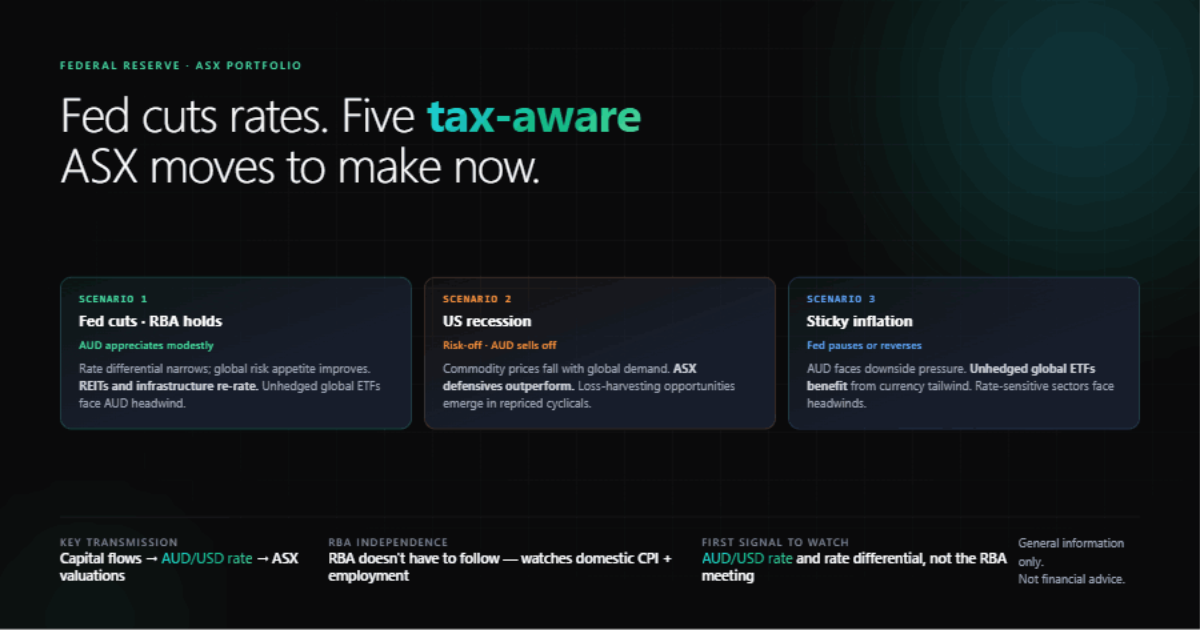
The Fed transmits rate signals to the ASX through capital flows and the currency, not through any obligation on the RBA to follow. The RBA sets the Australian cash rate based on domestic inflation and employment — it and the Fed are independent central banks with separate mandates. What actually connects them is capital. When the interest-rate differential between the US and Australia shifts, global money moves in response: that reprices the Australian dollar, adjusts the risk premium investors demand on Australian assets, and feeds back into ASX valuations — often faster than the RBA changes its own policy. So a Fed cut can ripple through your portfolio well before any local rate decision. The practical takeaway is that the first place a Fed move shows up is not the RBA next meeting; it is the AUD/USD exchange rate and the repricing of rate-sensitive ASX sectors. Watching the currency and the rate differential tells you more, sooner, than waiting on domestic policy.
How are the Fed and the RBA related?
The RBA sets the Australian cash rate based on domestic inflation and employment — not Fed decisions. These are two independent central banks with separate mandates.
What connects them is capital. When the interest rate differential between the US and Australia shifts, global capital flows respond. That reprices the AUD, adjusts risk premiums on Australian assets, and feeds back into ASX valuations — often faster than the RBA responds with its own policy changes.
Why is the AUD/USD exchange rate your first signal?
When the Fed cuts faster than the RBA, Australian rates look relatively more attractive to global investors. That draws capital toward AUD assets and puts upward pressure on the exchange rate.
A stronger AUD compresses returns on your unhedged global ETFs. If your offshore holdings rise 10% in USD terms but the AUD appreciates 5%, your AUD return shrinks. The reverse applies in a higher-for-longer Fed scenario: AUD weakness flatters unhedged offshore returns but usually signals risk-off conditions across global markets.
What do the three Fed–RBA scenarios mean for your portfolio?
The three Fed–RBA scenarios each point to a different portfolio tilt. In Scenario 1 the Fed cuts while the RBA holds: global risk appetite improves, the AUD appreciates modestly against the USD, and ASX growth and yield sectors benefit from lower global discount rates — though unhedged global ETF returns face an AUD headwind, and domestic high-franking stocks and listed infrastructure look relatively more attractive. In Scenario 2 a US recession forces aggressive Fed cuts: risk-off conditions dominate, and the AUD sells off alongside commodity prices as global growth fears take over, which can actually cushion unhedged global holdings in AUD terms. In Scenario 3, sticky inflation keeps the Fed on pause or reversing while the RBA diverges, scrambling the usual playbook. The point is not to predict which plays out, but to know in advance how your currency exposure, resources weighting and franked-income holdings would behave in each — so you can pre-decide your response.
Scenario 1: what if the Fed cuts and the RBA holds?
Global risk appetite improves and the AUD appreciates modestly against the USD. ASX growth and yield sectors benefit from lower global discount rates. Resources remain mixed and depend heavily on Chinese demand.
Unhedged global ETF returns face an AUD headwind in this scenario. Domestic yield plays — particularly high-franking stocks and listed infrastructure — become more attractive on a relative basis.
Scenario 2: what if a US recession forces aggressive cuts?
Risk-off conditions dominate. The AUD sells off alongside commodity prices as global growth fears take hold. ASX defensives — utilities, consumer staples and infrastructure — tend to outperform cyclicals in this environment.
This scenario also creates loss-harvesting opportunities. Positions that reprice lower generate realisable capital losses. Timing those realisations within the same ATO financial year (1 July to 30 June) lets you offset them against capital gains elsewhere in your portfolio.
Scenario 3: what if inflation stays sticky?
The AUD faces downside pressure as the US rate advantage holds. Unhedged offshore positions receive a currency tailwind, but ASX rate-sensitive sectors — REITs and long-duration growth stocks — reprice lower.
This is the scenario where your hedged versus unhedged global ETF split matters most. Review duration exposure and consider whether your current allocation still reflects your intended risk position.
Which ASX sectors win and lose when rates fall?
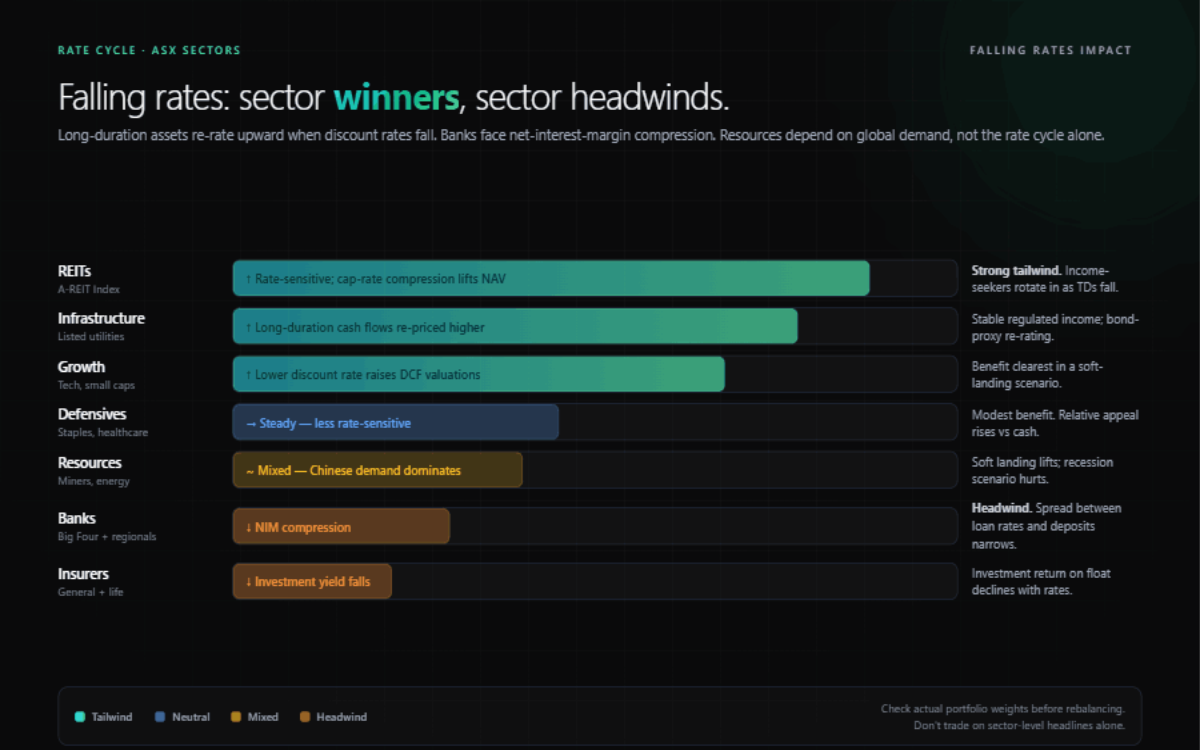
When rates fall, the winners and losers on the ASX split along duration and margin lines. Long-duration assets are valued by discounting future cash flows, so when the discount rate drops, their valuations rise — which is why listed REITs and infrastructure stocks have historically re-rated upward during easing cycles. As term-deposit rates decline alongside the cash rate, income-focused investors and SMSF pension accounts tend to rotate toward these yield-generating sectors, adding to the tailwind. The clearest losers are banks and insurers: falling rates compress net interest margins — the spread between what banks earn on loans and pay on deposits — creating an earnings headwind for the majors. Resources sit in a more ambiguous spot, because their fortunes depend more on global growth and Chinese demand than on the level of rates alone. So a falling-rate environment generally favours rate-sensitive yield and growth sectors over banks, but it does not reward every part of the market equally.
Which sectors benefit most from falling rates?
Long-duration assets are valued by discounting future cash flows. When rates fall, that discount rate drops and valuations rise. Listed REITs and infrastructure stocks on the ASX have historically re-rated upward during easing cycles.
For income-focused investors and SMSF pension accounts seeking yield, this sector tends to attract attention as term deposit rates decline.
How do rate cuts pressure banks and insurers?
Falling rates compress net interest margins — the spread between what banks earn on loans and pay on deposits. That creates a headwind for the major ASX banks.
Higher credit growth from an improving economy can partially offset this, but investors with heavy exposure to the Big Four banks should factor margin pressure into their expectations before any rate-cutting cycle takes hold.
Do rate cuts help ASX resources stocks?
Commodity prices and Chinese demand drive ASX resources far more than the domestic or US rate cycle. A US soft landing supports global growth and commodity demand. A recession scenario undermines both.
Before rebalancing your resources exposure, check your actual portfolio weights rather than reacting to sector-level headlines.
Why do franking credits matter more when rates fall?
Franking credits matter more when rates fall because their value is fixed while everything they compete against shrinks. A fully franked dividend is paid out of profits already taxed at the 30% corporate rate, and it comes with an attached franking credit. For an investor on a 0% marginal rate that credit is fully refundable; for those in lower brackets, the grossed-up, pre-tax equivalent of a franked dividend compares favourably against interest income. The key dynamic is relative. As term-deposit rates fall alongside the cash rate, the gap between a grossed-up dividend yield and a bank deposit rate widens. The franking credit itself does not change — but its relative attractiveness rises as the income alternatives pay less. This is especially powerful in SMSF pension accounts, where a 0% tax rate makes the credit fully refundable. So in an easing cycle, fully franked Australian dividends become a more competitive source of income precisely because cash and term deposits yield less.
Why do franked dividends become more competitive?
A fully franked dividend paid out of profits taxed at the 30% corporate rate comes with an attached franking credit. For an investor on a 0% marginal rate, that credit is fully refundable. For investors in lower brackets, the grossed-up pre-tax equivalent of a franked dividend compares favourably against interest income.
As term deposit rates fall alongside the cash rate, the gap between a grossed-up dividend yield and a bank deposit rate widens. The franking credit’s value doesn’t change — but its relative attractiveness does.
How do franking credits work in an SMSF pension?
SMSFs in pension phase pay 0% tax on earnings. Excess franking credits are fully refundable from the ATO, making high-franking ASX equities particularly efficient in this structure during a falling-rate environment.
Keep ATO-compliant records. Dividend statements and franking credit schedules must be retained as required by the ATO.
What are the 5 tax-aware moves to consider now?
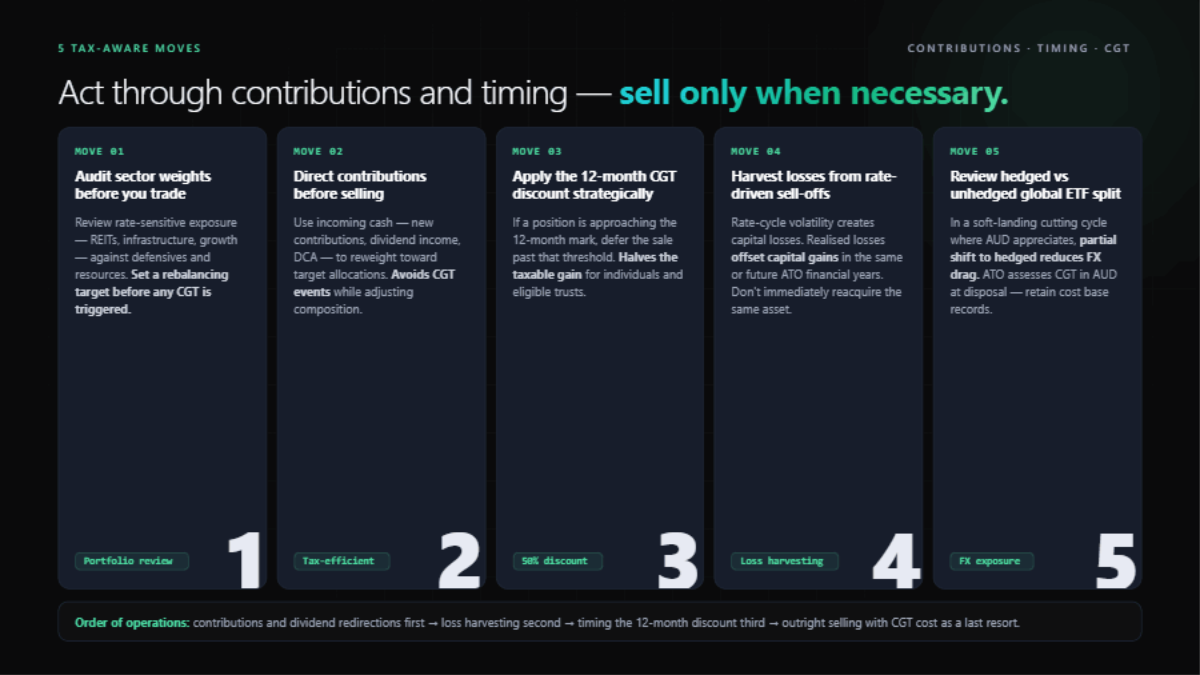
The five tax-aware moves are about adjusting to a falling-rate environment without handing back gains in tax. First, audit your sector weights — review exposure to rate-sensitive sectors like REITs, infrastructure and growth versus defensives and resources, using portfolio-level data rather than reacting to headlines, and set a rebalancing target before any CGT is triggered. Second, direct new contributions and dividend income toward your target weights before selling existing holdings, so you reshape the portfolio without realising gains. Third, apply the 12-month CGT discount strategically, timing disposals so holdings qualify for the 50% discount. Fourth, harvest losses from rate-driven sell-offs to offset realised gains elsewhere. Fifth, review your hedged versus unhedged global ETF exposure, since the AUD direction under each Fed scenario changes your after-currency return. Together these let you respond through contributions, timing and loss offsets first — using outright selling, with its CGT cost, only where it is genuinely needed.
Note: the 50% CGT discount is legislated to be replaced by cost-base indexation and a 30% minimum tax on net capital gains from 1 July 2027; the treatment described here applies to disposals before that date.
- Audit your sector weights before you trade.
- Direct new contributions and dividend income before selling.
- Apply the 12-month CGT discount strategically.
- Harvest losses from rate-driven sell-offs to offset gains.
- Review hedged vs unhedged global ETF exposure.
Move 1 — Audit Your Sector Weights Before You Trade
Review your current exposure to rate-sensitive sectors — REITs, infrastructure, growth — versus defensives and resources. Use portfolio-level data rather than reacting to individual stock headlines. Set a rebalancing target before any CGT consequences are triggered.
Move 2 — Direct New Contributions and Dividend Income Before Selling
Use incoming cash — new contributions, dividend income, DCA instalments — to reweight toward your target allocations first. This avoids unnecessary CGT events while still adjusting your portfolio composition. It is particularly useful within accumulation-phase SMSFs where contribution room exists.
Move 3 — Apply the 12-Month CGT Discount Strategically
Gains on assets held for more than 12 months attract the 50% CGT discount for individuals and eligible SMSFs. If a position is approaching the 12-month mark, deferring a sale past that threshold halves the taxable gain. Keep parcel-level records — acquisition date, cost base, brokerage — as required by the ATO.
Move 4 — Harvest Losses From Rate-Driven Sell-Offs to Offset Gains
Rate-cycle volatility creates capital losses in sectors that reprice lower. Realised capital losses offset capital gains in the same or future ATO financial years. One important caution: the ATO scrutinises arrangements where an asset is disposed of primarily for a tax benefit and then immediately reacquired. Avoid that pattern.
Move 5 — Review Hedged vs Unhedged Global ETF Exposure
In a soft-landing cutting cycle where the AUD appreciates, a partial shift toward hedged global exposure reduces FX drag on your returns. Note that the ATO assesses capital gains on foreign assets in AUD terms at disposal — both the underlying gain and the currency movement feed into your CGT calculation. Retain cost base records in AUD.
Tools like Crowdfolio make it straightforward to track parcel-level cost bases and model unrealised CGT before you rebalance — which matters when you’re timing moves across a financial year.
How do Fed rate cuts affect the ASX?
Q: Does the RBA have to follow the Fed when it cuts rates?
No. The RBA operates independently and sets the cash rate based on domestic inflation and employment. Persistent US–Australia rate differentials influence capital flows, the AUD/USD exchange rate, and ASX valuations — so the Fed’s moves are still relevant without a corresponding RBA cut.
Q: How does a stronger AUD affect my unhedged global ETF returns?
When the AUD rises against the USD, the AUD value of your offshore holdings falls even if the underlying assets appreciated in USD terms. The ATO assesses your capital gain in AUD at disposal — so a rising AUD between purchase and sale reduces both your taxable gain and your actual return.
Q: Are franking credits worth prioritising in a falling rate environment?
For investors in lower marginal tax brackets, retirees, and SMSF pension-phase members, fully franked dividends become comparatively more attractive as term deposit rates fall. The gross-up value of a franking credit doesn’t change with the cash rate — but the gap between a grossed-up dividend yield and a deposit rate widens as rates decline.
Q: How do I rebalance without triggering unnecessary CGT?
Direct new contributions, DCA instalments and dividend income toward underweight positions before selling anything. Where selling is necessary, prioritise assets held for more than 12 months to access the 50% CGT discount, and consider realising available capital losses in the same financial year to offset gains.