
ANZ NAB house price forecasts show ANZ expecting 2.8% capital-city growth in 2026 (Sydney -0.7%, Melbourne -1.7%) and NAB projecting 6.7% national growth in 2025 before slowing. Both banks anticipate further RBA rate cuts into 2026, which supports ASX bank earnings via improved mortgage LVRs and A-REIT valuations through cap-rate compression.
What are ANZ and NAB actually forecasting?
ANZ and NAB have both revised their Australian residential property forecasts, and the numbers matter for more than homeowners. ANZ now expects capital-city home price growth of 2.8% in 2026, down from an earlier forecast of 4.8%, with Sydney forecast to fall 0.7% and Melbourne 1.7% before a potential rebound in 2027. NAB sits close by, pencilling in national growth of around 6.7% for 2025 before a meaningful slowdown. For most people, property forecasts prompt thoughts about their home or an investment property. But if you hold ASX bank shares or listed property trusts, these figures are directly relevant to your portfolio: the housing cycle transmits into bank earnings, dividends and A-REIT valuations through several mechanisms. Treating the forecasts as a portfolio signal — not just a property-market story — is the key shift, because the same interest-rate and confidence settings that move dwelling prices also move your ASX income holdings.
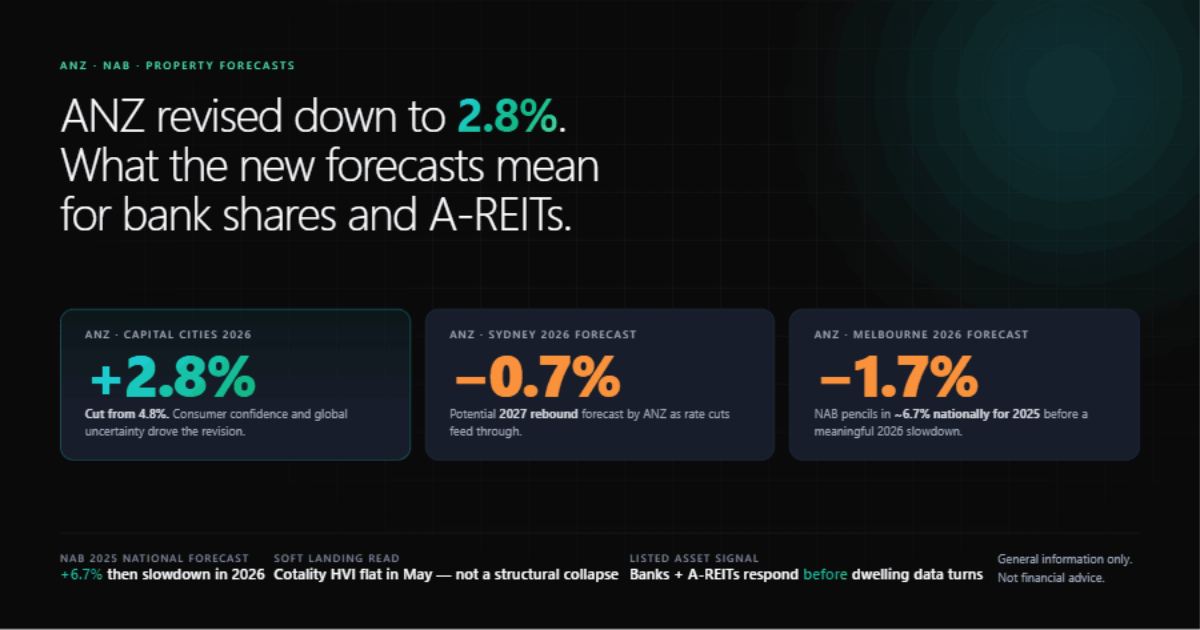
For most Australians, property forecasts trigger thoughts about their home or investment property. But if you hold ASX bank shares or listed property trusts, these numbers are directly relevant to your portfolio. The transmission from housing cycle to listed assets runs through several mechanisms worth understanding clearly.
- ANZ: capital-city home price growth of 2.8% in 2026, cut from an earlier 4.8%.
- ANZ: Sydney forecast to fall 0.7% and Melbourne 1.7% in 2026 before a potential 2027 rebound.
- NAB: national growth of around 6.7% for 2025, then a meaningful slowdown.
ANZ entered 2025 with relatively optimistic expectations but has since cut its 2026 capital-city growth forecast from 4.8% to 2.8%. The revision reflects weaker consumer confidence, sticky inflation, and global uncertainty weighing on buyer sentiment. Sydney is forecast at -0.7% and Melbourne at -1.7% for 2026, with ANZ expecting a recovery in 2027.
NAB’s 2025 forecast of around 6.7% national growth is more constructive in the near term, pointing to structural housing undersupply and strong population growth as supportive factors. The divergence between the two banks reflects different weightings on timing and the pace of RBA rate cuts feeding through to buyer demand — not a contradiction.
Both forecasts describe a cooling cycle, not a structural collapse. Cotality’s national Home Value Index was flat in May, which supports a soft-landing read. For ASX investors, the key question is not whether prices rise or fall by a specific percentage, but whether the cycle turns hard enough to stress bank credit quality or impair REIT asset values.
How does the property cycle connect to big four bank shares?
The property cycle connects to big four bank shares mainly through mortgage books and loan-to-value ratios. Australian banks hold enormous residential mortgage portfolios, so when property prices rise, loan-to-value ratios (LVRs) improve across the book — borrowers hold more equity, collateral values increase, and the probability of loss on any given loan falls. That directly reduces the bad-debt provisions banks must set aside, and lower provisioning feeds straight into higher reported earnings. Combined with stronger mortgage-lending volumes in a rising market, this supports earnings per share and gives bank boards more confidence to maintain or grow dividends — which is what income-focused investors care about. The relationship runs the other way too: falling prices lift LVRs, raise provisioning and pressure earnings. So a forecast of continued price growth is, in effect, a forecast of supportive conditions for bank profitability and the franked dividends that flow from it.

How do mortgage books and LVRs affect bank risk?
Australian banks hold enormous residential mortgage books. When property prices rise, loan-to-value ratios (LVRs) improve across the book — borrowers have more equity, collateral values increase, and the probability of loss on any given loan falls. This directly reduces the bad debt provisions banks need to hold.
Lower provisioning feeds into higher reported earnings. Combined with stronger mortgage lending volumes in a rising market, this supports earnings per share and gives bank boards more confidence to maintain or grow dividends. For income-focused investors holding ANZ.AX or NAB.AX, this is the mechanism worth understanding.
The reverse is also true. Price declines push LVRs higher, increase the risk of loss on defaulted loans, and force banks to increase impairment charges. Mortgage arrears typically rise with a lag after prices fall, particularly among investors who bought at peak values with higher leverage.
What happens to bank dividends and franking credits?
Big Four bank dividends are fully franked, meaning Australian shareholders receive franking credits that offset personal income tax. A deteriorating mortgage book does not immediately cut dividends, but it tightens the payout ratio and reduces management’s flexibility. Watch arrears data and provisioning trends, not just the headline property price index.
Are A-REITs the same as residential property?
No — A-REITs are not the same as residential property, and conflating the two is one of the most common mistakes in Australian investing. A-REITs are listed property trusts that earn income from commercial, industrial, retail or diversified portfolios, so their returns depend on rental income, lease structures, occupancy rates and capitalisation rates — not on Sydney or Melbourne median dwelling prices. What actually drives them is interest rates. When rates fall, investors accept lower yields on property assets, which compresses cap rates and pushes asset values higher, lifting the net asset value of A-REITs and tending to support the S&P/ASX 200 A-REIT Index. Rising residential prices can coincide with strong A-REIT performance, but usually because both respond to the same falling-rate environment, not because house prices directly move commercial property trusts. So an A-REIT allocation is really a bet on rates and commercial property fundamentals, even though it sits under the broad property label.
A-REITs (listed property trusts on the ASX) generate income from commercial, industrial, retail, or diversified property portfolios. Their returns depend on rental income, lease structures, occupancy rates, and capitalisation rates — not Sydney or Melbourne median dwelling prices. This is the most commonly misunderstood relationship in Australian investing.
When interest rates fall, investors accept lower yields on property assets, which compresses cap rates and pushes asset values higher. This lifts the net asset value (NAV) of A-REITs and tends to support the S&P/ASX 200 A-REIT Index. Rising residential prices coinciding with falling rates create a situation where both asset classes benefit — but from the same cause (lower rates), not from one driving the other.
If long-duration bond yields rise while residential prices hold up, A-REIT valuations face pressure even as your neighbour’s house gains value. An investor holding residential property and an industrial A-REIT in the same period could see very different outcomes, driven by duration risk in the listed trust rather than any change in housing fundamentals.
How does the RBA cash rate tie it all together?
The RBA cash rate is the single variable that ties residential property and listed property returns together. Rate cuts reduce borrowing costs for home buyers, which supports housing demand and prices; at the same time, lower rates reduce the discount rate applied to A-REIT cash flows, lifting their valuations. Because A-REITs are long-duration assets with relatively stable distributions, the market tends to value them like bonds — higher rates push prices down, lower rates push prices up. That is why the same easing cycle can lift both your home value and your A-REIT holdings at once. ANZ, NAB and CBA all expect the RBA cash rate to fall further into 2026, and if that plays out, both residential prices and A-REIT valuations would have a tailwind. The flip side is the risk: an unexpected pause or hike would simultaneously pressure housing, bank earnings and A-REIT prices, concentrating your exposure to a single macro variable.
A-REITs are long-duration assets with relatively stable distributions, so the market values them like bonds — higher rates push prices down, lower rates push prices up. ANZ, NAB, and CBA all expect the RBA cash rate to fall further into 2026. If that plays out, both residential property prices and A-REIT valuations should benefit from the same catalyst.
Watch RBA meeting outcomes and the accompanying statement closely. A more dovish tone tends to lift both property sentiment and listed property trust prices before any actual rate move occurs. The ASX reaction often precedes the real-economy housing data by several months.
How are these investments taxed in Australia?
Bank shares and A-REITs are taxed quite differently, and the distinction matters for after-tax income. Bank-share income arrives as fully franked dividends: the franking credit attached to each payment lets you offset tax at your marginal rate, and if your rate is below the 30% corporate tax rate, you receive a refund of the excess credit. A-REIT income is structured as trust distributions, which are not franked. Those distributions are made up of different components — tax-deferred amounts, capital gains and assessable income — each taxed differently in your hands, so the headline yield is not the whole story. When you sell A-REIT units or bank shares, normal CGT rules apply, and holding for more than 12 months makes individuals eligible for the 50% CGT discount. Because the two income streams behave so differently at tax time, your marginal rate and whether you can use franking refunds should shape how much of each you hold.
Note: the 50% CGT discount is legislated to be replaced by cost-base indexation and a 30% minimum tax on net capital gains from 1 July 2027; the treatment described here applies to disposals before that date.
Franked dividends vs trust distributions: what is the difference?
Bank share income arrives as fully franked dividends. The franking credit attached to each payment allows you to offset tax at your marginal rate, and if your rate is below the 30% corporate tax rate, you receive a refund of the excess credit.
A-REIT income is structured differently — it arrives as trust distributions, which are not franked. The components include tax-deferred amounts, capital gains, and assessable income, each taxed differently in your hands.
What CGT records do you need to keep?
If you sell A-REIT units or bank shares held for more than 12 months, you access the 50% CGT discount under ATO rules (for individuals and trusts). Accurate cost base tracking is essential, particularly for A-REITs where tax-deferred distributions reduce your cost base over time and increase the eventual capital gain on sale.
What should SMSF investors consider?
An SMSF gains residential and commercial property exposure through A-REITs without the borrowing complexity, liquidity risk, or stamp duty costs of direct property. Distributions received in the accumulation phase are taxed at 15%; in pension phase, they are tax-free. The liquidity and diversification advantages of the ASX route are significant for trustees comparing options.
How should you position your portfolio?
Positioning comes down to recognising hidden correlation. Both bank shares and A-REITs carry property-cycle exposure, even though the mechanisms differ — banks through mortgage books, A-REITs through rate-sensitive valuations. A portfolio heavy in both at once is more correlated to Australian interest rates and property sentiment than it might appear, and that concentration is worth quantifying before the cycle turns rather than after. At the same time, do not overreact to a single forecast. ANZ and NAB softer 2026 numbers reflect cyclical factors — rate settings, confidence and affordability — not a structural collapse in housing demand; Australia population growth and chronic undersupply of new dwellings remain intact. Selling property-related ASX positions on the back of one soft year risks triggering CGT and abandoning franked income for a move that may not be warranted. The measured response is to size your combined bank-plus-A-REIT exposure, decide whether it matches your risk tolerance, and rebalance deliberately.

Both bank shares and A-REITs carry property-cycle exposure, even though the mechanisms differ. A portfolio heavy in both simultaneously is more correlated to Australian interest rates and property sentiment than it might appear. This concentration is worth quantifying before the cycle turns.
ANZ and NAB’s softer 2026 forecasts reflect cyclical factors — rate settings, confidence, and affordability — not a structural collapse in housing demand. Australia’s population growth and chronic undersupply of new dwellings remain intact. Selling property-related ASX positions based on a single year of soft price growth, without distinguishing cyclical from structural drivers, is likely the wrong response.
A gradual accumulation strategy during a cooling cycle reduces timing risk. If rate cuts arrive in 2026 as forecast, bank earnings outlooks and A-REIT valuations are likely to respond positively before dwelling prices themselves recover. Investors who wait for the property headline to turn positive before acting may find listed markets have already moved.
Frequently asked questions
What are ANZ and NAB forecasting for Australian house prices?
ANZ forecasts capital-city growth of around 3% for 2025 and 2.8% for 2026, with Sydney at -0.7% and Melbourne at -1.7%. NAB sits closer to 6.7% for 2025 with a slower 2026. Both expect the RBA cash rate to fall further.
How do rising house prices affect ASX bank shares and dividends?
Rising prices improve LVRs, reduce bad debt provisioning, and support earnings stability — creating a more favourable environment for maintaining fully franked dividends.
Do A-REITs go up when Australian house prices rise?
Not automatically. A-REITs respond to cap rate movements, lease income, occupancy, and interest rate changes. If residential prices rise because of rate cuts, A-REITs likely benefit from the same catalyst. But if prices rise during a high-rate environment, A-REIT valuations face headwinds from higher discount rates.
Should I hold A-REITs or bank shares if property prices are expected to rise?
Both have property-cycle sensitivity, but the mechanisms differ. Bank shares benefit most from improved credit quality and mortgage lending growth. A-REITs benefit most from falling interest rates and cap rate compression. The right mix depends on your income needs, tax position, and existing concentration.