
For the oil price outlook in Australia, five ASX energy plays offer distinct exposure: currency-hedged crude oil futures ETF OOO, global energy equities ETF FUEL, broad resources ETFs OZR, MVR and QRE, and direct ASX energy shares, each differing in currency hedging, franking credits and CGT outcomes.
How do oil prices move the AUD and ASX energy sector?
Oil prices move the Australian dollar and ASX energy stocks mainly through the terms of trade. Australia exports large volumes of LNG, coal and iron ore alongside oil-linked energy products, so when global energy prices rise, export revenues improve relative to import costs, strengthening the terms of trade and generally supporting the AUD. The link is directional rather than mechanical: RBA policy, iron ore prices and global risk sentiment all push the currency at once. A supply-driven oil spike that triggers a global recession can actually weaken the AUD despite higher energy prices. For investors this matters at the portfolio level — if you hold unhedged oil exposure, the AUD/USD rate directly affects your AUD-denominated returns. A rising Australian dollar can offset the gains from a higher oil price, while a falling dollar amplifies them. Currency, not just the oil price, drives what you actually earn.
How does the terms of trade link oil to the AUD?
Australia exports large volumes of LNG, coal, and iron ore alongside oil-linked energy products. When global energy prices rise, Australia’s export revenues tend to improve relative to import costs. This strengthens the terms of trade and generally supports the AUD.
The relationship is directional, not mechanical. RBA policy, iron ore prices, and global risk sentiment all influence the AUD simultaneously. A supply-driven oil spike triggering a global recession may weaken the AUD despite higher energy prices.
For Australian investors holding unhedged oil exposure, the AUD/USD rate directly affects AUD-denominated returns. A rising AUD offsets gains from rising oil prices when positions are not currency-hedged.
Supply shocks vs demand-driven rallies: which matters more?
A supply-driven oil spike — caused by geopolitical disruption or OPEC+ production cuts — compresses consumer and industrial margins while lifting producer revenues. ASX energy producers benefit. Airlines, transport companies, and consumer discretionary stocks face headwinds.
A demand-driven rally reflects strong global growth, tending to lift the broader resources complex alongside energy. The macro environment is more supportive across the ASX in this scenario.
Your read on why oil is moving should inform which ASX vehicle you choose. The S&P/ASX 200 Energy sub-index has historically tracked Brent crude with a lag, reflecting the time it takes for higher prices to flow through to reported earnings.
What are the 5 ASX vehicles for oil and energy exposure?
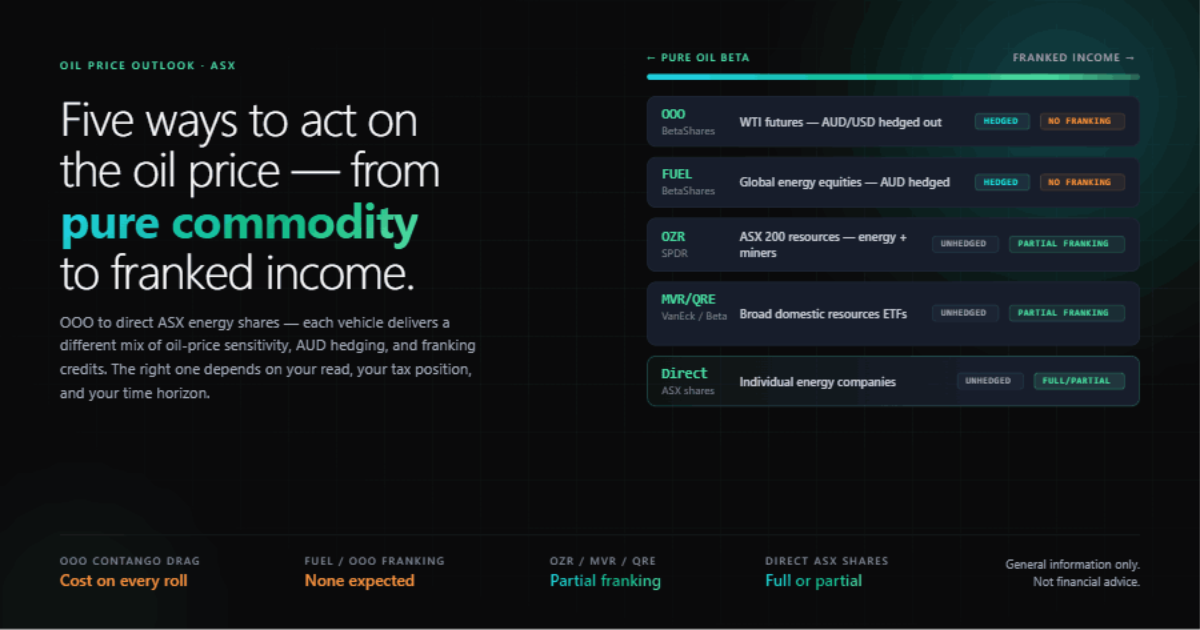
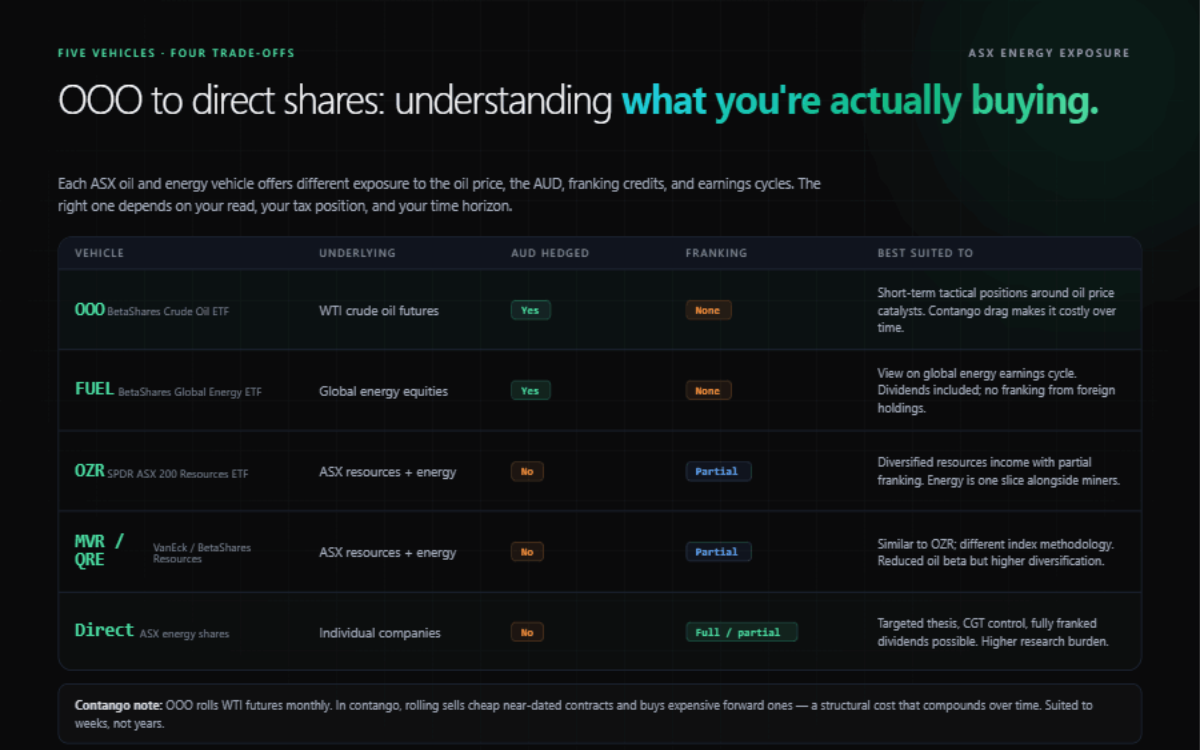
There are five main ways to get oil and energy exposure on the ASX, and they behave very differently. OOO (BetaShares Crude Oil Index ETF) is a currency-hedged synthetic ETF tracking WTI crude oil futures, so your return reflects the futures price rather than the combined effect of oil and the AUD/USD rate — but it carries contango drag and no franking credits, suiting shorter tactical positions. FUEL (BetaShares Global Energy Companies ETF) holds global energy equities. OZR, MVR and QRE are broad Australian resources ETFs that bundle energy with miners and may pass through some franking credits. Finally, direct ASX energy shares give you concentrated exposure and potentially franked dividends. The right choice depends on whether you want pure commodity-price sensitivity, equity income, or a diversified resources blend — each trades off franking, currency hedging and how closely it tracks the oil price itself.
OOO — BetaShares Crude Oil Index ETF-Currency Hedged
OOO is a synthetic ETF tracking WTI crude oil futures, with AUD/USD movements hedged out. Your return reflects oil futures price movement rather than the combined effect of oil prices and the AUD/USD rate.
The key trade-off is contango drag. OOO holds futures contracts and must roll them regularly. In a contangoed market, rolling from cheaper near-dated contracts into more expensive forward contracts creates a structural cost that compounds over time. OOO carries no franking credits and suits shorter tactical positions around oil price catalysts more than long-term buy-and-hold strategies.
FUEL — BetaShares Global Energy Companies ETF-Currency Hedged
FUEL holds equities in global energy producers and is also AUD-hedged. Unlike OOO, your return includes dividends and earnings growth from underlying companies, not only commodity price movement. Because FUEL holds foreign equities, its distributions are unlikely to carry Australian franking credits. Investing through FUEL means expressing a view on the earnings cycle of global energy producers, not a direct bet on daily oil price moves.
OZR, MVR and QRE — Broad Australian Resources ETFs
These three ETFs hold a blend of Australian energy and mining companies:
- OZR (SPDR S&P/ASX 200 Resources ETF) tracks the S&P/ASX 200 Resources Index, covering the GICS Energy sector and Metals and Mining sector.
- MVR (VanEck Australian Resources ETF) offers similar broad resources exposure with a different index methodology.
- QRE (BetaShares Australian Resources Sector ETF) provides comparable domestic resources coverage.
None are pure oil plays. Energy holdings sit alongside iron ore miners, copper producers, and other materials companies. This reduces your oil beta but increases diversification. Because underlying holdings include Australian-listed companies, these ETFs may pass through some franked distributions, improving tax efficiency for certain investors.
Direct ASX Energy Shares
Holding individual ASX-listed energy companies gives you the most targeted expression of a specific investment thesis. Key advantages include potential for fully or partially franked dividends, stock-specific upside from company execution, and more direct control over your CGT position. Trade-offs are higher single-stock risk, a greater research burden, and lower liquidity in smaller energy names.
How do you choose between the five vehicles?
- Pure oil price bet → OOO
- Global energy equities → FUEL
- Diversified resources income → OZR, MVR or QRE
- Franked income and stock selection → direct ASX energy shares
Combinations are common. A core resources ETF paired with a tactical position in OOO during oil price dislocations gives you both income and commodity price sensitivity.
Why does OOO diverge from the spot oil price?
OOO diverges from the spot oil price mainly because of contango and the cost of rolling futures. OOO does not hold physical oil; it holds WTI futures contracts and must roll them as they expire. Contango is when forward contracts are priced higher than the current spot price, so when OOO sells an expiring contract and buys the next month, it sells low and buys high. A simplified example: if an expiring contract is worth AUD 95 and the next-month contract costs AUD 100, the roll costs AUD 5 per unit of exposure. Repeated across roughly 12 monthly rolls a year, that drag compounds and opens a persistent gap between OOO and spot oil. The opposite state, backwardation, generates a positive roll yield. Oil markets swing between both, but contango has historically been more common — which is why OOO tends to lag spot oil over long holding periods.
Contango occurs when forward futures contracts are priced higher than the current spot price. When OOO rolls expiring contracts into the next month, it sells lower-priced contracts and buys higher-priced ones. That difference is a cost.
A simplified example: if an expiring contract is worth AUD 95 and the next-month contract costs AUD 100, rolling costs AUD 5 per unit of exposure. Repeated across 12 monthly rolls, this drag compounds and creates a persistent gap between OOO’s return and spot oil movement.
In backwardation — where forward contracts are cheaper than spot — rolling generates a positive yield. Oil markets oscillate between both states, but contango has been the more common condition in recent years. The longer you hold OOO, the more roll costs accumulate. It suits shorter-term tactical positioning around specific oil price catalysts rather than a multi-year strategic allocation.
How are ASX oil and energy investments taxed?
ASX-listed oil and energy investments are taxed under standard Australian rules, with a few ETF-specific wrinkles. Every time you buy or sell ETF units it is a CGT event, and each purchase creates a separate parcel with its own acquisition date and cost base. Individuals and trusts that hold units for more than 12 months qualify for the 50% CGT discount, while complying SMSFs receive a one-third discount; whichever method you use to identify parcels — FIFO or specific identification — apply it consistently. Most ASX-listed ETFs are structured as Attribution Managed Investment Trusts (AMITs), so each year the issuer sends an AMIT tax statement allocating taxable income, capital gains and other components to you as a unitholder. These attributions can adjust your cost base up or down, which affects the capital gain you calculate on sale. Keeping accurate parcel-level records is essential to report correctly and claim the discount you are entitled to.
Note: the 50% CGT discount is legislated to be replaced by cost-base indexation and a 30% minimum tax on net capital gains from 1 July 2027; the treatment described here applies to disposals before that date.
What are the CGT rules for ETF investors?
Buying and selling ETF units are CGT events under ATO rules. Each purchase creates a separate CGT parcel with its own acquisition date and cost base. The 50% CGT discount applies to individuals and trusts holding units for more than 12 months. Complying SMSFs receive a one-third CGT discount. Apply either FIFO or a specific identification method consistently across your parcels.
How do AMIT statements affect your cost base?
Most ASX-listed ETFs are structured as Attribution Managed Investment Trusts (AMITs). Each year, ETF issuers provide an AMIT tax statement allocating taxable income, capital gains, and other components to unitholders. Critically, AMIT statements often adjust your cost base — either upward or downward. Many DIY investors overlook this and calculate incorrect CGT amounts when they sell. Reconcile your AMIT statement against your personal records before lodging your return.
Which vehicles offer franking credits?
| Vehicle | Franking Credits |
|---|---|
| OOO | None expected |
| FUEL | None expected |
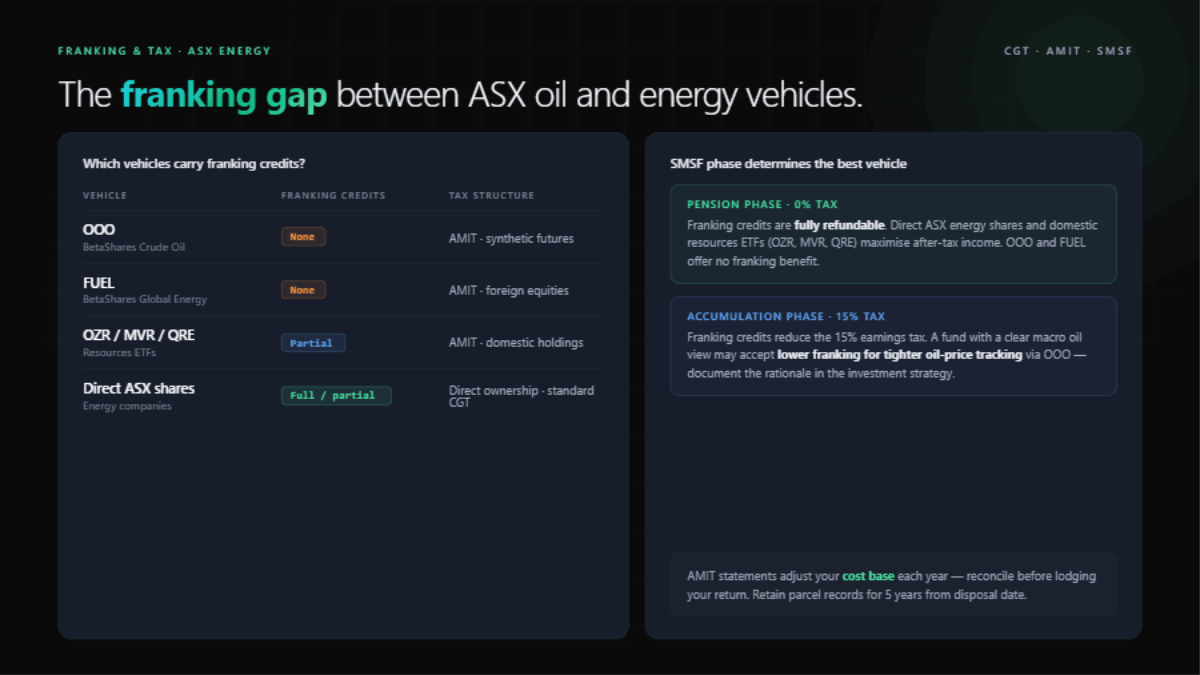
| OZR / MVR / QRE | Partial, from domestic holdings |
| Direct ASX energy shares | Potentially full or partial |
Dividend imputation allows Australian companies to pass tax already paid at the corporate level to shareholders as franking credits. Investors with lower marginal tax rates, and pension-phase SMSFs where the fund tax rate is zero, receive the greatest benefit.
What records must you keep for the ATO?
The ATO requires you to retain records for five years from the date of disposal. Frequent trading in OOO generates a high volume of CGT parcels quickly. Maintain a running parcel register updated after every transaction. Waiting until tax time to reconstruct your CGT position across dozens of trades creates errors.
What are the SMSF considerations for oil and energy?
For SMSFs, the tax phase of the fund shapes which vehicles make sense. A pension-phase SMSF pays zero tax on fund income, which makes franking credit refunds especially valuable — so direct ASX energy shares and domestic resources ETFs like OZR, MVR and QRE, which can carry franking, are generally more tax-efficient than OOO or FUEL for these funds. An accumulation-phase SMSF pays 15% tax on earnings; franking credits still reduce that liability, but the benefit is less dramatic, so a fund with a clear macro view on oil may accept lower franking in exchange for cleaner oil-price exposure through OOO or FUEL. Whatever the mix, every SMSF investment must satisfy the sole purpose test and be consistent with the fund documented investment strategy. Trustees should match the vehicle to the fund tax position and record the rationale, rather than chasing oil beta without regard to franking or strategy.
Pension Phase: Prioritising Franked Income
Pension-phase SMSFs pay zero tax on fund income, making franking credit refunds particularly valuable. Direct ASX energy shares and domestic resources ETFs like OZR, MVR, and QRE are generally more tax-efficient than OOO or FUEL for pension-phase funds. All SMSF investments must satisfy the sole purpose test and be consistent with the fund’s documented investment strategy.
Accumulation Phase: Accepting Lower Franking for Oil Beta
Accumulation-phase SMSFs pay 15% tax on earnings. Franking credits still reduce this liability, but the benefit is less dramatic than in pension phase. An accumulation-phase SMSF with a clear macro view on oil prices may reasonably accept lower or no franking in exchange for the tighter oil price tracking that OOO provides. The trustee must document the rationale.
Should you dollar-cost average into energy positions?
Dollar cost averaging (DCA) across multiple financial years reduces entry-point risk when building an oil or energy allocation. Each DCA purchase creates a new CGT parcel with its own acquisition date. Track each separately from the start to avoid CGT calculation errors later.
How much should you allocate to oil and energy?
How much to allocate comes down to balancing an inflation hedge against concentration risk. Rising oil prices feed through to petrol, electricity bills and broader CPI, so a modest energy allocation can partially offset those real-world costs — making it a risk-management tool rather than pure speculation. The catch is concentration. The ASX 200 already carries a heavy resources weighting, and your superannuation and direct holdings likely add more, so a dedicated oil or energy position on top can create more sector concentration than you intend. The practical starting point is to audit your existing exposure before adding anything. From there, blending OOO for direct commodity-price sensitivity with a broad resources ETF for equity income and franking gives you both dimensions without doubling down on a single bet. Size the position to complement what you already own, and keep it proportionate to your overall portfolio and risk tolerance.
Is oil a good inflation and living-cost hedge?
Rising oil prices feed through to petrol prices, electricity bills, and broader CPI. A modest energy allocation partially offsets these real-world costs, positioning energy exposure as a risk management tool rather than purely a speculative bet.
How do you manage concentration risk?
The ASX 200 already carries a heavy resources weighting. Adding a dedicated oil or energy position on top of existing super and direct holdings may create more sector concentration than you intend. Audit your existing holdings before adding an energy allocation. Blending OOO for commodity price sensitivity with a resources ETF for equity income gives you both dimensions within a single allocation.
What allocation suits your investor type?
These are illustrative frameworks only, not personal financial advice:
- Conservative income-focused investor: Direct ASX energy shares or a domestic resources ETF, modest allocation (5–10% of portfolio). Focus on franked income.
- Balanced growth investor: Core position in OZR, MVR or QRE, supplemented by a smaller tactical position in OOO around oil price dislocations.
- Active macro trader: OOO as a tactical overlay with strict position sizing, set against a well-diversified core portfolio.
Review your overall portfolio across super, property, and other ASX holdings before making any energy allocation decision.
Frequently asked questions
Does OOO track the oil price accurately for Australian investors?
OOO is AUD-hedged and tracks WTI crude oil futures, not spot price. In contangoed markets, roll costs mean OOO lags spot oil over time. It suits shorter tactical positions more than long-term buy-and-hold strategies.
Are there franking credits on ASX energy ETF distributions?
It depends on the ETF’s underlying holdings. OZR, MVR, and QRE may pass through some franking credits from Australian company holdings. FUEL and OOO are unlikely to carry franking credits. Direct ASX energy shares may offer fully or partially franked dividends.
How do I report oil ETF gains and losses to the ATO?
Each purchase and sale of ETF units is a CGT event. Record the acquisition date, cost base, and proceeds for each parcel. Reconcile annual AMIT statements against your records. The 50% CGT discount applies to individuals holding units longer than 12 months.