
Build an ASX ETF portfolio by first setting your investment timeframe: 10+ years allows 80% growth assets, 3-7 years suggests 60/40 balanced, under 3 years favors defensive. Choose one to three broad-market ETFs — Australian shares for franking credits, global shares for diversification, optionally bonds. Invest regularly via dollar-cost averaging, minimize MERs, and track records for tax efficiency.
What Is an ETF and How Does It Work on the ASX?
An exchange-traded fund (ETF) is a single investment that holds a basket of assets, typically shares, bonds, or a mix of both. Buy one unit and you get exposure to every asset inside it.
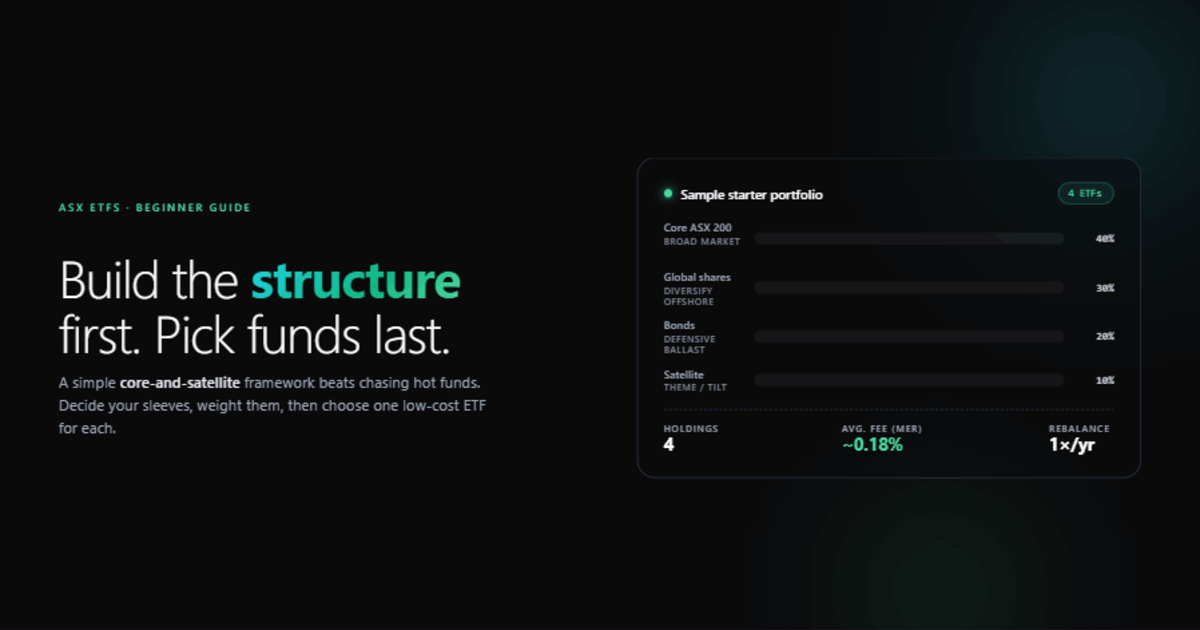
Unlike a managed fund, an ETF trades on the ASX like an ordinary share. You buy and sell through your broker during market hours, and your risk spreads across the entire index the ETF tracks.
ETFs offer three clear advantages for beginners: low ongoing costs, instant diversification, and simplicity. A broad-market ETF with a management expense ratio (MER) below 0.20% per annum costs far less than most actively managed funds.
How to build an ASX ETF portfolio step by step?
Your timeframe drives every other decision. The longer you invest, the more short-term volatility you absorb and the more growth assets you hold.
- 10-plus years: Growth-heavy allocation, around 80% shares and 20% defensive assets
- Three to seven years: Balanced split, roughly 60% shares and 40% defensive
- Under three years: Defensive or cash-focused, with minimal share market exposure
Lock this in before looking at any ETF.
Which ASX ETFs should I include in my portfolio?
Australian share ETFs
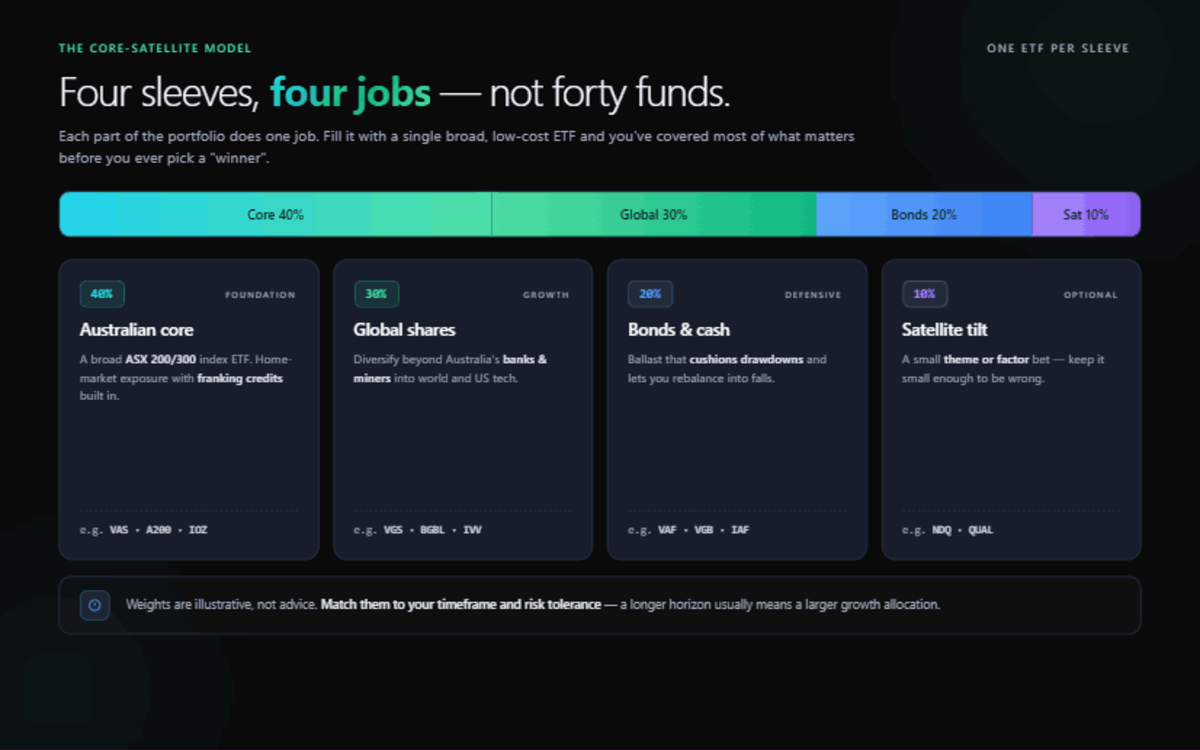
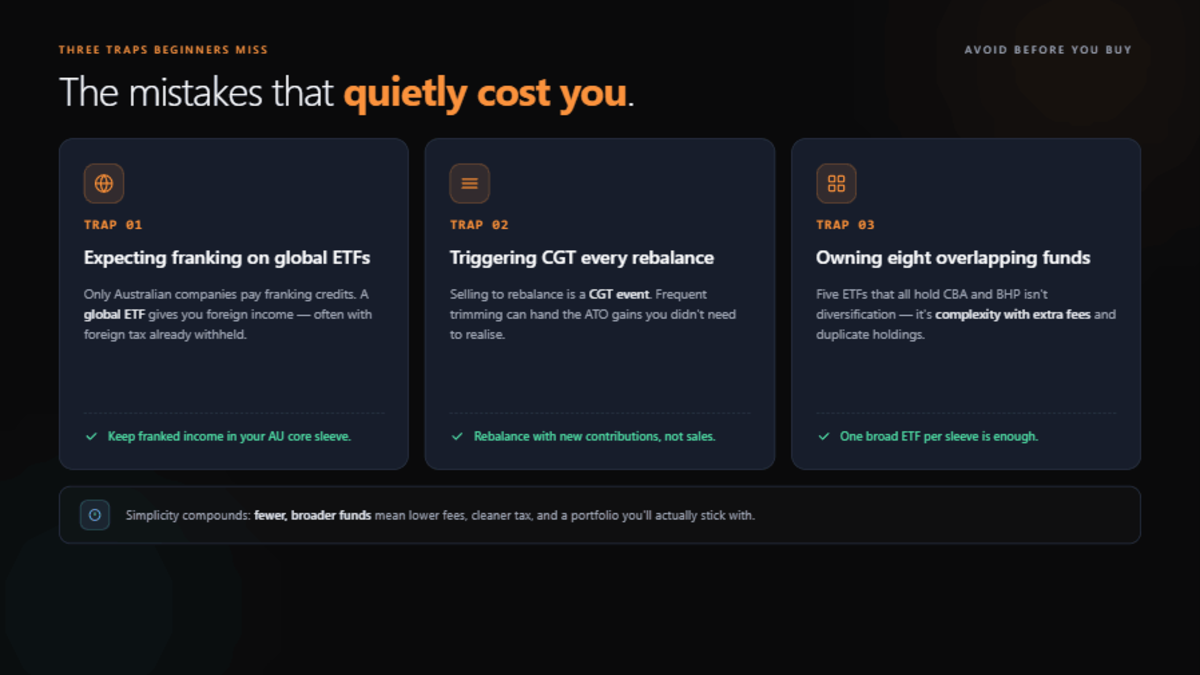
Australian share ETFs give you local market exposure and franking credits. Many ASX-listed companies pay fully franked dividends, and ETFs pass those credits through to you annually. For low-income earners, retirees, and SMSFs in pension phase, those credits offset tax or generate a refund.
Why the ASX alone is not enough
The ASX is heavily concentrated in financials and resources, leaving limited exposure to technology, healthcare, and consumer sectors. A global share ETF fills those gaps. Note that most global market-cap ETFs carry a 60 to 70 per cent weighting toward US equities by default.
| ETF Type | Key Benefit | Key Risk |
|---|---|---|
| Australian shares | Franking credits, local familiarity | Sector concentration |
| Global shares | Sector and geographic diversification | Currency risk, US concentration |
| Multi-asset | Single-fund simplicity | Less control over allocation |
What is the best ASX ETF portfolio for beginners?
Most beginners do not need more than three ETFs:
- One-ETF option: A diversified or multi-asset ETF handles everything internally. Ideal for maximum simplicity.
- Two-ETF option: Combine an Australian shares ETF with a global shares ETF. A common starting split is 40% Australian and 60% global.
- Three-ETF option: Add a bond or defensive ETF. For a balanced portfolio, consider 40% Australian shares, 40% global shares, and 20% bonds.
Beyond three ETFs, complexity grows without proportional benefit. More ETFs mean more overlap, higher brokerage costs, and more records to track at tax time.
Step 4 — What to Look for When Comparing ETFs
MERs matter more than most beginners realise
The MER is the annual fee deducted from your fund’s returns. It compounds silently over time.
Worked example: On a $100,000 portfolio, a 0.50% MER costs $500 per year. A 0.10% MER costs $100. That $400 annual difference, compounded over 20 to 30 years, is material. Prioritise low-cost, broad-market ETFs for your core holdings.
Index choice and liquidity
Broad-market index ETFs track an established index such as the ASX 200 or MSCI World. They are transparent, low-cost, and outperform most actively managed alternatives over long periods. Avoid thematic ETFs for your core portfolio.
Also check the fund’s net asset value (NAV), average daily trading volume, and bid-ask spread. Larger, more liquid ETFs have tighter spreads, reducing your transaction cost each time you trade.
Step 5 — Open a Brokerage Account and Buy Your First ETFs
Look for a broker with flat-fee brokerage on smaller trades, a clean interface, and strong support. Brokerage fees on small, frequent trades erode returns, so compare costs carefully.
CHESS sponsorship means your shares are registered in your own name under a Holder Identification Number (HIN), not held by the broker on your behalf. This gives you direct legal ownership and protects your holdings if the broker fails. For Australian DIY investors, CHESS-sponsored accounts are the preferred standard.
When placing your first trade, search for the ETF by its ASX ticker and use a limit order rather than a market order to control the price you pay.
How to allocate assets in an ASX ETF portfolio?
Dollar-cost averaging (DCA) means investing a fixed amount at regular intervals regardless of market conditions. When prices fall, your fixed amount buys more units. When prices rise, it buys fewer. Over time, your average cost per unit smooths out.
Worked example: You invest $500 per month into a two-ETF portfolio: $200 into Australian shares and $300 into global shares. Over 12 months, that’s $6,000 invested without timing the market once.
DCA removes the pressure of picking the right entry point, builds discipline, and reduces the anxiety that causes beginners to pause investing during downturns.
What are the tax implications of an ASX ETF portfolio?
Franking credits
When an Australian share ETF distributes income, it includes a breakdown of franked dividends and attached franking credits. You include both in your assessable income and claim the credit as a tax offset. If your tax rate is low enough, the ATO refunds the excess.
Capital gains tax
Every time you sell ETF units, you trigger a capital gains tax (CGT) event. Units held longer than 12 months by individuals and trusts qualify for the 50% CGT discount under ATO rules.
Distribution reinvestment plans
If you participate in a distribution reinvestment plan (DRP), the reinvested amount is still assessable income in the year received. It also increases your cost base in those units, affecting your CGT calculation when you eventually sell.
Record-keeping
The ATO requires you to calculate CGT based on the cost base of each parcel of units purchased. Keep all contract notes, CHESS statements, and annual AMMA statements. Missing early records cause serious problems when you sell years later.
Step 8 — Rebalance Without Triggering Unnecessary Tax
As markets move, your ETF allocation drifts from its target. Before selling anything, direct new contributions toward the underweight asset. This restores your allocation without triggering a CGT event and is the most tax-efficient rebalancing method available.
When selling is unavoidable, use a five-percentage-point drift rule: only sell when an allocation drifts more than five percentage points from its target. Review your portfolio once or twice a year, not monthly.
Common Beginner Mistakes to Avoid
- Over-diversifying: Eight ETFs with overlapping global exposure adds complexity, not real diversification
- Chasing thematic ETFs: Build broad-market foundations first; thematic funds are satellites, not a core
- Switching ETFs to save 0.10% in fees: Selling crystallises CGT — run the numbers first
- Neglecting records from day one: Start a folder for contract notes and AMMA statements from your first trade
- Reacting to short-term volatility: A long-term strategy requires staying invested through downturns
Frequently asked questions
How much do I need to start?
Most ASX brokers allow purchases from around $500. The minimum is usually driven by the ETF’s unit price, not an account minimum.
How do franking credits work with ETFs?
Australian share ETFs distribute franked dividends with attached credits. You include the grossed-up dividend in your income and claim the credit as a tax offset. Low-income earners and SMSFs in pension phase benefit most.
Do I pay CGT on ASX ETFs?
Yes. Selling units triggers a CGT event. Units held longer than 12 months by individuals and trusts qualify for the 50% CGT discount under ATO rules.
How many ETFs should a beginner hold?
One to three. A single diversified ETF, a two-ETF combination, or a three-ETF structure adding a defensive component covers the needs of most beginners.
Putting It All Together
Building a simple ASX ETF portfolio starts with your goal, not your fund selection. Define your timeframe, choose one to three broad-market ETFs that match your risk tolerance, invest regularly using DCA, and manage your records carefully from the start.
To track your portfolio allocation, monitor drift, and keep CGT records in one place, Australian DIY investors use Crowdfolio to manage their holdings without juggling spreadsheets at tax time.