
Portfolio management alternatives to portfolio123.com offer different strengths in tax-aware rebalancing, automation and multi-account tracking. This comparison helps you find the right tool for your ASX portfolio without paying for features you do not need.
Selecting a portfolio management software that provides both tax-aware rebalancing and comprehensive reporting across multiple accounts often leads to compromise on automation, data security, or integrations. Many platforms either lock advanced analytics and consolidated tracking behind high subscription fees or favor cloud-based tools without offering local data control or transparent pricing. This comparison outlines where each of five portfolio management alternatives excels and where they fall short so you can choose the best fit for your workflow, risk profile, and data privacy needs.
Table of Contents
- Crowdfolio
- Ziggma
- MarketRiders
- Smartleaf
- Investment Account Manager
- Portfolio Management Software Comparative Analysis
Crowdfolio

At a Glance
Parcel level CGT minimization is at the core of Crowdfolio, combined with scenario modeling for the 2027 tax changes. The platform ties trade guidance to tax outcomes so you can see tax cost before you execute a rebalance.
Crowdfolio targets Australian DIY investors and portfolio managers who want tax-aware decision tools without paying advisor fees.
Core Features
- CGT aware rebalancing that models tax cost for specific sell decisions and suggests lower tax alternatives.
- Parcel level tax calculations supporting FIFO, LIFO, and CGT optimized methods for trade selection.
- Automated CGT reporting and tax loss harvesting opportunity identification with execution planning.
- Drift detection, scenario analysis for upcoming reforms, backtesting, and benchmarking against indices.
- Model portfolio copying and customization so you can adopt a proven allocation and tune it to your values and risk appetite.
Key Differentiator
Crowdfolio’s standout capability is parcel level CGT minimization during rebalancing combined with scenario modelling for upcoming tax reforms. That lets you compare tax outcomes across individual parcels and timing alternatives rather than relying on aggregate estimates.
Pros
Helps you minimize CGT when rebalancing by identifying which parcels to sell and showing the tax tradeoff in cash terms and after tax returns. That makes trade decisions materially more defensible.
Supports multiple parcel identification methods and simulates the impact of the 2027 CGT reform so you can plan trade timing ahead of legislative change.
Provides actionable monitoring tools: drift alerts, parcel granularity, and automated tax reports that reduce manual spreadsheet work for parcel tracking and CGT bookkeeping.
Lets you copy proven model portfolios from trusted investors and then customize allocations, values, and tax handling to match your goals and risk appetite.
Offers tax loss harvesting signals plus execution planning so you can convert tax opportunities into concrete trade steps rather than loose recommendations.
Cons
- Requires active engagement and accurate parcel or broker data to deliver value; it is not a fully automated trading or custody service and outcomes depend on user inputs.
Who It’s For
Australian DIY investors who actively rebalance and want to optimize tax outcomes. Also useful for small portfolio managers or advisors handling multiple client books who need parcel level reporting and scenario tools for CGT planning.
Unique Value Proposition
Copy a trusted model portfolio, then run parcel level tax scenarios before you trade. That workflow converts a strategy you like into a tax aware execution plan in the same interface so newcomers avoid costly trial and error while experienced investors get precise tax math.
Crowdfolio pairs model copying with automated CGT reporting and tax loss harvesting workflows that remove much of the advisory premium for comparable tax analysis.
Real World Use Case
An Aussie ETF investor uses Crowdfolio to rebalance after a sector shift. They select parcels to sell based on estimated CGT costs, run a scenario for selling now versus after the 2027 rule change, and schedule trades that preserve a larger after tax return.
Pricing
Pricing details are not published and appear limited in transparency ahead of launch. The vendor indicates paid plans will follow but full tiers and costs are to be announced, so budgeting requires direct inquiry.
Website: https://crowdfolio.com.au
Ziggma
At a Glance
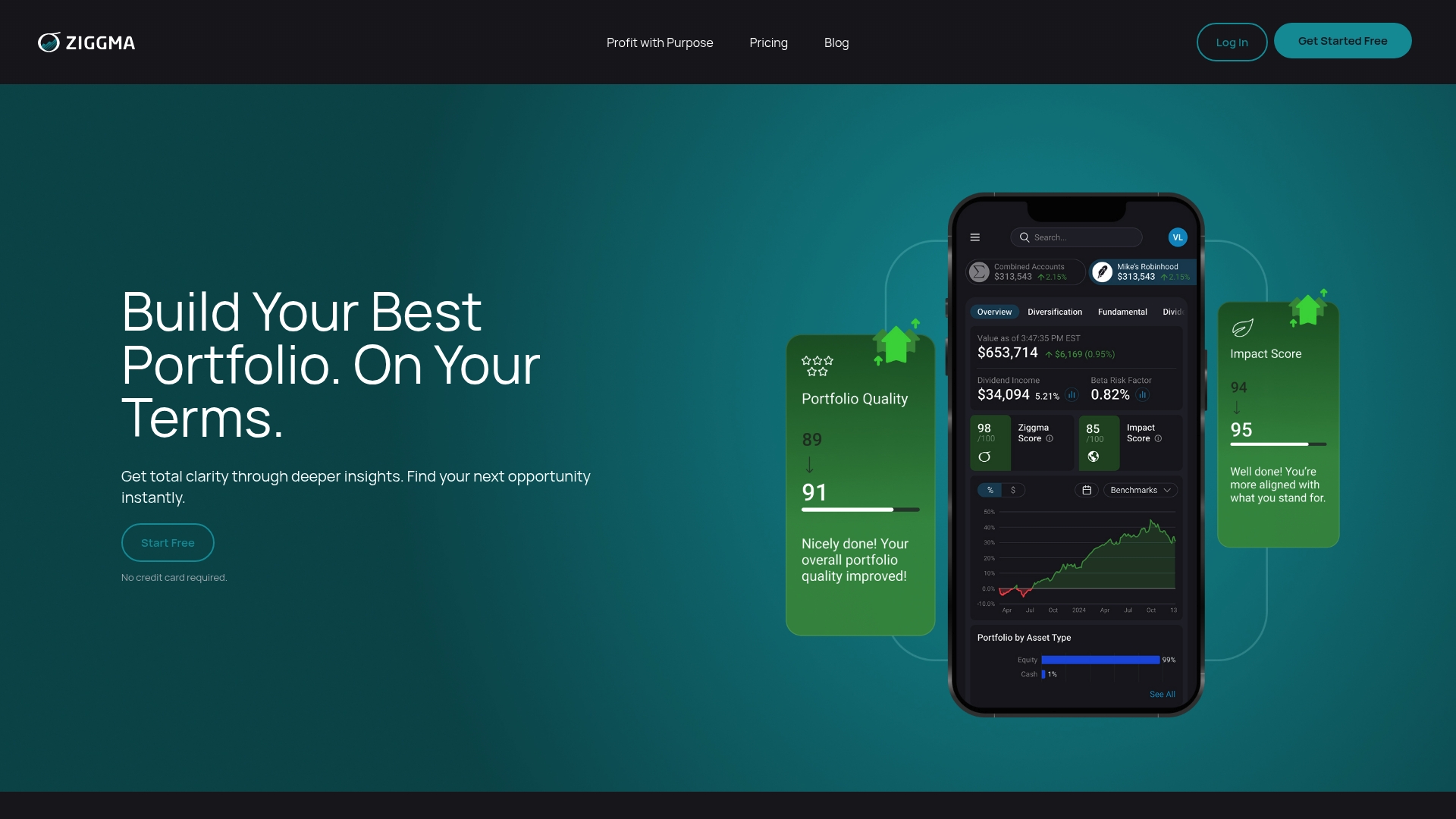
Ziggma reports broker integration with more than 10,000 platforms, a scale aimed at letting you consolidate accounts from multiple brokers into one dashboard.
The product pairs portfolio checkups, impact scoring, and screening tools so long-term investors can evaluate return, risk, income, and values without jumping between sites.
Core Features
- Portfolio Optimizer that proposes rebalances to balance risk and return while preserving your tax preferences.
- Impact Score and proprietary scoring that quantify sustainability and values alignment at the stock and ETF level.
- Real-time portfolio tracking, smart alerts, and screening tools including a Ziggma Stock Score for quick comparisons.
These pieces combine to support ongoing portfolio maintenance rather than intra-day trading or complex institutional workflows.
Key Differentiator
Ziggma combines independent portfolio insights with impact analytics and broad broker connectivity to prioritize values-driven, long-term investing.
That integration breadth above is useful when your goal is consolidated reporting and impact measurement across many accounts. Compared with Crowdfolio, which emphasizes copying model portfolios and automated tax reporting, Ziggma leans toward scoring and sustainability analysis rather than advisor-style model replication.
Pros
- Clean interface speeds analysis. The layout reduces clutter so you can run a portfolio checkup and reach a rebalance decision in a single session.
- Deep screening for values-minded investors. The impact scoring and screening filters help you find stocks or ETFs that meet specific environmental or social criteria.
- Free plan and trial options lower the barrier to test workflow and data before committing to a paid tier.
- Broker linking via OAuth and encrypted connections simplifies consolidated tracking across accounts, reducing manual CSV imports.
- The platform provides clear, exportable analytics useful for quarterly reviews or sharing with a financial planner.
Cons
- Free users see limited features in practice, and the most useful analytics sit behind paid tiers.
- Some lower-tier plans offer less depth than active investors or quants expect, which can be frustrating if you want advanced factor analysis.
- Ziggma depends on third-party data providers, so data accuracy or update timing can vary by instrument and source.
When It May Not Fit
If you need institutional-grade analytics, direct trading from the platform, or high-frequency signals, Ziggma will feel narrow; its strengths are scoring, tracking, and impact metrics rather than execution or multi-factor research at scale.
Also, if you require exhaustive proprietary datasets or deep factor models, an institutional terminal will be a better fit than Ziggma’s retail-focused toolset.
Who It’s For
Self-directed, long-term investors who want to align portfolio decisions with sustainability goals while keeping an eye on return and risk. Ideal for investors who consolidate multiple brokerage accounts and prefer score-based screening over building models from scratch.
Real World Use Case
You link IRA, taxable, and brokerage accounts, run a portfolio checkup, and the optimizer highlights five overweight positions and tax-aware sell candidates. You then screen for high Impact Score ETFs, adjust allocations, and export the plan for your quarterly review.
Pricing
Free plan covers basic tracking and screening. Paid tiers start at $6.99/mo for Starter and go to $13.99/mo for Expert, with free trials available for paid plans so you can test the full toolset.
Website: https://ziggma.com
MarketRiders
At a Glance
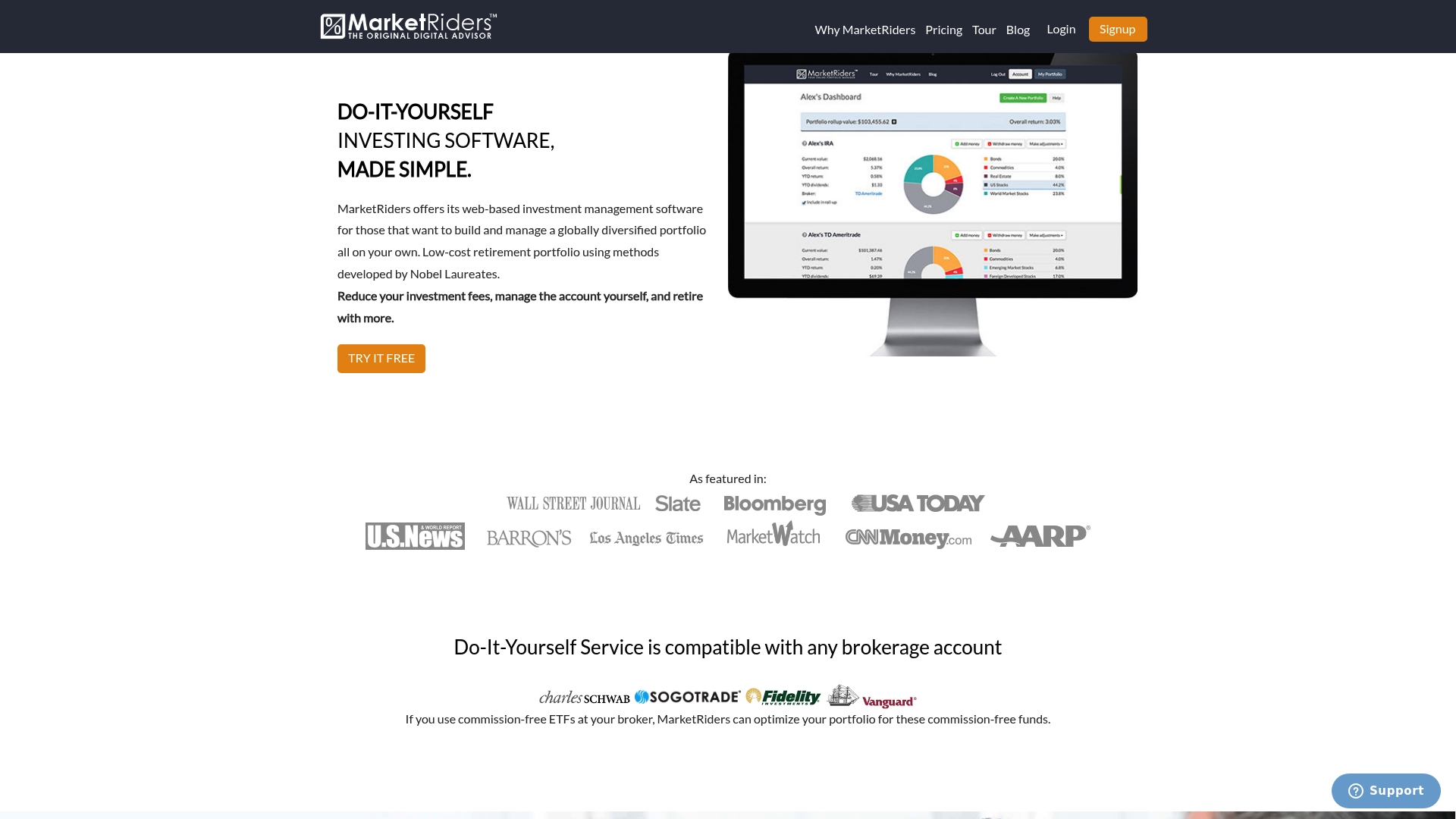
MarketRiders’ marketing materials claim its proprietary rebalancing algorithms can add 1–2% annually to returns on back-tested portfolios. The service is web based, has offered both DIY subscriptions and managed accounts since 2007, and centers portfolio construction on low cost ETFs.
Core Features
- Web-based portfolio building and management with a focus on ETFs for precise asset allocation.
- Automated asset allocation recommendations that map target exposures across global markets and asset classes.
- Automatic rebalancing alerts and execution guidance so you know when and how to restore target weights.
- Fee optimization advice that favors low cost ETFs and aims to reduce fund and trading costs where possible.
These features aim to let a self directed investor apply rules based methods without designing the mechanics from scratch.
Key Differentiator
That performance claim above is the primary distinction: MarketRiders emphasizes a rebalancing engine tuned to capture incremental return through disciplined execution. The company packages those rules into both a subscription DIY workflow and an optional managed offering, making the methodology available to investors with different levels of hands on time.
Pros
Empowers individuals with institutional style rebalancing technology so you can keep a target allocation without manual math.
Fee reduction focus helps shift allocations into lower cost ETFs, which lowers drag on portfolio growth compared with many retail mutual funds.
Compatible with major brokerages, which simplifies implementing recommendations inside your existing accounts at firms like Fidelity or Vanguard.
Offers both a low cost DIY plan and a managed service, giving a clear upgrade path if you want delegation later.
Back tested strategies provide a rules based framework you can evaluate rather than an opaque active manager approach.
Cons
Independent user reviews are scarce, so third party feedback on the live experience is limited.
Focus on ETFs excludes mutual funds and single stock strategies, which reduces flexibility for some tax or account specific needs.
No native real time trading or direct brokerage execution inside the platform, so you follow guidance rather than submit trades from the interface.
Subscription fees may feel steep for very small accounts where fee drag matters most.
When It May Not Fit
If you require direct, in platform trading or you rely on mutual funds and individual equities, MarketRiders will frustrate you. Also, investors with very small accounts who want zero platform fees will find the subscription model harder to justify.
Who It’s For
Self directed investors and advisors who prioritize low cost ETF portfolios and disciplined, rules based rebalancing. Good fit for retirees, DIY retirement savers, and advisors seeking portfolio technology rather than full custody solutions.
Real World Use Case
A DIY investor with $50,000 at Fidelity uses MarketRiders to map a global ETF allocation, receives rebalance alerts each quarter, and shifts trades into lower cost ETFs where suitable. The aim is to reduce expense drag and maintain target exposures over decades.
Pricing
Subscription based. DIY access starts at $14.95 per month or $149.95 per year. Managed accounts incur additional fees depending on service level and assets under management.
Website: https://marketriders.com
Smartleaf

At a Glance
Smartleaf’s marketing notes it operates an RIA subsidiary, Smartleaf Asset Management (SAM), to provide portfolio review and trading services alongside its platform. That arrangement is aimed at giving advisors a turnkey path from modeling to execution while preserving client policy control.
The vendor emphasizes automation and tax-aware workflows for firms managing many bespoke accounts.
Core Features
Smartleaf focuses on portfolio personalization and active tax management with advisor controls and automation.
- Personalized and tax-optimized portfolios with unlimited customization options.
- Automated rebalancing and trading tied to advisor policies.
- Direct indexing presented as accessible alongside ETF-style management.
- Tax loss harvesting, tax savings reporting, multi-year transition planning, ESG and religious value screening, cash automation, and scenario analysis.
Key Differentiator
What sets Smartleaf apart is the combination of automated scale and immediate feedback for advisors. The platform pairs automated rebalancing with real-time scenario analysis so an advisor can adjust personalization while seeing tax and trade impacts before committing.
That feedback loop reduces manual modeling for large book sizes.
Pros
- Enables broad personalization while keeping advisor intervention low. The model reduces repetitive manual trades across hundreds of accounts.
- Direct indexing is integrated in a way that the vendor positions as comparable to ETFs for operational ease. That approach helps firms move away from purely pooled solutions.
- Clear tax reporting shows clients deferred or realized tax outcomes, which helps advisors justify active tax strategies.
- The advisor portal provides scenario feedback in near real time, speeding client conversations and proposal iterations.
- Multi-year transition planning and ESG screening let firms align portfolios to client values without manual overlays.
Cons
- Public, independent user reviews and discussion are limited, which makes third-party assessment of day-to-day usability harder.
- The platform is clearly oriented toward wealth managers and RIAs, so individual retail investors will likely be excluded or routed through advisors.
- Documentation in the scraped content does not list specific third-party integrations, leaving some uncertainty about custodial or accounting connections.
When It May Not Fit
If you are an individual investor seeking a direct self-serve account, Smartleaf is not a match: the offering targets advisors and institutional workflows. Also, firms that require a long list of publicly documented third-party integrations may find the vendor’s public materials too sparse for procurement reviews.
Notable Integrations
The scraped content notes partner and integration support but does not detail named integrations. Prospective buyers should request an integrations matrix during vendor evaluation to verify custody, trading, and reporting connectors.
Who It’s For
Wealth management firms, RIAs, and financial advisors running large books of high net worth clients who need automated rebalancing, tax-aware transition planning, and scalable personalization.
Real World Use Case
An RIA uses Smartleaf to automate rebalancing and tax loss harvesting across hundreds of bespoke client accounts, adds ESG filters per client preference, and relies on SAM for centralized trading when execution scale requires it.
Pricing
Pricing is not explicitly disclosed in public materials. The vendor appears to use custom enterprise pricing for advisor and institutional clients; expect a negotiated contract rather than a per-user subscription.
Website: https://smartleaf.com
Investment Account Manager

At a Glance
Desktop-only operation with no cloud connectivity and roots going back to 1985. Investment Account Manager focuses on keeping all data local while offering deep reporting and multi-account tracking for investors who want strict control over where their data lives.
Core Features
- Desktop-based portfolio management: local installation for Windows with centralized data files and offline storage.
- Tracking for stocks, bonds, funds, options, cash, and custom asset classes across multiple accounts.
- Automatic imports: pulls transactions from some financial institutions and accepts CSV file imports for manual feeds.
- Over 50 reports: performance, tax preparation, allocation, and combined-portfolio reporting for year-end documentation.
- Portfolio rebalancing and allocation tools: Level 1 and Level 2 analysis for tactical and strategic adjustments.
Key Differentiator
IAM’s standout point is its offline design: the application deliberately avoids cloud sync to minimize external attack surface and keep sensitive records on your machine. That makes it a different proposition than cloud-first services that offer model copying or automated tax-loss harvesting. If you prize local custody of data, IAM’s approach is the defining trade-off.
Pros
- The product reflects decades of development and history, which shows up in its deep reporting and stable feature set.
- Secure desktop posture means no vendor-hosted databases and fewer surface points for outside access to your transaction history.
- Reporting depth is a strength: detailed performance, tax, and allocation reports cut down time spent assembling year-end files.
- Support and longevity are often cited by long-term users, which helps when migrating older tax or cost-basis records into the system.
- Manages multiple portfolios and asset classes in one file, useful if you consolidate individual accounts, IRAs, and taxable brokerage holdings.
Cons
- No third-party integrations: there is no cloud API or app ecosystem, so modern sync, mobile access, or platform linkages are absent.
- Limited pricing transparency: the vendor lists shop links and license options but does not publish clear tiered pricing on the main site.
- Older interface: the user interface feels dated compared with contemporary web apps and has a steeper learning curve for newcomers.
- Sparse public reviews: there is limited community feedback available on mainstream forums, making independent verification of user experience harder.
Who It’s For
Active individual investors and small-scale portfolio managers who prefer running software locally rather than trusting cloud providers. Ideal if you maintain multiple taxable and tax-advantaged accounts, want detailed, exportable reports, and are comfortable with desktop installations and manual import workflows.
Real World Use Case
A retail investor consolidates three brokerage accounts and an IRA into IAM4, imports year-to-date transactions via CSV, and runs combined performance and tax lot reports. The investor uses the allocation tools to script a rebalance and exports the tax reports to hand to their accountant for year-end filing.
Pricing
The vendor does not publish a standard subscription price. Licenses and support renewal options are available through the online shop, with a choice of product licenses and optional maintenance renewals. Expect desktop license models rather than per-user cloud subscriptions.
Website: https://investmentaccountmanager.com
Which portfolio tracker offers tax-aware rebalancing in Australia?
Exploring these portfolio management platforms reveals a spectrum of capabilities tailored for distinct use cases and user preferences. Here, we compare these solutions across key dimensions to illuminate where each excels and the scenarios they best support.
Tax Optimization and Rebalancing
Crowdfolio distinguishes itself with its parcel-level Capital Gains Tax (CGT) minimization support, encompassing FIFO, LIFO, and advanced CGT-optimized methods. This granularity empowers users to align their trade decisions with tax-efficient outcomes. On the other hand, MarketRiders also emphasizes rebalancing strategies to achieve consistent returns, though it does not address property-specific tax considerations as Crowdfolio does. Ziggma, while strong in impact scoring and consolidating accounts, lacks comparable tax optimization mechanisms.
Platform Connectivity and Data Security
While Crowdfolio and Ziggma embrace cloud-based frameworks for operational efficiency, Investment Account Manager (IAM) offers a compelling alternative for users who prioritize local data storage. IAM’s offline portfolio management ensures users maintain complete control over sensitive financial information, providing a reassurance absent in its web-based competitors. However, such a model may not suit those seeking automated updates or integration with brokerage accounts.
Competitive Recommendations
- Crowdfolio is best suited for users within Australia seeking tax-aware portfolio management tools.
- Users valuing ethical and environmental investment metrics might find Ziggma better aligns with their goals, given its impact scoring system.
- If autonomous local data processing is vital, IAM provides the necessary tools without requiring cloud connectivity.
Selecting Your Platform
Crowdfolio’s unique capability in tax minimization makes it an excellent choice for Australian investors managing complex CGT scenarios. However, users outside of Australia or those preferring broader integration options might consider exploring alternatives. Evaluate your primary needs to find the platform that best aligns with your investment strategy goals.
Portfolio Management Software Comparison
Understanding the impact of your investment decisions is crucial. Below is a comparison of leading portfolio management software, focused on key features and unique capabilities to help you choose the best fit for your needs.
| Platform | Core Feature | Best For | Pricing | Notable Limitation |
|---|---|---|---|---|
| Crowdfolio | CGT-aware rebalancing and tax scenario modeling | Australian DIY investors optimizing taxes | Not disclosed | Requires active engagement and accurate data inputs |
| Ziggma | Portfolio assessment with impact scoring | Values-driven investors | $6.99–13.99/mo | Limited features in free tier, advanced analytics extra cost |
| MarketRiders | ETF-focused portfolio construction and optimization | Low-cost ETF investors | $14.95/mo or $149.95/year | Limited to ETFs, no direct trading capabilities |
| Smartleaf | Personalized automated rebalancing and tax management | Institutional advisors managing large books | Not disclosed | Primarily targets RIAs, not individual retail users |
| Investment Account Manager | Desktop-based, offline portfolio management | Investors preferring local data storage | Not disclosed | No cloud connectivity or third-party integrations |
Can I track multiple accounts with portfolio123 alternatives?
Choosing the right portfolio management platform can feel overwhelming, especially when you want to balance tax efficiency with strategic investing. This article highlights pain points like complex tax calculations, costly advisory fees, and the challenge of adapting to upcoming tax reforms. Crowdfolio addresses these concerns by offering parcel level capital gains tax minimization and letting you copy proven model portfolios tailored to your personal values and risk appetite.

Take control of your investments now at Crowdfolio and gain access to automated CGT reporting, tax-loss harvesting, and scenario modeling that help you plan trades with confidence. Import your portfolio data to see detailed tax costs before rebalancing and create a customized execution plan that maximizes after-tax returns. Stop guessing and start making tax-aware investment decisions with Crowdfolio today.
Frequently Asked Questions
What features does Crowdfolio provide for tax-aware portfolio management?
Crowdfolio offers CGT aware rebalancing that models tax cost for specific sell decisions. This allows users to minimize capital gains tax during rebalancing by identifying which parcels to sell and showing the tax tradeoff. By using this feature, you can make more defensible trade decisions that aim to maximize your after-tax returns.
How does Crowdfolio compare to Ziggma in terms of screening for values-driven investing?
Ziggma provides an Impact Score and proprietary scoring that quantifies sustainability and values alignment at the stock and ETF level. Crowdfolio, on the other hand, focuses more on parcel level CGT minimization and tax outcomes rather than emphasizing sustainability. If your priority is tax management while rebalancing, Crowdfolio would be the more suitable choice for that specific scenario.
Can I utilize Crowdfolio for automated tax loss harvesting?
Crowdfolio includes automated CGT reporting and tax loss harvesting opportunity identification, which helps you capitalize on tax-saving strategies. This feature streamlines the process of recognizing tax loss opportunities before executing trades. Investors looking for a straightforward way to navigate tax implications would benefit from utilizing Crowdfolio’s capabilities.
Does Crowdfolio support multiple parcel identification methods?
Yes, Crowdfolio supports multiple parcel identification methods, including FIFO and LIFO. This flexibility in tax calculations allows users to choose the method that aligns with their trading strategy. By configuring these settings, you can optimize your trading decisions based on tax implications.
What pricing information is available for Crowdfolio?
Pricing details for Crowdfolio are not published and are described as limited in transparency ahead of the launch. You will need to inquire directly for specific paid plans and pricing tiers. It is advisable to reach out to Crowdfolio for an accurate understanding of pricing options before making a decision.