
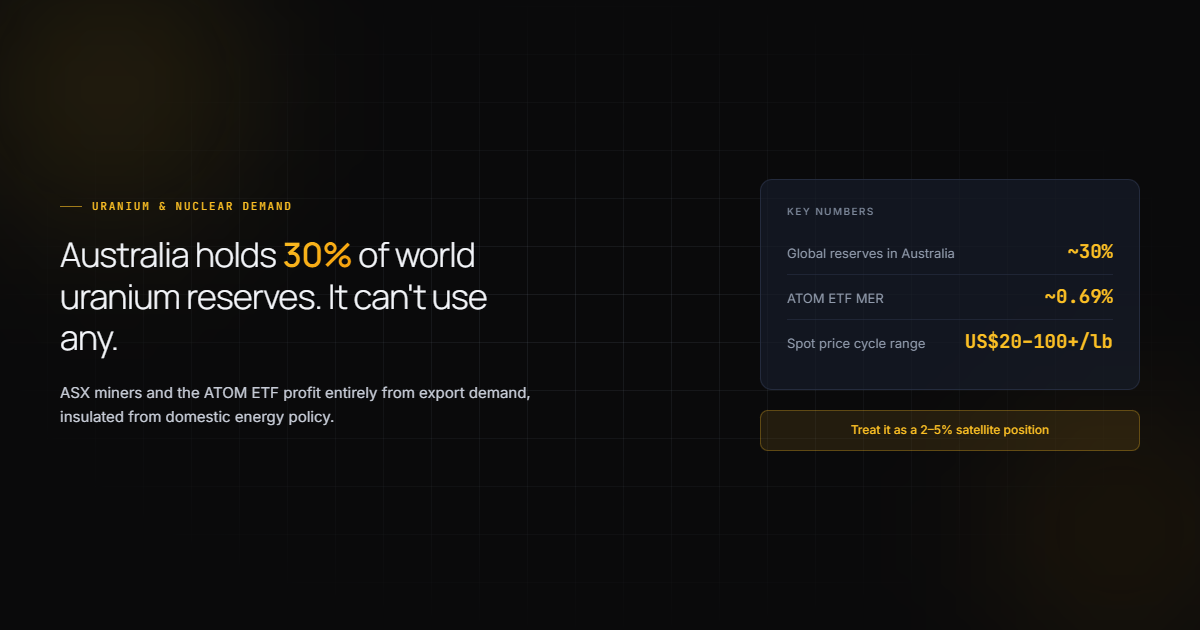
Australia exports roughly 30% of the world’s known uranium reserves to reactor operators overseas, yet a legislated ban prevents a single gram from powering an Australian home. For DIY investors, that paradox creates a specific opportunity: ASX-listed uranium companies generate revenue entirely from global nuclear demand, insulated from domestic energy policy while directly exposed to one of the strongest commodity themes of the decade.
Global electricity demand is accelerating faster than renewables alone can meet it. Nuclear energy is filling that baseload gap, and uranium is the fuel. This guide covers the investment thesis, available vehicles, real risks, and what the ATO expects at tax time.
Why Uranium Is Back on the Radar in 2025
The Nuclear Energy Renaissance
Governments across Europe, Asia, and North America are extending reactor lifespans and approving new builds to meet net-zero targets. These are long-duration commitments that lock in uranium demand for decades. Unlike wind or solar, nuclear provides firm 24-hour baseload power — a quality grid operators increasingly value as renewables penetration grows.
AI, Data Centres, and the Energy Crunch
AI infrastructure consumes enormous electricity. Microsoft, Google, and Amazon have all signed nuclear power purchase agreements in the past two years. When the world’s largest technology companies treat nuclear power as a strategic energy source, that strengthens the structural demand case for uranium.
Australia’s Unique Position
Australia holds roughly 30% of global uranium reserves and exports under a strict approvals framework to reactor operators in approved countries. Domestically, nuclear power remains banned. ASX uranium miners profit entirely from this export trade, making them sensitive to global reactor programmes and geopolitical shifts rather than anything on the Australian grid.
Understanding How Uranium Is Priced and Traded
Yellowcake (U3O8) is the semi-processed uranium oxide produced after mining and milling. It is the benchmark product ASX miners sell, quoted in USD per pound. The uranium spot price reflects immediate transactions, but most utilities buy under long-term contracts at negotiated prices, which is why spot and contract prices often diverge.
Supply comes primarily from Kazakhstan, Canada, and Australia. Uranium cycles are slow-moving — supply responses take years because bringing a new mine into production requires permitting, capital, and time. This structural lag creates the sharp price swings the commodity is known for.
The Sprott Physical Uranium Trust is a Toronto-listed fund that buys and holds physical U3O8. Not available directly on the ASX, but Australian investors can access it through international brokers. Its premium or discount to NAV is a useful sentiment indicator for anyone tracking the spot market.
How to Invest in Uranium From Australia: Three Main Routes
Route 1 — ASX-Listed Uranium Mining Shares
ASX uranium miners span three tiers:
- Producers (e.g., Boss Energy, Paladin Energy): operating mines generating or near-generating revenue
- Developers (e.g., Deep Yellow): advanced projects with defined resources, not yet in production
- Explorers: pre-resource, high-volatility names that can move 20% or more in a single session on news
| Type | Risk Level | Revenue Certainty | Typical Volatility |
|---|---|---|---|
| Producer | Medium | High | Moderate |
| Developer | Medium-High | Low | High |
| Explorer | Very High | None | Very High |
Key metrics to assess: resource size (million pounds U3O8), all-in sustaining cost (AISC), debt levels, and jurisdiction risk.
Route 2 — Uranium and Nuclear Thematic ETFs
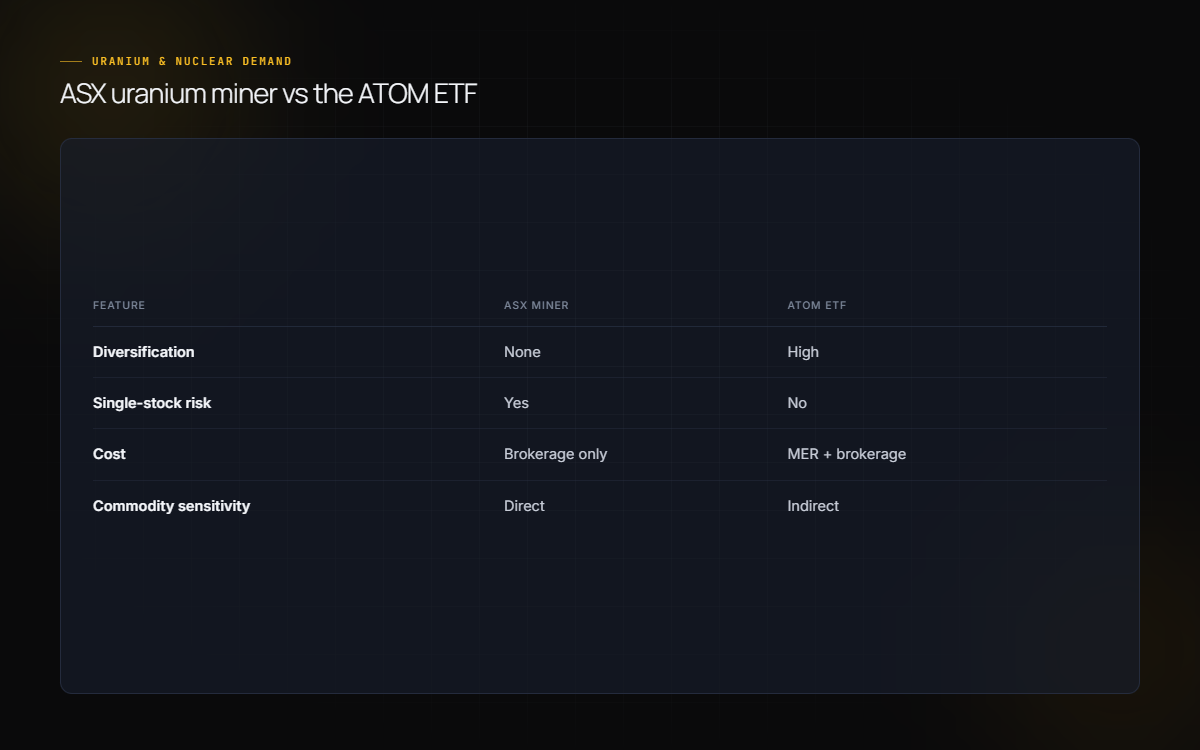
Global X Uranium ETF (ASX: ATOM) tracks an index of uranium mining and nuclear energy companies, giving instant diversification across dozens of global names. The management expense ratio is approximately 0.69%. You avoid single-stock risk but retain meaningful thematic concentration in uranium and nuclear energy.
| Feature | ASX Uranium Miner | Uranium ETF (ATOM) |
|---|---|---|
| Diversification | None | High |
| Single-stock risk | Yes | No |
| Cost | Brokerage only | MER + brokerage |
| Commodity sensitivity | Direct | Indirect |
| Liquidity | Variable | Generally good |
Route 3 — Broader and International Options
Some ASX resources funds hold uranium as incidental exposure alongside other commodities. For deeper exposure, international brokers provide access to US-listed uranium ETFs and the Sprott Physical Uranium Trust. Trade-offs include AUD/USD currency risk, foreign income reporting requirements, and higher brokerage costs.
Key Risks of Investing in Uranium
Commodity Price Volatility
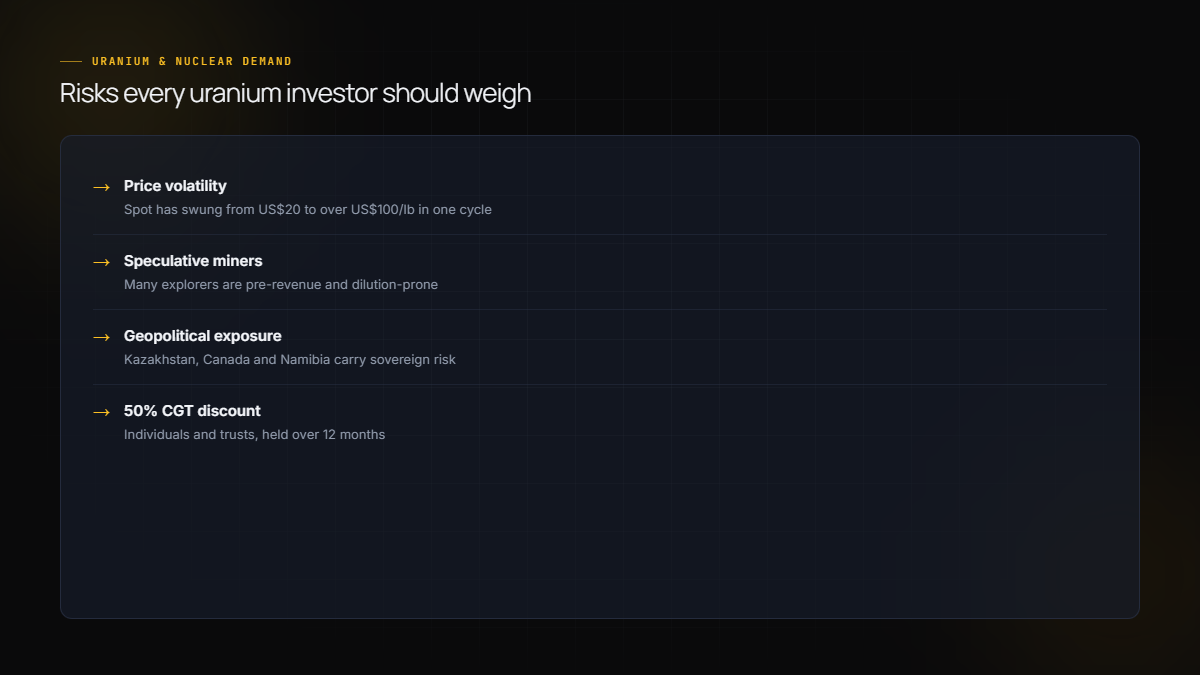
Uranium spot prices have moved from under USD 20 per pound to above USD 100 per pound within a single market cycle. ASX miner share prices amplify those moves in both directions.
Geopolitical and Regulatory Risk
Kazakhstan, Canada, and Namibia each carry distinct sovereign and operational risks. Any change to reactor licensing or fuel procurement rules in key markets affects ASX miner revenue outlooks.
Speculative Miner Risk
Many ASX uranium names are pre-revenue, cash-burning, and funded through equity raises. Dilution is a real and recurring risk. The gap between a compelling project on paper and a company that delivers on its production timeline is wide for most early-stage explorers.
Portfolio Concentration Risk
Uranium is a single-commodity, thematic exposure. Most financial educators suggest treating it as a satellite allocation — typically 2–5% of a diversified portfolio — rather than a core holding. Dollar cost averaging (DCA) is a practical way to build a position while reducing entry-point risk.
Australian Tax Considerations
CGT on ASX Uranium Shares and ETFs
ASX uranium shares and ETF units are both CGT assets under ATO rules. Gains realised on disposal attract the 50% CGT discount for individuals and trusts who held the asset for more than 12 months. The ATO tax year runs 1 July to 30 June. Retain records of purchase price, acquisition dates, and brokerage costs for five years.
ETF distributions from funds like ATOM can include foreign income, foreign capital gains, and trust components — each taxed differently at your marginal rate. The ATO’s AMIT regime governs how fund managers allocate tax components to unit holders at year-end. Check your annual tax statement carefully.
One timing note: the legislated CGT reform replaces the 50% discount with cost-base indexation for CGT events from 1 July 2027. It received royal assent on 26 June 2026, so it is law, but it has not yet commenced — the 50% discount still applies to disposals before that date. This affects how long-term uranium positions held beyond 2027 are taxed.
Franking Credits
Uranium miners and ETFs rarely generate franked dividends. Returns are almost entirely capital growth. Uranium exposure is most tax-efficient when held long enough to access the 12-month CGT discount.
SMSF Investors
SMSFs can hold ASX-listed uranium shares and ETF units as listed market-value investments. All holdings must satisfy the sole purpose test, align with the fund’s documented investment strategy, and comply with in-house asset and arm’s length rules. Speculative or concentrated thematic positions require clear written documentation explaining how they serve the fund’s retirement objective.
SMRs and the Longer-Term Nuclear Horizon
Small Modular Reactors (SMRs) are factory-built, smaller-scale reactors designed for faster deployment. Key global developers include NuScale, Rolls-Royce, and X-energy. Commercial deployment at scale is a 2030s story at the earliest — not a near-term catalyst for uranium prices.
It helps to separate two distinct theses: the near-term uranium spot-price thesis (driven by the existing reactor fleet and utility stockpiling) and the structural long-term thesis (driven by SMR deployment and new reactor build-out). Overcommitting to speculative names based on SMR timelines before commercial proof-of-concept carries significant execution risk.
Frequently asked questions
What is the difference between an ASX uranium miner and a uranium ETF like ATOM?
Direct miner shares give you leveraged exposure to a specific project and management team but carry single-stock, pre-revenue, and liquidity risks. ATOM spreads risk across dozens of global uranium and nuclear companies, reducing single-name volatility at the cost of a management fee.
How does the uranium spot price affect ASX uranium stocks?
The spot price directly influences revenue outlook and project economics. When it rises, even pre-revenue developers re-rate because the future value of their resources increases. When it falls, leveraged balance sheets face disproportionate pressure.
Can an SMSF invest in ASX uranium shares or ETFs?
Yes, provided the investment satisfies the sole purpose test, aligns with the fund’s written investment strategy, and complies with ATO in-house asset and arm’s length requirements.