
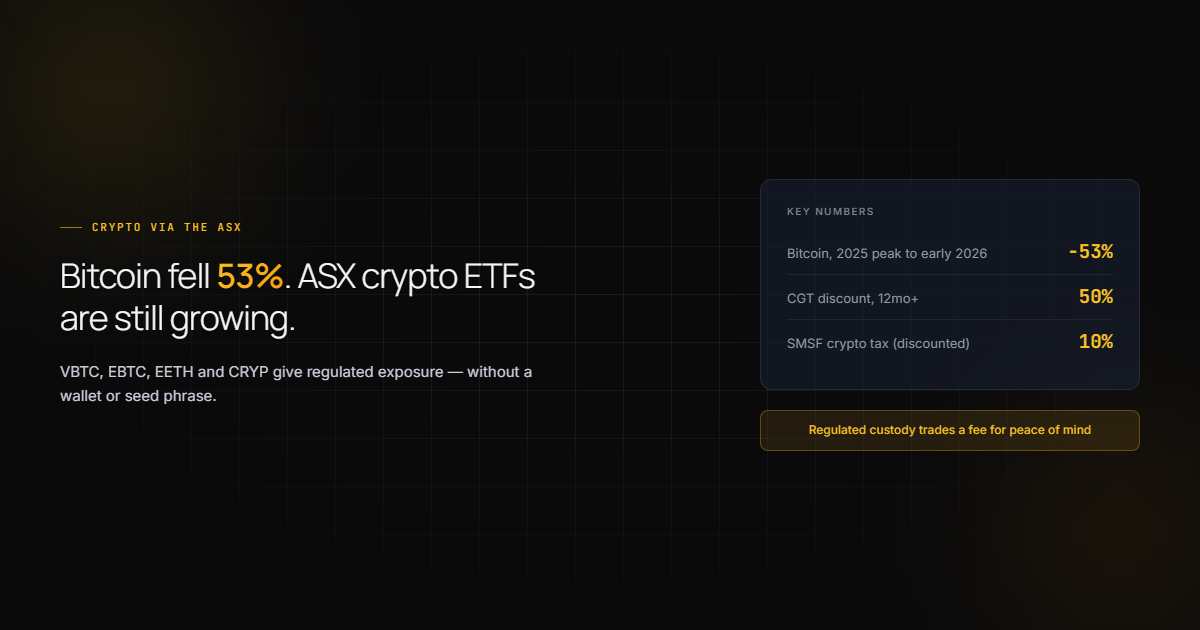
Bitcoin dropped roughly 53% from its 2025 peak in early 2026. Yet Australian investor interest in crypto exposure did not fall with it. What changed was how investors wanted that exposure — more choosing regulated, ASX-listed vehicles over self-managed wallets on offshore exchanges.
Australia has one of the highest crypto adoption rates among developed nations. With over 600,000 SMSFs in existence and a growing range of ASX-listed crypto products, many investors are asking: how do I get crypto exposure without the custody risk, tax complexity, and audit headaches of holding tokens directly?
This guide covers every ASX pathway, the ATO rules that apply, and what SMSF trustees must do to stay compliant.
What “Crypto Exposure” Means for ASX Investors
You do not need to own bitcoin to benefit from its price movements. ASX-listed products let you gain exposure through your standard brokerage account, the same way you buy shares in BHP.AX or CBA.AX. No wallet. No seed phrase. No offshore exchange account.
Your three main options are:
- ASX-listed crypto ETFs — funds that hold bitcoin or ether directly, or track crypto indices
- Bitcoin proxy shares — ASX-listed companies with material crypto holdings or revenue
- Direct exchange investing — buying tokens on platforms like CoinSpot or Swyftx
Each pathway triggers different ATO obligations. An ASX ETF unit is taxed like a managed fund unit. A proxy share is taxed like ordinary equity. Direct crypto generates CGT events every time you sell, swap, or gift a token. Choosing the wrong structure for your situation creates unnecessary tax complexity.
ASX-Listed Crypto ETFs in 2026
Spot and Thematic ETFs
Spot crypto ETFs hold the underlying asset directly. Issuers including VanEck, Global X, and Betashares offer ASX-listed products backed by physical bitcoin or ether held with institutional custodians. You buy and sell units through your broker like any other ETF.
Thematic ETFs such as Betashares Crypto Innovators ETF (CRYP.AX) hold equities across blockchain infrastructure, crypto exchanges, and mining companies rather than tokens. These provide broader sector exposure with a different risk and tax profile.
ASX-listed crypto ETFs are registered managed investment schemes regulated by ASIC. They must publish a Product Disclosure Statement (PDS), maintain independent custodians, and meet ongoing disclosure obligations.
Key ASX Crypto ETFs
| ETF | Issuer | Underlying Asset | Approx. Fee | Structure |
|---|---|---|---|---|
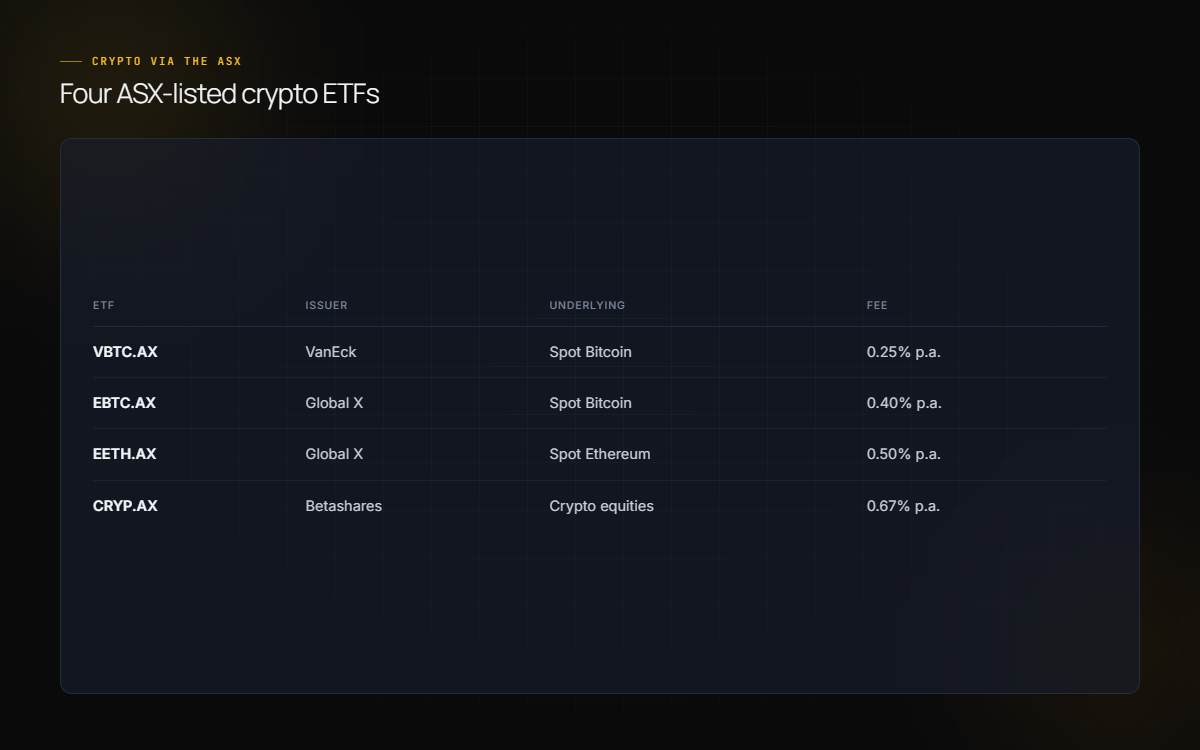
VBTC.AX | VanEck | Spot Bitcoin | 0.25% p.a. | Physical-backed |
EBTC.AX | Global X | Spot Bitcoin | 0.40% p.a. | Physical-backed |
EETH.AX | Global X | Spot Ethereum | 0.50% p.a. | Physical-backed |
CRYP.AX | Betashares | Crypto equities | 0.67% p.a. | Thematic equity |
Fees are indicative. Confirm current rates in each fund’s PDS before investing.
Bitcoin Proxy Stocks
A bitcoin proxy is an ASX-listed company whose share price correlates meaningfully with bitcoin — typically because it holds bitcoin on its balance sheet, mines it, or generates significant crypto-related revenue. Examples include Iris Energy (IEL.AX) and DigitalX (DCC.AX).
Proxy shares do not track bitcoin one-to-one. They carry operational risk, management decisions, and debt levels independent of crypto prices. In a bull run, a miner’s shares might outperform. In a downturn, they often fall harder than bitcoin itself.
Direct Exchange vs ASX ETF: Practical Comparison
Custody risk: On a direct exchange, you rely on the platform’s security and solvency. Several offshore exchanges collapsed between 2022 and 2025. An ASX ETF held via a CHESS-sponsored brokerage account sits within Australia’s financial services regulatory framework.
Cost: ASX crypto ETFs charge annual management fees of 0.25%–0.67%. Direct exchanges charge trading spreads of 0.5%–2% per transaction plus withdrawal fees. For buy-and-hold investors, ETF fees are often lower over time.
Tax reporting: Your broker produces an annual tax statement showing each ETF transaction in AUD. A crypto exchange produces a transaction history you must convert to AUD and calculate CGT for every event manually — or pay a crypto tax tool to do it.
Accessibility: You buy an ASX crypto ETF the same way you buy any share. No new account, no identity verification on a new platform, no withdrawal delays.
How to Buy a Crypto ETF on the ASX
- Open or use an existing ASIC-regulated brokerage account. CommSec, SelfWealth, and Stake all provide ASX access.
- Search for the ETF by ASX ticker. Confirm the full fund name and issuer match what you researched.
- Review the Product Disclosure Statement. Check the management fee, custody arrangements, and any leverage exposure before placing an order.
- Place your order and record the acquisition details. Note the date, number of units, price per unit, and brokerage cost. This forms the cost base of your CGT asset.
Dollar-cost averaging example: You invest AUD $500 per month into VBTC.AX for six months. Each monthly purchase creates a separate CGT parcel with its own acquisition date and cost base. After 12 months from each purchase date, that parcel becomes eligible for the 50% CGT discount on any net capital gain.
ATO and CGT Rules for Crypto in Australia
Classification and CGT Events
The ATO treats both cryptocurrency tokens and ASX ETF units as CGT assets. Neither is classified as currency. A CGT event occurs when you sell, swap, gift, or use crypto to purchase goods or services. For ASX ETF units, the CGT event occurs on sale. Staking rewards are assessable income at market value on receipt and become a new CGT asset.
The 50% CGT Discount
Individuals and trusts who hold a CGT asset for more than 12 months before disposal are eligible for a 50% CGT discount on any net capital gain. This applies equally to bitcoin held directly and to ASX crypto ETF units held in your personal name. Every ETF purchase is a separate CGT parcel — track each one separately to determine whether the 12-month period has been met at disposal.
Reporting and Record-Keeping
Both direct crypto gains and ETF disposal gains are reported at Item 18 — Capital gains in your 2026 tax return. All amounts must be in AUD. The ATO requires records for five years from when you lodge the relevant return.
2027 CGT discount change (now law): From 1 July 2027 the 50% CGT discount is replaced by cost base indexation for Australian resident individuals and trusts, and a separate 30% minimum tax rate applies to net capital gains for certain resident individuals. This was enacted by the Treasury Laws Amendment (Tax Reform No. 1) Act 2026, which received royal assent on 26 June 2026. A deemed disposal on 1 July 2027 preserves the 50% discount on gains accrued before that date. See our guide to the 2027 CGT changes, and consult a registered tax agent for your own position.
SMSF Crypto Compliance
Sole Purpose Test and Trust Deed Requirements
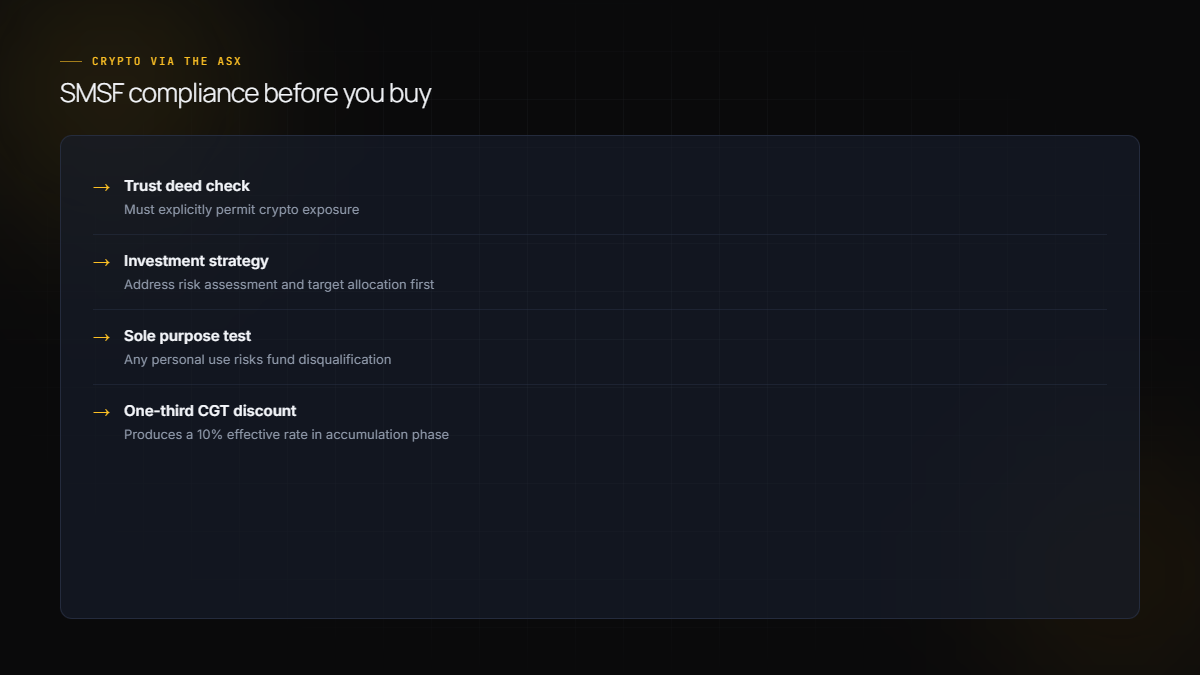
An SMSF may hold crypto, but only to provide retirement benefits to members. Any personal use breaches the sole purpose test and risks fund disqualification. Before any purchase, the trust deed must permit the investment and the investment strategy must explicitly address the asset class — including a risk assessment and target allocation — before the investment is made.
Tax Rate and CGT Discount
A complying SMSF in accumulation phase pays 15% tax on ordinary income and receives a one-third CGT discount on assets held longer than 12 months, producing an effective CGT rate of 10%.
Why ASX ETFs Simplify SMSF Compliance
An ASX ETF held via a CHESS-sponsored brokerage account generates broker statements, annual distribution tax statements, and CGT reports that auditors receive as standardised, verifiable documentation.
Holding tokens directly inside an SMSF requires sole custody of private keys, independent market valuations at 30 June each year, and wallet address evidence for auditors. The compliance burden is significantly greater.
Risk Considerations and Portfolio Allocation
ASX crypto ETFs are more liquid than direct exchange holdings during market stress, but the underlying asset remains highly volatile. Regulatory risk applies to all vehicles.
Most financial planners treat crypto exposure as a satellite holding of 1%–5% of total portfolio value. Sizing positions based on maximum tolerable loss — not maximum desired gain — is a more disciplined approach.
US-listed spot Bitcoin ETFs are accessible via international brokerages but introduce USD currency risk, US withholding tax considerations, and additional ATO reporting complexity. ASX-listed equivalents remove the currency conversion obligation and sit within Australia’s regulatory framework.
Frequently asked questions
What crypto ETFs are available on the ASX in 2026?
VBTC.AX (0.25% p.a.), EBTC.AX (0.40% p.a.), EETH.AX (0.50% p.a.), and CRYP.AX (0.67% p.a.). Always confirm current fees in the relevant PDS.
Do I pay CGT on an ASX Bitcoin ETF the same way as on direct crypto?
Yes. Both are CGT assets. The 50% discount applies to both if held longer than 12 months. The practical difference is that ETF transactions are already recorded in AUD via broker statements, while direct crypto requires manual AUD conversion of every transaction.
Can an SMSF hold a crypto ETF and remain ATO-compliant?
Yes, provided the trust deed permits it, the investment strategy explicitly addresses crypto exposure, and appropriate records are maintained. The one-third CGT discount produces an effective 10% rate in accumulation phase.
Is it better to buy bitcoin directly or through an ASX ETF?
It depends on your priorities. Direct exchange investing gives full asset ownership but adds custody risk and complex CGT record-keeping. An ASX ETF sits within a regulated framework, produces clean tax documentation, and fits inside an SMSF more easily. The trade-off is an annual management fee and slightly indirect exposure.