
Australian investors watching Nvidia, Apple, and Microsoft dominate global indices face a familiar problem: the ASX gives you limited direct exposure to US mega-cap technology. Leaving it out creates home bias risk, but buying it the wrong way creates tax problems you did not see coming.
ASX-listed ETFs solve the access problem cleanly. The tax and structural decisions underneath that simple trade are where most DIY investors get caught out. These five facts will change how you approach every US tech allocation.
Fact 1: ASX-Listed ETFs Are the Simplest Access Route — But Structure Matters
The Magnificent Seven — Apple, Microsoft, Nvidia, Alphabet, Amazon, Meta, and Tesla — represent a significant share of major global indices. An ASX-heavy portfolio with no US tech exposure is structurally underweight this group by design, not by choice.
ASX-domiciled ETFs remove the practical barriers. You need no US brokerage account, no W-8BEN form at the investor level, and no exposure to the US federal estate tax threshold that applies to non-resident aliens holding US assets directly.
| ETF Type | Example | Concentration | What You Get |
|---|---|---|---|
| Nasdaq-100 | NDQ.AX | High — top 10 holdings ~50%+ | Broad US tech plus other sectors |
| Mega-cap/FANG-style | FANG.AX | Very high — 10 stocks | Pure Magnificent Seven exposure |
| Thematic tech | RBTZ.AX, HACK.AX | Moderate | Robotics, cybersecurity, specific themes |
Key variables to compare: management expense ratio (MER), index methodology, fund size, and whether the ETF is hedged or unhedged.
Buying US shares directly gives you CHESS-free foreign custody, W-8BEN withholding obligations, and US estate tax risk on assets above USD $60,000. The ASX ETF wrapper eliminates all three. For most Australian retail investors, the ETF structure wins on simplicity and estate planning grounds alone.
Fact 2: Forget Franking Credits — Here’s What You Get Instead
Franking credits exist because Australian companies pay Australian corporate tax before distributing profits. US companies pay no Australian corporate tax, so distributions from international ETFs are entirely unfranked.
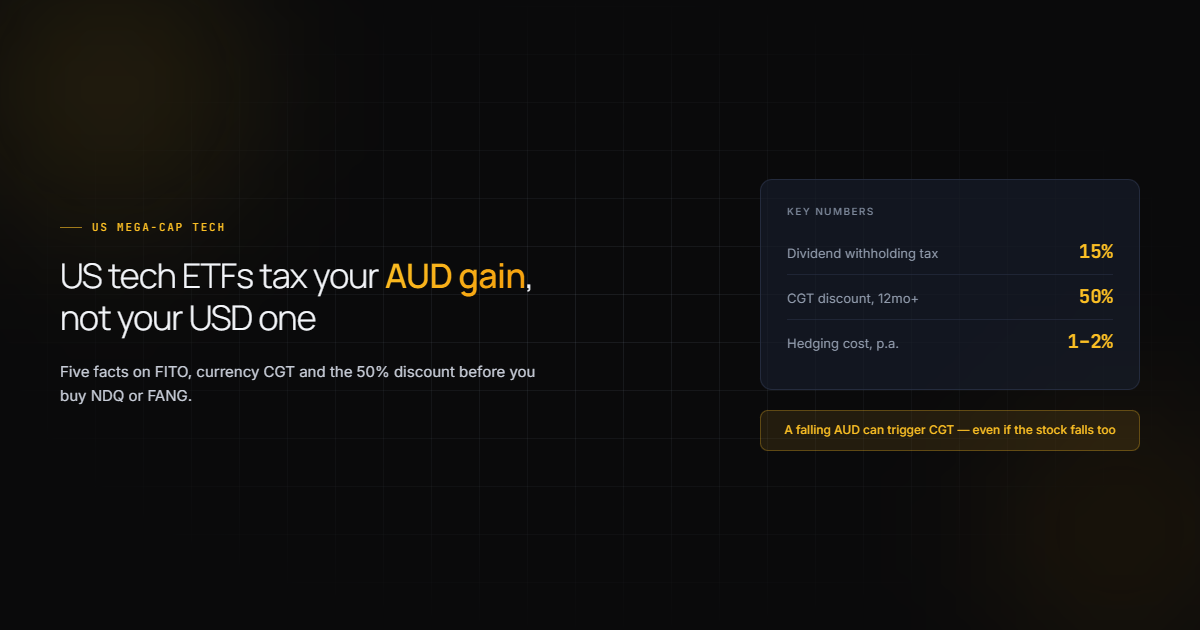
The US-Australia tax treaty caps dividend withholding tax at 15%, down from the default 30%. The fund manager bears this cost at the fund level before distributions reach you. The withheld amount is not lost — you reclaim it through your ATO tax return using the Foreign Income Tax Offset (FITO), which offsets foreign tax paid against your Australian tax liability, dollar-for-dollar.
Worked example:
- You receive AUD $1,000 in distributions from a US tech ETF
- AUD $150 has been withheld at 15%
- You declare AUD $1,000 as foreign income at Item 20 of your tax return
- You claim AUD $150 as a FITO, reducing your Australian tax liability by that amount
Keep distribution statements showing foreign tax paid for a minimum of five years.
Fact 3: The ATO Taxes Your AUD Gain, Not Your USD Gain
This is the fact most Australian investors miss. When you sell ASX-listed international ETF units, the ATO requires you to convert both your cost base and your sale proceeds into AUD at the exchange rate on each respective transaction date. This creates a currency CGT component completely independent of the fund’s USD performance.
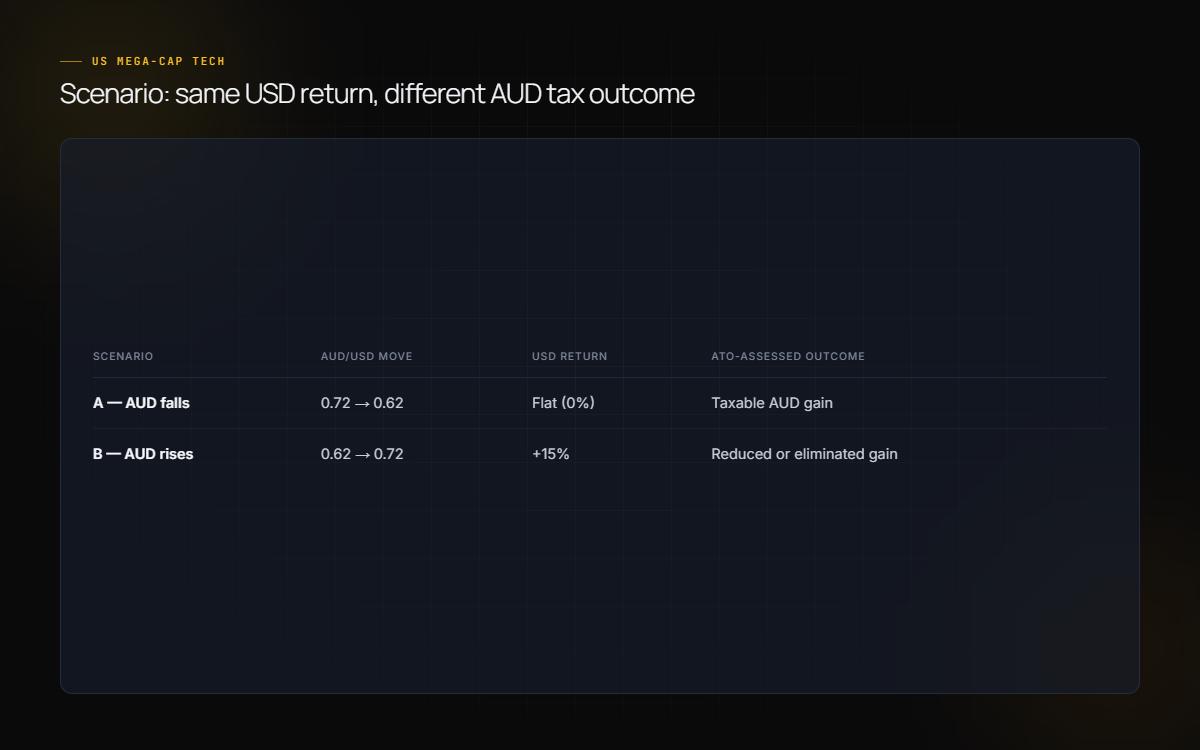
| Scenario | AUD/USD at purchase | AUD/USD at sale | USD return | ATO-assessed AUD outcome |
|---|---|---|---|---|
| A — AUD falls | 0.72 | 0.62 | Flat (0%) | Taxable AUD gain |
| B — AUD rises | 0.62 | 0.72 | +15% USD | Reduced or eliminated AUD gain |
Scenario A is the hidden insight. A falling AUD inflates your AUD-denominated return even when underlying US stocks go nowhere — and the ATO taxes that currency gain in full. You can owe CGT during a period when the Magnificent Seven declined in USD terms.
Record the AUD/USD rate on the purchase date and sale date for every parcel of ETF units. If you dollar-cost average, each purchase creates a separate CGT parcel with its own cost base and exchange rate. A portfolio tracker that logs trade dates, unit prices, and AUD cost bases will save significant tax-time effort — Crowdfolio is built specifically for Australian DIY investors managing this kind of multi-parcel record-keeping.
Fact 4: The 50% CGT Discount Still Applies — With One Important Nuance
Australian resident individuals and eligible SMSF trustees who hold ETF units for more than 12 months qualify for the 50% CGT discount. The discount applies to the full net AUD capital gain, including the currency component. Companies and non-resident investors are not eligible.
For an international ETF, the discount shelters the currency gain as well as the underlying price gain — making the 12-month threshold more valuable per dollar of gain than it is for a standard ASX share.
Illustration at a 37% marginal rate:
- After 13 months: AUD $10,000 net gain, 50% discount applied, taxable gain = $5,000, tax = $1,850
- After 11 months: AUD $10,000 gain, no discount, tax = $3,700
The difference is $1,850 on the same gain — by waiting two months. For dollar-cost averaging investors, track each parcel’s 12-month anniversary separately.
SMSFs in pension phase pay no tax on income distributions or capital gains, including currency gains. SMSFs adding international equity exposure must also update their investment strategy documentation to reflect that allocation.
Fact 5: Hedged vs. Unhedged Is a Tax and Return Decision, Not Just a Preference
A hedged ETF uses rolling currency forward contracts to neutralise AUD/USD movements at the fund level. An unhedged ETF passes AUD/USD movements directly into your unit price — and into your CGT calculation.
Hedging is not free. Costs include the forward rate differential, transaction costs, and rolling drag — typically 1–2% per year when Australian rates exceed US rates. On an AUD $50,000 position, a 1.5% annual drag compounds to roughly AUD $8,000 in forgone return over 10 years. The AUD has also structurally depreciated against the USD over multi-decade periods, giving unhedged investors a long-term tailwind that hedged investors forfeited while paying for the privilege.
| Hedged | Unhedged | |
|---|---|---|
| Currency exposure | Removed | Full AUD/USD pass-through |
| Hedging cost | 1–2% p.a. drag (approximate) | None |
| CGT complexity | Lower | Higher — currency gain/loss component |
| Best suited to | Shorter horizons, tactical use | Long-term buy-and-hold investors |
For holding periods beyond five to seven years, the compounding hedging cost and loss of currency tailwind generally favour the unhedged structure.
A Pre-Purchase Checklist
Before buying any ASX-listed US tech ETF, work through these four decision layers:
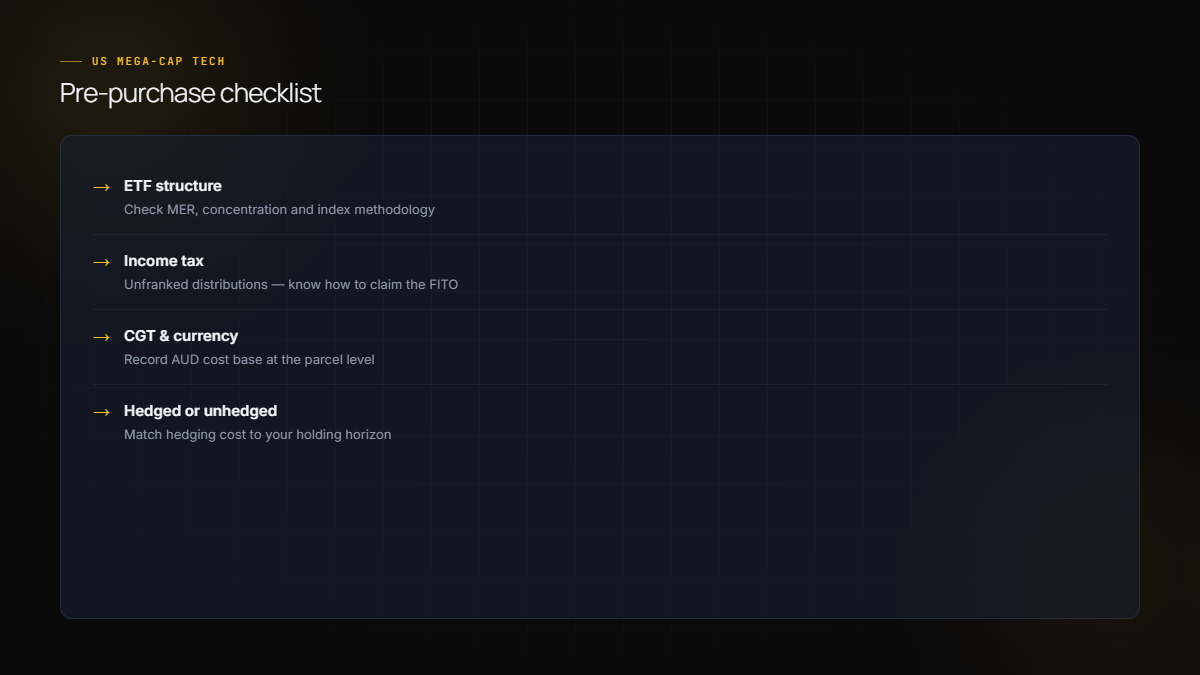
- ETF structure: Does the index concentration match your risk tolerance? Check MER, fund size, and methodology.
- Income tax: Are you prepared for unfranked distributions? Do you know how to claim the FITO at tax time?
- CGT and currency: Do you have a system for recording AUD cost bases at the parcel level? Have you planned your holding period around the 12-month CGT discount threshold?
- Hedged or unhedged: Does your time horizon justify the ongoing hedging cost, or does unhedged exposure align better with a long-term strategy?
Dollar-cost averaging removes the need to call the bottom and spreads the AUD/USD rate at which your cost bases are set — a practical advantage given the currency CGT dynamics above.
Frequently asked questions
Which ASX ETF gives the most concentrated exposure to US mega-cap tech?
FANG.AX holds a concentrated basket of ten mega-cap names. NDQ.AX tracks the Nasdaq-100 and provides broader exposure across roughly 100 stocks, with tech still dominant.
How does the ATO calculate CGT on USD-denominated assets?
Both your cost base and sale proceeds are converted to AUD at the exchange rate on each transaction date. Currency movements create a gain or loss independent of the asset’s USD performance.
Why don’t international ETFs pay franking credits, and how do I claim the FITO?
Franking credits reflect Australian corporate tax already paid. US companies pay no Australian tax, so no franking attaches. Declare your gross distribution as foreign income at Item 20 of your tax return and claim the withheld US tax as a FITO in the same return.
Should I use a hedged or unhedged ETF for long-term US tech exposure?
For holding periods beyond five to seven years, unhedged structures have historically performed better after accounting for hedging costs and the long-term AUD depreciation trend. For shorter or tactical positions, hedging removes near-term currency noise.